Key Statistics
Key Takeaways
- Market size: U.S. finished GaN power-device factory-gate revenue is modeled at USD 794.51 million in 2026, rising to USD 4,292.06 million by 2036 at 18.4% on the endpoint-reconciled scenario. The revenue boundary excludes full inverters, power supplies, substrates and RF-only gallium-nitride amplifiers.
- Product mix: Six-inch fabrication-wafer origin is the largest inferred manufacturing attribute at ~49% of finished device value, while eight-inch origin accounts for ~40%. These percentages are modeled device-revenue allocations by inferred fabrication substrate, not counts of wafers or a claim that wafer diameters are finished-device types.
- Applications: Industrial power, solar and wind conversion leads the U.S. application mix at ~30%; consumer adapters and electronics follow at ~28%, while automotive power conversion is modeled at ~21%. RF transmit amplifiers in communications are excluded even when their devices use GaN epitaxial material.
- Geography: The Pacific subregion leads at ~28% of U.S. end-market purchasing, with the South at ~26% and Northeast at ~24%. These are inferred procurement shares across mutually exclusive domestic state groups; there are no global continents in this U.S.-only market.
- Manufacturing: Infineon has documented eight-inch CoolGaN fabrication, and EPC markets 80V, 100V and 200V merchant power transistors. No inspected manufacturer document establishes commercial merchant shipments of twelve-inch GaN power transistors, so the twelve-inch class carries a zero modeled share.
- Competitive structure: EPC, Texas Instruments, Navitas, Infineon and Renesas/Transphorm have direct power-conversion product evidence. GaN Systems was acquired by Infineon in 2023, while Transphorm joined Renesas in 2024; acquired brands are not independent competitors.
- Growth and risk: Higher switching frequency and improved power density support 48V DC-DC, 650V AC-DC, EV charging and renewable conversion, but design-in qualification, thermal packaging, silicon alternatives and capital intensity restrain penetration. Six-column impact analysis reconciles drivers of +25.10 percentage points with restraints of -6.70 points.
- Coverage: The analysis uses a 2026 base, 2027 estimate and 2036 horizon, with six revenue-share axes: U.S. subregion, inferred wafer origin, application, voltage class, product format and buyer channel. All shares are modeled rather than audited manufacturer sales disclosures.
United States GaN Power Semiconductor Devices Market Overview
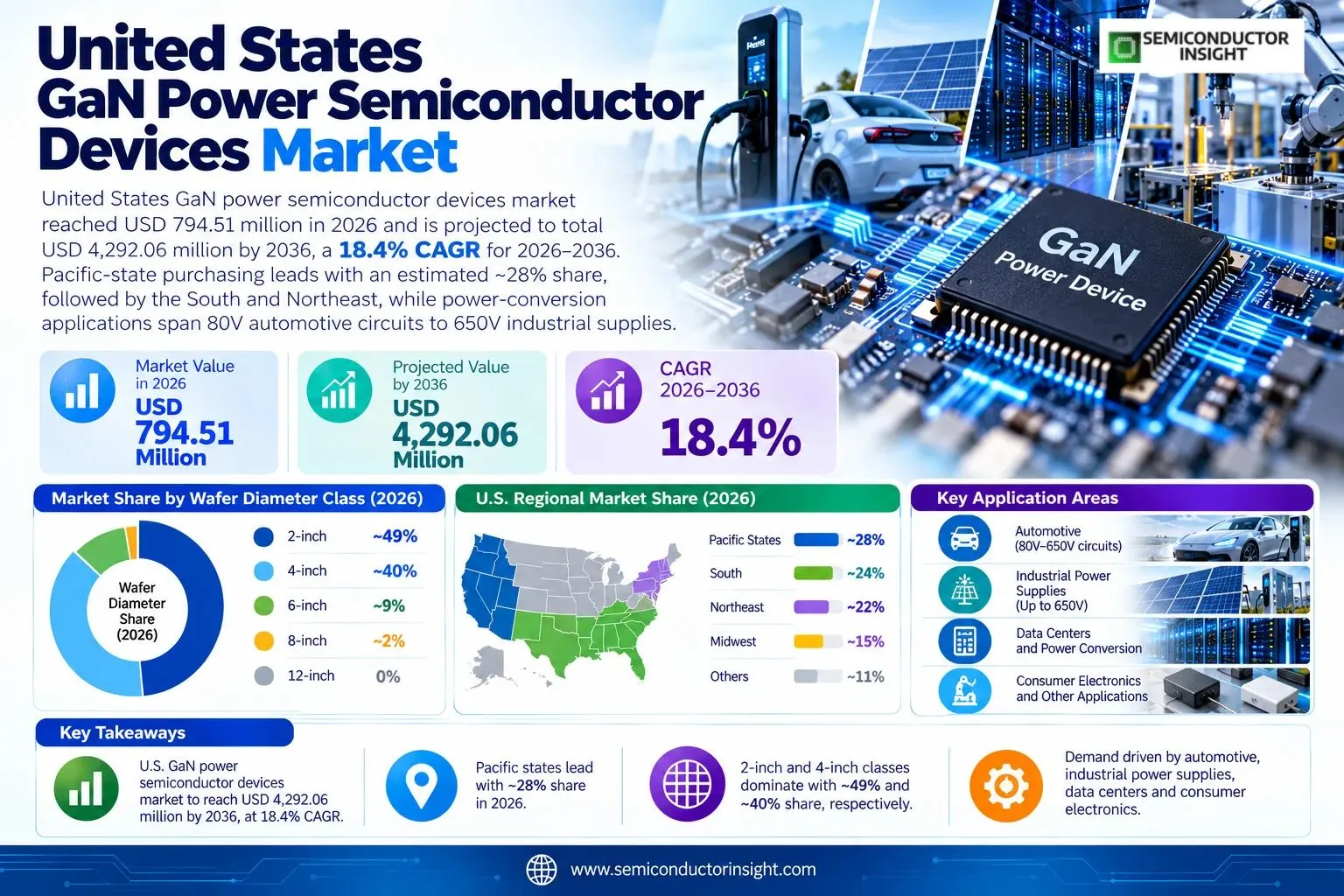
United States GaN power semiconductor devices market reached USD 794.51 million in 2026 and is projected to total USD 4,292.06 million by 2036, a 18.4% CAGR for 2026–2036. Pacific-state purchasing leads with an estimated ~28% share, followed by the South and Northeast, while power-conversion applications span 80V automotive circuits to 650V industrial supplies.
Gallium nitride power semiconductors are finished switching components that use the wide-bandgap material to move energy through DC-DC and AC-DC circuits with lower switching losses and higher operating frequency than many silicon alternatives. A sale enters this U.S. market when a discrete GaN FET, a driver-integrated GaN switch or a qualifying power module is sold for U.S. power conversion. The sale of a complete charger, data-center rack, electric vehicle, solar inverter or RF transmitter does not enter the component revenue boundary.
The 2026 market value is a rebased extension of a 2024 publisher anchor of USD 567 million and a 2030 endpoint of USD 1,560 million. Those two anchors imply 18.374% compound annual growth, rather than an exact 18.400% mathematical rate; the rounded forecast rate is therefore retained at one decimal place. The 2027 modeled market reaches USD 940.49 million, while the 2036 endpoint extends six years beyond the publisher window and should be treated as a constant-rate scenario, not confirmed manufacturer orders.
Low-voltage GaN is visible in EPC catalogues for 80V, 100V and 200V devices used in point-of-load converters, synchronous rectifiers and automotive electrical systems. The AEC-Q101 qualified EPC2218A specifies 80V and a maximum on-resistance of 3.2 milliohms, while the EPC2206 lists 80V and 2.2 milliohms for 48V-to-12V bidirectional automotive conversion. These part-level specifications demonstrate sellable components and qualified use cases, but not the aggregate number of U.S. devices sold in any forecast year.
High-voltage power conversion is supported by Texas Instruments LMG3614, which integrates a 650V GaN FET and gate driver in an 8-by-5.3-millimetre QFN package, and by Transphorm SuperGaN TO-247-4L parts rated at 650V. A 35-milliohm Transphorm device was described as sampling during the first quarter of 2024, while the 50-milliohm variant was available in January of that year. Product availability must therefore be distinguished from engineering samples when translating a catalogue into commercial market breadth.
Eight-inch fabrication has become an important manufacturing lever. Infineon announced CoolGaN families fabricated on eight-inch processes in Kulim and Villach in May 2024, while EPC product notices indicate changes in eight-inch epitaxial manufacturing for selected devices. The wafer-origin segmentation in this analysis refers to the substrate diameter used upstream of finished device fabrication; it does not imply that customers purchase 8-inch finished transistors. No manufacturer evidence inspected here validates merchant 12-inch power GaN sales.
U.S. demand is driven by engineers optimizing power density, cooling requirements and switching frequency in applications that are sensitive to energy loss or available board area. Industrial power supplies can use 650V devices, whereas 48V server distribution and automotive auxiliary conversion often use lower voltage ratings. Product value depends on qualification status, gate-driver integration, packaging and reliability testing, so a simple device count cannot be multiplied by a single average selling price without introducing material errors.
The vendor landscape requires careful corporate normalization. Renesas completed its Transphorm acquisition on 20 June 2024, bringing a high-voltage GaN portfolio into its power offering; Infineon acquired GaN Systems in 2023 and now markets CoolGaN devices across discrete and module formats. Both brands can appear in historical competitive lists, but counting each acquired name as a separate current manufacturer would overstate supplier diversity and distort any inferred company revenue shares.
The application label Communication requires a strict boundary because gallium nitride is also widely used in radio-frequency power amplifiers. Only power-management stages supporting telecom infrastructure, servers or communication equipment are included here; RF-only transmitter chains are excluded even when a catalogue markets them as high-power GaN. Similarly, silicon carbide MOSFETs and ordinary silicon IGBTs are competing technologies rather than part of GaN component revenue.
An estimated ~30% of 2026 U.S. component revenue is assigned to industrial power, solar and wind conversion, compared with ~28% for consumer electronics and ~21% for automotive. These shares represent a modeled end-use allocation informed by manufacturer application listings and power-electronics design cycles, not an independently audited breakdown. The high-voltage 650V class is modeled at ~44%, reflecting the value of industrial and AC-connected circuits relative to the numerous lower-priced low-voltage transistors.
The 2036 scenario compounds from 2026 over ten years, so a small change in the annual rate has a large effect on the terminal value. Manufacturer releases support the existence of automotive-qualified 100V parts, 650V power modules and renewable-energy design wins, but they do not certify U.S. factory-gate revenue in 2036. Buyers should separate this forecast from product qualification milestones and from overlapping global WBG device totals to avoid treating several market descriptions as additive demand.
EPC2252 is an AEC-Q101 qualified 80V GaN transistor listed for automotive lidar and isolated power supplies, while EPC2204A is another AEC-Q101 qualified 80V part with a 6-milliohm maximum on-resistance and automotive DC-DC applications. Infineon introduced its 600V CoolGaN GIT HEMT portfolio in May 2023, showing that high-voltage merchant GaN predates the more recent eight-inch process announcement. These official device specifications strengthen the product boundary but cannot independently validate a nationwide market-share model.
Segment Analysis: By Type
The publisher groups the market by 2-inch, 4-inch, 6-inch, 8-inch and 12-inch classes, which are upstream fabrication wafer diameters rather than finished device types. The following ~49%, ~40%, ~9%, ~2% and 0% revenue allocations are modeled by inferred wafer origin, with no twelve-inch merchant-device revenue asserted. A fabrication diameter is an upstream process descriptor, whereas the invoiceable product remains a qualified packaged switch or integrated stage.
| Inferred fabrication origin | Technical interpretation | U.S. market implication |
|---|---|---|
| 6-inch origin | A mature commercial fabrication origin inferred from available GaN-on-silicon processes; devices sold from this manufacturing stream span power converters rather than a customer-facing six-inch component format. Six-inch attribution reflects mature GaN-on-silicon fabrication pathways and device economics rather than a customer-specified transistor size. | ~49% of 2026 modeled component revenue. The largest origin category remains exposed to changes in yield and package cost, and its ~49% modeled share is not a disclosed foundry wafer-start count. |
| 8-inch origin | Infineon explicitly describes eight-inch CoolGaN manufacturing in Malaysia and Austria; EPC has an eight-inch epitaxy process-change notice, supporting the technical feasibility of this modeled attribution. Eight-inch attribution is supported by Infineon process disclosures and EPC epitaxy changes, although finished devices are sold in much smaller packages. | ~40% of 2026 modeled component revenue. The ~40% allocation reflects manufacturing scale potential and may change as individual suppliers move their qualified product families to larger substrates. |
| 4-inch origin | Legacy and specialty fabrication lines can remain relevant for low-volume industrial and high-reliability parts, although the inspected evidence does not identify a verified U.S. revenue series by wafer diameter. Four-inch origin represents legacy and specialized manufacturing processes that may persist where engineering qualification outweighs volume economics. | ~9% of 2026 modeled component revenue. The ~9% modeled revenue share should not be confused with a published four-inch GaN wafer shipment series or with a merchant substrate sales market. |
| 2-inch origin | Small-diameter development and legacy manufacturing can serve specialized engineering lots; a low modeled share reflects limited scale rather than a claim of disclosed device shipments. Two-inch origin is retained as a small specialized fabrication category with limited assumed volume and no audited device-level sales disclosure. | ~2% of 2026 modeled component revenue. Its ~2% scenario weight captures niche supply while avoiding a claim that development wafers are themselves finished power devices. |
| 12-inch origin | No inspected official manufacturer source confirms commercially shipped merchant power GaN FETs from twelve-inch fabrication, so this category is retained only to preserve the publisher axis and is assigned no current revenue. Twelve-inch origin is shown for completeness because the publisher lists it, but official evidence of merchant device commercialization was not established. | 0% of 2026 modeled component revenue. The modeled share is zero and does not imply a 300-millimetre GaN power FET product exists in routine commercial shipment. |
Wafer origin and finished-device classification
A power GaN transistor may be made on a six-inch or eight-inch semiconductor wafer but ultimately shipped as a small packaged switch or integrated power stage. For that reason, the origin allocation cannot be interpreted as a list of five customer-purchased device types. The 12-inch line is retained at zero until official product and fabrication evidence supports commercial merchant sales.
The modeled six-inch origin leads with ~49% and eight-inch origin follows at ~40%, while four-inch and two-inch processes occupy ~9% and ~2% respectively. These numbers are scenario allocations across the factory-gate revenue boundary; they are not derived from a disclosed foundry wafer-start count or an audited customer invoice database. Supplier procurement and reliability documentation are needed before attributing a specific die family to an origin class.
Segment Analysis: By Application
The U.S. market is divided by actual power-conversion end use: industrial/renewables, consumer electronics, automotive, communications power, defence/aerospace and healthcare. Industry/power/solar/wind leads with ~30% modeled revenue, followed by consumer electronics ~28% and automotive ~21%; the classification deliberately excludes GaN RF amplifiers. All six application categories use mutually exclusive primary customer purposes, avoiding double allocation of one power component.
| Application | Demand characteristics |
|---|---|
| Industry, Power, Solar & Wind | Industrial supplies, renewable converters, server power and high-efficiency AC-connected systems. Infineon EasyPACK 650V modules and Enphase IQ9 microinverter design evidence support actual technology deployment. Infineon EasyPACK and the Enphase IQ9 announcement give concrete component use cases, while industrial demand remains an inferred U.S. revenue allocation. |
| Consumer Electronics | Compact chargers, adapters, home electronics and high-frequency power supplies. Integrated drivers and low component count influence device selection when board area and thermal design are constrained. The ~28% scenario share reflects numerous compact power supply sockets rather than a disclosed count of chargers containing GaN switches. |
| Automotive | 48V auxiliary systems, onboard chargers, lidar power and related vehicle power conversion. EPC AEC-Q101 devices and Infineon automotive-qualified CoolGaN show that qualification is product specific. AEC-Q101 evidence supports specific qualified devices, but vehicle production volumes cannot be converted into GaN sales without approved platform content. |
| Communication | Telecom and data-center power-management circuits, excluding RF-only gallium-nitride transmit amplifiers. The revenue boundary includes DC-DC and AC-DC power switches but not complete base stations. Only conversion power stages enter this ~12% scenario allocation, and radio-frequency GaN amplifier products are deliberately excluded. |
| Defence/Aerospace | Specialized power conversion where reliability, qualification, supply continuity and temperature performance dominate over simple component price. RF radar transmitters are excluded from the scope. This ~5% allocation recognizes specialized power qualification without counting radar RF GaN transmitters or defence program budgets. |
| Healthcare | Medical equipment power supplies and compact regulated conversion stages. The share is a scenario allocation and does not imply device approval or a separately published medical GaN revenue statistic. The ~4% modeled share is a small power-supply use case and does not represent regulated medical equipment selling prices. |
The largest industrial and renewable segment is modeled at ~30%, partly because 650V GaN components can carry greater value per device than small low-voltage consumer transistors. Infineon has identified 650V CoolGaN modules for data-center and renewable applications, while its Enphase collaboration links GaN bidirectional switches to commercial solar microinverters. These product-level facts establish end-use relevance but do not validate a market-wide industrial sales total.
Automotive power conversion is modeled at ~21% with a faster segment growth path than many consumer uses, reflecting qualification-led adoption rather than a claim that every electric vehicle contains GaN. EPC markets AEC-Q101 qualified 80V parts, Navitas announced automotive-qualified GaNSafe ICs in April 2025, and Infineon introduced automotive-qualified 100V CoolGaN in October 2025. Each qualification pertains to specific products and must not be generalized to an entire vendor catalogue.
Regional Analysis
The U.S.-only revenue model allocates demand across Pacific ~28%, South ~26%, Northeast ~24%, Midwest ~14% and Mountain ~8%. These five disjoint groups cover the 50 states and Washington, DC exactly once; territories are excluded. The geographic mix is an analyst scenario for finished-device customer purchases, not global manufacturer production. State grouping follows the Census framework with the West split into Pacific and Mountain; every domestic sale belongs to one region.
Which United States subregions lead GaN power device demand?
Pacific states lead with an estimated ~28% because of engineering concentration in automotive electronics, cloud power and advanced consumer devices, while the South follows at ~26% through industrial, power-system and vehicle supply chains. Northeast buyers account for ~24%, Midwest for ~14% and Mountain states for ~8%. A company headquarters or overseas wafer fabrication plant does not determine the end-customer region for this allocation.
| Region | Position | Growth outlook | Demand profile | What decides supplier selection |
|---|---|---|---|---|
| Pacific | ~28% modeled share | ~18.9% CAGR | West Coast semiconductor design and power-electronics procurement | California, Oregon, Washington, Alaska and Hawaii |
| South | ~26% modeled share | ~20.0% CAGR | Texas power electronics, automotive supply chains and renewable conversion | Texas, North Carolina, Florida, Georgia, Virginia and other Census South states |
| Northeast | ~24% modeled share | ~17.9% CAGR | Industrial electronics, telecom infrastructure power and high-reliability engineering | New York, Massachusetts, Pennsylvania, New Jersey and other Census Northeast states |
| Midwest | ~14% modeled share | ~17.0% CAGR | Automotive electrical architecture and industrial motor-drive engineering | Michigan, Ohio, Illinois, Indiana, Wisconsin and other Census Midwest states |
| Mountain | ~8% modeled share | ~13.8% CAGR | Specialty electronics, semiconductor engineering and renewable installations | Arizona, Colorado, Utah, Nevada, Idaho, Montana, Wyoming and New Mexico |
United States GaN Power Devices: Manufacturers and Competitive Landscape
Competitive intensity spans merchant low-voltage FET specialists, integrated high-voltage power stages and power modules. The named roster must be normalized for the 2023 GaN Systems acquisition and the June 2024 Transphorm acquisition, while RF-only GaN manufacturers cannot be treated as directly comparable merchant power-switch vendors. Supplier comparisons focus on published merchant device families and verified ownership rather than aggregate company semiconductor sales.
Efficient Power Conversion provides unusually clear merchant product evidence, including 80V AEC-Q101 qualified EPC2218A and EPC2206 transistors, 100V EPC2071 and EPC2306 devices, and 200V EPC2207 components. Its published product ratings and applications demonstrate actual power-conversion use cases. The company competes where low gate charge, small die size and high-frequency operation justify the engineering and packaging trade-offs against established silicon MOSFETs.
Texas Instruments sells the 650V LMG3614 integrated-driver GaN FET, a component that combines protection and gate drive to reduce implementation complexity for power-supply designers. Infineon offers 100V automotive-qualified CoolGaN transistors and 650V EasyPACK modules, spanning a different power range and integration level. These product lines should be compared by voltage class, qualification and format rather than combining their entire corporate semiconductor revenues.
Renesas completed the acquisition of Transphorm on 20 June 2024 and began offering the acquired high-voltage GaN portfolio alongside 15 reference designs. Transphorm SuperGaN TO-247-4L devices include 650V 35-milliohm and 50-milliohm products for server and industrial conversion. Infineon acquired GaN Systems in 2023; both transactions change brand ownership and make unadjusted historic supplier lists unsuitable for a current manufacturer-count estimate.
Navitas markets integrated GaN power ICs and announced automotive qualification of high-power GaNSafe devices in April 2025. The qualification refers to defined product families, not every device sold by the group. MACOM and Qorvo have important RF GaN activities, but RF-only amplifiers are not substitutes for power-conversion switches in this revenue boundary. Legacy Cree naming and adjacent controller suppliers are therefore treated as context rather than automatically counted as direct GaN power merchants.
Tier structure
| Tier | Companies | Basis of competition |
|---|---|---|
| Direct merchant FETs | Efficient Power Conversion; Renesas / Transphorm | Discrete 80V, 100V, 200V and 650V power transistors compete on loss, switching performance, qualification, package and supply continuity. |
| Integrated stages and modules | Texas Instruments; Infineon; Navitas Semiconductor | Driver-integrated switches and 650V modules reduce converter design effort but require careful thermal and EMI validation. |
| Adjacent and legacy roster | Qorvo; MACOM; legacy Cree; acquired GaN Systems | RF-only devices and historic corporate names are excluded from direct power-device revenue comparisons without matching product evidence. |
Key companies profiled
- Efficient Power Conversion (EPC)
- Texas Instruments
- Infineon Technologies (including GaN Systems)
- Renesas Electronics (including Transphorm)
- Navitas Semiconductor
GaN Power Device Manufacturing and Production Capacity
Manufacturing economics depend on wafer diameter, epitaxial quality, device yield, packaging and qualification, not merely a count of announced fabrication plants. Eight-inch processes are documented, but 12-inch commercial merchant GaN power-device sales were not established by the inspected official sources. Wafer capacity announcements require yield and package economics before they can support any device-revenue inference.
Infineon announced two CoolGaN families built on eight-inch in-house foundry processes in Kulim and Villach in May 2024, covering medium- and high-voltage devices from 40V to 700V. The manufacturing disclosure is an important scale indicator, yet it is not a report of United States wafer starts or the U.S. revenue share attributable to eight-inch output. The modeled ~40% eight-inch-origin allocation therefore remains a scenario assumption.
EPC product documentation includes a manufacturing-site and tool change notice for eight-inch epitaxy on the EPC2367 product, indicating that wafer sourcing can evolve after a device has been introduced. EPC2367 is a 100V transistor with 1.2 milliohms typical on-resistance and 101A rated current. Device specifications and process notices are concrete technical evidence; neither provides a defensible count of all GaN dies shipped to U.S. buyers.
High-voltage GaN packages require electrical and thermal qualification alongside reliable epitaxial substrates. Renesas/Transphorm markets 650V TO-247-4L FETs with a Kelvin source terminal, while Infineon offers 650V EasyPACK modules. These distinct packages address different converter architectures and carry different component values, so converting a wafer-start assumption into factory-gate revenue requires yield, die area, module content and customer pricing that manufacturers have not disclosed comprehensively.
United States GaN Power Device Market Dynamics, Constraints and Growth Opportunities
The demand scenario combines efficiency improvements, 48V distribution, compact 650V supplies and automotive qualification with offsetting design-in costs, thermal constraints and silicon competition. Impact rankings express modeled percentage-point contributions to the 2026–2036 growth scenario, not a decomposition audited by component suppliers. Automotive product qualification and industrial power supply design-ins translate into commercial demand at different speeds.
MARKET DRIVERS
Drivers Impact Analysis
| Market Drivers | Impact Rank | CAGR Contribution (%) | 2026–2029 | 2030–2032 | 2033–2036 |
|---|---|---|---|---|---|
| Efficiency and power density in 650V converters | High | +8.20% | High | High | Medium |
| 48V server and automotive DC-DC architectures | High | +5.70% | High | High | Medium |
| Automotive-qualified GaN device portfolios | Medium-High | +4.60% | Medium | High | High |
| Renewable energy and charging conversion | Medium | +3.70% | Medium | High | High |
| Manufacturing scale and integrated driver packaging | Low-Medium | +2.10% | Medium | Medium | High |
| Others (industrial motor drives and specialized power) | Low | +0.80% | Low | Medium | Medium |
Higher-frequency 650V power supplies
A 650V GaN switch can reduce switching loss and permit smaller passive components when the converter topology and gate drive are properly engineered. Texas Instruments LMG3614 integrates a 170-milliohm GaN FET and driver, while Infineon introduced 650V EasyPACK modules for high-power applications. The resulting engineering benefits can support component demand, but converter efficiency must be validated at system level and cannot be translated directly into market revenue.
48V infrastructure and auxiliary automotive power
EPC markets 80V automotive-qualified transistors for 48V-to-12V bidirectional conversion and 100V devices for high-density DC-DC stages. These ratings align with server power distribution and vehicle auxiliary architectures that favor compact switches. A ~21% automotive application allocation reflects a modeled commercial opportunity, with production orders contingent on AEC qualification, thermal tests and OEM sourcing approvals.
Renewable conversion and charging
Infineon documented CoolGaN bidirectional switch technology in Enphase IQ9 microinverters in November 2025 and launched a 650V module aimed at renewable energy and DC charging. Those are concrete design and product milestones that broaden available GaN power formats. The modeled industrial/solar/wind segment leads with ~30%, although system-level solar investment and charger revenue are not part of factory-gate device sales.
Wafer scale and integrated power stages
Infineon has reported eight-inch CoolGaN manufacturing, while EPC documents eight-inch epitaxy sourcing changes for selected components. Larger wafer platforms can improve die economics when defect density and yield are controlled; integration of drivers can also simplify circuit design. The modeled eight-inch origin reaches ~40% of finished-device value, but this is an inferred manufacturing attribute rather than a verified U.S. wafer-start series.
MARKET RESTRAINTS
Restraints Impact Analysis
| Market Restraints | Impact Rank | CAGR Contribution (%) | 2026–2029 | 2030–2032 | 2033–2036 |
|---|---|---|---|---|---|
| High qualification and redesign expense | High | -2.70% | High | Medium | Medium |
| Silicon and SiC cost-performance competition | Medium-High | -2.10% | High | High | Medium |
| Packaging, reliability and supply-chain constraints | Medium | -1.30% | Medium | High | Medium |
| Others (EMI complexity and customer concentration) | Low | -0.60% | Medium | Medium | Low |
Qualification and redesign budgets
Moving from a silicon MOSFET to GaN can require revised gate drive, layout, EMI filtering, cooling and reliability tests, even when a nominal voltage class appears equivalent. Automotive buyers impose particularly demanding qualification requirements, and an AEC-Q101 certificate for one EPC transistor does not cover every device from the same vendor. These costs delay revenue conversion from prototype demonstrations to sustained production orders.
Competition from incumbent silicon and silicon carbide
Silicon MOSFETs retain strong cost and supply advantages in many low-frequency circuits, while silicon carbide competes at high voltage and power. Transphorm promoted its 650V TO-247-4L GaN devices as options for certain SiC replacement designs, but that positioning does not establish universal superiority. The device decision depends on converter topology, losses, packaging, thermal margin and lifetime system economics.
Manufacturing and thermal reliability
GaN devices can switch rapidly, making parasitic inductance, overvoltage transients and thermal management central to board design. The Infineon integrated-Schottky CoolGaN announcement specifically targets deadtime-related losses, and TI includes fault protection in its LMG3614 integrated stage. Process qualification and packaging quality affect yields and customer acceptance, limiting how quickly lower theoretical switching losses become market shipments.
Concentrated design-win and distribution channels
Major OEM programs may qualify only a small number of power-device suppliers for multi-year production, creating revenue concentration even where catalogues contain many parts. Authorized distributors can broaden access for engineering evaluation, but a purchased evaluation board is not equivalent to a production component order. The modeled direct OEM channel leads at ~48%, emphasizing how design approval shapes realized GaN power-device sales.
MARKET OPPORTUNITIES
Automotive auxiliary power conversion
EPC AEC-Q101 qualified 80V devices and Infineon automotive-qualified 100V CoolGaN products offer evidence of components suited to automotive electrical systems. The immediate opportunity lies in 48V-to-12V conversion, sensing power and compact auxiliary stages rather than assuming GaN traction inverters have already displaced silicon carbide. Qualification cycles and OEM validation remain the main commercial gating factors.
Data-center and telecom power stages
TI 650V integrated-driver GaN and Infineon 100V integrated-Schottky products target efficient conversion in server and telecom power architectures. Customers may value lower loss and smaller passives as rack density increases, especially across AC-DC front ends and 48V intermediate buses. RF-only GaN communication amplifiers must remain outside the addressable power-device revenue even when supplied by similarly named semiconductor vendors.
Solar microinverters and bidirectional switches
Infineon announced that its GaN bidirectional switching technology would power Enphase IQ9 microinverters, providing a real product application rather than a generic solar claim. Designers can evaluate GaN for efficient compact inverter topologies, while high-voltage modules broaden the range of power levels addressed. The market opportunity is the component value inside each inverter, not the full retail price of solar equipment.
Integration, packaging and new manufacturing scale
Driver-integrated GaN stages and compact power modules can reduce gate-drive design effort and parasitic losses, while eight-inch wafer processes may support better manufacturing economics. TI LMG3614 and Infineon EasyPACK represent different levels of integration, and EPC device catalogues show continued low-voltage optimization. Suppliers able to combine reliability documentation with stable delivery can win production programs beyond laboratory performance comparisons.
United States GaN Power Device Supply Chain and Route to Market
The component chain runs from semiconductor substrates and epitaxial deposition through GaN transistor fabrication, package and module assembly, distributor qualification and U.S. OEM conversion designs. Only the finished GaN power device or eligible module is counted as market revenue; upstream material value is embedded in that component rather than added separately.
Upstream materials. Epitaxial layers and wafer processes determine defect density, breakdown voltage and cost before a packaged GaN switch exists. Infineon has described eight-inch in-house manufacturing, while EPC product notices refer to epitaxy sourcing changes. These facts justify monitoring upstream capacity, but substrate and epitaxy sales are inputs to device production, not an additional market category that can be summed with the finished transistor invoice.
Device fabrication and packaging. Low-voltage EPC devices use small die optimized for fast switching, while 650V Transphorm and Infineon products require high-voltage structures and different packaging choices. TI integrates a driver into the LMG3614 package, changing component content and design complexity. Fabrication yield, package thermal impedance, voltage testing and reliability qualification shape price and availability across each voltage class.
Distribution and qualification. Direct OEM programs are modeled at ~48% of U.S. device revenue because automotive and industrial converters often require joint engineering and multi-year qualification. Authorized distributors account for ~38% and contract manufacturers or ODM channels ~14% in the scenario. These allocations describe commercial routes rather than a supplier-disclosed channel split; evaluation boards and full systems are not included in component sales.
Downstream power conversion. End users specify a switch by voltage rating, current, on-resistance, gate-drive requirements, thermal limits and lifetime reliability. A 100V EPC2071 may be appropriate for a high-density DC-DC stage, whereas a 650V TI or Transphorm device targets a different converter. The factory-gate revenue measure follows the GaN component sold into the design, not the electricity delivered or the equipment capital expenditure.
Recent Official Developments in United States GaN Power Semiconductors
- 12 November 2025 Commercial design
Infineon confirmed that its CoolGaN bidirectional switching technology powers the next-generation Enphase IQ9 solar microinverter family. The announcement connects a GaN power-switch architecture to a named renewable-energy customer and supports the industrial/solar application case. It does not disclose the number of U.S. devices shipped, the chip content value per inverter or any independently audited market share. Source - 15 October 2025 Automotive qualification
Infineon introduced the CoolGaN Automotive Transistor 100V G1 family qualified to AEC-Q101 and described additional high-voltage devices in pre-production sampling. The distinction between a production low-voltage family and future high-voltage qualification is commercially important. It supports automotive auxiliary power conversion without asserting that every planned automotive GaN design has entered volume vehicle production. Source - 2 May 2025 Power module
Infineon introduced an EasyPACK CoolGaN 650V module for high-power data-center, renewable-energy and DC charging applications. The module platform was described as delivering up to 70 kilowatts per phase in relevant configurations, indicating a different device format from a small discrete FET. Module capability is product evidence rather than an audited count of U.S. market units. Source - 15 April 2025 AEC qualification
Navitas announced automotive qualification of high-power GaNSafe power ICs against relevant AEC-Q100 and AEC-Q101 standards, describing integrated protection and high-voltage power applications. This expands the set of merchant devices eligible for vehicle electrical architectures. The statement concerns defined qualified products and does not certify adoption across all U.S. OEMs or provide a GaN component revenue total. Source - 14 April 2025 Device integration
Infineon launched a 100V CoolGaN G5 transistor family integrating a Schottky diode to reduce deadtime losses in industrial and intermediate-bus power conversion. The release identifies server and telecom power uses, not RF transmission amplifiers. It shows how packaging and circuit integration may influence device choice, but efficiency benefits must be evaluated in the actual converter topology. Source - 20 June 2024 Acquisition completed
Renesas completed its acquisition of Transphorm and introduced 15 GaN-based reference designs spanning automotive, industrial and other power applications. The transaction consolidates historical Transphorm revenue within the Renesas corporate family rather than creating an additional independent vendor. The reference designs demonstrate technical integration opportunities but are not evidence of 15 commercial production programs. Source - 29 May 2024 Fabrication platform
Infineon announced high- and medium-voltage CoolGaN transistor families manufactured using eight-inch in-house foundry processes in Kulim and Villach. This confirms commercial technology development at an eight-inch diameter, but neither manufacturing location is a measure of U.S. end-customer sales. The disclosure does not establish 12-inch merchant GaN device shipments or audited revenue shares by wafer origin. Source - 17 January 2024 High-voltage FET
Transphorm announced 650V SuperGaN devices in four-lead TO-247 packages with 35- and 50-milliohm resistance options for server, renewable and industrial converters. The 50-milliohm part was available while the 35-milliohm part was described as sampling for the first quarter of 2024. The distinction matters because a sampling product should not be counted as an established volume shipment. Source
REPORT SCOPE & SEGMENTATION
| Attribute | Details |
|---|---|
| Study Period | 2021–2036 |
| Base Year | 2026 |
| Estimated Year | 2027 |
| Forecast Period | 2026–2036 |
| 2026 U.S. Market Value | USD 794.51 million |
| 2027 Estimate | USD 940.49 million |
| 2036 Scenario Value | USD 4,292.06 million |
| Reconciled CAGR | 18.4% |
| Revenue Boundary | Factory-gate finished GaN power switches, diodes and integrated power stages for U.S. power conversion |
| Excluded Revenue | RF-only GaN, substrates, epitaxial wafers, silicon switches, full inverters, chargers, vehicles and services |
| Geographic Universe | 50 U.S. states and Washington DC; five disjoint domestic subregions; territories excluded |
| By Fabrication Wafer Origin | 2-inch · 4-inch · 6-inch · 8-inch · 12-inch (zero verified commercial merchant shipments) |
| By Application | Industry/Power/Solar/Wind · Consumer Electronics · Automotive · Communication Power · Defence/Aerospace · Healthcare |
| By Voltage Class | Below 100V · 100–200V · 650V Class · Above 650V |
| By Product Format | Discrete GaN FET · Integrated GaN Power Stage · Power Module |
| By Buyer Channel | Direct OEM/Tier-1 · Authorized Distribution · Contract Manufacturer/ODM |
| By Region | United States-only customer purchasing; modeled subregions are nonoverlapping and exclude territories. PacificCalifornia, Oregon, Washington, Alaska and Hawaii SouthTexas, North Carolina, Florida, Georgia, Virginia and other Census South states NortheastNew York, Massachusetts, Pennsylvania, New Jersey and other Census Northeast states MidwestMichigan, Ohio, Illinois, Indiana, Wisconsin and other Census Midwest states MountainArizona, Colorado, Utah, Nevada, Idaho, Montana, Wyoming and New Mexico |
| Key Companies Profiled | Efficient Power Conversion; Texas Instruments; Infineon (including GaN Systems); Renesas (including Transphorm); Navitas Semiconductor |
| Customization Scope | Power-conversion application split, U.S. customer procurement, product qualification, voltage rating and manufacturing-wafer-origin scenarios; no RF-only or upstream revenue. |
Frequently Asked Questions
What is the size of the U.S. GaN power-device market in 2026?
The factory-gate U.S. market is modeled at USD 794.51 million in 2026, covering finished GaN switching devices and eligible integrated power stages. It excludes full chargers, inverters, RF-only transmit amplifiers and upstream epitaxial materials. The figure is rebased from a publisher 2024 anchor and should not be interpreted as a manufacturer-audited U.S. sales total.
What is the 2036 U.S. GaN power-device forecast?
The ten-year scenario reaches USD 4,292.06 million by 2036, applying the reconciled endpoint growth rate from a publisher window ending in 2030. The extension is a mathematical projection, not a six-year shipment commitment from component manufacturers. Revenue remains limited to GaN power switches, qualifying stages and modules sold for U.S. power conversion.
What compound annual growth rate is used?
The modeled rate is 18.4% for 2026–2036 when rounded to one decimal place. The original 2024 USD 567 million and 2030 USD 1,560 million anchors imply 18.374% annually. The rate describes a scenario, not a validated sum of individual supplier forecasts, and should be distinguished from growth in complete equipment revenue.
Which U.S. subregion has the largest estimated share?
Pacific states lead at ~28% of modeled U.S. end-customer GaN power-device purchases in 2026, followed by the South at ~26% and Northeast at ~24%. Midwest and Mountain contribute ~14% and ~8%. The geography follows customer demand across disjoint state groups, not the physical location of overseas wafer fabrication or corporate headquarters.
Why does the Type segmentation use wafer diameter?
The publisher lists 2-inch, 4-inch, 6-inch, 8-inch and 12-inch categories, which describe fabrication substrate diameter rather than transistor package type. The modeled allocation attributes finished-device revenue to inferred manufacturing origin, with ~49% from six-inch and ~40% from eight-inch processes. Twelve-inch merchant GaN power-device shipments were not established and are assigned zero share.
What products are included in the GaN power market?
Eligible products include discrete GaN power FETs, driver-integrated GaN switching stages and qualifying power modules sold at factory gate for electrical conversion. EPC 80V automotive devices, TI 650V LMG3614 and Infineon 650V EasyPACK illustrate relevant component formats. Upstream wafers, full solar systems, RF-only amplifiers and silicon switches remain outside the revenue boundary.
Which end-use application is largest?
Industry, power, solar and wind conversion leads the modeled application split at ~30%, followed by consumer electronics ~28% and automotive ~21%. Telecom power conversion is counted separately from GaN RF amplifiers. Manufacturer application lists and named design wins establish commercial relevance, but they do not independently verify the revenue percentages assigned to each end market.
Which manufacturers directly supply GaN power components?
Efficient Power Conversion, Texas Instruments, Infineon, Renesas through Transphorm and Navitas have official evidence of merchant GaN power products. GaN Systems is now within Infineon following a 2023 acquisition, and Transphorm joined Renesas in June 2024. RF-focused firms should not be counted as power-switch vendors solely because they also sell gallium-nitride semiconductors.
Does 8-inch GaN production establish 12-inch market demand?
No. Infineon documented eight-inch CoolGaN fabrication in 2024, and EPC lists an eight-inch epitaxy manufacturing change for a selected device. These facts establish relevant production capability at eight inches, not merchant power-device shipments from twelve-inch wafers. The twelve-inch category is retained at zero modeled share until manufacturer qualification and commercial product evidence emerges.
Can this U.S. market be added to global WBG device forecasts?
No. U.S. GaN power devices form a geographic and technology subset of wider finished SiC/GaN power semiconductor markets, so adding the U.S. total to global WBG reports would double count value. Other similarly named U.S. GaN reports may also overlap. Cross-report comparisons require consistent geography, product boundary, base year and forecast assumptions before any consolidation.
Research Sources & Evidence Base

Get Sample Report PDF for Exclusive Insights
Report Sample Includes
- Table of Contents
- List of Tables & Figures
- Charts, Research Methodology, and more...
 Download Sample Report PDF