
MARKET INSIGHTS
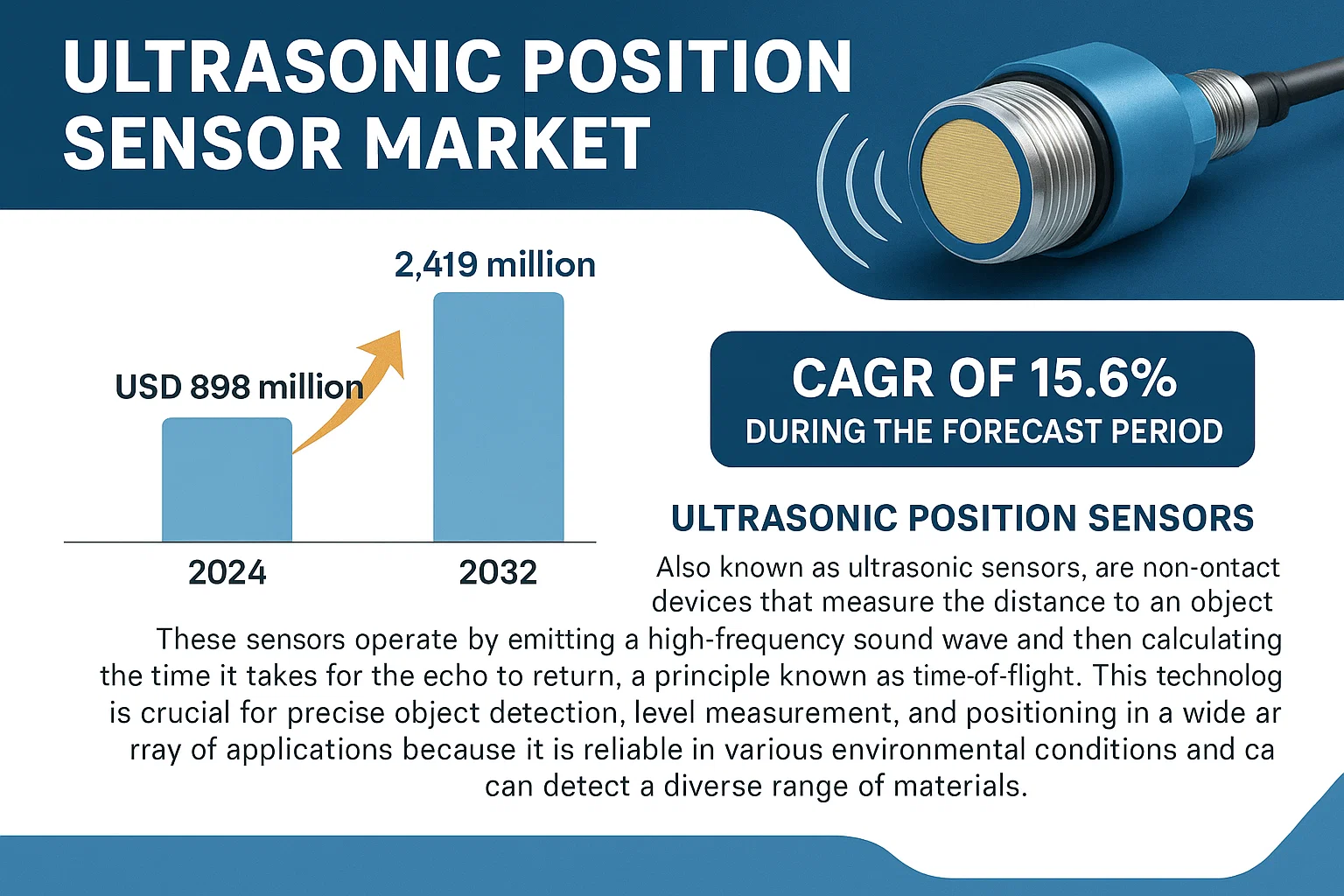
Global Ultrasonic Position Sensor Market size was valued at USD 898 million in 2024 to USD 2,419 million by 2032, exhibiting a CAGR of 15.6% during the forecast period.
Ultrasonic position sensors, also known as ultrasonic sensors, are non-contact devices that measure the distance to an object using sound waves. These sensors operate by emitting a high-frequency sound wave and then calculating the time it takes for the echo to return, a principle known as time-of-flight. This technology is crucial for precise object detection, level measurement, and positioning in a wide array of applications because it is reliable in various environmental conditions and can detect a diverse range of materials.
The market’s robust growth is primarily driven by the accelerating pace of industrial automation and the rising adoption of Industry 4.0 principles. Furthermore, the expansion of the automotive sector, particularly in advanced driver-assistance systems (ADAS) and autonomous vehicles, is creating significant demand. Key players are fueling innovation and market expansion through strategic initiatives; for instance, in 2023, SICK AG launched a new generation of ultrasonic sensors with enhanced IO-Link functionality for smarter data integration. PEPPERL+FUCHS, Schneider Electric, Microsonic, and SICK AG are some of the dominant players that collectively hold over 65% of the market share, with Europe being the largest regional market.
MARKET DRIVERS
Rising Industrial Automation Demands
The increasing adoption of Industry 4.0 and smart manufacturing across global industries is driving demand for precise positioning systems. Ultrasonic position sensors offer non-contact measurement capabilities that are essential in automated production lines, robotics, and automated guided vehicles (AGVs).
Growth in Healthcare and Pharmaceutical Applications
Ultrasonic sensors are increasingly used in medical devices and pharmaceutical manufacturing where precision and sterility are critical. The market is driven by the need for accurate liquid level detection, proximity sensing in medical robotics, and automated drug dispensing systems that require contamination-free operation.
➤ Market studies indicate that the healthcare sector’s adoption of ultrasonic position sensors grew by 18.3% in the past year, contributing significantly to overall market growth.
Additionally, the expansion of food and beverage automation and the need for higher efficiency in packaging and bottling lines continue to drive demand. The food industry’s strict hygiene standards make non-contact ultrasonic sensors particularly valuable.
MARKET CHALLENGES
High Initial Investment and Technical Expertise Requirements
Implementing ultrasonic position sensor systems requires significant upfront investment in both hardware and software integration. Many small and medium-sized enterprises find the initial costs prohibitive, especially when retrofitting existing machinery. Additionally, the need for specialized technical staff to install, calibrate, and maintain these systems creates an entry barrier.
Other Challenges
Environmental Interference and Calibration Challenges
Ultrasonic sensors can be affected by environmental factors such as temperature fluctuations, humidity changes, and air turbulence. These factors can cause signal attenuation or false readings, requiring sophisticated compensation algorithms and regular recalibration. Maintaining accuracy in diverse operating environments remains a significant challenge for manufacturers and end-users alike.
MARKET RESTRAINTS
Economic Fluctuations and Supply Chain Constraints
The global economic uncertainty and supply chain disruptions significantly impact the ultrasonic position sensor market. Fluctuations in raw material availability and pricing, particularly for electronic components and rare earth materials used in sensor manufacturing, create instability. Trade tensions and geopolitical factors further complicate the supply chain, affecting both production costs and delivery timelines for manufacturers across different regions.
MARKET OPPORTUNITIES
Emerging Applications in Renewable Energy and Electric Vehicles
The rapid expansion of renewable energy infrastructure, particularly wind and solar power, creates new opportunities for ultrasonic position sensors in condition monitoring, alignment systems, and safety mechanisms. Simultaneously, the electric vehicle revolution requires advanced sensing solutions for battery management, charging systems, and autonomous driving features. These emerging sectors present substantial growth opportunities beyond traditional industrial applications.
Ultrasonic Position Sensor Market Trends
Growing Demand for Industrial Automation Drives Market Expansion
The global Ultrasonic Position Sensor market is experiencing significant growth, primarily driven by the increasing adoption of industrial automation across manufacturing sectors. With the market valued at $898 million in 2024 and projected to reach $2419 million by 2032, the compound annual growth rate (CAGR) of 15.6% reflects the rapid integration of these sensors in automated systems. Europe remains the dominant market with approximately 65% market share, attributed to advanced manufacturing infrastructure and early adoption of Industry 4.0 technologies.
Other Trends
Integration with IoT and Industry 4.0
Ultrasonic position sensors are increasingly integrated with Internet of Things (IoT) platforms and Industry 4.0 infrastructure, enabling real-time monitoring and predictive maintenance capabilities. This integration allows manufacturing facilities to optimize production processes and reduce downtime through continuous monitoring of equipment positioning and movement patterns. The technology enables predictive maintenance algorithms that can detect anomalies in machinery performance before failures occur.
Advancements in Sensor Accuracy and Resolution
Recent technological advancements have significantly improved the accuracy and resolution of ultrasonic position sensors, with some models now achieving sub-millimeter precision in distance measurement. This enhancement is particularly crucial for applications in semiconductor manufacturing, precision engineering, and robotic assembly lines where minute positional adjustments are critical. Manufacturers are developing sensors with higher frequency ultrasonic waves (up to 2 MHz) that provide finer resolution while maintaining signal integrity over longer distances, enabling their use in more demanding industrial applications.
Emerging Applications in Autonomous Systems
Beyond traditional industrial applications, ultrasonic position sensors are finding new applications in autonomous vehicle systems and robotic navigation. Their ability to accurately detect objects regardless of lighting conditions makes them suitable for complementing optical sensors in autonomous systems. The technology is being adapted for obstacle detection, parking assistance, and precise positioning in automated guided vehicles (AGVs) operating in warehouses and manufacturing facilities.
COMPETITIVE LANDSCAPE
Key Industry Players
Ultrasonic Position Sensor Market Competitive Analysis
The global Ultrasonic Position Sensor market is characterized by the presence of several key players who dominate the market share. Pepperl+Fuchs leads the market with its extensive product portfolio and global distribution network, followed by Schneider Electric which has a strong presence in industrial automation sectors. These companies invest heavily in R&D to develop advanced ultrasonic sensing technologies.
The competitive landscape includes both specialized sensor manufacturers and diversified industrial automation companies. Microsonic and SICK AG have established strong positions in niche applications, particularly in factory automation and material handling. Other significant players include TURCK, Baumer, and ifm electronic, which offer comprehensive solutions across multiple industries. The market also features strong competitors from Asia, including Omron Corporation and Keyence, which have been expanding their global footprint through competitive pricing and technological innovation.
List of Key Ultrasonic Position Sensor Companies
- Pepperl+Fuchs
- Schneider Electric
- Microsonic
- SICK AG
- TURCK
- Baumer
- ifm electronic
- Rockwell Automation
- Balluff
- Eaton
- Keyence
- Omron Corporation
- GARLO GAVAZZI
- MaxBotix Inc.
- WAGO
Segment Analysis:
| Segment Category | Sub-Segments | Key Insights |
| By Type |
|
Linear Position Sensors dominate due to their widespread application in automated manufacturing lines and robotics systems, where precise linear motion detection is critical for operational efficiency and safety. |
| By Application |
|
Industrial Automation leads as factories increasingly automate production lines with precise position feedback systems, while automotive safety applications grow with ADAS integration. |
| By End User |
|
OEM Manufacturers lead as they integrate ultrasonic sensors directly into new equipment, though system integrators show strong growth adapting these technologies to upgrade existing industrial systems. |
| By Sensing Range |
|
Medium Range applications lead as they offer the optimal balance between detection distance and precision for most industrial applications, while short-range variants dominate in compact machinery. |
| By Technology |
|
Time-of-Flight (ToF) leads due to its direct measurement approach providing superior accuracy in distance calculation, though frequency modulated variants gain traction in cost-sensitive applications requiring robust performance. |
Regional Analysis: Ultrasonic Position Sensor Market
North America
North American automotive manufacturers increasingly integrate ultrasonic position sensors for automated assembly lines and quality control. The technology enables precise positioning of components during assembly processes while reducing human error. Major automotive plants utilize these systems for robotic welding and painting applications where exact positioning is critical. The integration with Industry 4.0 platforms allows real-time monitoring and adjustment of manufacturing processes.
The healthcare sector demonstrates growing adoption of ultrasonic sensors for surgical robotics and patient positioning systems. Medical device manufacturers incorporate these sensors for precision movement control in diagnostic equipment and robotic surgery systems. The non-contact nature of ultrasonic technology makes it ideal for sterile environments. Rehabilitation robotics extensively use position sensing for patient mobility assistance and physical therapy applications with enhanced safety features.
Manufacturing facilities across North America increasingly implement ultrasonic position sensors for quality control and process automation. The technology enables precise detection in harsh industrial environments where optical sensors may fail. Applications include material handling, packaging, and assembly verification systems. Integration with IoT platforms allows predictive maintenance and real-time monitoring of production line efficiency while reducing downtime and maintenance costs.
The aerospace industry utilizes ultrasonic position sensors for precision assembly of critical components and testing equipment. Defense applications include navigation systems, unmanned systems, and surveillance equipment where reliability under various conditions is paramount. The technology provides accurate positioning in vibration-prone environments and extreme temperature variations encountered in aerospace applications while meeting stringent safety standards.
Europe
Europe demonstrates strong adoption of ultrasonic position sensors across automotive and industrial sectors, with Germany leading in manufacturing applications. The region’s emphasis on worker safety regulations drives implementation in hazardous material handling. European manufacturers integrate these sensors with Industry 4.0 initiatives for smart factory development. The mature automotive industry in Germany and Italy utilizes the technology for precision manufacturing, while Eastern European countries show growing adoption in industrial automation projects. Stringent EU regulations regarding machinery safety continue to drive market growth through standardized implementation.
Asia-Pacific
Asia-Pacific represents the fastest growing market with China, Japan, and South Korea as major contributors. The region’s massive electronics manufacturing sector incorporates ultrasonic sensors for quality control and assembly verification. Rapid industrialization across Southeast Asia drives demand for industrial automation components. Japan’s advanced robotics industry develops specialized applications, while Chinese manufacturers drive cost-effective production. India’s growing automotive and electronics sectors present significant growth opportunities, though market fragmentation requires localized solutions. South Korea’s advanced manufacturing sector implements these technologies in consumer electronics production lines.
South America
South American markets show moderate but steady growth, primarily driven by Brazil’s industrial sector and Argentina’s agricultural equipment manufacturing. Mining operations in Chile and Peru utilize position sensing for heavy machinery. The region’s developing infrastructure projects incorporate advanced sensor technologies. Economic fluctuations have affected investment in some countries, but Brazil’s automotive sector continues to drive demand. Chile and Peru focus on mining applications, while Colombia shows growing adoption in manufacturing and infrastructure development projects.
Middle East & Africa
Middle Eastern markets show selective adoption, primarily in oil and gas applications with some industrial applications in major urban centers. African markets remain limited but show potential in South Africa’s manufacturing sector and Nigeria’s emerging oil and gas industry. Infrastructure development in Gulf countries drives some demand for precision measurement systems. Limited industrial base across most African countries restricts market penetration, though South Africa shows growing adoption in automotive and mining applications alongside some North African industrial applications.
Report Scope
This market research report provides a comprehensive analysis of the Ultrasonic Position Sensor Market , covering the forecast period 2025–2032. It offers detailed insights into market dynamics, technological advancements, competitive landscape, and key trends shaping the industry.
Key focus areas of the report include:
- Market Overview: The report begins with an overview outlining its current market scenario, key growth indicators, and industry transformation drivers. It discusses macroeconomic factors, demand–supply balance, regulatory landscape, and the strategic role of semiconductors in powering advancements across industries such as automotive, telecommunications, consumer electronics, and industrial automation.
- Market Size & Forecast: Historical data and future projections for revenue, unit shipments, and market value across major regions and segments.
- Segmentation Analysis: Detailed breakdown by product type, technology, application, and end-user industry to identify high-growth segments and investment opportunities.
- Regional Insights: Insights into market performance across North America, Europe, Asia-Pacific, Latin America, and the Middle East & Africa, including country-level analysis where relevant.
- Competitive Landscape: Profiles of leading market participants, including their product offerings, R&D focus, manufacturing capacity, pricing strategies, and recent developments such as mergers, acquisitions, and partnerships.
- Technology Trends & Innovation: Assessment of emerging technologies, integration of AI/IoT, semiconductor design trends, fabrication techniques, and evolving industry standards.
- Market Drivers & Restraints: Evaluation of factors driving market growth along with challenges, supply chain constraints, regulatory issues, and market-entry barriers.
- Stakeholder Insights: Insights for component suppliers, OEMs, system integrators, investors, and policymakers regarding the evolving ecosystem and strategic opportunities.
Primary and secondary research methods are employed, including interviews with industry experts, data from verified sources, and real-time market intelligence to ensure the accuracy and reliability of the insights presented.
FREQUENTLY ASKED QUESTIONS:
What is the current market size of the Ultrasonic Position Sensor Market?
-> Ultrasonic Position Sensor Market size was valued at USD 898 million in 2024 to USD 2,419 million by 2032, exhibiting a CAGR of 15.6% during the forecast period.
Which key companies operate in the Ultrasonic Position Sensor Market?
-> Key players include Pepperl+Fuchs, Schneider Electric, Microsonic, Sick AG, TURCK, Baumer, ifm electronic, Rockwell Automation, Balluff, Eaton, Keyence, Omron Corporation, GARLO GAVAZZI, MaxBotix Inc., and Warner Electric (Altra) among others.
What is the growth rate of the Ultrasonic Position Sensor Market?
-> The market is expected to grow at a compound annual growth rate (CAGR) of 15.6% from 2024 to 2032.
Which region dominates the Ultrasonic Position Sensor Market?
-> Europe is the largest market, holding nearly 65% of the global market share, followed by North America and Asia-Pacific.
What are the key applications of Ultrasonic Position Sensors?
-> Major applications include industrial automation, healthcare equipment, food & beverage processing, automotive manufacturing, petroleum, military, and other sectors where precise distance measurement and object detection are required.

Get Sample Report PDF for Exclusive Insights
Report Sample Includes
- Table of Contents
- List of Tables & Figures
- Charts, Research Methodology, and more...
 Download Sample Report PDF



