MARKET INSIGHTS
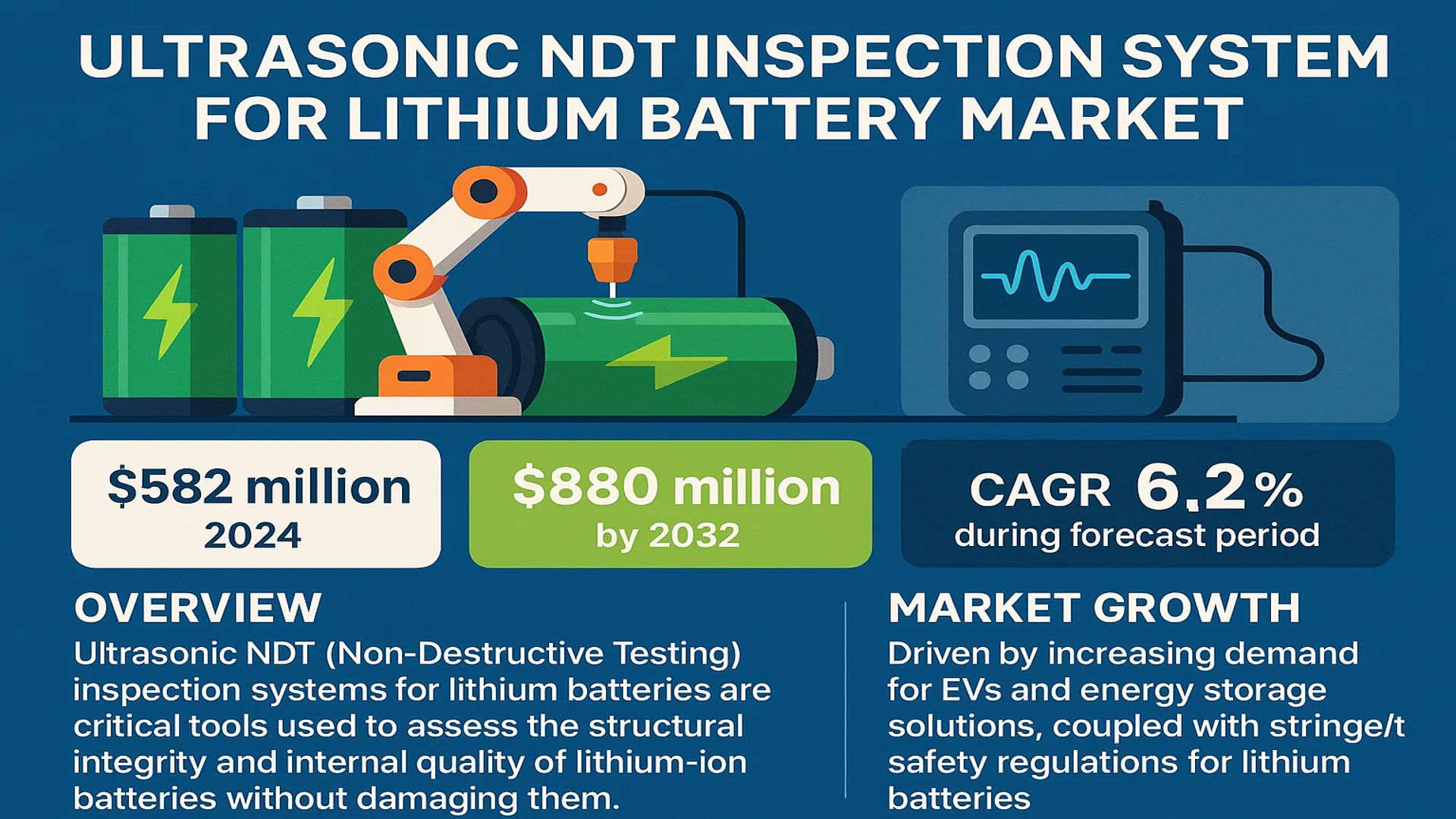
The global Ultrasonic NDT Inspection System for Lithium Battery Market was valued at 582 million in 2024 and is projected to reach US$ 880 million by 2032, at a CAGR of 6.2% during the forecast period.
Ultrasonic NDT (Non-Destructive Testing) inspection systems for lithium batteries are critical tools used to assess the structural integrity and internal quality of lithium-ion batteries without damaging them. These systems utilize ultrasonic waves to identify defects such as cracks, voids, delaminations, or internal separations that could compromise battery performance. Lithium-ion batteries are widely used in applications like electric vehicles (EVs), consumer electronics, and energy storage systems, making quality assurance essential for safety and efficiency.
The market growth is driven by increasing demand for EVs and energy storage solutions, coupled with stringent safety regulations for lithium batteries. Furthermore, advancements in ultrasonic testing technologies and rising investments in battery manufacturing infrastructure are propelling market expansion. Key players, including Baker Hughes, Olympus, and Sonatest, dominate the market with innovative product offerings. For instance, in 2023, Olympus introduced a high-resolution ultrasonic flaw detector specifically designed for battery inspection, enhancing defect detection accuracy.
MARKET DYNAMICS
MARKET DRIVERS
Rising Adoption of Electric Vehicles to Fuel Demand for Ultrasonic NDT Inspection Systems
The global electric vehicle market is projected to grow at a CAGR of over 20% from 2024 to 2032, creating substantial demand for reliable lithium-ion battery inspection solutions. Ultrasonic NDT systems have become critical quality control tools for battery manufacturers as EV production scales up to meet this demand. These systems enable detection of microscopic defects in battery cells that could lead to thermal runaway – a key safety concern that has prompted stricter quality standards across the industry. Automotive OEMs are increasingly mandating ultrasonic inspection at multiple production stages, from cell manufacturing to module assembly.
Increasing Safety Regulations Driving Market Adoption
Recent battery safety incidents and subsequent regulatory changes are accelerating market growth. New international standards now require comprehensive non-destructive testing of lithium-ion batteries before they enter the supply chain. Stringent regulations in North America, Europe, and Asia emphasize the need for ultrasonic inspection to detect internal flaws that traditional methods might miss. Government initiatives promoting battery safety, such as enhanced testing protocols from transportation authorities, are creating a favorable regulatory environment for ultrasonic NDT system adoption.
➤ For instance, updated UN transportation testing requirements for lithium batteries now include more rigorous inspection standards that benefit from ultrasonic NDT capabilities.
Additionally, the growing emphasis on battery lifespan optimization in energy storage applications presents another growth avenue for ultrasonic inspection technologies that can predict battery degradation patterns.
MARKET RESTRAINTS
High Equipment Costs and Technical Complexity Limit Market Penetration
While ultrasonic NDT systems offer superior detection capabilities, their adoption faces challenges due to significant capital investment requirements. Advanced phased array ultrasonic testing (PAUT) systems can cost between $50,000 to $200,000 per unit, creating barriers for small and medium-sized battery manufacturers. The need for specialized training to operate these systems and interpret results also adds to the total cost of ownership. Many facilities continue to rely on less precise but more affordable quality control methods for economic reasons.
Furthermore, the varying acoustic properties of different battery materials create technical challenges for ultrasonic inspection. Composite materials and layered structures in modern battery designs require sophisticated signal processing algorithms, increasing both equipment costs and operational complexity.
MARKET CHALLENGES
Standardization Issues Create Implementation Hurdles
The lack of universal testing standards for lithium battery inspection presents significant challenges for market participants. Different manufacturers employ diverse battery chemistries and designs, each requiring customized inspection parameters. This variability complicates the development of standardized ultrasonic testing protocols, forcing equipment providers to offer highly configurable solutions that drive up costs. The industry continues to debate optimal frequency ranges, transducer configurations, and acceptance criteria for different battery types.
Other Challenges
Workforce Shortages
The specialized nature of ultrasonic NDT testing has created a shortage of qualified technicians in the battery manufacturing sector. Certified NDT professionals often gravitate toward traditional industries like aerospace and oil & gas, leaving battery producers struggling to staff their quality control departments.
Rapid Technology Changes
The fast pace of battery innovation requires continuous upgrades to inspection systems, creating financial and operational burdens for manufacturers needing to maintain cutting-edge capabilities.
MARKET OPPORTUNITIES
Integration of AI and Automation Presents Growth Potential
The convergence of ultrasonic NDT with artificial intelligence creates significant opportunities for market expansion. Machine learning algorithms can enhance defect detection accuracy while reducing interpretation time, potentially lowering skilled labor requirements. Several leading manufacturers have already introduced AI-powered systems that automatically classify defects with over 95% accuracy, demonstrating the technology’s potential to revolutionize battery quality control. Automated inline inspection solutions are also gaining traction, particularly in high-volume battery production facilities.
Emerging markets represent another growth frontier, with battery manufacturing capacity in Asia expected to increase by over 150% in the next five years. Localization of inspection system production and the development of cost-optimized solutions could unlock substantial demand in these developing battery production hubs.
ULTRASONIC NDT INSPECTION SYSTEM FOR LITHIUM BATTERY MARKET TRENDS
Growing Demand for Electric Vehicles Drives Adoption of Ultrasonic NDT Inspection Systems
The rapid expansion of the electric vehicle (EV) sector is significantly boosting the demand for Ultrasonic Non-Destructive Testing (NDT) inspection systems in lithium battery manufacturing. With global EV sales projected to exceed 26 million units by 2030, the need for reliable battery inspection technologies has intensified. Ultrasonic NDT systems provide critical defect detection capabilities, identifying internal flaws such as delamination, air bubbles, and electrode misalignment without damaging the battery. These systems ensure battery safety and longevity, which is crucial for EV applications where performance and reliability are paramount.
Other Trends
Advancements in AI-Powered Ultrasonic Inspection
Artificial Intelligence (AI) integration is transforming ultrasonic NDT inspection by improving defect detection accuracy and reducing inspection time. Advanced machine learning algorithms enable automated defect classification with an accuracy rate exceeding 95%, significantly enhancing quality control in battery production. Companies are increasingly adopting AI-driven ultrasonic solutions to inspect high-volume battery lines, particularly in regions like Asia-Pacific where battery manufacturing capacity is expanding rapidly. This shift is expected to reduce inspection costs by up to 30% while improving throughput.
Energy Storage Sector Fueling Market Expansion
The rise in grid-scale energy storage deployments is accelerating the adoption of ultrasonic inspection systems for lithium-ion batteries. With global energy storage installations expected to reach 741 GWh by 2030, manufacturers are implementing rigorous inspection protocols to ensure battery pack reliability. Ultrasonic NDT systems provide critical validation of weld quality and internal electrode alignment in large-format battery cells. Furthermore, the growing emphasis on second-life battery applications has created additional demand for ultrasonic testing to assess battery health before repurposing.
COMPETITIVE LANDSCAPE
Key Industry Players
Innovation and Strategic Partnerships Drive Market Competition
The global Ultrasonic NDT Inspection System for Lithium Battery market features a dynamic mix of multinational corporations, specialized manufacturers, and emerging innovators competing for market share. Baker Hughes and Olympus dominate this space, collectively accounting for an estimated 28% of the 2024 market revenue. Their leadership stems from decades of expertise in ultrasonic testing technologies and strong distribution networks across automotive and energy sectors.
Sonatest and Zetec have emerged as formidable challengers, particularly in the EV battery inspection segment where resolution accuracy and speed are critical. Sonatest’s recent launch of portable phased array systems specifically designed for prismatic battery cells demonstrates the ongoing technological arms race in this space.
The mid-market features strong regional players like Nova Instruments (NDT Systems) in North America and Hitachi Power Solutions in Asia, both of which have significantly expanded their lithium battery testing capabilities through targeted R&D investments. Nova’s 2023 acquisition of a machine vision company has particularly enhanced its automated defect recognition capabilities.
Smaller innovators such as Proceq and Modsonic are carving out niches with specialized solutions. Proceq’s handheld ultrasonic thickness gauges optimized for battery pouch cells have gained traction among quality control teams, while Modsonic’s AI-powered analysis software reduces inspection time by up to 40% compared to conventional systems.
List of Key Ultrasonic NDT Inspection System Manufacturers
- Baker Hughes Company (U.S.)
- Olympus Corporation (Japan)
- Sonatest Ltd. (UK)
- Sonotron NDT (Israel)
- Karl Deutsch (Germany)
- Proceq SA (Switzerland)
- Zetec Inc. (U.S.)
- Nova Instruments (NDT Systems) (U.S.)
- Hitachi Power Solutions (Japan)
- Modsonic (India)
The competitive intensity continues to increase as battery manufacturers demand faster, more accurate inspection solutions capable of handling higher production volumes. While established players leverage their scale and customer relationships, technology disruptors are forcing all market participants to accelerate innovation cycles and explore new business models like inspection-as-a-service offerings.
Segment Analysis:
By Type
Thickness Gauges Segment Dominates Due to Critical Role in Battery Safety Testing
The Ultrasonic NDT Inspection System for Lithium Battery market is segmented based on type into:
- Thickness Gauges
- Flaw Detectors
- Others
By Application
Power Battery Application Leads Market Due to Surging Electric Vehicle Demand
The market is segmented based on application into:
- Power Battery
- Energy Storage Battery
- Consumer Electronics Battery
- Others
By Technology
Phased Array Technology Gains Traction for Enhanced Detection Capabilities
The market is segmented based on technology into:
- Phased Array Ultrasonic Testing
- Conventional Ultrasonic Testing
- Time-of-Flight Diffraction
By End-User
Battery Manufacturers Dominate as Primary Quality Control Stakeholders
The market is segmented based on end-user into:
- Battery Manufacturers
- Automotive OEMs
- Research Institutions
- Third-Party Inspection Services
Regional Analysis: Ultrasonic NDT Inspection System for Lithium Battery Market
Asia-Pacific
The Asia-Pacific region dominates the Ultrasonic NDT Inspection System for Lithium Battery market, accounting for the largest share globally due to rapid industrialization and a booming electric vehicle (EV) sector. China leads with over 50% of the world’s lithium-ion battery production, reinforcing the need for stringent quality inspections. Countries like Japan and South Korea contribute significantly with advanced technological adoption, while India is emerging as a key market with its ambitious EV adoption targets. Local manufacturers are investing heavily in automated inspection systems to meet global quality standards, further accelerating market growth. However, cost sensitivity in Southeast Asian markets remains a challenge for premium inspection technologies.
North America
North America’s market is driven by strict safety regulations for lithium batteries in industries such as automotive and aerospace. The U.S. maintains rigorous testing protocols under organizations like UL and NFPA, compelling manufacturers to implement advanced ultrasonic NDT solutions. Canada is witnessing steady growth in energy storage applications, particularly for grid stabilization projects. The region benefits from strong R&D initiatives by key players developing AI-integrated ultrasonic testing systems. Nevertheless, high implementation costs and competition from alternative inspection methods create moderate adoption barriers for small and medium-sized enterprises.
Europe
Europe’s stringent battery safety directives and the growing emphasis on renewable energy storage solutions are propelling market demand. Germany leads with its robust automotive sector adopting ultrasonic NDT for EV battery production lines. The EU’s Battery Passport initiative mandates comprehensive quality tracking, increasing reliance on non-destructive testing technologies. France and the UK are focusing on developing standardized inspection protocols for second-life battery applications. While environmental sustainability drives innovation, fragmented regulations across member states sometimes hinder uniform technology adoption. Collaboration between research institutes and manufacturers is accelerating development of portable ultrasonic testing devices.
South America
The South American market is in nascent stages but shows promising growth potential with increasing lithium mining activities and local battery assembly plants. Brazil and Argentina are establishing lithium-ion battery manufacturing facilities to reduce import dependency, creating opportunities for inspection system providers. Residential and commercial energy storage systems are gaining traction in urban areas, requiring quality assurance measures. However, limited technical expertise and economic instability constrain market expansion. Infrastructure challenges in remote mining regions also impact the deployment of advanced ultrasonic testing equipment, though government initiatives are gradually improving technical capabilities.
Middle East & Africa
This emerging market is witnessing gradual uptake of ultrasonic NDT systems, primarily driven by renewable energy projects and telecommunications infrastructure development. GCC countries are investing in battery storage solutions for solar power plants, necessitating reliable inspection methods. South Africa leads in technological adoption with its established automotive sector implementing battery quality controls. The region faces challenges including limited local manufacturing and reliance on imported inspection systems. However, partnerships with international technology providers and growing awareness about battery safety standards are slowly transforming the market landscape, particularly in urban industrial zones.
Report Scope
This market research report provides a comprehensive analysis of the global and regional Ultrasonic NDT Inspection System for Lithium Battery markets, covering the forecast period 2024–2032. It offers detailed insights into market dynamics, technological advancements, competitive landscape, and key trends shaping the industry.
Key focus areas of the report include:
- Market Size & Forecast: Historical data and future projections for revenue, unit shipments, and market value across major regions and segments. The global market was valued at USD 582 million in 2024 and is projected to reach USD 880 million by 2032.
- Segmentation Analysis: Detailed breakdown by product type (Thickness Gauges, Flaw Detectors, Others), application (Power Battery, Energy Storage Battery, Consumer Electronics Battery), and end-user industry to identify high-growth segments.
- Regional Outlook: Insights into market performance across North America, Europe, Asia-Pacific, Latin America, and the Middle East & Africa, with China and the U.S. as key markets.
- Competitive Landscape: Profiles of leading market participants including Baker Hughes, Olympus, Sonatest, Sonotron NDT, and Karldeutsch, covering their product offerings and strategic developments.
- Technology Trends & Innovation: Assessment of emerging ultrasonic testing technologies and their integration with AI for improved lithium battery inspection accuracy.
- Market Drivers & Restraints: Evaluation of factors such as growing EV adoption and battery safety concerns versus high equipment costs and technical complexities.
- Stakeholder Analysis: Insights for battery manufacturers, testing equipment providers, and investors regarding market opportunities and challenges.
Primary and secondary research methods are employed, including interviews with industry experts and data from verified sources, to ensure the accuracy and reliability of the insights presented.
FREQUENTLY ASKED QUESTIONS:
What is the current market size of Global Ultrasonic NDT Inspection System for Lithium Battery Market?
->Ultrasonic NDT Inspection System for Lithium Battery Market was valued at 582 million in 2024 and is projected to reach US$ 880 million by 2032, at a CAGR of 6.2% during the forecast period.
Which key companies operate in this market?
-> Key players include Baker Hughes, Olympus, Sonatest, Sonotron NDT, Karldeutsch, Proceq, and Zetec, among others.
What are the key growth drivers?
-> Key growth drivers include rising EV production, stringent battery safety regulations, and increasing demand for reliable battery inspection solutions.
Which region dominates the market?
-> Asia-Pacific leads the market due to strong battery manufacturing presence, while North America shows significant growth potential.
What are the emerging trends?
-> Emerging trends include AI-powered defect detection, portable inspection systems, and integration with battery production lines.

Get Sample Report PDF for Exclusive Insights
Report Sample Includes
- Table of Contents
- List of Tables & Figures
- Charts, Research Methodology, and more...
 Download Sample Report PDF