MARKET INSIGHTS
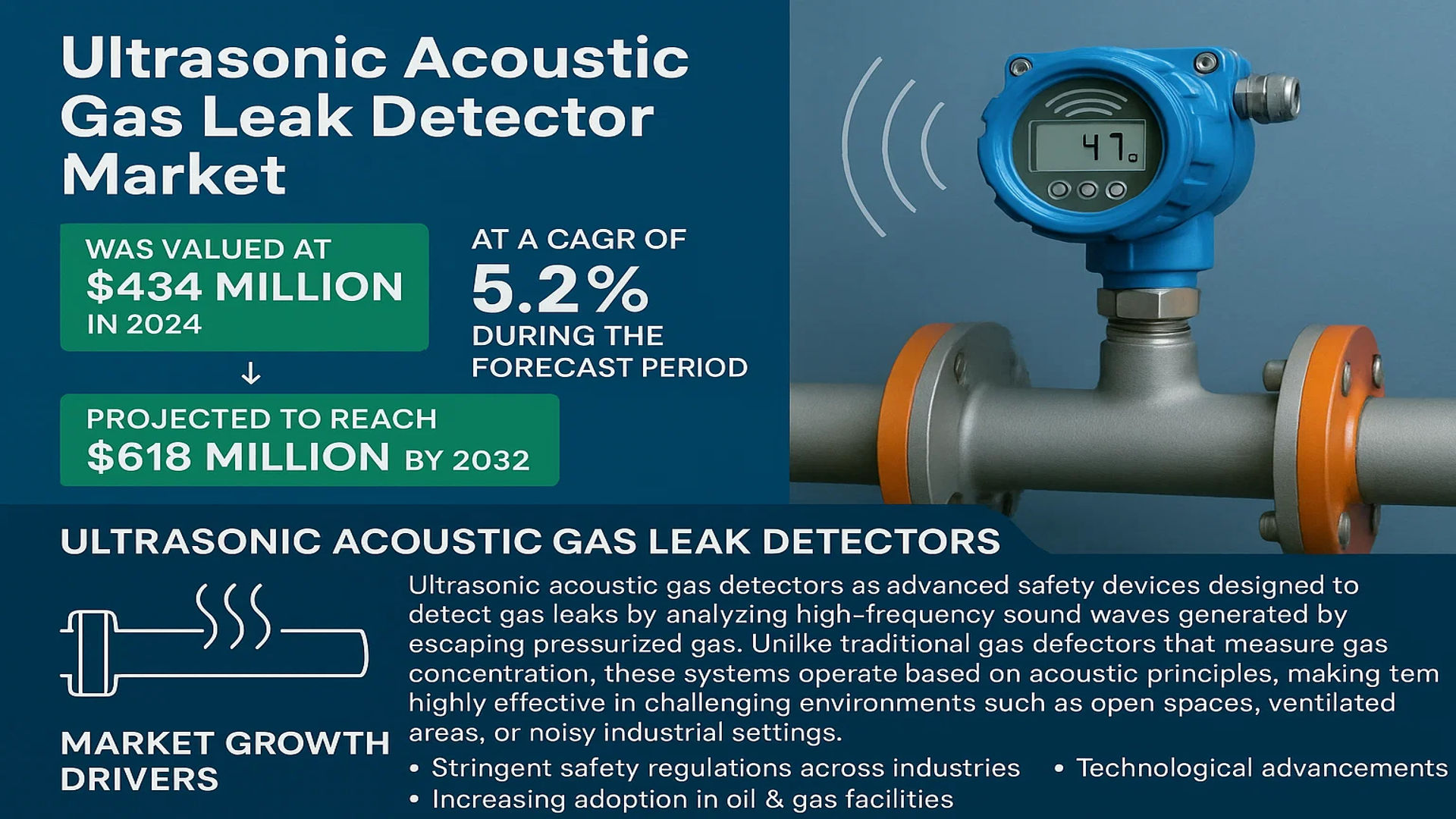
The global Ultrasonic Acoustic Gas Leak Detector Market was valued at 434 million in 2024 and is projected to reach US$ 618 million by 2032, at a CAGR of 5.2% during the forecast period.
Ultrasonic acoustic gas leak detectors are advanced safety devices designed to detect gas leaks by analyzing high-frequency sound waves generated by escaping pressurized gas. Unlike traditional gas detectors that measure gas concentration, these systems operate based on acoustic principles, making them highly effective in challenging environments such as open spaces, ventilated areas, or noisy industrial settings.
The market growth is driven by stringent safety regulations across industries, increasing adoption in oil & gas facilities, and technological advancements in leak detection systems. Fixed ultrasonic gas leak detectors currently dominate the market, accounting for over 60% of global sales, while portable variants are gaining traction for maintenance and inspection applications. Key players like Emerson, MSA, and Drager are expanding their product portfolios through innovations in sensor technology and wireless connectivity, further accelerating market expansion.
MARKET DYNAMICS
MARKET DRIVERS
Stringent Safety Regulations in Oil & Gas Industry Accelerate Market Adoption
The global ultrasonic acoustic gas leak detector market is experiencing significant growth due to increasing safety mandates across industrial sectors. Regulatory bodies worldwide are enforcing stricter guidelines for gas leak detection in hazardous environments, particularly in oil & gas facilities where undetected leaks can lead to catastrophic incidents. Recent standards now require continuous monitoring systems capable of detecting leaks before gas concentrations reach dangerous levels. These regulations are driving adoption of ultrasonic detectors which can identify leaks faster than traditional gas concentration sensors – often within seconds of a leak occurring, even in windy or high-noise conditions.
Growing Chemical Industry Expansion Creates Robust Demand
Chemical plants handling volatile organic compounds (VOCs) are increasingly deploying ultrasonic leak detection systems as part of their process safety management strategies. The technology’s ability to detect pressurized gas leaks regardless of wind direction or gas dilution makes it particularly valuable in chemical processing environments. With the chemical industry projected to grow at approximately 4% annually, new facility construction and retrofits of existing plants are generating consistent demand for advanced leak detection solutions. Emerging economies in Asia are driving much of this expansion, with China alone accounting for over 40% of global chemical production capacity.
Technological Advancements Enhance Detection Capabilities
Continuous innovation in sensor technology and signal processing algorithms is making ultrasonic detectors more reliable and cost-effective. Modern systems now incorporate artificial intelligence to distinguish between actual gas leaks and background industrial noise, significantly reducing false alarms. Some advanced models can pinpoint leak locations within a few meters across distances up to 25 meters. These improvements are expanding the technology’s applicability beyond traditional heavy industries to include applications like compressed natural gas (CNG) stations, refrigeration systems, and hydrogen fuel infrastructure.
➤ For instance, recent product launches incorporate IoT connectivity for remote monitoring and predictive maintenance capabilities, allowing operators to detect potential issues before they cause system failures.
Furthermore, integration with facility control systems enables automatic shutdown procedures when leaks are detected, minimizing risk while reducing response times.
MARKET RESTRAINTS
High Initial Investment Costs Limit Adoption in Price-Sensitive Markets
While ultrasonic gas leak detectors offer superior performance in many applications, their higher upfront costs compared to conventional gas sensors remain a significant adoption barrier. Complete industrial systems often require multiple detector units, sophisticated software, and trained personnel for proper installation and maintenance. This can result in total implementation costs 30-50% higher than traditional solutions, making the technology less accessible for small and medium enterprises in developing regions. The cost factor is particularly challenging in markets where safety regulations don’t yet mandate ultrasonic detection specifically.
Other Restraints
Technical Complexity Requires Specialized Expertise
Effective deployment of ultrasonic leak detection systems demands careful placement and calibration to account for site-specific acoustic conditions. Many industrial operators lack personnel with the necessary expertise to properly configure these systems, leading to suboptimal performance that may undermine confidence in the technology.
Limited Awareness in Emerging Applications
While well-established in oil & gas, many potential users in newer applications like hydrogen energy or pharmaceutical manufacturing remain unfamiliar with ultrasonic detection capabilities. This knowledge gap slows adoption as decision-makers often default to traditional solutions they understand better.
MARKET CHALLENGES
Environmental Interference Affects Detection Accuracy
Ultrasonic detectors face operational challenges in environments with high ambient noise levels from machinery, wind, or other sources. While advanced filtering algorithms help, extreme conditions can still generate false positives or mask genuine leak signals. Rain, hail, or heavy snowfall can also impact performance by creating ultrasonic noise that interferes with leak detection. These limitations require careful system design and placement to ensure reliable operation in challenging environments.
Competition from Alternative Technologies
New optical gas imaging (OGI) systems and laser-based detectors are emerging as competitive alternatives to ultrasonic solutions. While generally more expensive, these technologies offer visualization capabilities that help operators quickly locate leaks across large areas. Ultrasonic detector manufacturers must continue improving their offerings to maintain competitive advantages in detection range, response time, and integration with complementary safety systems.
MARKET OPPORTUNITIES
Emerging Hydrogen Economy Presents Significant Growth Potential
The global transition to hydrogen energy is creating substantial opportunities for ultrasonic leak detection systems. Hydrogen’s small molecular size and high flammability make leaks particularly dangerous yet difficult to detect with conventional methods. Ultrasonic technology’s ability to identify pressurized hydrogen leaks regardless of concentration or wind direction positions it as an ideal solution for hydrogen production, storage, and distribution infrastructure. Several major energy companies have already begun pilot programs incorporating ultrasonic detectors into their hydrogen facilities.
Smart City Infrastructure Development Drives New Applications
Urban gas distribution networks and smart building management systems represent growing markets for ultrasonic leak detection technology. Municipalities upgrading aging infrastructure are increasingly specifying ultrasonic detectors for continuous monitoring of underground gas lines and above-ground distribution points. Similarly, high-rise buildings and commercial complexes are adopting these systems to enhance safety for natural gas-powered heating and cooking systems. Integration with smart city IoT platforms allows for centralized monitoring across entire urban grids.
Retrofit Market Offers Substantial Untapped Potential
With many industrial facilities still relying on outdated gas detection systems, the retrofit market presents a significant growth avenue. Modern ultrasonic detectors can often be integrated with existing safety systems, providing an upgrade path that delivers improved protection without requiring complete system replacements. This is particularly appealing for operators seeking to enhance safety while managing capital budgets carefully. As regulations tighten and awareness of ultrasonic technology grows, retrofit projects are expected to account for an increasing share of market revenue.
ULTRASONIC ACOUSTIC GAS LEAK DETECTOR MARKET TRENDS
Integration of IoT and AI in Gas Leak Detection Systems Boosts Market Growth
The ultrasonic acoustic gas leak detector market is experiencing substantial growth due to the rapid integration of Internet of Things (IoT) and Artificial Intelligence (AI) technologies. Modern ultrasonic detectors leverage AI algorithms to differentiate between gas leak sounds and ambient noise, significantly improving detection accuracy. Industrial facilities deploying IoT-enabled systems can now monitor leaks in real-time, reducing response times and minimizing safety risks. The global market for smart gas detection systems is projected to grow at a CAGR of 5.2% from 2024 to 2032, driven by increasing adoption in high-risk sectors such as oil & gas and chemical manufacturing. Furthermore, advancements in wireless connectivity allow seamless integration with central monitoring platforms, ensuring rapid incident reporting and compliance with stringent safety regulations.
Other Trends
Regulatory Compliance and Safety Standards
Stringent government regulations mandating gas leak detection in hazardous environments are compelling industries to adopt ultrasonic acoustic detectors. Regulatory bodies such as OSHA and EPA enforce safety protocols requiring real-time gas monitoring, accelerating the demand for these systems. Industries operating in high-risk zones are investing in fixed and portable ultrasonic detectors to comply with these guidelines, preventing potential fines and operational shutdowns. The European Union’s ATEX directive further reinforces the need for explosion-proof gas detection equipment, creating a robust market opportunity for manufacturers. Additionally, recent incidents of gas leaks in industrial facilities highlight the necessity for preventive measures, pushing companies to upgrade their detection systems.
Increased Adoption in Oil & Gas and Chemical Industries
The oil & gas sector remains the largest end-user of ultrasonic acoustic gas leak detectors, accounting for over 40% of the market share. These detectors are widely deployed in refineries, petrochemical plants, and pipeline networks to identify leaks in high-pressure systems. Similarly, the chemical industry is increasingly utilizing ultrasonic detectors to prevent hazardous gas emissions during production. As companies expand their refining capacities and storage facilities, the demand for reliable leak detection technology is expected to surge. Fixed ultrasonic detectors, in particular, are witnessing higher adoption due to their ability to monitor large areas continuously. Portable variants also see growth, especially in maintenance applications where temporary monitoring is required.
COMPETITIVE LANDSCAPE
Key Industry Players
Technological Advancements and Strategic Partnerships Drive Market Competition
The global ultrasonic acoustic gas leak detector market is characterized by intense competition among established players and emerging innovators. Emerson leads the market with a dominant position in both fixed and portable gas detection solutions, backed by its extensive distribution network and continuous R&D investments. The company holds a significant revenue share, driven by its strong foothold in oil & gas and chemical industries.
MSA Safety and Drager follow closely, leveraging their legacy in industrial safety solutions. These companies have been focusing on integrating IoT and AI capabilities into their ultrasonic detectors, enhancing real-time monitoring and predictive maintenance features. Their growth is further supported by stringent safety regulations across Europe and North America.
Meanwhile, INFICON and Bacharach are gaining traction through specialized solutions for HVAC and refrigeration applications. Their ability to offer cost-effective, high-precision detectors for niche markets has allowed them to carve out a competitive edge. INFICON’s recent launch of wireless acoustic leak detectors demonstrates how innovation is reshaping the competitive dynamics.
Smaller players like Diatex and Beha-Amprobe are differentiating themselves through regional expertise and customized solutions. While these companies may lack global reach, their agility in addressing local compliance requirements and industry-specific challenges makes them formidable contenders in their target markets.
List of Key Ultrasonic Acoustic Gas Leak Detector Manufacturers
- Emerson Electric Co. (U.S.)
- MSA Safety Incorporated (U.S.)
- Dragerwerk AG & Co. KGaA (Germany)
- INFICON Holdings AG (Switzerland)
- AOIP (France)
- Diatex (France)
- Det-Tronics (U.S.)
- Bacharach, Inc. (U.S.)
- Spectris plc (U.K.)
- Beha-Amprobe (Germany)
Segment Analysis:
By Type
Fixed Ultrasonic Gas Leak Detectors Lead Market Due to High Demand in Industrial Monitoring Systems
The market is segmented based on type into:
- Fixed Ultrasonic Gas Leak Detectors
- Subtypes: Wall-mounted, Panel-mounted, and others
- Portable Ultrasonic Gas Leak Detectors
- Subtypes: Handheld, Wearable, and others
By Application
Oil and Gas Segment Dominates Due to Critical Safety Requirements in Processing Facilities
The market is segmented based on application into:
- Oil and Gas
- Mining
- Chemical Industry
- Others
By End-User
Industrial Sector Accounts for Maximum Adoption for Continuous Monitoring Needs
The market is segmented based on end-user into:
- Oil Refineries
- Chemical Plants
- Power Generation Facilities
- Manufacturing Units
- Others
By Technology
Digital Signal Processing (DSP) Technology Gains Traction for Enhanced Sensitivity
The market is segmented based on technology into:
- Digital Signal Processing (DSP)
- Fourier Transform
- Wavelet Analysis
- Others
Regional Analysis: Ultrasonic Acoustic Gas Leak Detector Market
North America
The North American market for ultrasonic acoustic gas leak detectors is driven by stringent safety regulations and the dominance of large-scale oil & gas and chemical industries. The U.S. accounts for the highest adoption, backed by OSHA and EPA mandates that enforce leak detection in hazardous environments. The region is home to key players like Emerson and MSA, who continue to innovate in fixed and portable detector solutions. Growth is further supported by strong investments in industrial automation and preventive maintenance programs, though high product costs remain a barrier for smaller enterprises.
Europe
Europe follows closely, with Germany, France, and the UK leading demand due to ATEX directives and stringent industrial emission norms. The EU’s push toward carbon neutrality has accelerated deployment in refineries and chemical plants, with significant R&D focused on IoT integration for real-time monitoring. However, market maturity and the shift toward renewable energy sources pose long-term challenges for conventional gas leak detection solutions in the region.
Asia-Pacific
This region is witnessing the fastest growth, propelled by rapid industrialization in China, India, and Southeast Asia. Expanding oil & gas infrastructure, coupled with increasing safety awareness, fuels demand. Local manufacturers are gaining traction by offering cost-effective alternatives to global brands, though concerns about product quality persist. China’s ‘Made in China 2025’ initiative is expected to drive technological advancements in domestic leak detection systems.
Middle East & Africa
The Middle East, particularly GCC countries, presents steady growth opportunities due to extensive hydrocarbon operations. Major oil producers prioritize ultrasonic detectors for large-scale facilities, with partnerships between international providers and local distributors strengthening market penetration. Africa’s adoption remains limited to mining operations in South Africa and oilfields in Nigeria, constrained by infrastructure challenges and inconsistent regulatory enforcement.
South America
The market here is emerging, with Brazil and Argentina accounting for most detector installations in petrochemical and mining sectors. Economic volatility slows investments, but upcoming offshore projects and stricter environmental policies are expected to bolster demand. Regional players face competition from low-cost Asian imports while struggling with currency fluctuations.
Key Market Dynamics:
The global ultrasonic gas leak detector market is transitioning toward smart, connected systems with AI-based predictive capabilities. While North America and Europe lead in technological adoption, Asia’s manufacturing boom creates volume-driven opportunities. Regulatory pressures and catastrophic event prevention remain universal drivers, though price sensitivity in developing regions continues to shape product strategies.
Report Scope
This market research report provides a comprehensive analysis of the Global Ultrasonic Acoustic Gas Leak Detector Market, covering the forecast period 2024–2032. It offers detailed insights into market dynamics, technological advancements, competitive landscape, and key trends shaping the industry.
Key focus areas of the report include:
- Market Size & Forecast: Historical data and future projections for revenue, unit shipments, and market value across major regions and segments. The market was valued at USD 434 million in 2024 and is projected to reach USD 618 million by 2032, growing at a CAGR of 5.2%.
- Segmentation Analysis: Detailed breakdown by product type (fixed vs. portable), application (oil & gas, mining, chemical industry, others), and technology to identify high-growth segments.
- Regional Outlook: Insights into market performance across North America, Europe, Asia-Pacific, Latin America, and Middle East & Africa, including country-level analysis for the U.S., China, Germany, and other key markets.
- Competitive Landscape: Profiles of leading manufacturers including Emerson, MSA, INFICON, Drager, and Bacharach, covering their market share, product portfolios, and strategic initiatives.
- Technology Trends: Assessment of AI integration, IoT connectivity, and advanced signal processing techniques in ultrasonic leak detection systems.
- Market Drivers & Restraints: Analysis of safety regulations, industrial automation trends, and cost sensitivity factors impacting adoption.
- Stakeholder Analysis: Strategic insights for equipment manufacturers, system integrators, and industrial end-users across key verticals.
The research methodology combines primary interviews with industry experts and analysis of verified market data from regulatory filings, trade associations, and financial reports to ensure accuracy and reliability.
FREQUENTLY ASKED QUESTIONS:
What is the current market size of Global Ultrasonic Acoustic Gas Leak Detector Market?
-> Ultrasonic Acoustic Gas Leak Detector Market was valued at 434 million in 2024 and is projected to reach US$ 618 million by 2032, at a CAGR of 5.2% during the forecast period.
Which key companies operate in this market?
-> Major players include Emerson, MSA, INFICON, Drager, Bacharach, Spectris, and Beha-Amprobe, with the top five companies holding significant market share.
What are the key growth drivers?
-> Growth is driven by stringent safety regulations, increasing industrial automation, and demand for non-contact leak detection in hazardous environments.
Which application segment dominates the market?
-> Oil & Gas remains the largest application sector, accounting for over 40% of total demand, followed by chemical industries.
What are the emerging technology trends?
-> Emerging trends include wireless monitoring systems, integration with predictive maintenance platforms, and advanced noise filtering algorithms.

Get Sample Report PDF for Exclusive Insights
Report Sample Includes
- Table of Contents
- List of Tables & Figures
- Charts, Research Methodology, and more...
 Download Sample Report PDF