Ultrapure Water Equipment for Semiconductor Market Insights
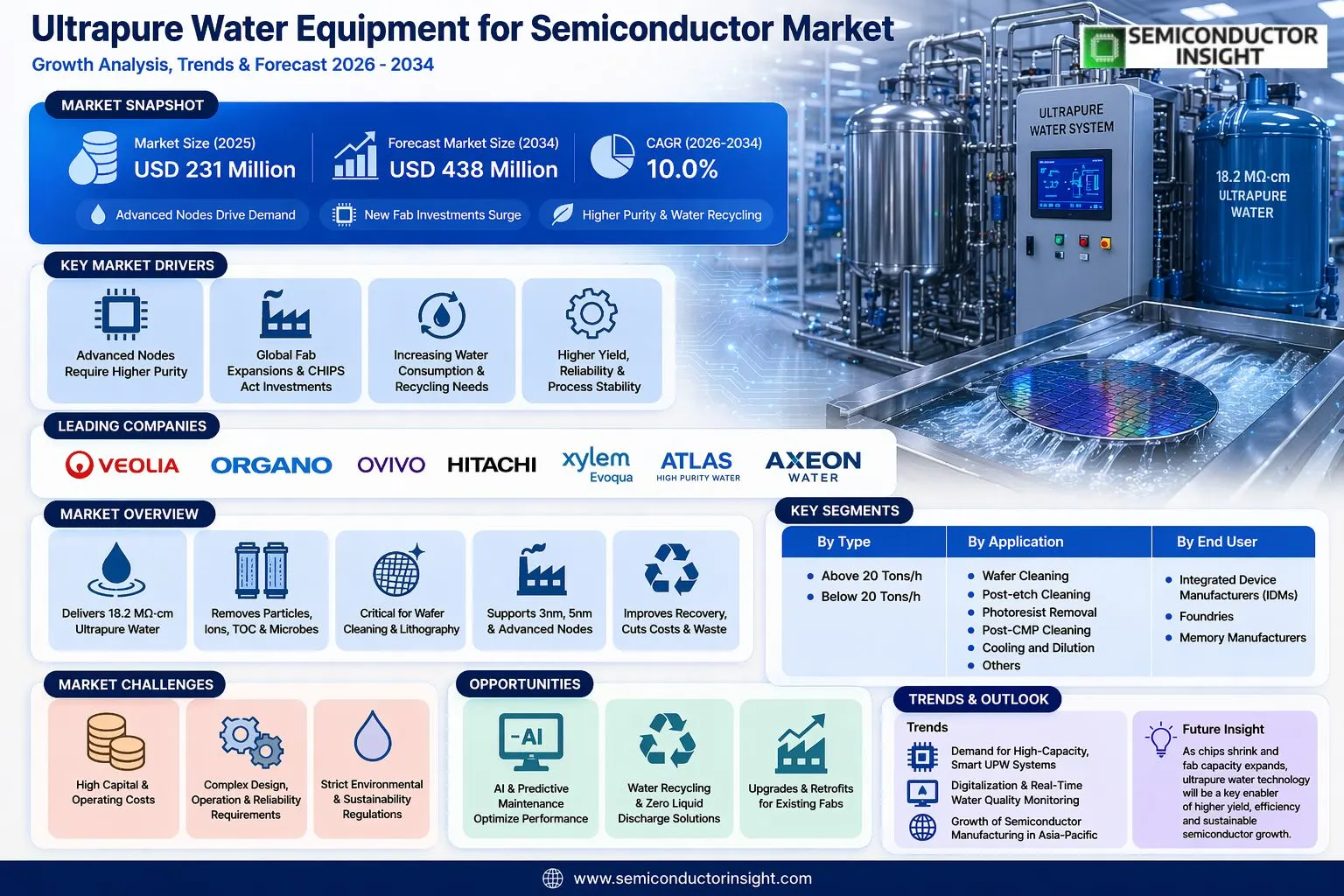
Global Ultrapure Water Equipment for Semiconductor market size was valued at USD 231 million in 2025. The market is projected to grow from USD 254 million in 2026 to USD 438 million by 2034, exhibiting a CAGR of 10.0% during the forecast period.
Ultrapure Water (UPW) equipment comprises integrated systems designed to produce water of exceptionally high purity, free from ionic, organic, particulate, and microbial contaminants. These systems are critical components in semiconductor manufacturing because they provide the high-purity water necessary for processes like wafer cleaning, photoresist removal, and post-CMP cleaning, where even trace impurities can cause catastrophic defects in sensitive electronic components.
The market is experiencing robust growth due to several factors, including Global expansion of semiconductor fabrication capacity, the transition to more advanced process nodes below 7nm and 5nm which demand even stricter water purity specifications, and significant government investments in domestic chip production. For instance, initiatives like the U.S. CHIPS Act are driving new fab construction, directly increasing demand for UPW systems. Furthermore, technological advancements aimed at reducing water consumption and improving recycling rates within fabs are prompting upgrades to existing equipment. Key players operating in this consolidated market include Veolia, Organo, and Evoqua (now part of Xylem), who provide comprehensive solutions encompassing pretreatment, reverse osmosis, electrodeionization (EDI), and final polishing.
MARKET DRIVERS
Advanced Semiconductor Fabrication Demands
The relentless push towards smaller process nodes below 5nm and the adoption of complex architectures like Gate-All-Around (GAA) has elevated the purity requirements for process water to unprecedented levels. This directly drives demand for next-generation Ultrapure Water Equipment for Semiconductor Manufacturing capable of removing particles at the angstrom scale and reducing ionic contamination to parts-per-quadrillion levels, making it a critical capital expenditure for new fabs.
Global Expansion of Semiconductor Manufacturing Capacity
Massive investments in new semiconductor fabrication facilities, particularly in regions like the United States, Southeast Asia, and Europe under various “Chips Act” initiatives, are creating a surge in demand for UPW systems. Each new megafab represents a multi-billion-dollar project where Ultrapure Water Equipment forms an indispensable and significant portion of the overall water treatment infrastructure budget.
➤ Increasing process steps for advanced chips directly correlates with higher ultrapure water consumption per wafer, necessitating larger and more efficient systems.
Furthermore, the growth of the semiconductor industry segments such as compound semiconductors (GaN, SiC) for power electronics and automotive applications also requires specialized, high-purity water for substrate cleaning and etching, broadening the market base for tailored Ultrapure Water Equipment solutions.
MARKET CHALLENGES
Extreme Technical and Operational Complexity
Designing and operating a system for Ultrapure Water Equipment for Semiconductor Market involves integrating multiple complex technologies,reverse osmosis, electrodeionization, advanced ultrafiltration, and degasification,into a seamless, reliable loop. Maintaining consistent 18.2 MΩ·cm resistivity and near-zero particle counts 24/7, with zero tolerance for downtime that could ruin entire production batches, presents a monumental engineering and operational challenge for suppliers and manufacturers alike.
Other Challenges
Intense Competitive Pressure and Consolidation
The market is characterized by a few dominant global players and intense competition on technological superiority and total cost of ownership. This pressure drives continuous R&D investment but also squeezes margins, leading to industry consolidation as companies seek to acquire niche technology expertise or broader geographical reach.
Stringent Environmental and Sustainability Regulations
Modern Ultrapure Water systems must achieve near-perfect recovery rates, often exceeding 90-95%, to minimize wastewater and chemical usage. Complying with evolving global regulations on water discharge and chemical handling adds significant complexity and cost to both system design and ongoing facility operations.
MARKET RESTRAINTS
High Capital and Operational Expenditure
The initial capital investment for a complete, fab-scale Ultrapure Water system is extraordinarily high, often running into tens of millions of dollars. This is compounded by significant operational costs for energy, membrane and resin replacements, and continuous chemical consumables. For smaller semiconductor manufacturers or those in cost-sensitive markets, this high barrier to entry can delay or limit investments in the most advanced Ultrapure Water Equipment, restraining market expansion in certain segments.
Cyclical Nature of Semiconductor Industry
The demand for new Ultrapure Water Equipment is intrinsically tied to the capital investment cycle of the semiconductor industry. During periods of overcapacity or economic downturn, chip manufacturers frequently delay or cancel new fab projects and expansions, leading to volatile and unpredictable order books for UPW equipment suppliers, which restrains steady, linear market growth.
MARKET OPPORTUNITIES
Adoption of Digitalization and Predictive Maintenance
The integration of IoT sensors, AI, and digital twins into Ultrapure Water Equipment presents a major growth frontier. These technologies enable predictive maintenance, real-time water quality optimization, and remote operation, which can significantly reduce unplanned downtime, lower operational costs, and improve system reliability for semiconductor manufacturers, creating a high-value service-based revenue stream for equipment providers.
Innovation in Purification and Monitoring Technologies
There is significant opportunity in developing next-generation purification modules, such as more durable membranes and advanced oxidation processes, and in-line monitoring tools capable of detecting contaminants at ever-lower thresholds. Innovations that reduce the system’s physical footprint, energy consumption, or chemical usage directly address key customer pain points in Ultrapure Water Equipment for Semiconductor Market, offering competitive advantages.
Retrofitting and Upgrading Existing Fabrication Facilities
A substantial installed base of older semiconductor fabs requires system upgrades to meet the purity demands of newer manufacturing processes or to improve water recovery and energy efficiency. This creates a persistent aftermarket and retrofit opportunity for suppliers of Ultrapure Water Equipment, offering modernization packages that extend the life and performance of existing infrastructure at a lower cost than building entirely new systems.
Ultrapure Water Equipment for Semiconductor Market Trends
Focus on High-Capacity Systems for Advanced Node Manufacturing
The dominant trend is the shift towards higher-capacity systems to support the expansion of advanced logic and memory chip fabrication. With semiconductor device geometries shrinking below 7nm, the contamination tolerance for processes like wafer cleaning, chemical mechanical planarization, and photoresist removal approaches theoretical limits. This necessitates ever-higher purity levels and reliability from Ultrapure Water Equipment for Semiconductor Market systems, which are being achieved through more sophisticated multi-stage purification. Systems with capacities above 20 Tons/h are increasingly favored to support the larger wafer fabrication facilities being built, ensuring a consistent and voluminous supply of water that meets the stringent specifications required for leading-edge production.
Other Trends
Geographic Diversification of Manufacturing Hubs
While established markets like the United States remain key, significant investment in new semiconductor capacity is driving demand in Asia, particularly in China. This geographic expansion of fabrication capacity is compelling suppliers of Ultrapure Water Equipment to strengthen their local service and supply networks to support these new facilities, creating a more globally distributed and competitive market landscape.
Emphasis on Operational Efficiency and Sustainability
An increasing operational trend is the integration of water reclamation and recycling systems within the ultrapure water loop. Semiconductor manufacturers are prioritizing equipment that offers higher water recovery rates and lower energy consumption per liter produced. This focus on sustainability and total cost of ownership is becoming a critical purchasing factor alongside technical performance metrics for Ultrapure Water Equipment for Semiconductor.
Intensifying Competition and Technological Collaboration
The competitive landscape is characterized by both the presence of major global water treatment specialists and dedicated regional players. Leaders such as Veolia, Organo, and Evoqua (Xylem) leverage extensive process expertise. A key market trend is the deepening collaboration between these equipment suppliers and semiconductor manufacturers to co-develop next-generation purification technologies, specifically targeting the reduction of novel contaminants that emerge with new fabrication materials and chemistries. This partnership model is essential for keeping pace with the industry’s relentless technological roadmap.
COMPETITIVE LANDSCAPE
Key Industry Players
Global Market Characterized by Consolidated Leadership and Specialized Niche Players
Global ultrapure water (UPW) equipment market for semiconductor manufacturing is led by a few dominant international corporations with extensive system integration, service, and technological capabilities. Veolia stands as a principal leader, leveraging its broad water technology portfolio and global footprint. Other top-tier players such as Organo, Ovivo, and Evoqua, now integrated into Xylem, form a strong competitive bloc, collectively holding a significant share of the market revenue. These established players compete intensely on the basis of total cost of ownership (TCO), system reliability to meet the extreme purity requirements of advanced nodes (7nm, 5nm, and 3nm), and the ability to provide comprehensive, value-added services including long-term operation and maintenance contracts to major semiconductor fab operators.
Beyond Global leaders, the competitive landscape includes dedicated niche and regional specialists that cater to specific segments or geographies. Companies like Atlas High Purity Water and AXEON Water focus on high-purity water treatment with expertise in demanding applications. The market in Asia, particularly China, features a dynamic group of domestic manufacturers such as Hangzhou Ouquan and Shenzhen Jianghui Environmental Protection Technology, which are scaling their presence to support the region’s aggressive semiconductor fabrication expansion. Additional companies like Gaopin Tech and Shenzhen Hongsen Environmental Protection Technology further contribute to a diverse and competitive supplier base, often competing on cost-effectiveness and localized service for specific foundries and component manufacturers.
List of Key Ultrapure Water Equipment for Semiconductor Companies Profiled
- Veolia
- Organo
- Ovivo
- Hitachi
- Evoqua (Xylem)
- Atlas High Purity Water
- AXEON Water
- Hangzhou Ouquan
- Shenzhen Jianghui Environmental Protection Technology
- Shenzhen Hongsen Environmental Protection Technology
- Gaopin Tech
Segment Analysis:
| Segment Category | Sub-Segments | Key Insights |
| By Type |
|
Above 20 Tons/h systems are the leading segment, driven by the demands of large-scale semiconductor fabrication plants. These high-capacity systems are essential for maintaining the continuous, voluminous supply of ultrapure water required for wafer processing at advanced nodes. Facilities producing high-volume chips necessitate robust and reliable equipment to minimize downtime risks. This segment benefits from significant technological investments from manufacturers to enhance system reliability, integrate advanced monitoring, and reduce the total cost of ownership, making it the preferred choice for greenfield and major expansion projects by leading foundries. |
| By Application |
|
Wafer Cleaning stands as the dominant application segment due to its critical and repeated role in the manufacturing flow. This process requires the highest purity standards to remove particulate, metallic, and ionic contaminants without damaging intricate circuit patterns, especially as feature sizes shrink below five nanometers. The relentless drive for higher chip yields and performance directly ties to the efficacy of cleaning processes, making it the most stringent and high-consumption application for UPW. Advances in cleaning chemistries and single-wafer processing further intensify the demand for consistently pure water with precise quality control. |
| By End User |
|
Foundries represent the leading end-user segment, propelled by massive capacity expansions and technological leadership in advanced process nodes. As the primary manufacturers for fabless semiconductor companies, leading foundries operate at the technological frontier where water purity specifications are most extreme. Their capital-intensive nature and focus on operational excellence drive continuous investment in next-generation UPW equipment to secure a competitive advantage in yield and reliability. The concentrated geographic expansion of major foundry capacity creates significant, localized demand clusters for high-performance UPW systems and related service contracts. |
| By Technology Module |
|
Polishing Loop Systems are the pivotal technology segment, as they are responsible for achieving and maintaining the final, near-theoretical purity levels required at the point-of-use. This segment’s dominance is underscored by its direct impact on minimizing particle counts and total organic carbon, which are critical for advanced semiconductor processes. The complexity of these recirculating systems, which often employ advanced oxidation, electrodeionization, and ultrafiltration, represents a core area of innovation and differentiation among equipment suppliers, focusing on reducing microbial regrowth and ensuring stable resistivity. |
| By Service Model |
|
Operation & Maintenance Services is the leading and strategically vital service segment. Given the mission-critical nature of UPW systems, semiconductor manufacturers prioritize guaranteed system uptime and consistent water quality through long-term service agreements. This trend shifts vendor relationships from transactional equipment sales to strategic partnerships, encompassing remote monitoring, predictive maintenance, consumables management, and regulatory compliance support. This model provides equipment suppliers with stable recurring revenue streams while offering end-users reduced operational risk and expertise in managing these highly complex utility systems. |
Regional Analysis: Ultrapure Water Equipment for Semiconductor Market
Asia-Pacific
These nations are the core of advanced logic and memory production. The demand for ultrapure water equipment here is driven by leading-edge foundries and DRAM facilities where water purity directly impacts wafer yield. Suppliers must provide systems capable of achieving parts-per-quadrillion impurity levels, with a strong emphasis on reliability and redundancy to prevent costly fab downtime. The market dynamics are characterized by long-term partnerships with major semiconductor manufacturers.
China’s market is defined by a massive push for domestic semiconductor manufacturing capacity, supported by national policies. This creates a dual demand for new turnkey ultrapure water equipment for greenfield fabs and technology transfer. While international suppliers are key for high-end systems, there is a growing trend of localizing supply chains, leading to increased competition and partnerships with domestic water treatment companies.
Japan’s role is unique, leveraging its expertise in advanced materials, filtration, and precision component manufacturing. The market outlook is supported by investments in new domestic fabs and the critical supply of high-purity chemicals and membranes used within ultrapure water systems. Japanese suppliers are pivotal in the value chain, providing essential sub-components that define the performance ceiling of the overall purification equipment.
Countries like Singapore, Malaysia, and Vietnam are growing in importance as semiconductor companies diversify their geographic footprint. The market involves establishing new supply lines for ultrapure water equipment to support assembly, test, and packaging facilities, as well as some front-end operations. This presents opportunities for regional service and support networks to maintain the sophisticated ultrapure water systems required.
North America
The North American ultrapure water equipment for semiconductor market is driven by major investments in domestic chip manufacturing, spurred by legislation like the CHIPS Act. Key demand originates from new megafab projects in the U.S., which require massive, state-of-the-art ultrapure water systems designed for high-volume, advanced-node production. This region sees strong demand for integrated solutions that combine water purification with advanced analytics and digital monitoring for operational efficiency. While not the largest manufacturing base, its focus on cutting-edge R&D and pilot production lines for next-generation semiconductors creates a specialized market for high-precision, modular ultrapure water equipment for semiconductor prototyping.
Europe
Europe’s market is focused on strategic autonomy and specialized semiconductor production, including power semiconductors and automotive chips. The demand for ultrapure water equipment is linked to investments in new fabs aligned with the European Chips Act, which emphasizes a resilient supply chain. Market dynamics involve upgrading existing facilities and integrating sustainable water reclamation and recycling technologies into new ultrapure water systems to meet stringent environmental regulations, making system efficiency and low chemical consumption key selling points for equipment suppliers.
Middle East & Africa
This region is an emerging participant, with strategic investments aimed at diversifying economies into high-tech sectors. The market for ultrapure water equipment is nascent but developing, centered on establishing initial semiconductor manufacturing capabilities. Projects are often part of larger technology hub initiatives, requiring foundational water purification infrastructure. The primary focus for equipment suppliers is on providing robust, reliable systems that can operate effectively in local conditions, with an emphasis on training and long-term service support to build local expertise.
South America
South America’s market remains limited but shows potential for long-term growth in specialized areas. Current activities are concentrated in supporting existing industrial operations and potential future investments in semiconductor assembly and test. The demand for dedicated ultrapure water equipment for semiconductor fabrication is minimal, but there is interest in related high-purity water technologies for other electronics manufacturing. Market development hinges on broader economic and industrial policy shifts toward advanced manufacturing on the continent.
Report Scope
This market research report provides a comprehensive analysis of the Ultrapure Water Equipment for Semiconductor Market , covering the forecast period 2026–2034. It offers detailed insights into market dynamics, technological advancements, competitive landscape, and key trends shaping the industry.
Key focus areas of the report include:
- Market Overview: The report begins with an overview outlining its current market scenario, key growth indicators, and industry transformation drivers. It discusses macroeconomic factors, demand–supply balance, regulatory landscape, and the strategic role of semiconductors in powering advancements across industries such as automotive, telecommunications, consumer electronics, and industrial automation.
- Market Size & Forecast: Historical data and future projections for revenue, unit shipments, and market value across major regions and segments.
- Segmentation Analysis: Detailed breakdown by product type, technology, application, and end-user industry to identify high-growth segments and investment opportunities.
- Regional Insights: Insights into market performance across North America, Europe, Asia-Pacific, Latin America, and the Middle East & Africa, including country-level analysis where relevant.
- Competitive Landscape: Profiles of leading market participants, including their product offerings, R&D focus, manufacturing capacity, pricing strategies, and recent developments such as mergers, acquisitions, and partnerships.
- Technology Trends & Innovation: Assessment of emerging technologies, integration of AI/IoT, semiconductor design trends, fabrication techniques, and evolving industry standards.
- Market Drivers & Restraints: Evaluation of factors driving market growth along with challenges, supply chain constraints, regulatory issues, and market-entry barriers.
- Stakeholder Insights: Insights for component suppliers, OEMs, system integrators, investors, and policymakers regarding the evolving ecosystem and strategic opportunities.
Primary and secondary research methods are employed, including interviews with industry experts, data from verified sources, and real-time market intelligence to ensure the accuracy and reliability of the insights presented.
FREQUENTLY ASKED QUESTIONS:
What is the current market size and projected growth for Ultrapure Water Equipment for Semiconductor Market?
-> Ultrapure Water Equipment for Semiconductor Market was valued at USD 231 million in 2025 and is projected to reach USD 438 million by 2034, growing at a CAGR of 10.0% during the forecast period.
Which key companies operate in Ultrapure Water Equipment for Semiconductor Market?
-> Key players include Veolia, Organo, Ovivo, Hitachi, Evoqua (Xylem), Atlas High Purity Water, AXEON Water, Hangzhou Ouquan, Shenzhen Jianghui Environmental Protection Technology, and Shenzhen Hongsen Environmental Protection Technology, among others.
What are the key applications for ultrapure water in semiconductor manufacturing?
-> Key applications include Wafer Cleaning, Post-etch Cleaning, Photoresist Removal, Post-CMP Cleaning, and Cooling and Dilution, among others.
How is the market segmented by equipment capacity?
-> The market is segmented by type, primarily into systems with capacities Above 20 Tons/h and Below 20 Tons/h.
Which regions are covered in the market analysis?
-> The report provides regional insights for North America, Europe, Asia, South America, and the Middle East & Africa, with country-level analysis for key markets including the United States, China, Japan, and Germany.

Get Sample Report PDF for Exclusive Insights
Report Sample Includes
- Table of Contents
- List of Tables & Figures
- Charts, Research Methodology, and more...
 Download Sample Report PDF