TV Tuner Chip Market Insights
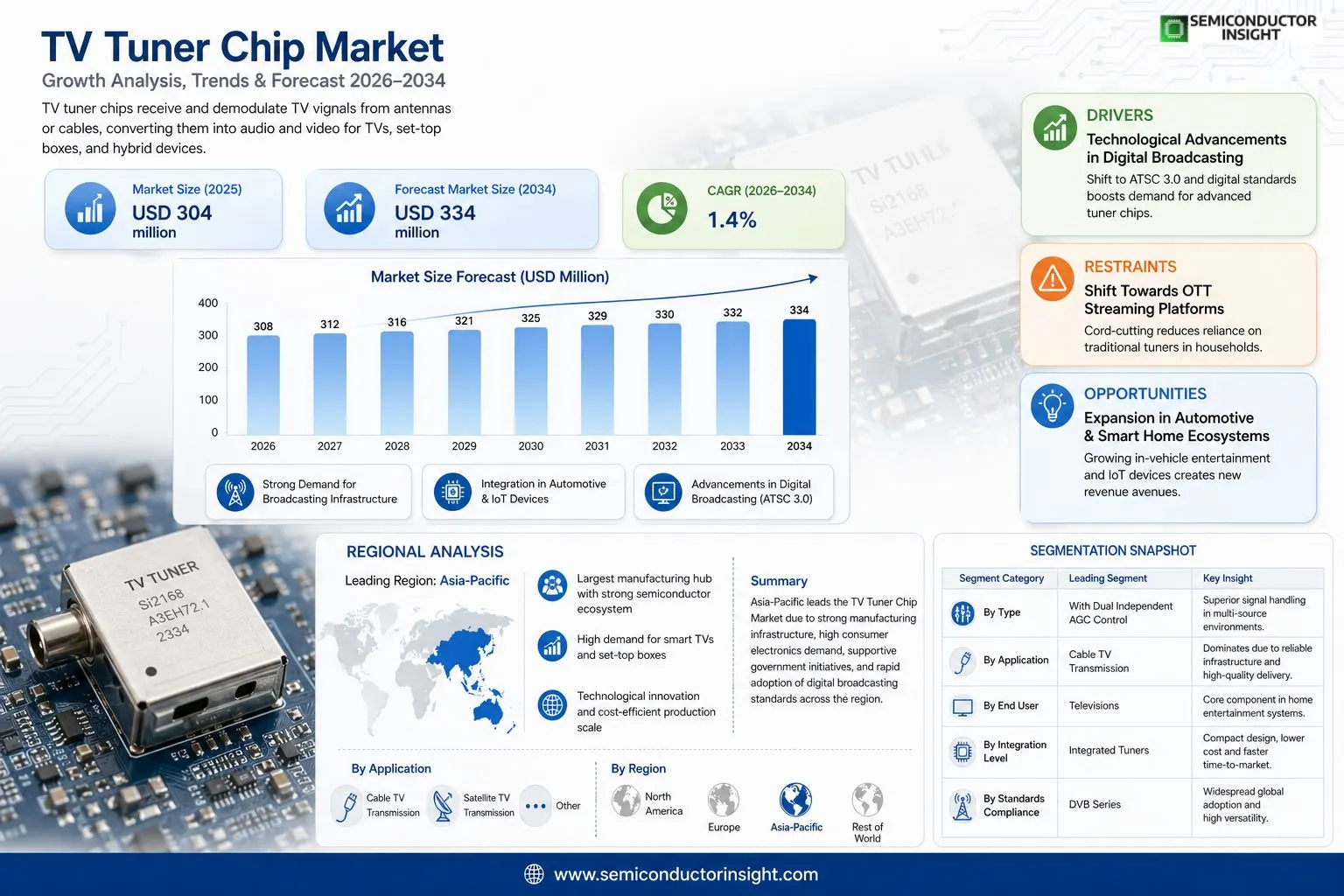
Global TV Tuner Chip market size was valued at USD 304 million in 2025. The market is projected to reach USD 334 million by 2034, exhibiting a CAGR of 1.4% during the forecast period.
TV tuner chips are electronic components used to receive and demodulate TV signals. They serve as crucial elements in modern televisions and set-top boxes, converting radio frequency signals from antennas or cables,such as terrestrial broadcasts, satellite, or cable TV,into processable audio and video signals.
The market maintains steady expansion driven by persistent demand for cable TV transmission and satellite TV applications, particularly in regions with strong traditional broadcasting infrastructure. While streaming services challenge growth, integration into hybrid devices and automotive entertainment systems supports resilience. Key players like Mediatek, NXP, Sony, Silicon Labs, ADI, Skyworks, MaxLinear, SiTune, and AltoBeam Inc. dominate, holding significant revenue shares through innovative tuner technologies and broad portfolios.
MARKET DRIVERS
Technological Advancements in Digital Broadcasting
TV Tuner Chip Market is propelled by the ongoing shift to digital terrestrial television standards like ATSC 3.0, enhancing signal quality and enabling 4K UHD broadcasts. This transition necessitates advanced tuner chips capable of handling higher data rates, driving adoption in set-top boxes and integrated TVs across North America and Europe.
Growing Integration in Consumer and Automotive Devices
Rising demand for multimedia convergence in PCs, laptops, and automotive infotainment systems boosts the TV tuner chip sector. With vehicle connectivity surging, tuners supporting live TV reception via antennas are increasingly embedded, contributing to a projected market expansion at a 5.2% CAGR through 2030.
➤ Key integration in IoT devices further accelerates growth in TV Tuner Chip Market.
Furthermore, the proliferation of hybrid broadcast-broadband services underscores the essential role of efficient tuner chips, ensuring seamless access to over-the-air content amid evolving viewer preferences.
MARKET CHALLENGES
Shift Towards OTT Streaming Platforms
TV Tuner Chip Market faces pressure from the dominance of streaming services like Netflix and YouTube, reducing reliance on traditional tuners in households. This cord-cutting trend has slowed hardware tuner sales in mature markets, compelling manufacturers to innovate for niche applications.
Other Challenges
High Development Costs and Miniaturization Demands
Chipmakers encounter escalating R&D expenses for silicon tuners compliant with diverse global standards, alongside challenges in shrinking form factors for mobile integration. Supply chain volatility exacerbates production delays, impacting TV Tuner Chip Market competitiveness.Additionally, interoperability issues across DVB-T2, ISDB-T, and DTMB standards complicate design, while intense vendor rivalry from players like Silicon Labs and MaxLinear squeezes margins in this consolidating sector.
MARKET RESTRAINTS
Declining Traditional TV Penetration
Saturation in developed regions limits growth in TV Tuner Chip Market, as broadband households prioritize internet-delivered content over broadcast reception. Annual TV tuner shipments have stabilized at around 150 million units globally, reflecting subdued demand.Regulatory hurdles, including spectrum reallocations for 5G, restrict tuner performance and availability, particularly in urban areas with interference concerns. These factors constrain market expansion despite technological merits.Moreover, economic slowdowns in emerging economies delay consumer electronics upgrades, perpetuating reliance on legacy tuners and hampering new deployments in TV Tuner Chip Market.
MARKET OPPORTUNITIES
Expansion in Automotive and Smart Home Ecosystems
TV Tuner Chip Market holds promise in automotive sectors, where in-vehicle entertainment systems integrate tuners for live news and sports, fueled by EV adoption and advanced driver-assistance features. This segment could capture 25% market share by 2028.Smart home devices and IoT gateways present untapped potential, enabling hybrid TV-over-IP solutions that blend OTA signals with streaming, especially in regions with limited broadband like Asia-Pacific.Advancements in low-power, multi-standard tuners open doors for portable gadgets and drones, positioning TV Tuner Chip Market for renewed vigor amid next-gen broadcasting rollouts.
TV Tuner Chip Market Trends
Advancements in Dual Independent AGC Control Technology
In TV Tuner Chip Market, a prominent trend is the growing preference for TV tuner chips equipped with dual independent automatic gain control (AGC) features. These chips excel in handling diverse signal inputs, including terrestrial broadcasts, cable TV transmission, and satellite TV transmission, by independently adjusting gain levels for optimal demodulation. This advancement ensures superior audio and video quality in set-top boxes and modern televisions, addressing the complexities of varying signal strengths. Manufacturers are prioritizing this technology to meet the demands of broadcasters transitioning to more reliable reception standards, enhancing overall user experience without compromising on power efficiency.
Other Trends
Expansion in Satellite and Cable TV Applications
TV Tuner Chip Market continues to witness robust growth in applications tailored for satellite TV transmission and cable TV transmission segments. As global broadcasters invest in infrastructure to support high-definition and multi-channel services, TV tuner chips are being optimized for these environments, offering seamless integration with antennas and cable inputs. Other applications, such as terrestrial TV, also benefit from versatile chip designs that support multiple modulation formats, driving adoption in emerging markets where hybrid viewing solutions are gaining traction.
Evolving Competitive Landscape and Regional Shifts
Competition within TV Tuner Chip Market is intensifying among leading manufacturers like MediaTek, NXP, Sony, Silicon Labs, ADI, Skyworks, MaxLinear, SiTune, and AltoBeam Inc., who are focusing on innovative product developments and strategic partnerships to strengthen their positions. Recent industry surveys highlight trends toward customized solutions for regional preferences, with Asia regions including China, Japan, and South Korea leading in production volumes due to strong consumer electronics manufacturing. North America and Europe follow with emphasis on premium set-top box integrations, while emerging regions in South America and the Middle East & Africa present opportunities for expansion through affordable tuner chip variants. This dynamic landscape underscores the need for players to navigate drivers like technological integration and challenges such as supply chain constraints, shaping future market directions.
COMPETITIVE LANDSCAPE
Key Industry Players
TV Tuner Chip Market Leading Manufacturers and Market Shares
TV Tuner Chip Market exhibits an oligopolistic structure dominated by a handful of semiconductor giants, with MediaTek, NXP Semiconductors, and Sony emerging as the leading players. In 2025, the global top five manufacturers collectively command a significant revenue share, underscoring their technological prowess in demodulating terrestrial, cable, and satellite TV signals into processable audio-video formats. These leaders leverage integrated solutions for modern TVs, set-top boxes, and hybrid devices, driving efficiency amid a projected market growth from US$304 million in 2025 to US$334 million by 2034 at a 1.4% CAGR. NXP’s expertise in RF tuners and MediaTek’s cost-effective SoC integrations position them strongly against commoditization pressures, while Sony maintains a premium edge through proprietary standards compliance.
Beyond the frontrunners, niche and specialized players like Silicon Labs, Analog Devices (ADI), Skyworks Solutions, MaxLinear, SiTune Corporation, and AltoBeam Inc. contribute meaningfully, focusing on advanced features such as dual independent AGC control for enhanced signal handling in cable and satellite TV transmissions. These firms target specific applications, including high-end demodulation for OTT hybrids and automotive infotainment, fostering innovation amid challenges like cord-cutting trends and 5G interference. Emerging competition from Broadcom, Qualcomm, and STMicroelectronics intensifies R&D in multi-standard tuners, while regional dynamics favor Asia-Pacific suppliers amid supply chain shifts. This fragmented yet concentrated landscape demands continuous adaptation to evolving broadcast standards and integration with smart devices.
List of Key TV Tuner Chip Companies Profiled
- MediaTek
- NXP Semiconductors
- Sony
- Silicon Labs
- Analog Devices (ADI)
- Skyworks Solutions
- MaxLinear
- SiTune Corporation
- AltoBeam Inc.
- Broadcom
- Qualcomm
- STMicroelectronics
- Renesas Electronics
- Microchip Technology
- Geneva
Segment Analysis:
| Segment Category | Sub-Segments | Key Insights |
| By Type |
|
With Dual Independent AGC Control leads the segment by offering advanced signal management capabilities.
|
| By Application |
|
Cable TV Transmission dominates due to its reliable infrastructure and high-quality delivery.
|
| By End User |
|
Televisions is the foremost segment driven by core functionality in home entertainment.
|
| By Integration Level |
|
Integrated Tuners prevails with its compact and efficient design advantages.
|
| By Standards Compliance |
|
DVB Series leads owing to its widespread global adoption and versatility.
|
Regional Analysis: TV Tuner Chip Market
Asia-Pacific
The region excels as a production powerhouse for TV tuner chips, with advanced fabs producing high-volume, cost-optimized solutions for global TV brands. Seamless integration with display panel manufacturing drives efficiencies in TV Tuner Chip Market.
Booming sales of smart TVs and digital set-top boxes in populous markets like China and India propel demand for versatile TV tuner chips, supporting diverse broadcast standards in TV Tuner Chip Market.
Leading firms pioneer multi-standard, low-power tuners with enhanced noise rejection, catering to hybrid analog-digital transitions prevalent in Asia-Pacific’s TV Tuner Chip Market dynamics.
Collaborations among chip designers, OEMs, and broadcasters foster customized tuner developments, solidifying Asia-Pacific’s pivotal role in TV Tuner Chip Market supply chain.
North America
North America plays a vital role in TV Tuner Chip Market through cutting-edge innovation and premium device integration. The U.S. leads in developing next-generation tuners for ATSC 3.0 standards, focusing on over-the-air broadcasting resilience. Tech giants emphasize high-performance chips for smart home ecosystems, blending TV tuners with voice assistants and streaming. Regulatory pushes for energy-efficient electronics encourage low-power designs, while automotive infotainment applications expand tuner usage beyond traditional TVs. Market dynamics favor quality over volume, with R&D hubs driving signal processing advancements for 4K UHD reception. Strategic investments in domestic fabrication aim to reduce supply chain vulnerabilities, positioning the region for growth in integrated multimedia solutions.
Europe
Europe’s TV Tuner Chip Market is shaped by stringent broadcast regulations and a mature digital TV infrastructure. Adoption of DVB-T2 and HEVC standards dominates, with tuner chips optimized for cable, satellite, and terrestrial signals in set-top boxes and hybrid TVs. Environmental policies drive demand for eco-friendly, compact designs, while public service broadcasters prioritize reliable reception in rural areas. Key players collaborate on open standards, enhancing interoperability across member states. The shift to IP-hybrid reception integrates tuners with broadband gateways, reflecting evolving viewer habits. This regulatory-driven ecosystem fosters steady innovation in TV Tuner Chip Market.
South America
South America emerges as a growth pocket in TV Tuner Chip Market, propelled by digital TV migrations like ISDB-T in Brazil and Argentina. Affordable tuner solutions enable mass adoption in budget TVs and converters, addressing diverse terrains and signal challenges. Local assembly plants import chips tailored for tropical climates, emphasizing durability. Rising middle-class consumption boosts demand for HD-enabled devices, with governments subsidizing transitions. Integration with pay-TV services strengthens market penetration, while regional partnerships adapt tuners for mobile reception, unlocking potential in underserved areas.
Middle East & Africa
The Middle East & Africa TV Tuner Chip Market features high potential amid satellite dominance and terrestrial expansions. DVB-S2 compliant tuners prevail in premium set-top boxes for multilingual broadcasting, supported by oil-funded infrastructure. In Africa, ISDB-T adoptions in select nations drive affordable chip demand for social TV viewing. Harsh environments necessitate rugged designs, while urbanization spurs smart TV growth. Strategic alliances with Asian suppliers customize solutions, fostering gradual market maturation in the TV Tuner Chip sector.
Report Scope
This market research report provides a comprehensive analysis of TV Tuner Chip Market, covering the forecast period 2026–2034. It offers detailed insights into market dynamics, technological advancements, competitive landscape, and key trends shaping the industry.
Key focus areas of the report include:
- Market Overview: The report begins with an overview outlining its current market scenario, key growth indicators, and industry transformation drivers. It discusses macroeconomic factors, demand–supply balance, regulatory landscape, and the strategic role of semiconductors in powering advancements across industries such as automotive, telecommunications, consumer electronics, and industrial automation.
- Market Size & Forecast: Historical data and future projections for revenue, unit shipments, and market value across major regions and segments.
- Segmentation Analysis: Detailed breakdown by product type, technology, application, and end-user industry to identify high-growth segments and investment opportunities.
- Regional Insights: Insights into market performance across North America, Europe, Asia-Pacific, Latin America, and the Middle East & Africa, including country-level analysis where relevant.
- Competitive Landscape: Profiles of leading market participants, including their product offerings, R&D focus, manufacturing capacity, pricing strategies, and recent developments such as mergers, acquisitions, and partnerships.
- Technology Trends & Innovation: Assessment of emerging technologies, integration of AI/IoT, semiconductor design trends, fabrication techniques, and evolving industry standards.
- Market Drivers & Restraints: Evaluation of factors driving market growth along with challenges, supply chain constraints, regulatory issues, and market-entry barriers.
- Stakeholder Insights: Insights for component suppliers, OEMs, system integrators, investors, and policymakers regarding the evolving ecosystem and strategic opportunities.
Primary and secondary research methods are employed, including interviews with industry experts, data from verified sources, and real-time market intelligence to ensure the accuracy and reliability of the insights presented.
FREQUENTLY ASKED QUESTIONS:
What is the current market size of TV Tuner Chip Market?
-> TV Tuner Chip Market was valued at USD 304 million in 2025 and is expected to reach USD 334 million by 2034, at a CAGR of 1.4% during the forecast period.
Which key companies operate in TV Tuner Chip Market?
-> Key players include Mediatek, NXP, Sony, Silicon Labs, ADI, Skyworks, MaxLinear, SiTune, AltoBeam Inc., among others.
What are the key growth drivers?
-> Key growth drivers include demand for TV tuner chips in modern TVs and set-top boxes, growth in cable and satellite TV transmission, and advancements in signal demodulation technologies.
Which region dominates the market?
-> Asia is the fastest-growing region, while North America remains a dominant market.
What are the emerging trends?
-> Emerging trends include Dual Independent AGC Control segment growth, satellite TV transmission expansion, and integration in digital broadcasting systems.

Get Sample Report PDF for Exclusive Insights
Report Sample Includes
- Table of Contents
- List of Tables & Figures
- Charts, Research Methodology, and more...