MARKET INSIGHTS
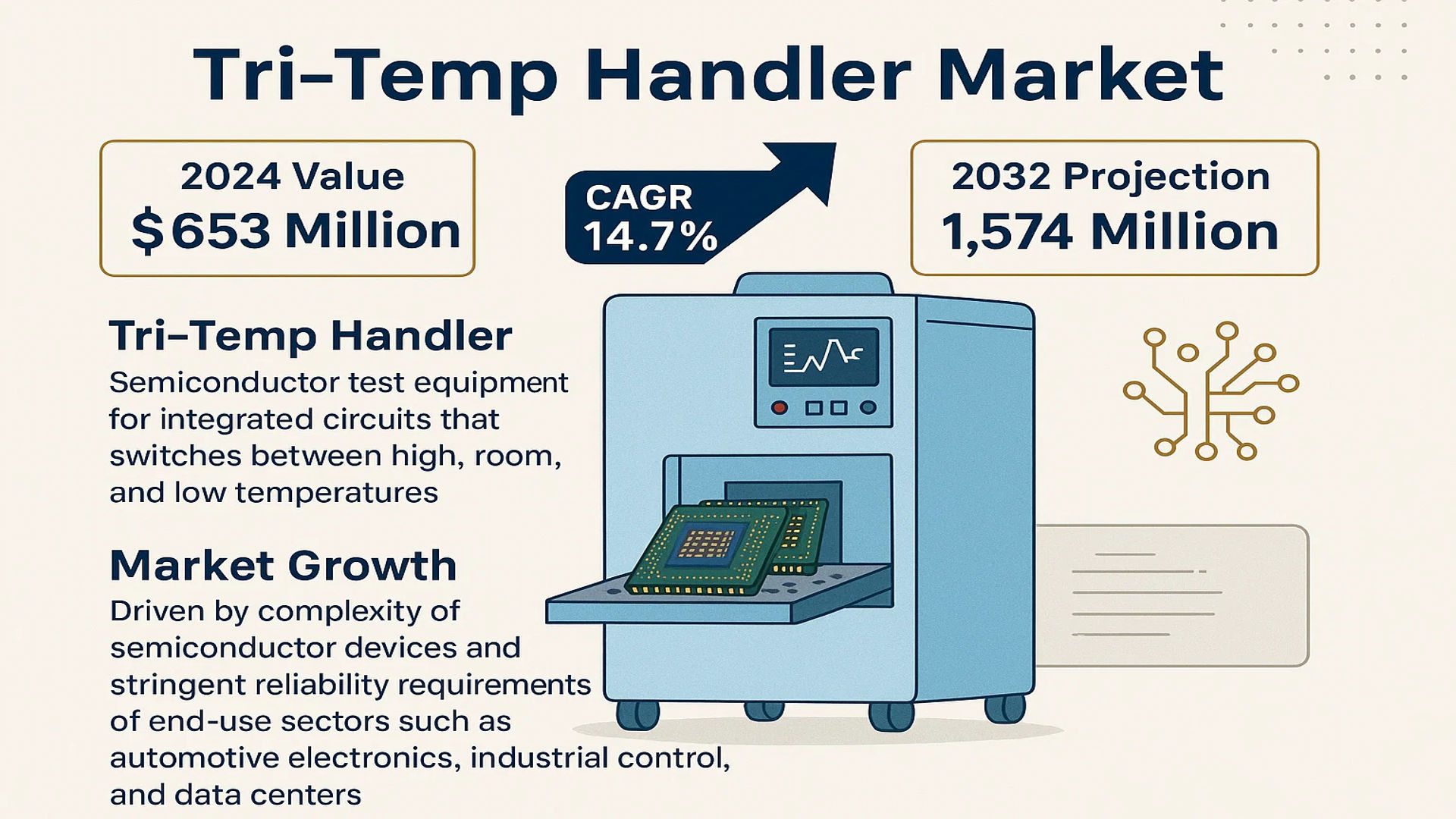
The global Tri-Temp Handler Market was valued at 653 million in 2024 and is projected to reach US$ 1574 million by 2032, at a CAGR of 14.7% during the forecast period.
A Tri-Temp Handler is a sophisticated piece of semiconductor test equipment designed specifically for integrated circuits. Its core function is to dynamically switch between three distinct temperature conditions—high temperature, room temperature, and low temperature—while simultaneously performing electrical performance testing and mechanical sorting. This process is crucial for achieving comprehensive reliability screening of semiconductor devices under various thermal stress scenarios, ensuring they perform as intended in real-world applications.
The market is experiencing robust growth driven by the increasing complexity of semiconductor devices and the stringent reliability requirements of end-use sectors such as automotive electronics, industrial control, and data centers. According to industry analysis, the broader global test handler market reached USD 2.3 billion in 2024, underscoring the critical role of this equipment category. The transition from traditional 2-4 station handlers to advanced multi-station, three-temperature systems represents a significant technological leap, enabling large-scale mass production of advanced chips. This evolution, supported by innovations in mechanical design and temperature control algorithms, is a primary catalyst for market expansion.
MARKET DYNAMICS
MARKET DRIVERS
Expansion of Automotive Electronics and High-Reliability Applications to Drive Market Growth
The global Tri-Temp Handler market is experiencing robust growth driven primarily by the expansion of automotive electronics and other high-reliability applications requiring comprehensive temperature testing. Automotive semiconductors must operate flawlessly across extreme temperature ranges from -40°C to 150°C to ensure vehicle safety and reliability. This stringent requirement has created substantial demand for three-temperature testing solutions that can validate chip performance under thermal stress conditions. The automotive semiconductor market has demonstrated consistent growth, with automotive-grade chips representing approximately 10% of the total semiconductor market, a percentage that continues to increase as vehicles incorporate more electronic systems. Furthermore, the transition to electric and autonomous vehicles has accelerated the need for advanced testing equipment capable of handling complex integrated circuits under varying thermal conditions.
Increasing Complexity of Semiconductor Devices to Boost Market Demand
The increasing complexity of semiconductor devices represents another significant driver for the Tri-Temp Handler market. Modern chips featuring advanced nodes below 7nm require more sophisticated testing methodologies to ensure reliability across temperature variations. These complex devices often incorporate heterogeneous integration, 3D packaging, and advanced materials that behave differently under thermal stress compared to traditional semiconductors. The market has responded with handlers capable of testing up to 16 stations simultaneously while maintaining precise temperature control across all test positions. This technological evolution addresses the growing need for higher throughput in semiconductor manufacturing facilities where testing represents approximately 25-30% of total production costs. As chip complexity continues to increase, the demand for advanced testing equipment that can handle multiple temperature scenarios simultaneously is expected to grow correspondingly.
Moreover, the rise of artificial intelligence and machine learning chips has created additional demand for comprehensive thermal testing. These processors generate significant heat during operation and must maintain stability across varying thermal conditions, making three-temperature testing essential for quality assurance.
➤ For instance, leading semiconductor manufacturers have implemented Tri-Temp Handlers as standard equipment for testing high-performance computing chips destined for data center applications where thermal management is critical for operational efficiency.
Furthermore, the ongoing miniaturization of semiconductor components has necessitated more rigorous testing protocols. As feature sizes decrease, devices become more susceptible to temperature-induced performance variations, making comprehensive thermal testing not just desirable but essential for product validation and reliability assurance.
MARKET CHALLENGES
High Capital Investment and Operational Costs to Challenge Market Penetration
The Tri-Temp Handler market faces significant challenges related to high capital investment and operational costs, which can limit adoption particularly among smaller semiconductor manufacturers and testing facilities. Advanced three-temperature handlers represent substantial capital expenditures, with prices ranging significantly higher than conventional single-temperature test handlers. The sophisticated temperature control systems, precision mechanical components, and advanced software integration required for these systems contribute to their elevated cost structure. Additionally, operational expenses including maintenance, calibration, and energy consumption for maintaining extreme temperature conditions add to the total cost of ownership. These financial barriers can be particularly challenging in price-sensitive markets and for companies with limited testing budgets.
Other Challenges
Technical Complexity and Integration Hurdles
The technical complexity of Tri-Temp Handlers presents substantial implementation challenges. Integrating these systems into existing semiconductor test floors requires specialized expertise and often necessitates modifications to facility infrastructure. The handlers must interface seamlessly with testers, probers, and other equipment while maintaining stable temperature conditions, creating integration challenges that can delay deployment and increase implementation costs. Additionally, the sophisticated software required to manage temperature cycling, test sequencing, and data collection demands specialized programming skills that may not be readily available in all manufacturing environments.
Maintenance and Reliability Concerns
Maintaining consistent performance across extreme temperature ranges presents ongoing operational challenges. The thermal cycling inherent in three-temperature testing accelerates wear on mechanical components and can lead to increased maintenance requirements and downtime. Reliability concerns are particularly acute in high-volume manufacturing environments where equipment availability directly impacts production throughput. The need for regular calibration and validation of temperature accuracy adds another layer of operational complexity, requiring specialized metrology equipment and technical expertise that may not be available in all testing facilities.
MARKET RESTRAINTS
Limited Technical Expertise and Specialized Workforce Shortages to Deter Market Growth
The Tri-Temp Handler market faces significant restraints due to limited technical expertise and specialized workforce shortages in the semiconductor testing equipment sector. Operating and maintaining advanced three-temperature test handlers requires highly specialized knowledge spanning thermal engineering, precision mechanics, software integration, and semiconductor testing methodologies. The global semiconductor industry has been experiencing a notable shortage of qualified technicians and engineers with experience in advanced test equipment operation and maintenance. This skills gap is particularly pronounced for Tri-Temp Handlers due to their complex nature and the relatively recent widespread adoption of three-temperature testing methodologies.
Additionally, the rapid technological evolution in semiconductor testing creates continuous learning requirements for technical staff. As handler technology advances with improvements in temperature range, throughput, and integration capabilities, existing personnel must regularly update their skills to effectively operate and maintain new equipment. This ongoing training requirement represents a significant investment for companies and can slow the adoption of new handler technologies. The shortage of qualified professionals is further exacerbated by demographic factors including retirements and intense competition for technical talent across the semiconductor industry ecosystem.
Furthermore, the specialized nature of Tri-Temp Handler operation creates dependencies on equipment manufacturers for support and maintenance services. This reliance can lead to increased downtime when technical issues arise and may limit the operational flexibility of testing facilities. The combination of technical complexity and workforce challenges represents a substantial restraint on market growth, particularly in regions where semiconductor manufacturing is expanding rapidly but local technical expertise remains underdeveloped.
MARKET OPPORTUNITIES
Emerging Applications in Aerospace and Defense Electronics to Create New Growth Opportunities
The Tri-Temp Handler market stands to benefit significantly from emerging opportunities in aerospace and defense electronics applications, where components must operate reliably across extreme environmental conditions. Aerospace systems routinely encounter temperature variations from -55°C to 125°C during operation, creating stringent testing requirements for electronic components. The defense sector similarly demands robust testing protocols to ensure equipment reliability in diverse operational environments. These sectors have traditionally employed environmental chambers for temperature testing, but the limitations of these methods in terms of throughput and integration with electrical testing have created opportunities for advanced handler solutions.
The increasing electrification of aircraft systems and the growing complexity of defense electronics have accelerated the adoption of semiconductor components in these applications. This trend has correspondingly increased the demand for comprehensive testing solutions capable of validating component performance across the full operational temperature range. Tri-Temp Handlers offer significant advantages over traditional testing methods by enabling simultaneous electrical testing at multiple temperature points, reducing testing time and improving throughput. The ability to test components under thermal stress while performing electrical measurements provides valuable data on performance degradation and failure mechanisms that simpler testing methods cannot capture.
Additionally, the growing emphasis on supply chain security and component reliability in critical infrastructure applications has driven increased investment in comprehensive testing methodologies. Governments and industry consortia are establishing more rigorous testing standards for components used in critical systems, creating regulatory-driven demand for advanced testing equipment. This trend is particularly evident in regions with strong aerospace and defense industries, where localization of testing capabilities has become a strategic priority. The convergence of technological advancement, regulatory requirements, and strategic priorities creates substantial growth opportunities for Tri-Temp Handler manufacturers capable of meeting the specialized needs of these high-reliability applications.
TRI-TEMP HANDLER MARKET TRENDS
Rising Demand for High-Reliability Chip Testing in Automotive and AI Sectors
The global Tri-Temp Handler market is experiencing robust growth, primarily driven by the escalating need for high-reliability semiconductor testing in mission-critical industries. Automotive electronics, which require components to function flawlessly across extreme temperature ranges from -40°C to over 150°C, represent a massive growth vector. This is compounded by the rapid expansion of artificial intelligence and data center infrastructure, where processors must be tested for thermal stability under heavy computational loads. The market, valued at approximately 653 million in 2024, is projected to surge as these end-use sectors demand more rigorous and efficient testing protocols. While traditional handlers sufficed for consumer electronics, the complexity of modern chips used in autonomous vehicles and high-performance computing necessitates advanced equipment capable of dynamic multi-temperature cycling to identify latent failures and ensure long-term operational integrity.
Other Trends
Technological Advancements in Handler Architecture
Manufacturers are aggressively innovating to overcome the throughput limitations of earlier models. A key trend is the shift from 2-4 station handlers to systems boasting 8, 16, or even 32 stations, enabling parallel testing of multiple devices across different temperature zones simultaneously. This architectural evolution is achieved through sophisticated mechanical designs that minimize device transfer time and advanced temperature control algorithms that ensure rapid thermal stabilization, reducing test cycle times by over 30% in some advanced systems. Furthermore, the integration of IoT sensors and data analytics platforms allows for real-time monitoring and predictive maintenance, maximizing equipment uptime and yield for high-volume semiconductor production facilities, which is critical for meeting the massive output demands of the global market.
Accelerating Localization and Supply Chain Diversification
Geopolitical tensions and a heightened focus on supply chain resilience are accelerating the localization of semiconductor manufacturing equipment, including Tri-Temp Handlers. This is most evident in Asia, particularly in China, where government initiatives and substantial investment are fueling the growth of domestic manufacturers. Companies like Hangzhou Changchuan and JHT Design Co. have made significant strides, developing competitive products that are capturing market share. This push for self-reliance is expected to increase the localization rate of China’s semiconductor equipment to over 65% by 2030. This trend is not isolated; other regions are also incentivizing local production, which is fostering greater competition, potentially driving innovation, and altering the global competitive landscape previously dominated by a few key international players.
COMPETITIVE LANDSCAPE
Key Industry Players
Companies Focus on Technological Innovation and Strategic Expansion to Capture Market Share
The global Tri-Temp Handler market exhibits a semi-consolidated competitive structure, characterized by the presence of established multinational corporations, rapidly growing regional champions, and specialized niche players. This dynamic is driven by the critical need for advanced semiconductor testing equipment capable of handling the rigorous demands of modern integrated circuits across automotive, industrial, and data center applications. Market leadership is largely determined by technological prowess, product reliability, and the ability to offer scalable solutions for high-volume manufacturing environments.
Advantest Corporation and Cohu, Inc. are recognized as dominant forces in the global landscape. Their leadership is anchored in extensive R&D investments, which have yielded handlers capable of testing at extreme temperatures ranging from -55°C to +150°C, and robust global service and support networks that cater to major Integrated Device Manufacturers (IDMs) and Outsourced Semiconductor Assembly and Test (OSAT) providers. These companies collectively held a significant portion of the market revenue in 2024.
Meanwhile, Hangzhou Changchuan Technology and Techwing are pivotal players spearheading market growth in the Asia-Pacific region, particularly in China. Their expansion is fueled by aggressive pricing strategies, government support for semiconductor equipment localization, and a deep understanding of regional manufacturing requirements. These companies are crucial to the projected increase in China’s semiconductor equipment localization rate, which is expected to exceed 65% by 2030.
Furthermore, other key participants like Boston Semi Equipment and Chroma ATE Inc. are strengthening their positions through strategic collaborations and continuous product enhancements. Their focus on developing handlers with higher throughput, improved thermal management systems, and enhanced software integration is critical to addressing the evolving needs for efficiency and precision in semiconductor testing pipelines.
List of Key Tri-Temp Handler Companies Profiled
- Advantest Corporation (Japan)
- Cohu, Inc. (U.S.)
- HON PRECISION, INC. (Taiwan)
- Hangzhou Changchuan Technology (China)
- JHT Design Co.,Ltd (China)
- Boston Semi Equipment (U.S.)
- SESSCO Technologies (Malaysia)
- Chroma ATE Inc (Taiwan)
- SYNAX (South Korea)
- Microtec Handling Systems GmbH (Germany)
- Tesec Inc (Japan)
- Techwing (South Korea)
- Kanematsu (Japan)
- UENO SEIKI NAGANO (Japan)
- Shanghai Cascol (China)
Segment Analysis:
By Type
Pick and Place Handler Segment Commands Significant Market Share Due to High Precision and Throughput in Advanced Semiconductor Testing
The market is segmented based on type into:
- Pick and Place Handler
- Gravity Handler
By Application
IDM Segment Holds a Prominent Position Owing to In-House Manufacturing and Testing Requirements for High-Reliability Chips
The market is segmented based on application into:
- IDM (Integrated Device Manufacturer)
- OSAT (Outsourced Semiconductor Assembly and Test)
By Temperature Range
Full Three-Temperature Range (-55°C to +150°C) Segment is Critical for Automotive and Industrial Grade IC Validation
The market is segmented based on temperature range into:
- Full Three-Temperature Range (-55°C to +150°C)
- High-Temperature Range (Ambient to +150°C)
- Low-Temperature Range (-55°C to Ambient)
By Number of Test Sites
High-Density Multi-Site Handlers (16+ Sites) are Gaining Traction to Meet Mass Production Demands for Consumer Electronics and Data Center ICs
The market is segmented based on the number of test sites into:
- Single-Site Handlers
- Multi-Site Handlers (2-8 Sites)
- High-Density Multi-Site Handlers (16+ Sites)
Regional Analysis: Tri-Temp Handler Market
Asia-Pacific
The Asia-Pacific region is the undisputed global leader in the Tri-Temp Handler market, driven by its immense semiconductor manufacturing and packaging, assembly, and test (OSAT) capacity. China, Taiwan, South Korea, and Japan collectively represent the largest concentration of semiconductor fabrication plants globally. This dense ecosystem creates unparalleled demand for advanced test handlers to ensure chip reliability, particularly for automotive electronics and industrial applications. China’s aggressive push for semiconductor self-sufficiency, exemplified by its “Made in China 2025” initiative, has catalyzed the domestic production of equipment like tri-temperature handlers. Local champions such as Hangzhou Changchuan Technology and JHT Design Co., Ltd. have made significant strides, with the national semiconductor equipment localization rate projected to exceed 65% by 2030. While cost-competitiveness is a key advantage for local suppliers, multinational giants like Advantest and Cohu maintain a strong presence, serving both multinational IDMs and leading OSATs. The region’s growth is further fueled by massive government investments and the relentless expansion of data center infrastructure, which requires high-reliability chips tested across extreme temperature ranges.
North America
North America’s market is characterized by high-value, innovation-driven demand, primarily from Integrated Device Manufacturers (IDMs) and fabless companies designing cutting-edge chips for aerospace, defense, and high-performance computing. The region’s focus is on high-throughput, highly accurate test handlers capable of validating next-generation semiconductors, including those based on advanced nodes and heterogeneous integration. Stringent quality and reliability standards, especially for automotive and medical applications, mandate comprehensive three-temperature testing. While the volume of units sold may be lower than in Asia-Pacific, the average selling price and technological sophistication of the handlers deployed are among the highest globally. Key players like Cohu and Boston Semi Equipment are headquartered here and work closely with leading chip designers. Recent U.S. policies aimed at reshoring semiconductor manufacturing, backed by funding from the CHIPS and Science Act, are expected to stimulate long-term investment in domestic test and packaging facilities, thereby bolstering demand for advanced test handling equipment.
Europe
Europe’s Tri-Temp Handler market is niche but critically important, serving a specialized industrial base focused on automotive, industrial automation, and aerospace. The region is a global hub for automotive semiconductor innovation, necessitating rigorous reliability testing under the extreme temperature conditions vehicles experience. This drives consistent demand for high-performance tri-temperature handlers from both automotive IDMs and the OSATs that serve them. European manufacturers, such as Microtec Handling Systems GmbH, cater to this high-reliability segment. The market is also supported by significant research and development activities in compound semiconductors and microelectromechanical systems (MEMS), which require specialized testing capabilities. While the number of large-scale volume manufacturing fabs is fewer than in other regions, the emphasis on quality over quantity ensures a stable market for advanced test equipment that meets strict EU performance and safety standards.
South America
The South American market for Tri-Temp Handlers is in an early stage of development. Demand is primarily limited to servicing existing electronics manufacturing and a small number of industrial equipment producers. The region lacks a significant semiconductor fabrication presence, meaning most demand stems from a handful of OSAT facilities and labs focused on basic consumer electronics. Economic volatility and limited government investment in high-tech industrial policy have historically constrained the growth of a local semiconductor ecosystem. Consequently, adoption of advanced, high-cost capital equipment like tri-temperature handlers is slow. Market activity is concentrated in countries with relatively larger industrial bases, such as Brazil. Growth in this region is expected to be gradual, closely tied to broader economic stability and potential future government initiatives aimed at technological development.
Middle East & Africa
The Tri-Temp Handler market in the Middle East & Africa is the smallest globally and remains largely emergent. Current demand is almost exclusively for research, development, and maintenance purposes within academic institutions and a limited number of industrial electronics repair facilities. There is negligible local semiconductor production, so the need for high-volume production test equipment is absent. However, select nations in the Middle East, particularly in the Gulf Cooperation Council (GCC), have long-term economic diversification plans that include investments in technology and manufacturing. These visions could, over the long term, create a foundational demand for semiconductor test equipment. For the foreseeable future, however, the market will be characterized by very low volume sales and will be served by the global distribution networks of major international suppliers.
Report Scope
This market research report provides a comprehensive analysis of the global and regional Semiconductor Test Handler markets, covering the forecast period 2025–2032. It offers detailed insights into market dynamics, technological advancements, competitive landscape, and key trends shaping the industry.
Key focus areas of the report include:
- Market Size & Forecast: Historical data and future projections for revenue, unit shipments, and market value across major regions and segments.
- Segmentation Analysis: Detailed breakdown by product type, technology, application, and end-user industry to identify high-growth segments and investment opportunities.
- Regional Outlook: Insights into market performance across North America, Europe, Asia-Pacific, Latin America, and the Middle East & Africa, including country-level analysis where relevant.
- Competitive Landscape: Profiles of leading market participants, including their product offerings, R&D focus, manufacturing capacity, pricing strategies, and recent developments such as mergers, acquisitions, and partnerships.
- Technology Trends & Innovation: Assessment of emerging technologies, integration of AI/IoT, semiconductor design trends, fabrication techniques, and evolving industry standards.
- Market Drivers & Restraints: Evaluation of factors driving market growth along with challenges, supply chain constraints, regulatory issues, and market-entry barriers.
- Stakeholder Analysis: Insights for component suppliers, OEMs, system integrators, investors, and policymakers regarding the evolving ecosystem and strategic opportunities.
Primary and secondary research methods are employed, including interviews with industry experts, data from verified sources, and real-time market intelligence to ensure the accuracy and reliability of the insights presented.
FREQUENTLY ASKED QUESTIONS:
What is the current market size of Global Tri-Temp Handler Market?
-> Tri-Temp Handler Market was valued at 653 million in 2024 and is projected to reach US$ 1574 million by 2032, at a CAGR of 14.7% during the forecast period.
Which key companies operate in Global Tri-Temp Handler Market?
-> Key players include Advantest, Cohu, HON PRECISION, INC, Hangzhou Changchuan Technology, and JHT Design Co.,Ltd, among others.
What are the key growth drivers?
-> Key growth drivers include rising demand for high-reliability semiconductor testing in automotive electronics, industrial control, and data centers, alongside increasing chip complexity and the shift towards multi-station, multi-temperature testing solutions.
Which region dominates the market?
-> Asia-Pacific is the dominant and fastest-growing region, largely driven by semiconductor manufacturing hubs in China, Taiwan, South Korea, and Japan.
What are the emerging trends?
-> Emerging trends include advancements in temperature control algorithms, integration of AI for predictive maintenance and optimization, and the strategic push for equipment localization in key markets like China.

Get Sample Report PDF for Exclusive Insights
Report Sample Includes
- Table of Contents
- List of Tables & Figures
- Charts, Research Methodology, and more...
 Download Sample Report PDF