Transparent 5G Antenna Market Insights
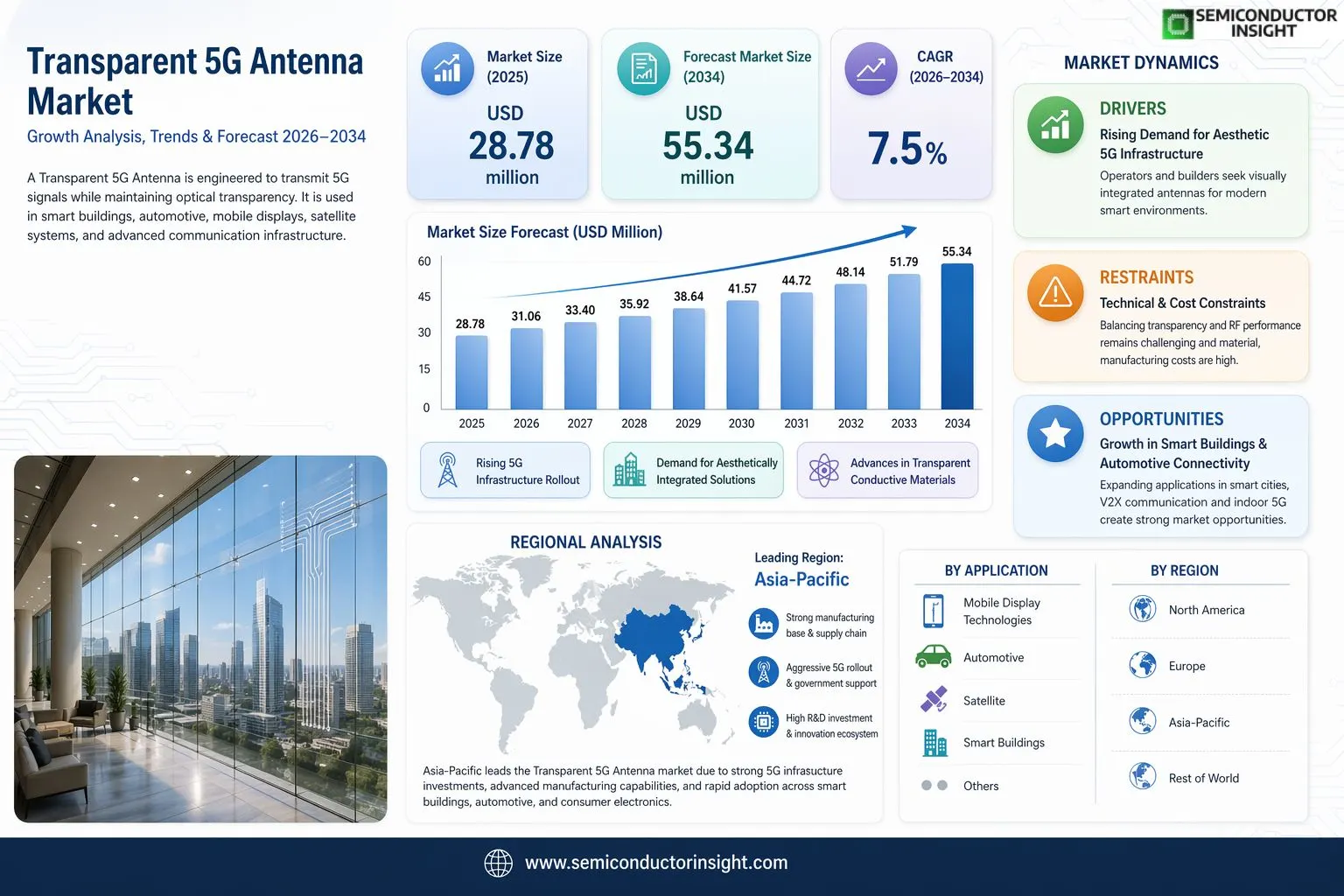
Global Transparent 5G Antenna market size was valued at USD 28.78 million in 2025. The market is projected to grow from USD 31.06 million in 2026 to USD 55.34 million by 2034, exhibiting a CAGR of 7.5% during the forecast period.
A Transparent 5G Antenna is a type of antenna specifically engineered for 5G communication systems that exhibits optical transparency to visible light while simultaneously maintaining full functionality as an antenna for electromagnetic radiation within the 5G frequency range. These antennas leverage advanced materials such as indium tin oxide (ITO), silver nanowires, and transparent conductive films to achieve both high optical transmittance and reliable radio frequency performance, making them particularly suited for integration into glass surfaces, displays, and architectural elements.
The market is gaining strong momentum driven by the accelerating global rollout of 5G infrastructure, rising demand for aesthetically integrated connectivity solutions in smart buildings and automotive applications, and continuous advancements in transparent conductive material technologies. The growing adoption of transparent antennas in mobile display technologies and satellite communication platforms is further broadening the application landscape. Key manufacturers actively shaping the competitive environment include Meta Materials Inc., CHASM Advanced Materials, ALCAN Systems, AGC, DONGWOO FINE-CHEM, Dengyo, VENTI Group, Taoglas, Nippon Electric Glass, and Kreemo (in collaboration with Sivers Semiconductors), among others.
MARKET DRIVERS
Rising Demand for Aesthetically Integrated 5G Infrastructure
Transparent 5G Antenna Market is experiencing notable momentum as telecommunications operators and urban planners seek solutions that combine high-frequency signal transmission with architectural compatibility. Traditional antenna installations often face resistance from municipalities and property owners due to visual intrusion, and transparent antenna technologies directly address this challenge. By enabling antennas to be embedded within glass facades, windows, and building surfaces, these solutions allow for seamless integration into smart buildings and urban environments without compromising structural aesthetics. The growing deployment of millimeter-wave (mmWave) 5G networks, which require dense antenna placement at shorter intervals, has further amplified demand for low-visibility antenna formats.
Acceleration of Smart Building and Smart City Initiatives
Global investment in smart city infrastructure is a significant catalyst for Transparent 5G Antenna Market. As municipalities across North America, Europe, and the Asia-Pacific region prioritize connected urban ecosystems, the need for embedded, non-intrusive wireless connectivity infrastructure has intensified. Transparent antennas can be integrated into street-level retail glazing, transit shelters, commercial towers, and residential high-rises, enabling ubiquitous 5G coverage without the visual or regulatory friction associated with conventional antenna masts. This alignment with smart building standards such as LEED and BREEAM further encourages adoption among property developers and facility managers committed to sustainable, technology-forward construction.
➤ The convergence of 5G densification requirements and architectural design standards is positioning transparent antenna technology as a foundational element of next-generation urban connectivity infrastructure, creating sustained demand across commercial real estate, transportation, and public sector verticals.
Material science advancements are also propelling market growth, with innovations in transparent conductive materials such as indium tin oxide (ITO), silver nanowire meshes, and graphene-based substrates enabling antennas that maintain optical clarity while achieving the signal performance required for sub-6 GHz and mmWave 5G bands. Leading research institutions and antenna manufacturers are investing in improving the trade-off between transparency and radiation efficiency, with recent prototypes demonstrating optical transmittance above 80% alongside competitive gain and bandwidth characteristics. These technical milestones are strengthening the commercial viability of transparent 5G antennas across a broadening range of deployment scenarios.
MARKET CHALLENGES
Technical Limitations in Balancing Optical Transparency and RF Performance
One of the most persistent challenges facing Transparent 5G Antenna Market is the fundamental engineering tension between optical transparency and radio frequency performance. Conventional antenna designs rely on highly conductive metals such as copper or aluminum, which are inherently opaque. Substituting these with transparent conductive materials introduces trade-offs in electrical conductivity, which can reduce antenna gain, efficiency, and bandwidth. Achieving the performance benchmarks demanded by 5G standards , particularly for mmWave frequencies requiring precise beam characteristics , while maintaining commercially acceptable levels of visual transparency remains a critical technical barrier that constrains product readiness and scalability for mass deployment.
Other Challenges
High Manufacturing and Material Costs
The production of transparent antennas involves advanced materials and precision fabrication processes that are currently more costly than those used in conventional antenna manufacturing. Transparent conductive oxides, nanowire-based films, and graphene substrates require specialized deposition techniques and quality controls that contribute to elevated unit costs. Until economies of scale are achieved through broader commercialization, these cost structures limit adoption primarily to premium applications such as high-end commercial real estate and flagship smart city projects, restricting market penetration in cost-sensitive segments.
Regulatory and Standardization Gaps
Transparent 5G Antenna Market also faces challenges related to the absence of unified testing standards and certification frameworks specifically tailored to transparent antenna products. Regulatory bodies in different regions apply varying electromagnetic compatibility (EMC) and building integration requirements, creating compliance complexity for manufacturers targeting global markets. The lack of standardized performance benchmarks for transparent antenna systems makes it difficult for network operators to evaluate and qualify these products within their procurement frameworks, slowing the pace of commercial adoption and network integration.
MARKET RESTRAINTS
Limited Commercial-Scale Manufacturing Capabilities
Despite growing interest from the telecommunications and construction sectors, Transparent 5G Antenna Market is currently restrained by the limited availability of commercial-scale manufacturing infrastructure. The fabrication of transparent antennas requires highly controlled production environments and access to specialized materials that are not yet widely available through mainstream supply chains. Most manufacturers operating in this space remain at pilot or small-batch production stages, which restricts their ability to fulfill large-scale orders from telecom operators or construction developers. This supply-side constraint is expected to moderate the pace of market expansion in the near term, particularly as demand from mmWave 5G deployments begins to accelerate in dense urban markets.
Durability and Long-Term Performance Concerns in Outdoor Environments
The long-term durability of transparent antenna materials under real-world environmental conditions represents another restraint on market growth. Transparent conductive films and substrates used in these antennas can be susceptible to degradation from ultraviolet exposure, thermal cycling, moisture ingress, and mechanical stress , conditions routinely encountered in outdoor building facade and transportation infrastructure applications. Telecom operators and infrastructure owners require antenna solutions with operational lifespans aligned with building maintenance cycles, typically spanning 15 to 25 years, and current transparent antenna products have limited field-validated long-term performance data. This uncertainty around durability and maintenance requirements creates hesitation among risk-averse procurement decision-makers, acting as a brake on broader market uptake.
MARKET OPPORTUNITIES
Integration with Next-Generation Automotive and Transportation Infrastructure
The automotive and transportation sector presents a compelling opportunity for Transparent 5G Antenna Market. The rapid advancement of connected and autonomous vehicle technologies is generating demand for high-bandwidth, low-latency vehicle-to-everything (V2X) communication systems. Transparent antennas integrated into vehicle windshields, side windows, and sunroofs can provide 5G connectivity without disrupting vehicle aerodynamics or aesthetics , a critical consideration for premium automotive manufacturers. Similarly, transparent antennas embedded in train windows, bus shelters, and airport glazing can support the dense connectivity requirements of intelligent transportation systems, opening a substantial addressable market as mobility infrastructure modernization programs expand across developed and emerging economies.
Expansion of Indoor 5G Small Cell Deployments in Commercial Real Estate
The growing emphasis on indoor 5G coverage quality within commercial real estate is creating significant opportunity for transparent antenna solutions. As enterprises, healthcare facilities, stadiums, and retail environments demand seamless indoor 5G connectivity to support IoT ecosystems, augmented reality applications, and high-density user environments, building owners face the challenge of deploying antenna infrastructure without compromising interior design standards. Transparent antennas that can be mounted on or laminated into interior glazing, partition walls, and skylights offer a practical pathway to achieving reliable indoor 5G signal distribution while meeting the aesthetic and space utilization priorities of premium commercial environments. This segment is expected to represent one of the fastest-growing application areas for Transparent 5G Antenna Market over the coming years.
Trend
Rising Demand for Visually Unobtrusive Connectivity Drives Transparent 5G Antenna Market
Transparent 5G Antenna Market is experiencing notable growth as industries increasingly seek antenna solutions that combine high-frequency 5G performance with optical transparency. Transparent 5G antennas are engineered to allow visible light to pass through while maintaining full electromagnetic functionality within 5G frequency bands. This dual capability is making them a preferred choice across sectors where aesthetics and connectivity must coexist, including smart buildings, automotive applications, and advanced mobile display technologies. As 5G network infrastructure continues to expand globally, demand for antennas that integrate seamlessly into glass surfaces, vehicle windshields, and building facades is gaining strong commercial momentum.
Other Trends
Smart Building Integration Accelerating Adoption
One of the most prominent trends shaping Transparent 5G Antenna Market is the rapid integration of these antennas into smart building infrastructure. Modern commercial and residential developments increasingly require unobtrusive wireless connectivity solutions that do not compromise architectural design. Transparent antennas embedded in window glass or building panels allow structures to maintain 5G connectivity without the visual disruption of conventional antenna hardware. This trend is particularly evident in urban development projects across North America, Europe, and Asia, where smart building standards are becoming more stringent and design-forward connectivity solutions are in high demand.
Automotive Sector Emerging as a High-Growth Application Segment
The automotive industry is emerging as a significant growth driver for Transparent 5G Antenna Market. As connected and autonomous vehicles require continuous, high-bandwidth communication, integrating transparent antennas into windshields and windows offers a practical solution that preserves vehicle aerodynamics and aesthetics. Automakers and Tier-1 suppliers are collaborating with antenna manufacturers to develop 5G-capable transparent solutions suitable for mass production. This application segment is expected to see sustained investment as vehicle connectivity requirements continue to evolve alongside broader 5G deployment.
Material Innovation Supporting Performance Improvements
Advancements in conductive transparent materials, including specialized films and nano-structured coatings, are enabling manufacturers to push the boundaries of antenna transparency. Products offering 90% and 98% transparency levels represent two key segments within the market, with higher transparency variants gaining traction in applications where optical clarity is critical. Leading companies such as Meta Materials Inc, CHASM Advanced Materials, AGC, and Nippon Electric Glass are actively investing in material science innovation to improve signal performance while achieving greater light transmission, helping to address longstanding trade-offs in transparent antenna design.
Competitive Landscape Intensifying as Global Players Expand Capabilities
The competitive environment within Transparent 5G Antenna Market is intensifying, with both established material science firms and specialized antenna developers expanding their product portfolios. Key participants including ALCAN Systems, Taoglas, VENTI Group, DONGWOO FINE-CHEM, Dengyo, and Kreemo (alongside Sivers Semiconductors) are pursuing strategic developments to strengthen their market positions. Regional demand patterns, particularly across Asia, North America, and Europe, are influencing where manufacturers focus their production and commercialization efforts. As 5G infrastructure rollout matures across key markets, Transparent 5G Antenna Market is poised to benefit from sustained cross-industry demand spanning mobile display technologies, satellite applications, automotive, and smart infrastructure.
COMPETITIVE LANDSCAPE
Key Industry Players
Transparent 5G Antenna Market , Competitive Dynamics and Leading Manufacturer Profiles
Global Transparent 5G Antenna market, valued at USD 28.78 million in 2025 and projected to reach USD 48.41 million by 2032 at a CAGR of 7.9%, is characterized by a moderately consolidated competitive landscape with a handful of specialized technology firms commanding a significant share of revenues. Meta Materials Inc. stands out as a prominent leader in this space, leveraging its proprietary metamaterial and nanofabrication technologies to deliver high-performance transparent antennas that seamlessly integrate into display panels, automotive glass, and smart building surfaces. Alongside Meta Materials, CHASM Advanced Materials has carved out a strong market position through its advanced carbon nanotube-based transparent conductive films, enabling scalable production of optically clear antenna elements compatible with 5G frequency bands. AGC, the Japanese multinational glass and chemicals corporation, further reinforces the competitive intensity of the market with its deep expertise in specialty glass substrates and transparent conductive coatings, serving automotive and architectural application segments with precision-engineered transparent antenna solutions.
Beyond the top-tier players, several niche yet strategically significant competitors are shaping the Transparent 5G Antenna competitive ecosystem. ALCAN Systems distinguishes itself with its liquid-crystal-based reconfigurable antenna platforms, offering electronically steerable beamforming capabilities suited for satellite and smart infrastructure deployments. DONGWOO FINE-CHEM and Nippon Electric Glass contribute critical material innovation through transparent electrode films and specialty glass products, respectively, underpinning antenna manufacturing supply chains across Asia. Taoglas, a globally recognized antenna design and engineering firm, brings its extensive RF engineering portfolio to the transparent antenna segment, targeting mobile display and IoT connectivity applications. Dengyo and VENTI Group add further competitive depth through localized manufacturing capabilities and region-specific deployment expertise, particularly across Asia-Pacific markets. Kreemo, operating in collaboration with Sivers Semiconductors, integrates mmWave semiconductor front-end technology with transparent antenna architectures, positioning the combined entity at the forefront of high-frequency 5G transparent antenna innovation for next-generation mobile and connected device platforms.
List of Key Transparent 5G Antenna Companies Profiled
- Meta Materials Inc.
- CHASM Advanced Materials
- ALCAN Systems
- AGC Inc.
- DONGWOO FINE-CHEM
- Dengyo
- VENTI Group
- Taoglas
- Nippon Electric Glass
- Kreemo (and Sivers Semiconductors)
Segment Analysis:
| Segment Category | Sub-Segments | Key Insights |
| By Type |
|
90% Transparent antennas represent the leading segment in Transparent 5G Antenna Market, driven by their well-established manufacturing processes and broad compatibility with existing 5G infrastructure deployments.
|
| By Application |
|
Smart Buildings emerge as the leading application segment, underpinned by Global acceleration of intelligent infrastructure development and the increasing mandate to integrate seamless 5G connectivity within modern architectural designs.
|
| By End User |
|
Commercial Real Estate & Construction firms represent the dominant end-user segment, as property developers and facility managers increasingly specify transparent antenna solutions during the design phase of new commercial towers, airports, and hospitality venues to meet tenant connectivity expectations.
|
| By Material Technology |
|
Metal Mesh & Nanowire-Based technology is the leading material platform in transparent 5G antenna fabrication, valued for its superior combination of electrical conductivity, optical transmittance, and mechanical flexibility across a wide range of substrate types.
|
| By Frequency Band |
|
Sub-6 GHz Band transparent antennas currently lead the market, benefiting from the broad global adoption of mid-band 5G spectrum as the foundational layer for nationwide network coverage by leading telecommunications operators across North America, Europe, and Asia.
|
Regional Analysis: Transparent 5G Antenna Market
Asia-Pacific
Asia-Pacific hosts the world’s most integrated electronics manufacturing ecosystem, providing transparent 5G antenna producers with unparalleled access to raw materials, precision fabrication facilities, and cost-competitive production capabilities. This concentration of upstream and downstream supply chain assets enables faster product development cycles and more efficient scaling of transparent antenna solutions across commercial and industrial segments.
State-led initiatives across China, South Korea, and India are channeling substantial resources into 5G infrastructure expansion, creating a strong policy tailwind for transparent 5G antenna adoption. Spectrum allocation reforms, smart city mandates, and national broadband strategies are collectively accelerating demand for innovative, aesthetically integrated antenna technologies across urban and semi-urban environments throughout the region.
Asia-Pacific universities, national research institutes, and private technology corporations are investing heavily in the development of advanced transparent conductive materials and antenna miniaturization techniques. Collaborative innovation models between academia and industry are producing breakthroughs in flexible, high-transmittance antenna substrates, positioning the region as a global hub for transparent 5G antenna technology development and intellectual property generation.
North America
North America represents one of the most strategically significant markets for the transparent 5G antenna industry, underpinned by the rapid commercialization of 5G networks across the United States and Canada. The region’s technology-forward enterprise culture, combined with a strong appetite for smart building solutions and connected vehicle platforms, is generating sustained demand for optically transparent antenna systems. Leading telecommunications carriers are actively collaborating with antenna technology developers to explore aesthetically unobtrusive deployment methods suited to urban architectural environments. The United States, in particular, benefits from a mature venture capital ecosystem that continues to fund early-stage companies pioneering novel transparent antenna materials and manufacturing processes. Federal communications policy supporting mid-band and millimeter-wave 5G spectrum deployment further creates structural opportunities for transparent antenna integration across commercial real estate, transportation infrastructure, and public safety networks across the broader transparent 5G antenna market.
Europe
Europe occupies a significant and steadily growing position within Global transparent 5G antenna market, shaped by the region’s strong regulatory frameworks, commitment to sustainable technology development, and increasing focus on smart urban infrastructure. The European Union’s coordinated 5G action plans and digital single market strategies are driving harmonized spectrum policies that encourage network densification, thereby expanding opportunities for transparent antenna deployment in heritage buildings, transportation hubs, and retail environments where visual aesthetics are a critical consideration. Germany, the United Kingdom, and the Nordic countries are particularly active in piloting transparent antenna solutions as part of broader smart city and Industry 4.0 initiatives. European manufacturers are also leveraging the region’s expertise in advanced materials science and precision optics to develop competitive transparent antenna products, reinforcing Europe’s role as both a key consumer and a meaningful contributor to global transparent 5G antenna market innovation.
South America
South America is an emerging participant in Global transparent 5G antenna market, with growth prospects closely tied to the pace of 5G network rollout and the maturation of the region’s digital economy. Brazil leads regional adoption efforts, with telecommunications operators progressing through spectrum auctions and early-stage commercial 5G deployments in major metropolitan areas. While infrastructure investment levels remain comparatively modest, rising demand for enhanced mobile broadband services and the gradual proliferation of smart city pilots in cities such as São Paulo and Bogotá are beginning to create openings for transparent antenna technologies. The region’s evolving regulatory environment and increasing foreign direct investment in telecommunications infrastructure are expected to support more structured market development in the transparent 5G antenna segment over the medium term, as affordability and local manufacturing capabilities continue to improve.
Middle East & Africa
The Middle East and Africa region presents a nuanced and progressively developing landscape for Transparent 5G Antenna Market. Gulf Cooperation Council nations, particularly the United Arab Emirates, Saudi Arabia, and Qatar, are spearheading regional 5G advancement through ambitious smart city programs such as NEOM and various Vision 2030-aligned digital transformation initiatives. These projects generate specific demand for transparent and architecturally integrated antenna solutions capable of supporting dense urban connectivity without disrupting premium urban aesthetics. Across sub-Saharan Africa, 5G adoption remains in earlier stages, with infrastructure investment primarily concentrated in key commercial hubs. However, the increasing involvement of global technology partners and multilateral development organizations in expanding digital connectivity across the continent is laying a foundational layer that could progressively support broader transparent 5G antenna market engagement across the Middle East and Africa region over the coming decade.
Report Scope
This market research report provides a comprehensive analysis of Transparent 5G Antenna Market, covering the forecast period 2026–2034. It offers detailed insights into market dynamics, technological advancements, competitive landscape, and key trends shaping the industry.
Key focus areas of the report include:
- Market Overview: The report begins with an overview outlining its current market scenario, key growth indicators, and industry transformation drivers. It discusses macroeconomic factors, demand–supply balance, regulatory landscape, and the strategic role of transparent antenna technologies in powering advancements across industries such as automotive, telecommunications, smart buildings, and mobile display technologies.
- Market Size & Forecast: Historical data and future projections for revenue, unit shipments, and market value across major regions and segments.
- Segmentation Analysis: Detailed breakdown by product type (90% Transparent, 98% Transparent, Others), application, and end-user industry to identify high-growth segments and investment opportunities.
- Regional Insights: Insights into market performance across North America, Europe, Asia-Pacific, Latin America, and the Middle East & Africa, including country-level analysis where relevant.
- Competitive Landscape: Profiles of leading market participants, including their product offerings, R&D focus, manufacturing capacity, pricing strategies, and recent developments such as mergers, acquisitions, and partnerships.
- Technology Trends & Innovation: Assessment of emerging technologies, integration of AI/IoT, transparent conductive material design trends, fabrication techniques, and evolving 5G industry standards.
- Market Drivers & Restraints: Evaluation of factors driving market growth along with challenges, supply chain constraints, regulatory issues, and market-entry barriers.
- Stakeholder Insights: Insights for component suppliers, OEMs, system integrators, investors, and policymakers regarding the evolving ecosystem and strategic opportunities.
Primary and secondary research methods are employed, including interviews with industry experts, data from verified sources, and real-time market intelligence to ensure the accuracy and reliability of the insights presented.
FREQUENTLY ASKED QUESTIONS:
What is the current market size of Transparent 5G Antenna Market?
-> Transparent 5G Antenna Market was valued at USD 28.78 million in 2025 and is projected to reach USD 48.41 million by 2032, growing at a CAGR of 7.9% during the forecast period.
Which key companies operate in Transparent 5G Antenna Market?
-> Key players include Meta Materials Inc, CHASM Advanced Materials, ALCAN Systems, AGC, DONGWOO FINE-CHEM, Dengyo, VENTI Group, Taoglas, Nippon Electric Glass, and Kreemo (and Sivers Semiconductors), among others.
What are the key growth drivers?
-> Key growth drivers include rapid 5G network deployment, rising demand for aesthetically integrated antenna solutions in smart buildings and automotive applications, growth in mobile display technologies, and increasing adoption of transparent conductive materials in next-generation communication infrastructure.
Which region dominates the market?
-> Asia is a significant and fast-growing region in Transparent 5G Antenna Market, with China, Japan, and South Korea leading adoption, while North America, including the U.S., also represents a major share of global market revenue.
What are the emerging trends?
-> Emerging trends include the development of highly transparent antenna materials (90% and 98% transparency grades), integration into smart building facades, expansion into satellite communication systems, and growing use in automotive and mobile display technologies as 5G infrastructure continues to scale globally.
What are the key market segments covered in this report?
-> The report covers segmentation by product type (90% Transparent, 98% Transparent, Others) and by application (Mobile Display Technologies, Automotive, Satellite, Smart Buildings, Others), along with regional and country-level analysis across North America, Europe, Asia, South America, and the Middle East & Africa.
Global Transparent 5G Antenna market size was valued at USD 28.78 million in 2025. The market is projected to grow from USD 31.06 million in 2026 to USD 55.34 million by 2034, exhibiting a CAGR of 7.5% during the forecast period.
A Transparent 5G Antenna is a type of antenna specifically engineered for 5G communication systems that exhibits optical transparency to visible light while simultaneously maintaining full functionality as an antenna for electromagnetic radiation within the 5G frequency range. These antennas leverage advanced materials such as indium tin oxide (ITO), silver nanowires, and transparent conductive films to achieve both high optical transmittance and reliable radio frequency performance, making them particularly suited for integration into glass surfaces, displays, and architectural elements.
The market is gaining strong momentum driven by the accelerating global rollout of 5G infrastructure, rising demand for aesthetically integrated connectivity solutions in smart buildings and automotive applications, and continuous advancements in transparent conductive material technologies. The growing adoption of transparent antennas in mobile display technologies and satellite communication platforms is further broadening the application landscape. Key manufacturers actively shaping the competitive environment include Meta Materials Inc., CHASM Advanced Materials, ALCAN Systems, AGC, DONGWOO FINE-CHEM, Dengyo, VENTI Group, Taoglas, Nippon Electric Glass, and Kreemo (in collaboration with Sivers Semiconductors), among others.
is across North America, Europe, Asia, South America, and the Middle East & Africa.

Get Sample Report PDF for Exclusive Insights
Report Sample Includes
- Table of Contents
- List of Tables & Figures
- Charts, Research Methodology, and more...
 Download Sample Report PDF