Transimpedance amplifier with DC cancellation for optical receivers Market Insights
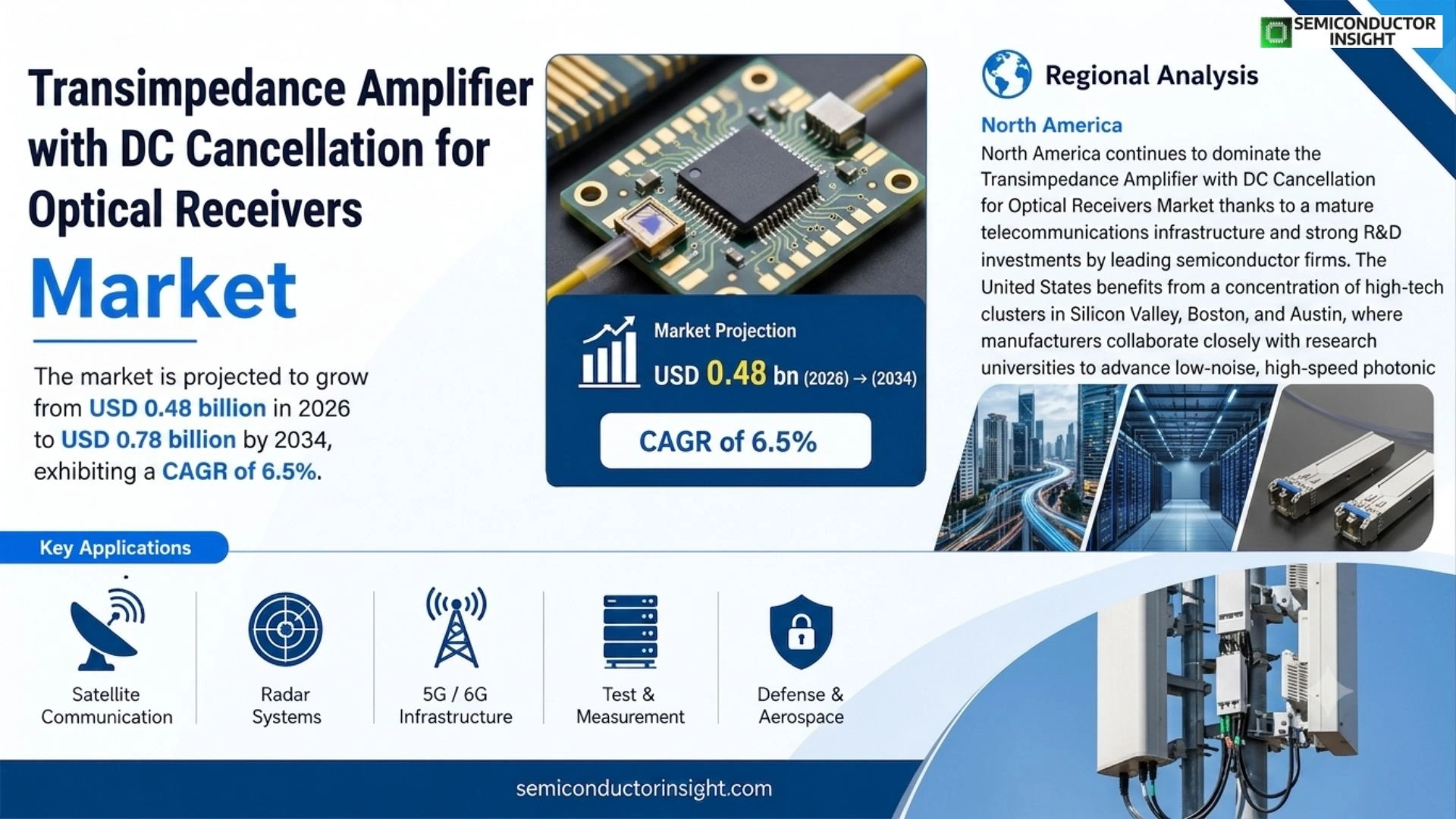
Transimpedance amplifier with DC cancellation for optical receivers market size was valued at USD 0.45 billion in 2025. The market is projected to grow from USD 0.48 billion in 2026 to USD 0.78 billion by 2034, exhibiting a CAGR of 6.5% during the forecast period.
A transimpedance amplifier (TIA) with DC cancellation is a specialized circuit that converts low‑level photocurrent from optical receivers into voltage while actively eliminating DC offsets caused by photodiode leakage or bias currents. This architecture enhances signal integrity, extends dynamic range, and reduces power consumption,critical attributes for high‑speed fiber‑optic communication and data‑center interconnects.
The market is gaining momentum due to rising demand for bandwidth‑intensive services such as cloud computing, 5G backhaul, and hyperscale data centers. Furthermore, advancements in silicon photonics and integration of TIAs into CMOS platforms are driving cost efficiencies. Key players are accelerating product launches that incorporate adaptive DC cancellation techniques, thereby strengthening adoption across telecom and enterprise segments.
MARKET DRIVERS
Rising Data‑Center Bandwidth Demands
Transimpedance amplifier with DC cancellation for optical receivers Market is being propelled by exponential growth in cloud services and hyperscale data‑center deployments. Operators require higher‑speed optical links that can sustain 400 Gb/s and beyond, creating a strong demand for amplifiers that deliver low noise, high gain, and robust DC offset mitigation.
Advancements in Integrated Photonics
Recent breakthroughs in silicon photonics and heterogeneous integration enable compact, power‑efficient transimpedance amplifiers with on‑chip DC cancellation circuits. These technological gains reduce bill‑of‑materials costs and accelerate time‑to‑market for next‑generation optical transceivers.
➤ Manufacturers that embed DC‑cancellation directly into the ASIC architecture report up to 30 % lower power consumption compared with legacy discrete solutions.
In addition, telecom carriers are upgrading legacy fiber infrastructure to support coherent modulation formats. This migration fuels the need for high‑performance amplifiers that can handle stringent linearity requirements while preserving signal integrity.
MARKET CHALLENGES
Stringent Noise Performance Requirements
Achieving ultra‑low input‑referred noise in Transimpedance amplifier with DC cancellation for optical receivers Market is technically demanding. Designers must balance bandwidth, gain, and stability, which often leads to complex compensation networks that increase design cycles.
Other Challenges
Supply‑Chain Constraints
The scarcity of high‑quality silicon‑germanium (SiGe) process wafers and specialized passive components can delay product launches, particularly for niche applications such as aerospace communication.
MARKET RESTRAINTS
Cost Sensitivity in Tier‑1 Networks
While performance is paramount, capital‑expenditure pressure forces network operators to prioritize cost‑effective solutions. The higher unit price of integrated DC‑cancellation modules compared with conventional amplifiers can restrain adoption, especially in regions with tight budget allocations.
MARKET OPPORTUNITIES
Emergence of 6G and Quantum Communication
Anticipated rollout of 6G wireless backhaul and quantum‑key‑distribution networks will require ultra‑low‑noise, high‑speed optical receivers. Transimpedance amplifier with DC cancellation for optical receivers Market stands to capture a significant share by delivering customized solutions that meet the stringent latency and security benchmarks of these emerging technologies.
Transimpedance amplifier with DC cancellation for optical receivers Market Trends
Growing Demand for High‑Speed Optical Links in Data‑Center and 5G Infrastructure
The rapid expansion of cloud‑based services, hyperscale data centers, and 5G backhaul networks is creating a sustained need for optical receivers that can handle ever‑increasing bit rates while preserving signal fidelity. Transimpedance amplifiers with DC cancellation address this need by eliminating photodiode leakage and bias‑current offsets, thereby extending dynamic range and reducing power draw. As operators migrate to 400 Gb/s and beyond, the ability to maintain low noise figures without sacrificing energy efficiency becomes a decisive factor in component selection. Consequently, system designers are prioritizing TIAs that integrate adaptive DC cancellation, enabling tighter link budgets and more compact transceiver modules across enterprise and telecom deployments.
Other Trends
Silicon Photonics Integration
Advances in silicon photonics have opened a pathway for integrating transimpedance amplifiers directly onto CMOS platforms, substantially lowering BOM costs and simplifying manufacturing. By embedding the TIA within the same die as the driver and receiver optics, manufacturers achieve tighter thermal control and reduced parasitic capacitance, which translates into higher bandwidth and lower jitter. Recent design cycles demonstrate that monolithic integration can support wavelength‑division multiplexing arrays while preserving the DC cancellation capability, making the technology attractive for next‑generation optical modules in both telecom central offices and data‑center racks. The convergence of photonic and electronic processes is accelerating product roadmaps, prompting several key vendors to announce silicon‑based TIA families that promise scalability from 25 Gb/s to 400 Gb/s links.
Adaptive DC Cancellation Techniques
Competitive pressure is driving suppliers to embed smarter control loops that dynamically adjust the cancellation voltage in response to temperature shifts and aging effects. These adaptive schemes leverage on‑chip digital calibration, allowing the amplifier to maintain optimal performance over the full operating envelope without manual tuning. Early field deployments have reported up to a 30 % reduction in error‑vector magnitude compared with static‑offset designs, directly contributing to higher eye‑diagram margins in long‑reach fiber links. As standards evolve toward higher spectral efficiencies, the market is expected to reward TIAs that combine low‑power silicon integration with real‑time DC offset correction, positioning them as essential components for future high‑capacity optical networks.
COMPETITIVE LANDSCAPE
Key Industry Players
Transimpedance Amplifiers with DC Cancellation – Competitive Overview
The market is anchored by a handful of large semiconductor firms that leverage deep analog design expertise and extensive foundry partnerships. Analog Devices and Texas Instruments dominate the high‑speed TIA segment, offering fully integrated DC‑cancellation blocks that are widely adopted in datacenter transceivers and 5G back‑haul modules. Their product portfolios benefit from mature CMOS processes, aggressive road‑maps, and strong OEM relationships, which together create a tiered market structure where these incumbents capture the bulk of volume while setting performance benchmarks for lower‑cost alternatives.
Beyond the dominant tier, a diverse set of niche players contributes specialized IP and silicon‑photonic solutions that address emerging form‑factor constraints. Companies such as Infineon Technologies, NXP Semiconductors, and ON Semiconductor focus on low‑power, silicon‑photonic‑compatible TIAs, whereas Broadcom, Lumentum and Finisar bring optical‑module integration expertise that couples DC‑cancellation circuitry with advanced photonic packages. Smaller innovators,including AMS, Skyworks Solutions, Qorvo, and Microchip Technology,target niche applications such as automotive lidar and industrial fiber links, expanding the competitive landscape through differentiated architectures and application‑specific optimizations.
List of Key Transimpedance Amplifier with DC Cancellation Companies Profiled
- Analog Devices
- Texas Instruments
- Infineon Technologies
- NXP Semiconductors
- ON Semiconductor
- Broadcom Inc.
- Lumentum Holdings
- Finisar (II‑VI Incorporated)
- AMS AG
- Skyworks Solutions
- Qorvo, Inc.
- Microchip Technology
Segment Analysis:
| Segment Category | Sub-Segments | Key Insights |
| By Type |
|
Integrated CMOS TIA is emerging as the dominant type because:
|
| By Application |
|
Data‑center interconnect stands out due to:
|
| By End User |
|
Cloud data‑center operators benefit most because:
|
| By [Segment Category 3]] |
|
N/A |
| By [Segment Category 4]] |
|
N/A |
Regional Analysis: Transimpedance amplifier with DC cancellation for optical receivers Market
North America
Robust data‑center traffic growth and the rollout of 5G networks are prompting operators to seek high‑speed optical links. The need for amplifiers that can neutralize DC offsets while preserving signal integrity creates a clear demand surge for Transimpedance amplifier with DC cancellation for optical receivers Market across the region.
Integrated photonic platforms are increasingly embedding transimpedance amplifiers with on‑chip DC cancellation, reducing form factor and power consumption. Advances in silicon‑photonic processes and heterogeneous integration enable tighter coupling between lasers, modulators, and amplifiers.
The Federal Communications Commission (FCC) and Industry Canada maintain stringent emission and noise standards, encouraging manufacturers to adopt designs that inherently mitigate DC bias and meet low‑noise specifications without additional circuitry.
A handful of established semiconductor players dominate, yet niche innovators are emerging with specialized low‑power variants for automotive lidar and aerospace telemetry, intensifying the competitive dynamics within the market.
Europe
European telecom operators are modernizing backbone networks to support bandwidth‑intensive services such as cloud gaming and remote collaboration. Countries like Germany and the United Kingdom host several fab facilities that focus on precision analog‑RF components, including transimpedance amplifiers with built‑in DC cancellation. The region’s emphasis on sustainability drives demand for energy‑efficient photonic solutions, prompting OEMs to prioritize amplifiers that reduce power waste while delivering high linearity. Collaborative research initiatives under the EU Horizon program foster cross‑border innovation, accelerating the integration of advanced photonic circuits into 5G and future 6G deployments.
Asia-Pacific
Asia‑Pacific showcases rapid expansion of fiber‑optic infrastructure, driven by densely populated urban centers in China, Japan, and South Korea. Local manufacturers are scaling production of high‑performance transimpedance amplifiers to meet the surge in data‑center interconnects and metro‑network upgrades. Government incentives for smart‑city projects and autonomous vehicle testing create additional demand for low‑noise optical receivers with DC cancellation capabilities. The competitive landscape is marked by aggressive pricing strategies, while collaborations between semiconductor firms and university research labs accelerate the roll‑out of next‑generation integrated photonic platforms.
South America
In South America, emerging broadband initiatives across Brazil, Mexico, and Argentina are extending fiber reach into previously underserved regions. While the market remains nascent, growing investment in long‑haul optical links for cloud services is prompting local distributors to seek reliable transimpedance amplifiers that can handle variable environmental conditions. The focus on cost‑effective solutions drives interest in modules that combine DC cancellation with robust thermal management, enabling stable performance in diverse climatic zones.
Middle East & Africa
The Middle East & Africa region is witnessing strategic infrastructure projects that link major financial hubs and data centers across the Gulf Cooperation Council and Sub‑Saharan corridors. Initiatives such as Saudi Vision 2030 and the African Continental Free Trade Area (AfCFTA) are fostering demand for high‑speed optical connectivity. Operators prioritize transimpedance amplifiers with DC cancellation to ensure signal fidelity over long distances and harsh desert environments. Partnerships between global OEMs and regional system integrators are accelerating technology transfer and building local expertise in advanced photonic design.
Report Scope
This market research report provides a comprehensive analysis of the Transimpedance amplifier with DC cancellation for optical receivers Market , covering the forecast period 2026–2034. It offers detailed insights into market dynamics, technological advancements, competitive landscape, and key trends shaping the industry.
Key focus areas of the report include:
- Market Overview: The report begins with an overview outlining its current market scenario, key growth indicators, and industry transformation drivers. It discusses macroeconomic factors, demand–supply balance, regulatory landscape, and the strategic role of semiconductors in powering advancements across industries such as automotive, telecommunications, consumer electronics, and industrial automation.
- Market Size & Forecast: Historical data and future projections for revenue, unit shipments, and market value across major regions and segments.
- Segmentation Analysis: Detailed breakdown by product type, technology, application, and end-user industry to identify high-growth segments and investment opportunities.
- Regional Insights: Insights into market performance across North America, Europe, Asia-Pacific, Latin America, and the Middle East & Africa, including country-level analysis where relevant.
- Competitive Landscape: Profiles of leading market participants, including their product offerings, R&D focus, manufacturing capacity, pricing strategies, and recent developments such as mergers, acquisitions, and partnerships.
- Technology Trends & Innovation: Assessment of emerging technologies, integration of AI/IoT, semiconductor design trends, fabrication techniques, and evolving industry standards.
- Market Drivers & Restraints: Evaluation of factors driving market growth along with challenges, supply chain constraints, regulatory issues, and market-entry barriers.
- Stakeholder Insights: Insights for component suppliers, OEMs, system integrators, investors, and policymakers regarding the evolving ecosystem and strategic opportunities.
Primary and secondary research methods are employed, including interviews with industry experts, data from verified sources, and real-time market intelligence to ensure the accuracy and reliability of the insights presented.
FREQUENTLY ASKED QUESTIONS:
What is the current market size of Transimpedance amplifier with DC cancellation for optical receivers Market?
-> Transimpedance amplifier with DC cancellation for optical receivers market is projected to grow from USD 0.48 billion in 2026 to USD 0.78 billion by 2034.
Which key companies operate in Transimpedance amplifier with DC cancellation for optical receivers Market?
-> Key players include Axalta Coating Systems, AkzoNobel, BASF SE, PPG, Sherwin-Williams, and 3M, among others.
What are the key growth drivers?
-> Key growth drivers include railway infrastructure investments, urbanization, and demand for durable coatings.
Which region dominates the market?
-> Asia-Pacific is the fastest-growing region, while Europe remains a dominant market.
What are the emerging trends?
-> Emerging trends include bio-based coatings, smart coatings, and sustainable rail solutions.
Get Sample Report PDF for Exclusive Insights
Report Sample Includes
- Table of Contents
- List of Tables & Figures
- Charts, Research Methodology, and more...