MARKET INSIGHTS
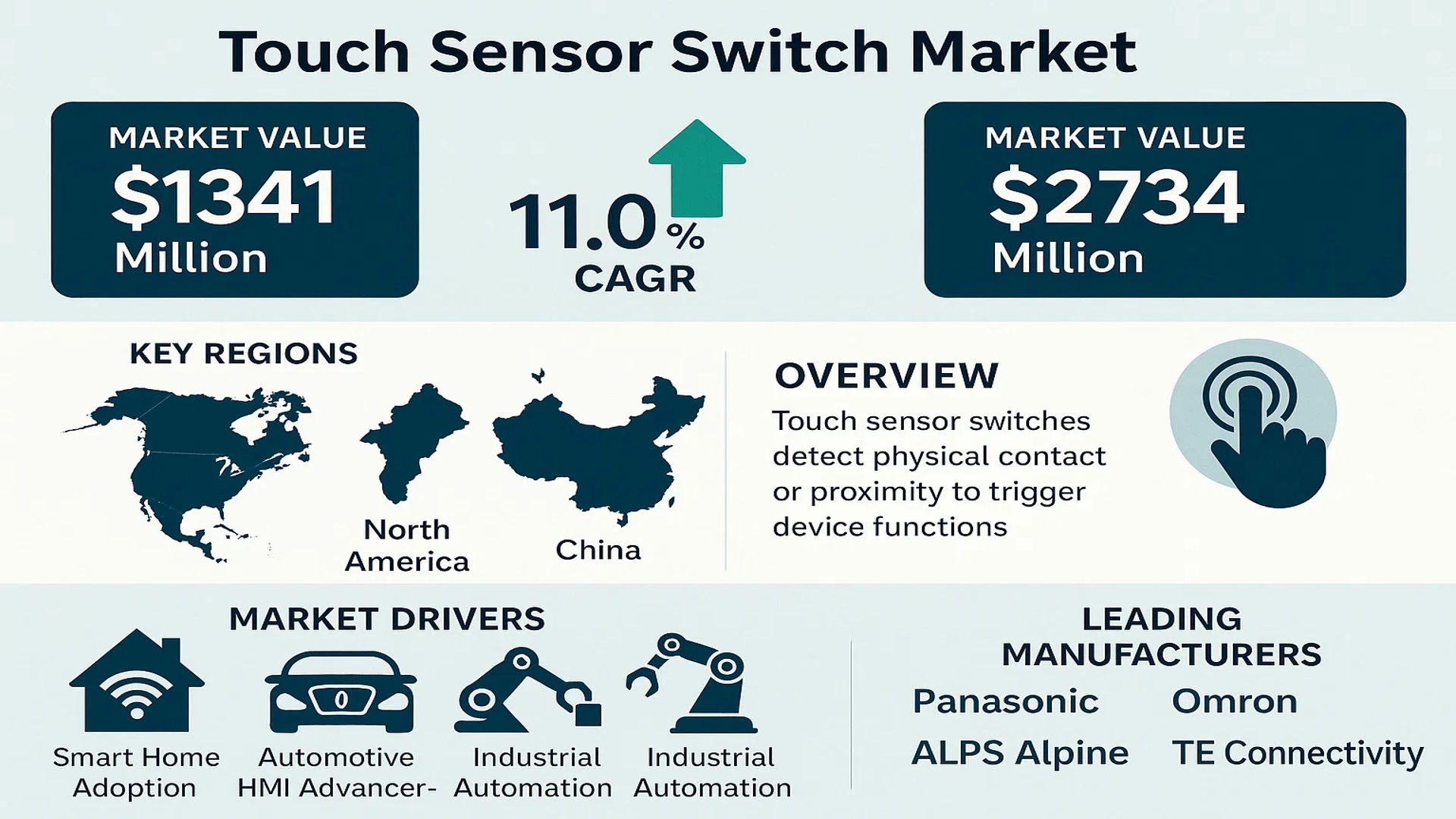
The global Touch Sensor Switch market was valued at 1341 million in 2024 and is projected to reach US$ 2734 million by 2032, at a CAGR of 11.0% during the forecast period. While North America remains a key market, China’s touch sensor switch sector is demonstrating accelerated growth potential.
Touch sensor switches are electronic components that detect physical contact or proximity to trigger device functions, eliminating mechanical parts for enhanced durability. These devices operate through various technologies, primarily resistive (pressure-sensitive) and capacitive (field-disturbance) systems, with capacitive variants gaining dominance due to multi-touch capabilities and better responsiveness.
The market expansion is driven by increasing smart home adoption, automotive HMI advancements, and industrial automation trends. The shift toward sleek, buttonless interfaces in consumer electronics has particularly boosted demand. Leading manufacturers like Panasonic, Omron, and TE Connectivity are investing in low-power IoT-compatible switches, with ALPS Alpine recently introducing a new moisture-resistant capacitive series for automotive applications in Q1 2024.
MARKET DYNAMICS
MARKET DRIVERS
Smart Home Adoption and IoT Integration Driving Touch Sensor Switch Demand
The rapid expansion of smart home ecosystems across developed and emerging economies represents one of the strongest growth drivers for touch sensor switches. With global smart home device shipments expected to exceed 1.1 billion units annually by 2026, the demand for intuitive control interfaces like touch sensor switches has surged. These products enable seamless integration with IoT platforms while offering aesthetic and functional advantages over traditional mechanical switches. Major players like Panasonic and Omron have recently introduced compact, energy-efficient touch switches specifically designed for smart home applications, further accelerating market penetration.
Commercial Sector Modernization Creating Significant Growth Potential
Commercial infrastructure development worldwide is increasingly incorporating touch sensor technology as part of modern building automation systems. Industries such as hospitality and healthcare show particular preference for capacitive touch switches due to their hygienic, easy-to-clean surfaces and vandal-resistant properties. The global commercial construction sector’s annual growth rate of approximately 8% directly correlates with rising demand for advanced electrical solutions. Recent technology exhibitions have showcased innovative applications including touch-sensitive smart mirrors and interactive control panels, indicating expanding use cases beyond traditional switch applications.
Advancements in Touch Technology Enhancing Product Capabilities
Technological breakthroughs in capacitive sensing and haptic feedback mechanisms have significantly improved touch sensor switch performance. Modern capacitive variants now achieve >99% accuracy in detection while consuming minimal power, addressing previous concerns about reliability and energy efficiency. Leading manufacturers have recently introduced multi-touch capable switches with programmable gesture controls, opening new possibilities for user interaction. These advancements, combined with decreasing production costs through economies of scale, make touch sensor switches increasingly viable for mass-market adoption across both residential and commercial segments.
MARKET RESTRAINTS
Higher Initial Costs Compared to Mechanical Switches Limit Wider Adoption
Despite their advantages, touch sensor switches face market penetration challenges due to their higher price points compared to conventional switches. Current pricing analysis indicates capacitive touch switches carry approximately 3-5 times the cost of basic mechanical alternatives. This cost differential proves particularly prohibitive in price-sensitive emerging markets and large-scale commercial projects where hundreds of switches may be required. While lifecycle cost benefits exist through durability and energy efficiency, many buyers focus solely on upfront expenses, creating a barrier to wholesale replacement of traditional switch solutions.
Technical Limitations in Harsh Environments Pose Implementation Challenges
Performance reliability under extreme conditions remains a concern for some touch sensor switch applications. Specific industrial environments with heavy electromagnetic interference or frequent liquid exposure can degrade capacitive touch sensor functionality. Recent product testing reveals certain models experience decreased responsiveness when subjected to temperatures exceeding 60°C or humidity levels above 90%. These technical constraints necessitate careful product selection for specialized applications, potentially limiting market expansion in sectors like heavy industry or outdoor infrastructure where durability is paramount.
Skilled Installation and Maintenance Requirements Create Adoption Barriers
The transition from conventional wiring to sophisticated touch sensor systems demands electrical professionals with specialized training. Many traditional electricians lack experience with the low-voltage wiring and programming requirements of advanced touch interfaces. This skills gap has led to installation challenges in certain regions, with reports of improper configurations causing performance issues. Additionally, troubleshooting complex capacitive sensing circuits requires diagnostic equipment not commonly available in standard electrical service operations, creating post-installation maintenance concerns that may discourage some potential adopters.
MARKET OPPORTUNITIES
Emerging Markets Present Significant Untapped Potential
Rapid urbanization in developing economies offers substantial growth opportunities for touch sensor switch manufacturers. Government-led smart city initiatives across Asia and the Middle East increasingly specify modern electrical solutions in their infrastructure plans. The Asia-Pacific region alone represents a potential market valued in the hundreds of millions, with commercial and residential construction booming in key markets. Localized product adaptations addressing regional preferences and price sensitivity could open new revenue streams for manufacturers willing to invest in tailored market entry strategies.
Integration With Emerging Technologies Creating New Applications
Convergence with adjacent technologies presents exciting possibilities for touch sensor switch evolution. Recent prototypes demonstrate promising integrations with biometric authentication for security applications and AI-driven adaptive lighting controls. The incorporation of machine learning algorithms could enable predictive touch interfaces that anticipate user needs based on behavioral patterns. These innovations may lead to premium product categories commanding higher margins while expanding the technology’s applicability beyond simple switching functions to comprehensive environmental control solutions.
Energy Efficiency Regulations Driving Sustainable Solutions
Increasingly stringent global energy efficiency standards are creating favorable conditions for touch sensor adoption. Compared to mechanical switches, capacitive touch variants typically achieve 20-30% better energy efficiency due to optimized power management circuits. Regulatory bodies in multiple jurisdictions are updating building codes to encourage modern electrical solutions, with some regions reportedly considering mandated touch interfaces for certain commercial applications. Manufacturers emphasizing sustainability credentials and compliance with emerging standards stand to gain competitive advantage as environmental considerations become principal decision factors for buyers.
MARKET CHALLENGES
Supply Chain Vulnerabilities Impacting Production Capacity
The touch sensor switch industry faces material procurement challenges affecting manufacturing timelines. Specialty components including capacitive sensing ICs and durable surface materials remain subject to periodic shortages, with lead times extending beyond standard projections. Recent disruptions in the semiconductor supply chain have particularly impacted production schedules, forcing some manufacturers to revise delivery commitments. These constraints coincide with rising material costs that pressure profit margins, requiring innovative supply chain strategies to maintain competitive positioning.
Consumer Preferences Vary Significantly by Region
Market acceptance patterns demonstrate substantial geographic variation that complicates global product strategies. While European markets favor minimalist capacitive designs, North American consumers often prefer products with more pronounced tactile feedback. Asian markets show preference for additional smart features and app integration. These divergent preferences necessitate costly product customization and localized marketing approaches, making standardized global rollouts challenging for manufacturers seeking international expansion.
Intellectual Property Protection Concerns in Competitive Landscape
The proliferation of patent filings in touch interface technology indicates intensifying competition among established players and new entrants alike. Recent litigation involving alleged intellectual property infringements highlights the risks associated with rapid technology adoption. Smaller manufacturers face particular challenges in navigating complex patent landscapes while developing differentiated products. This environment demands substantial R&D investment and legal vigilance to protect innovations, potentially concentrating market power among larger corporations with greater resources.
TOUCH SENSOR SWITCH MARKET TRENDS
Rising Adoption of Capacitive Touch Technology to Drive Market Growth
The global touch sensor switch market is experiencing significant growth, driven primarily by the increasing adoption of capacitive touch technology. Unlike traditional mechanical switches, capacitive touch sensors offer superior durability, sleek design integration, and enhanced user experience. This technology is widely preferred in consumer electronics, automotive interiors, and smart home applications. Industry projections indicate that capacitive touch switches accounted for approximately 65% of the market share in 2024, with this dominance expected to continue through 2032 due to their compatibility with modern touchscreens and IoT-enabled devices.
Other Trends
Smart Home and IoT Integration
The proliferation of smart home systems and IoT-enabled devices has created substantial demand for touch sensor switches. Home automation systems increasingly rely on these switches for seamless control of lighting, HVAC, and security systems. With the global smart home market projected to grow at a CAGR of over 12% from 2024 to 2032, manufacturers are integrating advanced features like gesture recognition and voice control compatibility into touch switches. These innovations cater to the evolving preferences for contactless and intuitive control interfaces in residential and commercial spaces.
Automotive Industry Transition to Touch-Based Controls
Automakers are progressively replacing mechanical buttons with touch sensor switches in vehicle dashboards, center consoles, and infotainment systems. This shift aligns with consumer demand for minimalist, high-tech interiors and the automotive industry’s push toward electrification and connectivity. By 2024, over 45% of mid-range vehicles incorporated some form of touch-sensitive controls, with premium segments reaching nearly 80% adoption. However, manufacturers face challenges in balancing aesthetic appeal with functional reliability, particularly regarding haptic feedback and operation while driving.
Healthcare and Industrial Applications
While consumer electronics and automotive sectors dominate demand, healthcare and industrial applications are emerging as high-growth segments. In medical equipment, touch sensor switches enable easy sterilization and prevent bacterial buildup compared to traditional buttons. Industrial applications benefit from their resilience in harsh environments when properly sealed. Between 2024-2032, these specialized segments are expected to grow at approximately 9-11% annually, driven by increased automation in manufacturing and higher standards for medical device hygiene.
COMPETITIVE LANDSCAPE
Key Industry Players
Market Leaders Accelerate R&D and Expand Capacities to Meet Growing Demand
The global touch sensor switch market features a moderately fragmented competitive environment, with established electronics giants competing alongside specialized component manufacturers. ALPS Alpine emerges as a dominant force, holding significant market share in 2024 due to its diversified product range spanning resistive and capacitive technologies. The company’s strong distribution network across Asia-Pacific and North America reinforces its leadership position.
Panasonic Corporation and Omron Corporation maintain robust positions through continuous product innovation, particularly in industrial-grade touch solutions. Their technological edge in reliability testing and IP-rated switches gives them competitive advantage in commercial applications. Meanwhile, TE Connectivity has been gaining traction through strategic acquisitions that expanded its capacitive touch switch offerings.
Several regional players are making notable strides – BEWIN in China has demonstrated aggressive pricing strategies, while Wurth Elektronik focuses on eco-friendly designs compliant with EU regulations. The market also sees growing participation from semiconductor companies integrating touch controller ICs with switch modules, creating new competitive dynamics.
Recent developments highlight increasing M&A activity, with players like C&K Components expanding through targeted acquisitions to strengthen their capacitive technology portfolios. Simultaneously, Japanese manufacturers are investing heavily in miniaturized switch designs to cater to IoT device manufacturers.
List of Key Touch Sensor Switch Manufacturers
- ALPS Alpine (Japan)
- Mitsumi Electric (Japan)
- Panasonic Corporation (Japan)
- Omron Corporation (Japan)
- TE Connectivity (Switzerland)
- BEWIN (China)
- Wurth Elektronik (Germany)
- C&K Components (U.S.)
- Xinda (China)
- CTS Corporation (U.S.)
- Marquardt (Germany)
- NKK Switches (Japan)
- OMTEN (China)
- Oppho (China)
- Changfeng (China)
- Han Young (South Korea)
- Bourns (U.S.)
Segment Analysis:
By Type
Capacitive Touch Switch Segment Dominates Due to High Sensitivity and Multi-Touch Capabilities
The market is segmented based on type into:
- Resistive Touch Switch
- Subtypes: 4-wire, 5-wire, 8-wire, and others
- Capacitive Touch Switch
- Subtypes: Surface capacitance, Projected capacitance, and others
- Piezoelectric Touch Switch
- Optical Touch Switch
- Others
By Application
Commercial Segment Leads Due to Extensive Use in Industrial and Public Spaces
The market is segmented based on application into:
- Domestic
- Subtypes: Smart home appliances, lighting controls, and others
- Commercial
- Subtypes: Retail POS systems, industrial control panels, and others
- Automotive
- Healthcare
- Others
By Technology
Haptic Feedback Technology Gains Traction for Enhanced User Experience
The market is segmented based on technology into:
- Standard Touch
- Multi-Touch
- Haptic Feedback
- Gesture Recognition
- Others
By Interface
Touch Screen Interface Dominates Due to Smart Device Proliferation
The market is segmented based on interface into:
- Touch Screen
- Touch Pad
- Touch Button
- Touch Slider
Regional Analysis: Touch Sensor Switch Market
North America
The North American touch sensor switch market is driven by the region’s strong technological adoption and demand for smart home automation solutions. The U.S. accounts for the largest share, with capacitive touch switches gaining popularity due to their durability and seamless integration with IoT-enabled devices. Strict energy efficiency regulations, particularly in California’s Title 24, are pushing manufacturers to innovate low-power solutions. The commercial sector—especially office spaces and retail—is a key growth area, leveraging touch sensors for enhanced user experience and automation. High R&D investments from key players like TE Connectivity and Omron further solidify regional competitiveness.
Europe
Europe is a mature market with stringent electromagnetic compatibility (EMC) and RoHS compliance requirements, shaping product development. Germany and France lead in industrial applications, where haptic feedback touch switches are increasingly adopted for enhanced precision. The residential sector is also growing, supported by EU directives promoting smart buildings. However, high manufacturing costs compared to Asian counterparts create pricing pressures. Companies like Wurth Elektronik and Marquardt focus on customization to cater to niche automotive and appliance segments. Sustainability trends are pushing demand for recyclable materials in switch production.
Asia-Pacific
As the fastest-growing region, China, Japan, and South Korea dominate both production and consumption. China’s electronics manufacturing ecosystem provides cost advantages, with local players like Xinda and Oppho competing globally. While resistive touch switches remain prevalent in budget appliances, capacitive variants are gaining traction in premium devices. India’s expanding middle-class population is driving residential adoption, though price sensitivity limits value growth. Japan leads in automotive touch interfaces, integrating advanced gesture-control switches. The region benefits from strong supply chains but faces margin pressures due to intense competition.
South America
Market growth is steady but constrained by economic instability and slower technological uptake compared to global peers. Brazil is the largest market, where proximity sensors are increasingly used in commercial security systems. Limited local production means heavy reliance on imports, particularly from China. While smart city initiatives in Chile and Colombia create opportunities, low consumer purchasing power restricts residential demand. Distributors emphasize affordability, with basic resistive switches comprising over 60% of sales. Long-term potential exists in industrial automation as manufacturing sectors modernize.
Middle East & Africa
The MEA market is nascent but shows promise, driven by smart infrastructure projects in the UAE and Saudi Arabia. High-end commercial buildings in Dubai incorporate touch switches for lighting and climate control, favoring branded European and American products. Africa’s growth is slower due to infrastructural gaps, though South Africa and Nigeria see rising demand in hospitality and retail. Price remains a critical factor—Chinese imports dominate lower-tier markets. Limited local technical expertise creates after-sales service challenges. Governments’ focus on energy-efficient buildings may accelerate adoption in the coming decade.
Report Scope
This market research report provides a comprehensive analysis of the global and regional Touch Sensor Switch markets, covering the forecast period 2024–2032. It offers detailed insights into market dynamics, technological advancements, competitive landscape, and key trends shaping the industry.
Key focus areas of the report include:
- Market Size & Forecast: Historical data and future projections for revenue, unit shipments, and market value across major regions and segments. The Global Touch Sensor Switch market was valued at USD 1,341 million in 2024 and is projected to reach USD 2,734 million by 2032.
- Segmentation Analysis: Detailed breakdown by product type (resistive and capacitive touch switches), application (domestic and commercial), and end-user industry to identify high-growth segments and investment opportunities.
- Regional Outlook: Insights into market performance across North America, Europe, Asia-Pacific, Latin America, and the Middle East & Africa, including country-level analysis where relevant. Asia-Pacific is expected to dominate due to rapid industrialization.
- Competitive Landscape: Profiles of leading market participants including ALPS, Panasonic, Omron, TE Connectivity, and BEWIN, including their product portfolios, R&D investments, and strategic initiatives.
- Technology Trends & Innovation: Assessment of emerging capacitive touch technologies, integration with IoT systems, and advancements in haptic feedback solutions.
- Market Drivers & Restraints: Evaluation of factors driving market growth such as smart home adoption and automotive digitization, along with challenges like supply chain disruptions and component shortages.
- Stakeholder Analysis: Strategic insights for OEMs, component suppliers, and investors regarding emerging opportunities in consumer electronics and industrial automation sectors.
Primary and secondary research methods are employed, including interviews with industry experts, data from verified sources, and real-time market intelligence to ensure the accuracy and reliability of the insights presented.
FREQUENTLY ASKED QUESTIONS:
What is the current market size of Global Touch Sensor Switch Market?
-> Touch Sensor Switch market was valued at 1341 million in 2024 and is projected to reach US$ 2734 million by 2032, at a CAGR of 11.0% during the forecast period.
Which key companies operate in Global Touch Sensor Switch Market?
-> Key players include ALPS, Panasonic, Omron, TE Connectivity, BEWIN, Wurth Elektronik, and C&K Components, among others.
What are the key growth drivers?
-> Key growth drivers include rising demand for smart home devices, automotive digitization, and industrial automation solutions.
Which region dominates the market?
-> Asia-Pacific is the dominant market, driven by manufacturing hubs in China and Japan, while North America shows strong growth in smart home applications.
What are the emerging trends?
-> Emerging trends include integration with IoT platforms, ultra-thin touch solutions, and waterproof touch sensor technologies.

Get Sample Report PDF for Exclusive Insights
Report Sample Includes
- Table of Contents
- List of Tables & Figures
- Charts, Research Methodology, and more...