TIR Optics Market, Trends, Business Strategies 2025-2032

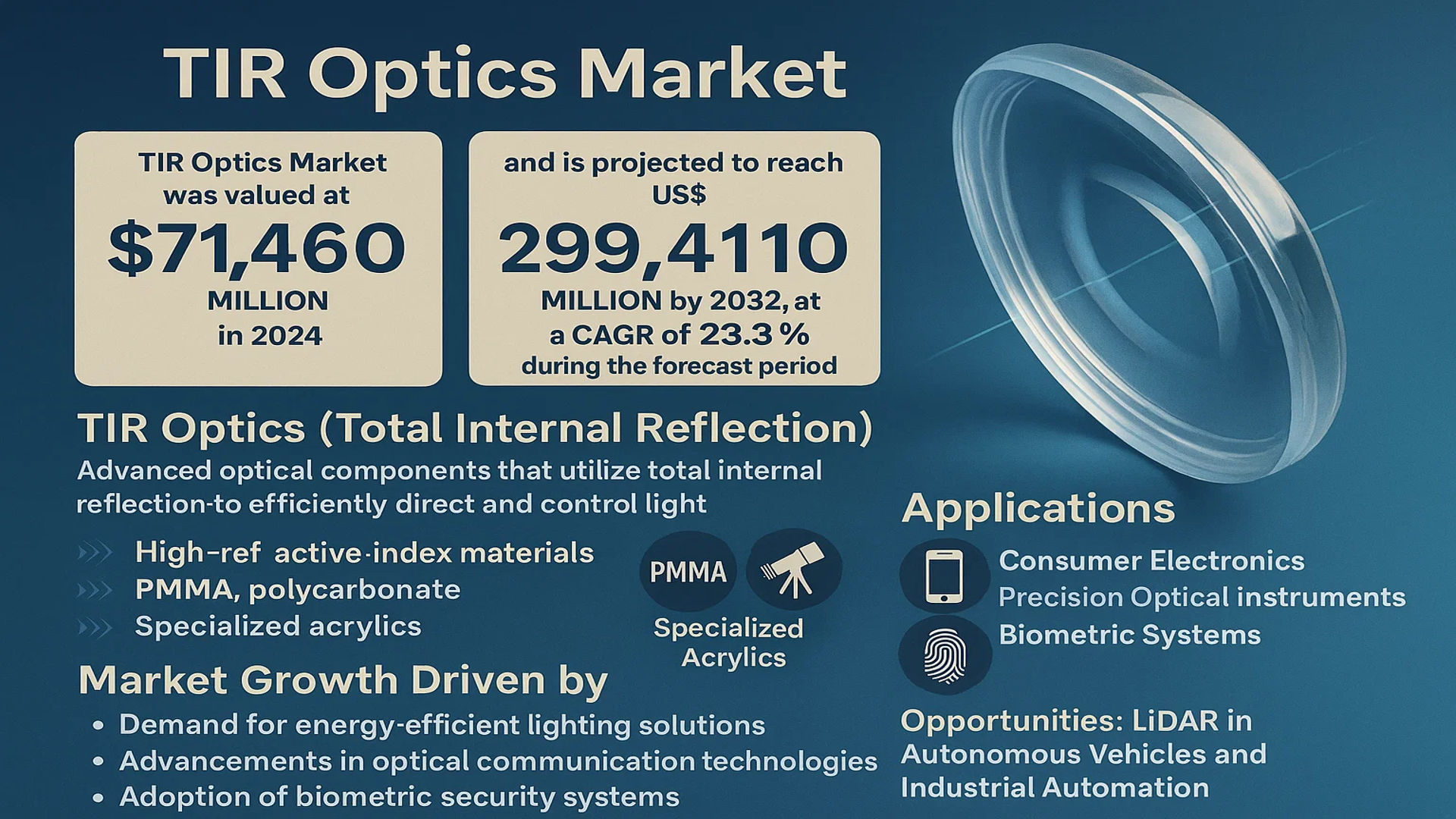
TIR Optics Market was valued at 71460 million in 2024 and is projected to reach US$ 299410 million by 2032, at a CAGR of 23.3% during the forecast period

PDF Icon Download Sample Report PDF
  • Quick Dispatch

    All Orders

  • Secure Payment

    100% Secure Payment

Price range: $1,500.00 through $4,250.00

Clear

MARKET INSIGHTS

The global TIR Optics Market was valued at 71460 million in 2024 and is projected to reach US$ 299410 million by 2032, at a CAGR of 23.3% during the forecast period.

TIR (Total Internal Reflection) optics are advanced optical components that utilize the principle of total internal reflection to efficiently direct and control light. These lenses are engineered with high-refractive-index materials, such as polymethylmethacrylate (PMMA), polycarbonate, and specialized acrylics, to enhance light transmission while minimizing losses. TIR optics find critical applications across industries including consumer electronics, precision optical instruments, and biometric systems.

The market growth is primarily driven by increasing demand for energy-efficient lighting solutions, rapid advancements in optical communication technologies, and the expanding adoption of biometric security systems. Furthermore, the rise of LiDAR applications in autonomous vehicles and industrial automation is creating new opportunities for TIR optics manufacturers. Key players such as Thorlabs, Osram Sylvania, and Shanghai Optics are actively innovating to meet these demands, with strategic partnerships and product launches accelerating market expansion.
TIR Optics Market

MARKET DYNAMICS

MARKET DRIVERS

Rising Demand for High-Efficiency Optical Solutions in Consumer Electronics Fuels Market Expansion

The global TIR optics market is experiencing robust growth driven by the rapidly expanding consumer electronics sector. With smartphone manufacturers increasingly incorporating advanced camera systems and augmented reality features, the demand for precision optical components has surged. Modern flagship smartphones now integrate 4-5 TIR lenses per device for tasks ranging from depth sensing to facial recognition. This trend is accelerating as manufacturers push the boundaries of computational photography and 3D sensing technologies. The consumer electronics segment accounted for over 42% of total TIR optics revenue in 2024, establishing it as the dominant application category.

Advancements in Optical Communication Infrastructure Create New Demand

Telecommunications infrastructure upgrades worldwide are driving significant adoption of TIR optics in fiber optic networks. As 5G rollouts accelerate and data centers expand to handle growing cloud computing demands, optical components that minimize signal loss while maximizing efficiency become critical. TIR lenses demonstrate up to 99.5% light transmission efficiency in commercial applications, making them indispensable for next-gen communication systems. Major network equipment providers are increasingly specifying TIR-based solutions for their performance advantages in signal integrity and thermal stability.

Automotive LiDAR Adoption Presents Substantial Growth Opportunity

The automotive industry’s rapid embrace of autonomous driving technologies is creating a new high-growth sector for TIR optics. Modern LiDAR systems for advanced driver assistance (ADAS) and autonomous vehicles typically incorporate multiple TIR lenses to shape and direct laser beams with precision. With the global autonomous vehicle market projected to grow at over 21% CAGR through 2032, the demand for reliable, high-performance optical components continues to strengthen. Leading automotive suppliers are actively forming strategic partnerships with TIR optics manufacturers to secure supply chains for these mission-critical components.

MARKET RESTRAINTS

High Manufacturing Costs Constrain Price-Sensitive Market Segments

The TIR optics market faces significant challenges from the relatively high production costs associated with precision optical manufacturing. The fabrication process requires specialized equipment, ultra-pure materials, and controlled environments that drive up capital expenditures. Polymethylmethacrylate (PMMA) and polycarbonate substrates, while cost-effective for some applications, often require additional coatings to achieve the necessary optical performance. These factors currently limit adoption in price-sensitive consumer applications where manufacturers face intense margin pressures.

Material Limitations Create Design Constraints

While TIR optics offer excellent performance characteristics, the available substrate materials present certain technical limitations. Optical plastics like PMMA have relatively low maximum operating temperatures (typically below 85°C), restricting use in high-temperature automotive and industrial applications. Additionally, UV stability concerns with some polymer materials require careful engineering for outdoor deployments. These material constraints force design compromises in some applications, potentially limiting market penetration where extreme environmental conditions exist.

MARKET CHALLENGES

Global Supply Chain Disruptions Impact Component Availability

The TIR optics industry continues facing supply chain challenges affecting raw material availability and lead times. The precision optical components market relies heavily on specialized polymer resins from a limited number of suppliers, creating vulnerability to disruptions. Recent geopolitical tensions have exacerbated these issues, with some critical optical-grade materials experiencing price volatility upwards of 30% year-over-year. Manufacturers are responding by diversifying supplier networks and increasing inventory buffers, but these measures increase working capital requirements.

Intellectual Property Protection Presents Ongoing Concerns

As competition intensifies in the TIR optics space, intellectual property protection has become a critical challenge. The industry has seen increasing patent disputes related to optical designs and manufacturing processes, particularly in the biometric and LiDAR application segments. Smaller manufacturers without extensive patent portfolios face growing barriers to entry, potentially stifling innovation. This IP landscape requires companies to dedicate substantial resources to legal protection while navigating existing patent thickets that may limit design freedom.

MARKET OPPORTUNITIES

Medical Imaging and Diagnostic Equipment Present Growth Frontier

The healthcare sector offers significant untapped potential for TIR optics manufacturers. Advanced medical imaging systems increasingly incorporate optical components for applications ranging from endoscopy to laser surgery. TIR lenses’ ability to deliver high light throughput with minimal losses makes them ideal for sensitive diagnostic equipment where signal integrity is paramount. With global healthcare spending projected to exceed $10 trillion by 2025, medical applications represent a high-value growth vector for manufacturers able to meet stringent regulatory requirements.

Emerging AR/VR Markets Demand Innovative Optical Solutions

The rapid evolution of augmented and virtual reality technologies creates compelling opportunities for TIR optics innovation. Next-generation AR glasses and VR headsets require compact, lightweight optical systems capable of delivering crisp imagery while minimizing form factor. TIR-based waveguide solutions are gaining traction as they enable more ergonomic designs compared to traditional optics. With the AR/VR hardware market expected to grow at 26% CAGR through 2030, optics manufacturers investing in specialized TIR solutions stand to capture substantial value in this emerging sector.

TIR OPTICS MARKET TRENDS

Rising Demand in Consumer Electronics to Drive Growth

The global TIR Optics market is witnessing significant expansion, primarily driven by the explosive growth in consumer electronics. Smartphones, augmented reality (AR) glasses, and advanced display technologies increasingly utilize TIR lenses for superior light management and compact design integration. With the consumer electronics sector projected to maintain a compound annual growth rate (CAGR) of over 7% through 2030, manufacturers are prioritizing high-performance optical solutions that enhance display clarity while minimizing energy consumption. TIR optics are particularly valuable in devices requiring precise beam shaping, such as virtual reality headsets and LiDAR sensors for autonomous vehicles.

Other Trends

Precision Optical Instrument Innovations

The expansion of medical diagnostics and life sciences has accelerated the adoption of TIR optics in precision instruments like confocal microscopes and biosensors. These applications demand ultra-high light efficiency and minimal aberration, which TIR lenses deliver effectively. Furthermore, the surge in biometric security systems, including facial recognition and iris scanning technologies, relies on TIR optics for accurate light collimation across diverse environmental conditions. This trend aligns with global biometric market growth, anticipated to surpass $100 billion by 2030, creating sustained demand for specialized optical components.

Material Science Breakthroughs Reshaping Production

Polycarbonate and acrylic-based TIR lenses continue dominating the market due to their optimal refractive indices and durability, but recent material innovations are unlocking new possibilities. Advanced polymer blends with enhanced thermal stability (withstanding temperatures exceeding 120°C) are gaining traction in automotive lighting systems, while nano-structured surfaces enable unprecedented control over light dispersion patterns. These developments coincide with a 23% year-over-year increase in R&D investments by leading optical material suppliers, signaling strong industry commitment to next-generation TIR solutions. Concurrently, the shift toward eco-friendly manufacturing processes is prompting manufacturers to explore recyclable optical materials without compromising performance metrics.

COMPETITIVE LANDSCAPE

Key Industry Players

Innovation and Strategic Expansion Drive Competition in the TIR Optics Market

The global TIR optics market is characterized by a mix of established players and emerging competitors, all vying for dominance in a rapidly evolving optical technologies landscape. Shanghai Optics leads the market with its cutting-edge TIR lens solutions, particularly in the precision optical instruments segment, where demand rose by 18% in 2024. The company’s dominance stems from its vertically integrated manufacturing and strong R&D capabilities across Asia and North America.

Thorlabs and Osram Sylvania maintain significant market shares, particularly in industrial and consumer electronics applications. These players benefit from their extensive distribution networks and ability to customize TIR optical solutions for niche applications. Recent investments by Thorlabs in hybrid optical systems incorporating TIR technology demonstrate the industry’s shift toward multifunctional components.

While large players dominate revenue shares, mid-sized companies like Carclo and Apollo Optical Systems are gaining traction through specialized offerings. Carclo’s precision injection-molded TIR optics, for instance, captured 12% of the automotive lighting segment last year. These companies compete through technological differentiation rather than scale, focusing on high-value applications in biometrics and medical devices.

The competitive intensity is further heightened by regional specialists. Shanghai Winvow Optoelectronics dominates China’s growing market, while NMB Italia maintains strong European footholds in industrial laser applications. Such geographical specialization creates pockets of intense competition, pushing all players toward continuous innovation.

List of Key TIR Optics Companies Profiled

  • Shanghai Optics (China)
  • Thorlabs, Inc. (U.S.)
  • Osram Sylvania (Germany)
  • Carclo Technical Plastics (U.K.)
  • Apollo Optical Systems (U.S.)
  • DMF Lighting (U.S.)
  • Shanghai Winvow Optoelectronics Technology Co. Ltd (China)
  • Okamoto Glass Co Ltd (Japan)
  • Greenlight Optics (U.S.)
  • NMB Italia S.r.l. (Italy)

Segment Analysis:

By Type

Polycarbonate Segment Leads Due to Superior Optical Clarity and Impact Resistance

The market is segmented based on material type into:

  • Polymethylmethacrylate (PMMA)
  • Acrylic Acid
  • Polycarbonate
  • Others

By Application

Consumer Electronics Drives Demand for High-Precision Optical Components

The market is segmented based on application into:

  • Consumer Electronics
    • Smartphone cameras
    • Virtual reality headsets
    • Augmented reality devices
  • Precision Optical Instruments
    • Microscopes
    • Laser systems
    • Spectrometers
  • Biometric Security Systems
    • Facial recognition
    • Fingerprint scanners
  • Others

By Light Source

LED Applications Dominate the Market for Energy-Efficient Lighting Solutions

The market is segmented based on light source compatibility into:

  • LED
  • Laser
  • Halogen
  • Others

By Design Type

Conical TIR Optics Gain Preference for Directional Light Control Applications

The market is segmented based on optical design into:

  • Conical
  • Spherical
  • Aspherical
  • Hybrid

Regional Analysis: TIR Optics Market

Asia-Pacific
The Asia-Pacific region dominates the TIR optics market, accounting for over 45% of global demand in 2024, with China spearheading growth through its flourishing electronics manufacturing sector. Major manufacturers such as Shanghai Optics and Shanghai Winvow Optoelectronics Technology Co. Ltd have established advanced production facilities in the region to cater to rising demand for optical components in consumer electronics and telecommunications. The proliferation of 5G networks and increasing investments in fiber-optic infrastructure are accelerating adoption, particularly for applications in precision optical instruments and biometric systems. While Japan and South Korea continue to innovate with high-performance polycarbonate-based optics, emerging economies face challenges in maintaining consistent quality standards across their supply chains.

North America
Characterized by strong R&D capabilities and stringent quality requirements, the North American market represents approximately 28% of global TIR optics revenue. The U.S. leads in specialized applications, with companies like Thorlabs and Apollo Optical Systems developing advanced solutions for medical lasers and defense systems. The region’s emphasis on miniaturization has driven demand for polymethylmethacrylate-based optics in compact electronic devices. However, higher production costs compared to Asian counterparts have led to strategic partnerships with overseas manufacturers to maintain competitiveness. Government-funded research initiatives in photonics further stimulate innovation, though supply chain disruptions remain a concern for critical infrastructure projects.

Europe
European manufacturers prioritize eco-friendly production methods and regulatory compliance, with Germany and the U.K. accounting for the majority of regional demand. Osram Sylvania and NMB Italia S.r.l. have gained prominence through precision-engineered optical solutions for automotive lighting and industrial lasers. The adoption of TIR optics in biometric security systems has increased steadily, supported by strict data protection regulations across EU member states. While the market demonstrates steady growth, price sensitivity in Eastern European countries has limited penetration of advanced acrylic acid-based optical components, creating a bifurcated demand landscape within the region.

South America
This emerging market shows gradual but inconsistent growth, primarily driven by Brazil’s expanding telecommunications sector. Economic instability and import dependence hinder local manufacturing development, forcing regional players to rely on cost-effective, mass-produced optical components from global suppliers. Recent investments in urban infrastructure have created opportunities for TIR optics in traffic management and public safety applications. However, the lack of specialized technical expertise and limited R&D investment have prevented the establishment of a robust domestic supply chain, keeping the region dependent on foreign technology transfers.

Middle East & Africa
The adoption of TIR optics remains in nascent stages across most of the region, with Israel and the UAE representing the primary markets due to their focus on advanced security and surveillance systems. Government initiatives to develop smart cities have increased demand for optical components in biometric identification and environmental monitoring applications. While the market shows long-term potential, inadequate technical infrastructure and the absence of local manufacturing capabilities have constrained growth. Strategic partnerships with European and Asian suppliers are gradually addressing these gaps, though progress varies significantly between oil-rich nations and less developed economies.

Report Scope

This market research report provides a comprehensive analysis of the global and regional TIR Optics markets, covering the forecast period 2025–2032. It offers detailed insights into market dynamics, technological advancements, competitive landscape, and key trends shaping the industry.

Key focus areas of the report include:

  • Market Size & Forecast: Historical data and future projections for revenue, unit shipments, and market value across major regions and segments. The Global TIR Optics market was valued at USD 71,460 million in 2024 and is projected to reach USD 299,410 million by 2032, growing at a CAGR of 23.3%.
  • Segmentation Analysis: Detailed breakdown by product type (Polymethylmethacrylate, Acrylic Acid, Polycarbonate), application (Consumer Electronics, Precision Optical Instruments, Biometric, Others), and end-user industry to identify high-growth segments.
  • Regional Outlook: Insights into market performance across North America, Europe, Asia-Pacific, Latin America, and Middle East & Africa, with country-level analysis of key markets.
  • Competitive Landscape: Profiles of leading market participants including Shanghai Optics, Apollo Optical Systems, Carclo, DMF Lighting, and Thorlabs, covering their product portfolios and strategic initiatives.
  • Technology Trends & Innovation: Assessment of emerging optical technologies, material science advancements, and integration with IoT/AI applications.
  • Market Drivers & Restraints: Evaluation of factors driving market growth along with challenges in supply chain, raw material availability, and technical barriers.
  • Stakeholder Analysis: Insights for optical component manufacturers, system integrators, research institutions, and investors regarding market opportunities.

Primary and secondary research methods are employed, including interviews with industry experts and data from verified sources to ensure the accuracy and reliability of the insights presented.

FREQUENTLY ASKED QUESTIONS:

What is the current market size of Global TIR Optics Market?

-> TIR Optics Market was valued at 71460 million in 2024 and is projected to reach US$ 299410 million by 2032, at a CAGR of 23.3% during the forecast period.

Which key companies operate in Global TIR Optics Market?

-> Key players include Shanghai Optics, Apollo Optical Systems, Carclo, DMF Lighting, Osram Sylvania, and Thorlabs, among others.

What are the key growth drivers?

-> Key growth drivers include increasing demand for precision optics in consumer electronics, advancements in optical communication technologies, and growing applications in biometric security systems.

Which region dominates the market?

-> Asia-Pacific is the fastest-growing region, driven by manufacturing capabilities in China and Japan, while North America leads in technological innovation.

What are the emerging trends?

-> Emerging trends include development of hybrid optical materials, miniaturization of optical components, and integration with smart devices and IoT applications.

TIR Optics Market, Trends, Business Strategies 2025-2032

Get Sample Report PDF for Exclusive Insights

Report Sample Includes

  • Table of Contents
  • List of Tables & Figures
  • Charts, Research Methodology, and more...

PDF Icon Download Sample Report PDF

Download Sample Report

Table of Content

1 Introduction to Research & Analysis Reports
1.1 TIR Optics Market Definition
1.2 Market Segments
1.2.1 Segment by Type
1.2.2 Segment by Application
1.3 Global TIR Optics Market Overview
1.4 Features & Benefits of This Report
1.5 Methodology & Sources of Information
1.5.1 Research Methodology
1.5.2 Research Process
1.5.3 Base Year
1.5.4 Report Assumptions & Caveats
2 Global TIR Optics Overall Market Size
2.1 Global TIR Optics Market Size: 2024 VS 2032
2.2 Global TIR Optics Market Size, Prospects & Forecasts: 2020-2032
2.3 Global TIR Optics Sales: 2020-2032
3 Company Landscape
3.1 Top TIR Optics Players in Global Market
3.2 Top Global TIR Optics Companies Ranked by Revenue
3.3 Global TIR Optics Revenue by Companies
3.4 Global TIR Optics Sales by Companies
3.5 Global TIR Optics Price by Manufacturer (2020-2025)
3.6 Top 3 and Top 5 TIR Optics Companies in Global Market, by Revenue in 2024
3.7 Global Manufacturers TIR Optics Product Type
3.8 Tier 1, Tier 2, and Tier 3 TIR Optics Players in Global Market
3.8.1 List of Global Tier 1 TIR Optics Companies
3.8.2 List of Global Tier 2 and Tier 3 TIR Optics Companies
4 Sights by Product
4.1 Overview
4.1.1 Segment by Type – Global TIR Optics Market Size Markets, 2024 & 2032
4.1.2 Polymethylmethacrylate
4.1.3 Acrylic Acid
4.1.4 Polycarbonate
4.2 Segment by Type – Global TIR Optics Revenue & Forecasts
4.2.1 Segment by Type – Global TIR Optics Revenue, 2020-2025
4.2.2 Segment by Type – Global TIR Optics Revenue, 2026-2032
4.2.3 Segment by Type – Global TIR Optics Revenue Market Share, 2020-2032
4.3 Segment by Type – Global TIR Optics Sales & Forecasts
4.3.1 Segment by Type – Global TIR Optics Sales, 2020-2025
4.3.2 Segment by Type – Global TIR Optics Sales, 2026-2032
4.3.3 Segment by Type – Global TIR Optics Sales Market Share, 2020-2032
4.4 Segment by Type – Global TIR Optics Price (Manufacturers Selling Prices), 2020-2032
5 Sights by Application
5.1 Overview
5.1.1 Segment by Application – Global TIR Optics Market Size, 2024 & 2032
5.1.2 Consumer Electronics
5.1.3 Precision Optical Instruments
5.1.4 Biometric
5.1.5 Others
5.2 Segment by Application – Global TIR Optics Revenue & Forecasts
5.2.1 Segment by Application – Global TIR Optics Revenue, 2020-2025
5.2.2 Segment by Application – Global TIR Optics Revenue, 2026-2032
5.2.3 Segment by Application – Global TIR Optics Revenue Market Share, 2020-2032
5.3 Segment by Application – Global TIR Optics Sales & Forecasts
5.3.1 Segment by Application – Global TIR Optics Sales, 2020-2025
5.3.2 Segment by Application – Global TIR Optics Sales, 2026-2032
5.3.3 Segment by Application – Global TIR Optics Sales Market Share, 2020-2032
5.4 Segment by Application – Global TIR Optics Price (Manufacturers Selling Prices), 2020-2032
6 Sights by Region
6.1 By Region – Global TIR Optics Market Size, 2024 & 2032
6.2 By Region – Global TIR Optics Revenue & Forecasts
6.2.1 By Region – Global TIR Optics Revenue, 2020-2025
6.2.2 By Region – Global TIR Optics Revenue, 2026-2032
6.2.3 By Region – Global TIR Optics Revenue Market Share, 2020-2032
6.3 By Region – Global TIR Optics Sales & Forecasts
6.3.1 By Region – Global TIR Optics Sales, 2020-2025
6.3.2 By Region – Global TIR Optics Sales, 2026-2032
6.3.3 By Region – Global TIR Optics Sales Market Share, 2020-2032
6.4 North America
6.4.1 By Country – North America TIR Optics Revenue, 2020-2032
6.4.2 By Country – North America TIR Optics Sales, 2020-2032
6.4.3 United States TIR Optics Market Size, 2020-2032
6.4.4 Canada TIR Optics Market Size, 2020-2032
6.4.5 Mexico TIR Optics Market Size, 2020-2032
6.5 Europe
6.5.1 By Country – Europe TIR Optics Revenue, 2020-2032
6.5.2 By Country – Europe TIR Optics Sales, 2020-2032
6.5.3 Germany TIR Optics Market Size, 2020-2032
6.5.4 France TIR Optics Market Size, 2020-2032
6.5.5 U.K. TIR Optics Market Size, 2020-2032
6.5.6 Italy TIR Optics Market Size, 2020-2032
6.5.7 Russia TIR Optics Market Size, 2020-2032
6.5.8 Nordic Countries TIR Optics Market Size, 2020-2032
6.5.9 Benelux TIR Optics Market Size, 2020-2032
6.6 Asia
6.6.1 By Region – Asia TIR Optics Revenue, 2020-2032
6.6.2 By Region – Asia TIR Optics Sales, 2020-2032
6.6.3 China TIR Optics Market Size, 2020-2032
6.6.4 Japan TIR Optics Market Size, 2020-2032
6.6.5 South Korea TIR Optics Market Size, 2020-2032
6.6.6 Southeast Asia TIR Optics Market Size, 2020-2032
6.6.7 India TIR Optics Market Size, 2020-2032
6.7 South America
6.7.1 By Country – South America TIR Optics Revenue, 2020-2032
6.7.2 By Country – South America TIR Optics Sales, 2020-2032
6.7.3 Brazil TIR Optics Market Size, 2020-2032
6.7.4 Argentina TIR Optics Market Size, 2020-2032
6.8 Middle East & Africa
6.8.1 By Country – Middle East & Africa TIR Optics Revenue, 2020-2032
6.8.2 By Country – Middle East & Africa TIR Optics Sales, 2020-2032
6.8.3 Turkey TIR Optics Market Size, 2020-2032
6.8.4 Israel TIR Optics Market Size, 2020-2032
6.8.5 Saudi Arabia TIR Optics Market Size, 2020-2032
6.8.6 UAE TIR Optics Market Size, 2020-2032
7 Manufacturers & Brands Profiles
7.1 Shanghai Optics
7.1.1 Shanghai Optics Company Summary
7.1.2 Shanghai Optics Business Overview
7.1.3 Shanghai Optics TIR Optics Major Product Offerings
7.1.4 Shanghai Optics TIR Optics Sales and Revenue in Global (2020-2025)
7.1.5 Shanghai Optics Key News & Latest Developments
7.2 Apollo Optical Systems
7.2.1 Apollo Optical Systems Company Summary
7.2.2 Apollo Optical Systems Business Overview
7.2.3 Apollo Optical Systems TIR Optics Major Product Offerings
7.2.4 Apollo Optical Systems TIR Optics Sales and Revenue in Global (2020-2025)
7.2.5 Apollo Optical Systems Key News & Latest Developments
7.3 Carclo
7.3.1 Carclo Company Summary
7.3.2 Carclo Business Overview
7.3.3 Carclo TIR Optics Major Product Offerings
7.3.4 Carclo TIR Optics Sales and Revenue in Global (2020-2025)
7.3.5 Carclo Key News & Latest Developments
7.4 DMF Lighting
7.4.1 DMF Lighting Company Summary
7.4.2 DMF Lighting Business Overview
7.4.3 DMF Lighting TIR Optics Major Product Offerings
7.4.4 DMF Lighting TIR Optics Sales and Revenue in Global (2020-2025)
7.4.5 DMF Lighting Key News & Latest Developments
7.5 Osram Sylvania
7.5.1 Osram Sylvania Company Summary
7.5.2 Osram Sylvania Business Overview
7.5.3 Osram Sylvania TIR Optics Major Product Offerings
7.5.4 Osram Sylvania TIR Optics Sales and Revenue in Global (2020-2025)
7.5.5 Osram Sylvania Key News & Latest Developments
7.6 Shanghai Winvow Optoelectronics Technology Co. Ltd
7.6.1 Shanghai Winvow Optoelectronics Technology Co. Ltd Company Summary
7.6.2 Shanghai Winvow Optoelectronics Technology Co. Ltd Business Overview
7.6.3 Shanghai Winvow Optoelectronics Technology Co. Ltd TIR Optics Major Product Offerings
7.6.4 Shanghai Winvow Optoelectronics Technology Co. Ltd TIR Optics Sales and Revenue in Global (2020-2025)
7.6.5 Shanghai Winvow Optoelectronics Technology Co. Ltd Key News & Latest Developments
7.7 Okamoto Glass Co Ltd
7.7.1 Okamoto Glass Co Ltd Company Summary
7.7.2 Okamoto Glass Co Ltd Business Overview
7.7.3 Okamoto Glass Co Ltd TIR Optics Major Product Offerings
7.7.4 Okamoto Glass Co Ltd TIR Optics Sales and Revenue in Global (2020-2025)
7.7.5 Okamoto Glass Co Ltd Key News & Latest Developments
7.8 Greenlight Optics
7.8.1 Greenlight Optics Company Summary
7.8.2 Greenlight Optics Business Overview
7.8.3 Greenlight Optics TIR Optics Major Product Offerings
7.8.4 Greenlight Optics TIR Optics Sales and Revenue in Global (2020-2025)
7.8.5 Greenlight Optics Key News & Latest Developments
7.9 NMB Italia S.r.l.
7.9.1 NMB Italia S.r.l. Company Summary
7.9.2 NMB Italia S.r.l. Business Overview
7.9.3 NMB Italia S.r.l. TIR Optics Major Product Offerings
7.9.4 NMB Italia S.r.l. TIR Optics Sales and Revenue in Global (2020-2025)
7.9.5 NMB Italia S.r.l. Key News & Latest Developments
7.10 Thorlabs
7.10.1 Thorlabs Company Summary
7.10.2 Thorlabs Business Overview
7.10.3 Thorlabs TIR Optics Major Product Offerings
7.10.4 Thorlabs TIR Optics Sales and Revenue in Global (2020-2025)
7.10.5 Thorlabs Key News & Latest Developments
8 Global TIR Optics Production Capacity, Analysis
8.1 Global TIR Optics Production Capacity, 2020-2032
8.2 TIR Optics Production Capacity of Key Manufacturers in Global Market
8.3 Global TIR Optics Production by Region
9 Key Market Trends, Opportunity, Drivers and Restraints
9.1 Market Opportunities & Trends
9.2 Market Drivers
9.3 Market Restraints
10 TIR Optics Supply Chain Analysis
10.1 TIR Optics Industry Value Chain
10.2 TIR Optics Upstream Market
10.3 TIR Optics Downstream and Clients
10.4 Marketing Channels Analysis
10.4.1 Marketing Channels
10.4.2 TIR Optics Distributors and Sales Agents in Global
11 Conclusion
12 Appendix
12.1 Note
12.2 Examples of Clients
12.3 DisclaimerList of Tables
Table 1. Key Players of TIR Optics in Global Market
Table 2. Top TIR Optics Players in Global Market, Ranking by Revenue (2024)
Table 3. Global TIR Optics Revenue by Companies, (US$, Mn), 2020-2025
Table 4. Global TIR Optics Revenue Share by Companies, 2020-2025
Table 5. Global TIR Optics Sales by Companies, (K Units), 2020-2025
Table 6. Global TIR Optics Sales Share by Companies, 2020-2025
Table 7. Key Manufacturers TIR Optics Price (2020-2025) & (US$/Unit)
Table 8. Global Manufacturers TIR Optics Product Type
Table 9. List of Global Tier 1 TIR Optics Companies, Revenue (US$, Mn) in 2024 and Market Share
Table 10. List of Global Tier 2 and Tier 3 TIR Optics Companies, Revenue (US$, Mn) in 2024 and Market Share
Table 11. Segment by Type – Global TIR Optics Revenue, (US$, Mn), 2024 & 2032
Table 12. Segment by Type – Global TIR Optics Revenue (US$, Mn), 2020-2025
Table 13. Segment by Type – Global TIR Optics Revenue (US$, Mn), 2026-2032
Table 14. Segment by Type – Global TIR Optics Sales (K Units), 2020-2025
Table 15. Segment by Type – Global TIR Optics Sales (K Units), 2026-2032
Table 16. Segment by Application – Global TIR Optics Revenue, (US$, Mn), 2024 & 2032
Table 17. Segment by Application – Global TIR Optics Revenue, (US$, Mn), 2020-2025
Table 18. Segment by Application – Global TIR Optics Revenue, (US$, Mn), 2026-2032
Table 19. Segment by Application – Global TIR Optics Sales, (K Units), 2020-2025
Table 20. Segment by Application – Global TIR Optics Sales, (K Units), 2026-2032
Table 21. By Region – Global TIR Optics Revenue, (US$, Mn), 2025-2032
Table 22. By Region – Global TIR Optics Revenue, (US$, Mn), 2020-2025
Table 23. By Region – Global TIR Optics Revenue, (US$, Mn), 2026-2032
Table 24. By Region – Global TIR Optics Sales, (K Units), 2020-2025
Table 25. By Region – Global TIR Optics Sales, (K Units), 2026-2032
Table 26. By Country – North America TIR Optics Revenue, (US$, Mn), 2020-2025
Table 27. By Country – North America TIR Optics Revenue, (US$, Mn), 2026-2032
Table 28. By Country – North America TIR Optics Sales, (K Units), 2020-2025
Table 29. By Country – North America TIR Optics Sales, (K Units), 2026-2032
Table 30. By Country – Europe TIR Optics Revenue, (US$, Mn), 2020-2025
Table 31. By Country – Europe TIR Optics Revenue, (US$, Mn), 2026-2032
Table 32. By Country – Europe TIR Optics Sales, (K Units), 2020-2025
Table 33. By Country – Europe TIR Optics Sales, (K Units), 2026-2032
Table 34. By Region – Asia TIR Optics Revenue, (US$, Mn), 2020-2025
Table 35. By Region – Asia TIR Optics Revenue, (US$, Mn), 2026-2032
Table 36. By Region – Asia TIR Optics Sales, (K Units), 2020-2025
Table 37. By Region – Asia TIR Optics Sales, (K Units), 2026-2032
Table 38. By Country – South America TIR Optics Revenue, (US$, Mn), 2020-2025
Table 39. By Country – South America TIR Optics Revenue, (US$, Mn), 2026-2032
Table 40. By Country – South America TIR Optics Sales, (K Units), 2020-2025
Table 41. By Country – South America TIR Optics Sales, (K Units), 2026-2032
Table 42. By Country – Middle East & Africa TIR Optics Revenue, (US$, Mn), 2020-2025
Table 43. By Country – Middle East & Africa TIR Optics Revenue, (US$, Mn), 2026-2032
Table 44. By Country – Middle East & Africa TIR Optics Sales, (K Units), 2020-2025
Table 45. By Country – Middle East & Africa TIR Optics Sales, (K Units), 2026-2032
Table 46. Shanghai Optics Company Summary
Table 47. Shanghai Optics TIR Optics Product Offerings
Table 48. Shanghai Optics TIR Optics Sales (K Units), Revenue (US$, Mn) and Average Price (US$/Unit) & (2020-2025)
Table 49. Shanghai Optics Key News & Latest Developments
Table 50. Apollo Optical Systems Company Summary
Table 51. Apollo Optical Systems TIR Optics Product Offerings
Table 52. Apollo Optical Systems TIR Optics Sales (K Units), Revenue (US$, Mn) and Average Price (US$/Unit) & (2020-2025)
Table 53. Apollo Optical Systems Key News & Latest Developments
Table 54. Carclo Company Summary
Table 55. Carclo TIR Optics Product Offerings
Table 56. Carclo TIR Optics Sales (K Units), Revenue (US$, Mn) and Average Price (US$/Unit) & (2020-2025)
Table 57. Carclo Key News & Latest Developments
Table 58. DMF Lighting Company Summary
Table 59. DMF Lighting TIR Optics Product Offerings
Table 60. DMF Lighting TIR Optics Sales (K Units), Revenue (US$, Mn) and Average Price (US$/Unit) & (2020-2025)
Table 61. DMF Lighting Key News & Latest Developments
Table 62. Osram Sylvania Company Summary
Table 63. Osram Sylvania TIR Optics Product Offerings
Table 64. Osram Sylvania TIR Optics Sales (K Units), Revenue (US$, Mn) and Average Price (US$/Unit) & (2020-2025)
Table 65. Osram Sylvania Key News & Latest Developments
Table 66. Shanghai Winvow Optoelectronics Technology Co. Ltd Company Summary
Table 67. Shanghai Winvow Optoelectronics Technology Co. Ltd TIR Optics Product Offerings
Table 68. Shanghai Winvow Optoelectronics Technology Co. Ltd TIR Optics Sales (K Units), Revenue (US$, Mn) and Average Price (US$/Unit) & (2020-2025)
Table 69. Shanghai Winvow Optoelectronics Technology Co. Ltd Key News & Latest Developments
Table 70. Okamoto Glass Co Ltd Company Summary
Table 71. Okamoto Glass Co Ltd TIR Optics Product Offerings
Table 72. Okamoto Glass Co Ltd TIR Optics Sales (K Units), Revenue (US$, Mn) and Average Price (US$/Unit) & (2020-2025)
Table 73. Okamoto Glass Co Ltd Key News & Latest Developments
Table 74. Greenlight Optics Company Summary
Table 75. Greenlight Optics TIR Optics Product Offerings
Table 76. Greenlight Optics TIR Optics Sales (K Units), Revenue (US$, Mn) and Average Price (US$/Unit) & (2020-2025)
Table 77. Greenlight Optics Key News & Latest Developments
Table 78. NMB Italia S.r.l. Company Summary
Table 79. NMB Italia S.r.l. TIR Optics Product Offerings
Table 80. NMB Italia S.r.l. TIR Optics Sales (K Units), Revenue (US$, Mn) and Average Price (US$/Unit) & (2020-2025)
Table 81. NMB Italia S.r.l. Key News & Latest Developments
Table 82. Thorlabs Company Summary
Table 83. Thorlabs TIR Optics Product Offerings
Table 84. Thorlabs TIR Optics Sales (K Units), Revenue (US$, Mn) and Average Price (US$/Unit) & (2020-2025)
Table 85. Thorlabs Key News & Latest Developments
Table 86. TIR Optics Capacity of Key Manufacturers in Global Market, 2023-2025 (K Units)
Table 87. Global TIR Optics Capacity Market Share of Key Manufacturers, 2023-2025
Table 88. Global TIR Optics Production by Region, 2020-2025 (K Units)
Table 89. Global TIR Optics Production by Region, 2026-2032 (K Units)
Table 90. TIR Optics Market Opportunities & Trends in Global Market
Table 91. TIR Optics Market Drivers in Global Market
Table 92. TIR Optics Market Restraints in Global Market
Table 93. TIR Optics Raw Materials
Table 94. TIR Optics Raw Materials Suppliers in Global Market
Table 95. Typical TIR Optics Downstream
Table 96. TIR Optics Downstream Clients in Global Market
Table 97. TIR Optics Distributors and Sales Agents in Global Market

List of Figures
Figure 1. TIR Optics Product Picture
Figure 2. TIR Optics Segment by Type in 2024
Figure 3. TIR Optics Segment by Application in 2024
Figure 4. Global TIR Optics Market Overview: 2024
Figure 5. Key Caveats
Figure 6. Global TIR Optics Market Size: 2024 VS 2032 (US$, Mn)
Figure 7. Global TIR Optics Revenue: 2020-2032 (US$, Mn)
Figure 8. TIR Optics Sales in Global Market: 2020-2032 (K Units)
Figure 9. The Top 3 and 5 Players Market Share by TIR Optics Revenue in 2024
Figure 10. Segment by Type – Global TIR Optics Revenue, (US$, Mn), 2024 & 2032
Figure 11. Segment by Type – Global TIR Optics Revenue Market Share, 2020-2032
Figure 12. Segment by Type – Global TIR Optics Sales Market Share, 2020-2032
Figure 13. Segment by Type – Global TIR Optics Price (US$/Unit), 2020-2032
Figure 14. Segment by Application – Global TIR Optics Revenue, (US$, Mn), 2024 & 2032
Figure 15. Segment by Application – Global TIR Optics Revenue Market Share, 2020-2032
Figure 16. Segment by Application – Global TIR Optics Sales Market Share, 2020-2032
Figure 17. Segment by Application -Global TIR Optics Price (US$/Unit), 2020-2032
Figure 18. By Region – Global TIR Optics Revenue, (US$, Mn), 2025 & 2032
Figure 19. By Region – Global TIR Optics Revenue Market Share, 2020 VS 2024 VS 2032
Figure 20. By Region – Global TIR Optics Revenue Market Share, 2020-2032
Figure 21. By Region – Global TIR Optics Sales Market Share, 2020-2032
Figure 22. By Country – North America TIR Optics Revenue Market Share, 2020-2032
Figure 23. By Country – North America TIR Optics Sales Market Share, 2020-2032
Figure 24. United States TIR Optics Revenue, (US$, Mn), 2020-2032
Figure 25. Canada TIR Optics Revenue, (US$, Mn), 2020-2032
Figure 26. Mexico TIR Optics Revenue, (US$, Mn), 2020-2032
Figure 27. By Country – Europe TIR Optics Revenue Market Share, 2020-2032
Figure 28. By Country – Europe TIR Optics Sales Market Share, 2020-2032
Figure 29. Germany TIR Optics Revenue, (US$, Mn), 2020-2032
Figure 30. France TIR Optics Revenue, (US$, Mn), 2020-2032
Figure 31. U.K. TIR Optics Revenue, (US$, Mn), 2020-2032
Figure 32. Italy TIR Optics Revenue, (US$, Mn), 2020-2032
Figure 33. Russia TIR Optics Revenue, (US$, Mn), 2020-2032
Figure 34. Nordic Countries TIR Optics Revenue, (US$, Mn), 2020-2032
Figure 35. Benelux TIR Optics Revenue, (US$, Mn), 2020-2032
Figure 36. By Region – Asia TIR Optics Revenue Market Share, 2020-2032
Figure 37. By Region – Asia TIR Optics Sales Market Share, 2020-2032
Figure 38. China TIR Optics Revenue, (US$, Mn), 2020-2032
Figure 39. Japan TIR Optics Revenue, (US$, Mn), 2020-2032
Figure 40. South Korea TIR Optics Revenue, (US$, Mn), 2020-2032
Figure 41. Southeast Asia TIR Optics Revenue, (US$, Mn), 2020-2032
Figure 42. India TIR Optics Revenue, (US$, Mn), 2020-2032
Figure 43. By Country – South America TIR Optics Revenue Market Share, 2020-2032
Figure 44. By Country – South America TIR Optics Sales, Market Share, 2020-2032
Figure 45. Brazil TIR Optics Revenue, (US$, Mn), 2020-2032
Figure 46. Argentina TIR Optics Revenue, (US$, Mn), 2020-2032
Figure 47. By Country – Middle East & Africa TIR Optics Revenue, Market Share, 2020-2032
Figure 48. By Country – Middle East & Africa TIR Optics Sales, Market Share, 2020-2032
Figure 49. Turkey TIR Optics Revenue, (US$, Mn), 2020-2032
Figure 50. Israel TIR Optics Revenue, (US$, Mn), 2020-2032
Figure 51. Saudi Arabia TIR Optics Revenue, (US$, Mn), 2020-2032
Figure 52. UAE TIR Optics Revenue, (US$, Mn), 2020-2032
Figure 53. Global TIR Optics Production Capacity (K Units), 2020-2032
Figure 54. The Percentage of Production TIR Optics by Region, 2024 VS 2032
Figure 55. TIR Optics Industry Value Chain
Figure 56. Marketing Channels