MARKET INSIGHTS
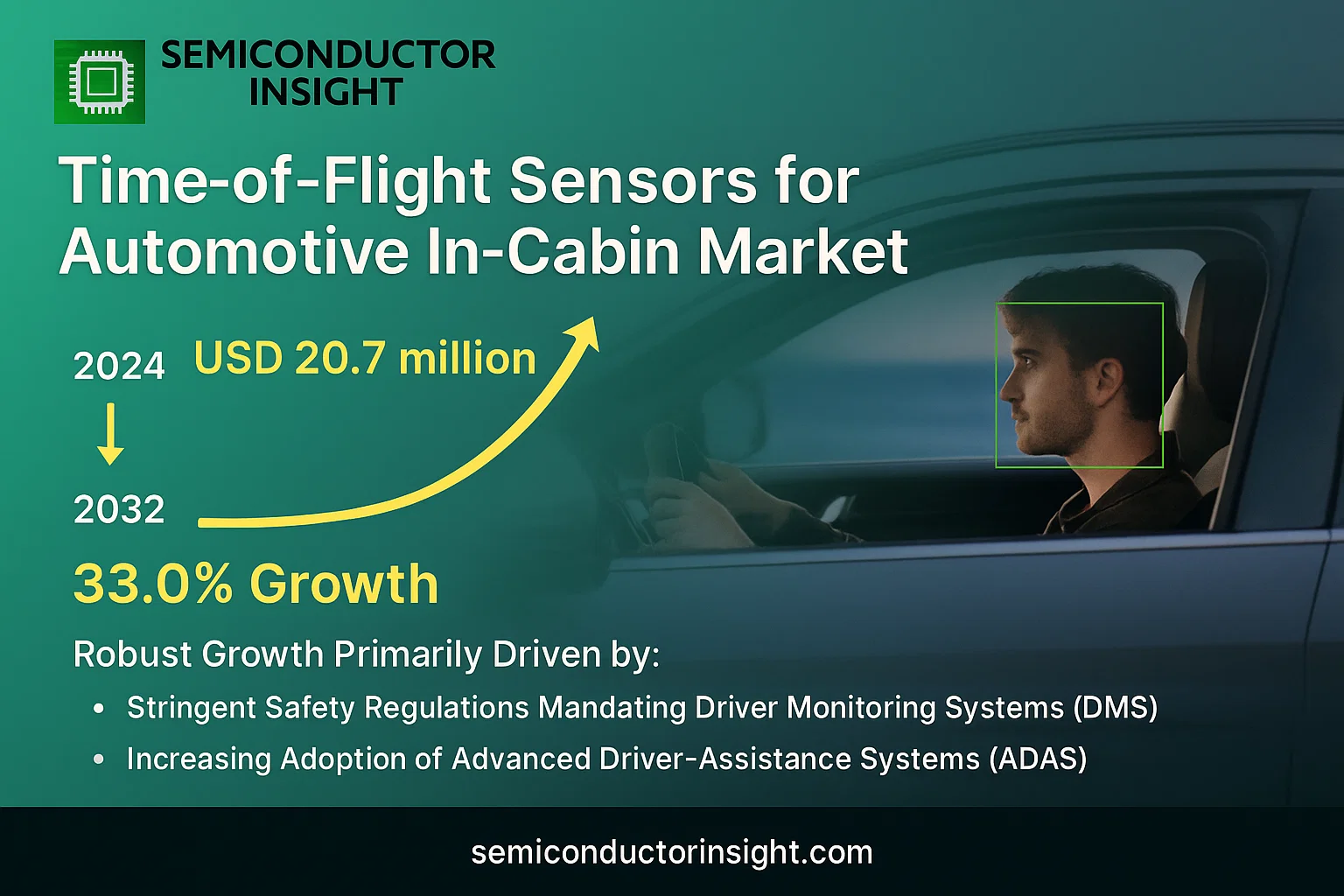
Global Time-of-Flight Sensors for Automotive In-Cabin Market was valued at USD 20.7 million in 2024 and is projected to reach USD 146 million by 2032, exhibiting a CAGR of 33.0% during the forecast period. The robust growth is primarily driven by stringent safety regulations mandating driver monitoring systems (DMS) and the increasing adoption of advanced driver-assistance systems (ADAS) in vehicles.
ToF sensors are integral to in-cabin monitoring, enabling features such as occupant detection, gesture control, and driver monitoring. These sensors provide high-resolution 3D imaging, allowing for accurate detection of driver drowsiness, distraction, or other unsafe behaviors. The integration of ToF sensors enhances safety by enabling features like adaptive airbag deployment based on occupant presence and size.
Key players in the market include Melexis, Infineon Technologies, and Ams AG, among others. These companies are focusing on developing advanced ToF sensors with higher accuracy, lower power consumption, and smaller form factors to meet the demanding requirements of the automotive industry.
MARKET DRIVERS
Rising Demand for In-Cabin Safety and Monitoring Systems
The increasing prioritization of occupant safety is a primary driver for ToF sensor adoption. Regulations like Euro NCAP’s 2023 roadmap, which will include direct assessment of child presence detection and driver monitoring systems from 2025, are compelling automakers to integrate advanced sensing technologies. The demand for robust driver monitoring systems (DMS) to detect drowsiness and distraction further accelerates this trend.
Proliferation of Advanced Cockpit Features
ToF sensors are crucial enablers for sophisticated in-cabin experiences, such as gesture control for infotainment systems and adaptive ambient lighting. The market for premium vehicles, where these features are a key differentiator, is a significant growth area. The global automotive gesture recognition market is projected to grow significantly in the coming years, with ToF technology playing a central role.
➤ The capability of ToF sensors to generate accurate 3D depth maps in real-time, even in low-light conditions, makes them superior for applications requiring precise spatial awareness.
Furthermore, the trend towards autonomous driving is fueling development. As vehicles become more automated, reliable in-cabin monitoring becomes essential to ensure driver readiness for takeover requests, creating a strong, long-term demand driver for ToF technology.
MARKET CHALLENGES
Stringent Automotive Qualification and Cost Sensitivity
Integrating any new component into an automotive environment presents significant challenges. ToF sensors must meet rigorous standards for temperature tolerance, vibration resistance, and long-term reliability, which extends development cycles and increases costs. The automotive supply chain is also highly cost-sensitive, making it difficult for advanced but expensive sensor technologies to achieve high-volume adoption in non-premium vehicle segments.
Other Challenges
System Complexity and Data Privacy
Processing the 3D data from ToF sensors requires substantial computational power, increasing system complexity and cost. Additionally, continuous in-cabin monitoring raises significant data privacy and security concerns among consumers and regulators, requiring robust data handling and anonymization protocols to gain widespread acceptance.
MARKET RESTRAINTS
Competition from Alternative Sensor Technologies
While ToF offers distinct advantages, it faces competition from other sensing modalities. Stereo vision systems and structured light sensors can also provide 3D data, and 2D cameras combined with advanced software algorithms are sometimes seen as a lower-cost alternative for certain functions like basic driver monitoring. The choice of technology often comes down to a trade-off between performance, robustness, and cost, which can restrain ToF sensor adoption in some applications.
MARKET OPPORTUNITIES
Expansion into Occupant Classification and Personalization
Beyond safety, ToF sensors present significant opportunities for occupant classification systems (OCS) that go beyond simple weight sensors. These systems can precisely identify the size and position of each occupant, enabling optimized airbag deployment and personalized seatbelt reminders. This data can also be used to create highly personalized cabin environments, adjusting settings like climate control and audio zones automatically for different passengers.
Growth in Electric and Shared Mobility Vehicles
The rapid growth of the electric vehicle (EV) market provides a key opportunity, as these platforms are often designed with advanced technology integration in mind. Furthermore, the rise of shared mobility and robotaxis creates a need for robust in-cabin monitoring to ensure passenger safety and prevent damage to vehicles, representing a promising new application area for ToF sensor systems.
Time-of-Flight Sensors for Automotive In-Cabin Market Trends
Enhanced Safety Driving Market Expansion
The global Time-of-Flight (ToF) Sensors for Automotive In-Cabin market is undergoing rapid expansion, driven predominantly by the imperative to enhance vehicle safety. The market, valued at $20.7 million in 2024, is projected to reach $146 million by 2032, representing a compound annual growth rate of 33.0%. A primary catalyst for this growth is the use of indirect Time-of-Flight (iToF) technology for driver monitoring systems. Given that over 90% of vehicle accidents are attributed to driver error, the ability of high-resolution iToF sensors to detect driver fatigue—such as yawning, drooping eyelids, or gaze direction—is critical. These systems can warn the driver or initiate safety protocols, including enforcing a break, thereby preventing accidents.
Other Trends
Advanced Passenger Safety Systems
Beyond driver monitoring, ToF sensors are integral to improving passenger safety, particularly through smart airbag deployment. Traditional airbags, while life-saving, can cause injury to occupants like infants or the elderly. ToF sensors can detect the size and estimate the weight of a passenger, allowing the airbag system to adjust its deployment force accordingly or prevent deployment entirely if a seat is unoccupied. This technology also prevents vehicles from automatically starting in unattended, confined spaces by confirming the absence of occupants.
Integration of Comfort and Human-Machine Interface Features
The same ToF sensor systems enabling safety features are also being leveraged to significantly enhance in-cabin comfort and convenience. These applications include automatically adjusting seats and seat belts when a passenger enters the vehicle, illuminating storage compartments as a hand approaches, and modifying infotainment system operation based on occupant number and location. A prominent trend is the evolution of the human-machine interface (HMI); ToF sensors paired with light projectors can create virtual control panels on any surface within the cabin, offering greater flexibility and an intuitive user experience. Gesture control is currently the largest application segment for these sensors.
Regional Market Concentration
The market exhibits a high degree of geographical and corporate concentration. Europe is the largest market, accounting for approximately 60% of the global share, followed by the combined markets of Asia Pacific and North America. The competitive landscape is dominated by a few key players, with Melexis and Infineon Technologies collectively holding over 95% of the market share, underscoring a highly concentrated supplier base for this advanced technology.
COMPETITIVE LANDSCAPE
Key Industry Players
High Concentration with Duopoly Dominating Supply
The global market for Time-of-Flight (ToF) sensors in automotive in-cabin applications is characterized by a highly concentrated supplier base. Market leadership is firmly held by a duopoly of Melexis and Infineon Technologies, which collectively command over 95% of the global market share. This dominance is built upon their extensive expertise in semiconductor manufacturing, strong relationships with major automotive Tier-1 suppliers and OEMs, and significant investments in research and development tailored for the demanding automotive environment. Their products are integral to enabling key safety and convenience features such as driver monitoring systems (DMS) and occupant detection for advanced airbag systems.
Beyond the dominant leaders, a select group of other semiconductor and sensor specialists are actively competing for niche opportunities and preparing for the market’s anticipated expansion. Companies like ams-OSRAM AG, STMicroelectronics, and Texas Instruments bring substantial technological capabilities and are developing advanced ToF solutions. Specialized players such as PMD Technologies, a pioneer in ToF, and Sony Semiconductor Solutions, with its strong imaging sensor background, are also key participants. As the market grows, driven by increasing adoption of safety regulations and enhanced in-cabin experiences, this broader ecosystem of players is expected to capture market segments and drive further innovation.
List of Key Time-of-Flight Sensors for Automotive In-Cabin Companies Profiled
- Melexis
- Infineon Technologies
- ams-OSRAM AG
- STMicroelectronics
- Texas Instruments
- PMD Technologies
- Sony Semiconductor Solutions Corporation
- Teledyne FLIR
- Broadcom Inc.
- Analog Devices, Inc.
- NXP Semiconductors
- ROHM Semiconductor
- Lumentum Holdings Inc.
Segment Analysis:
| Segment Category | Sub-Segments | Key Insights |
| By Type |
|
Indirect Time-of-Flight (iToF) is the dominant technology, primarily due to its superior resolution capabilities which are essential for critical safety applications such as monitoring minute driver behaviors like eye gaze and yawning. This high-resolution data is fundamental for advanced driver monitoring systems that aim to significantly enhance road safety by detecting distraction and fatigue. The technology’s effectiveness in complex in-cabin scenarios, where detailed depth mapping is required for both safety and convenience features, solidifies its leading position. |
| By Application |
|
Gesture Control represents the largest application segment, driven by the automotive industry’s push towards more intuitive and sophisticated human-machine interfaces. This application enhances user experience by allowing touchless control of infotainment and climate systems, promoting convenience and minimizing driver distraction. The growing demand for premium in-cabin features and the evolution towards fully digital cockpits are key factors propelling the adoption of gesture recognition systems powered by ToF sensors. |
| By End User |
|
Premium/Luxury Vehicle OEMs are the leading adopters of in-cabin ToF sensor technology, as they consistently integrate advanced safety and comfort features to differentiate their brands and justify premium pricing. These manufacturers are at the forefront of deploying sophisticated driver monitoring and passenger safety systems as standard or optional equipment. The emphasis on cutting-edge technology, superior in-cabin experiences, and rigorous safety standards makes this segment the primary driver for innovation and initial market penetration. |
| By Safety Function |
|
Active Safety is the primary driver for ToF sensor integration, as they play a crucial role in preventing accidents before they occur. This includes continuous driver monitoring for signs of drowsiness, distraction, or improper behavior, allowing the vehicle to issue warnings or intervene. The ability of ToF sensors to provide real-time, high-fidelity data on occupant status is foundational to developing the proactive safety systems that are central to the evolution of autonomous driving and overall road safety improvements. |
| By In-Cabin Zone |
|
Driver Zone Monitoring is the most critical and dominant application area, directly addressing the paramount concern of driver and road safety. The sensor’s ability to accurately track head position, eye gaze, and facial expressions in real-time is indispensable for assessing driver alertness and focus. This functionality is increasingly mandated by safety regulations and is considered a foundational technology for higher levels of vehicle automation, making it the most aggressively developed and deployed zone for in-cabin ToF sensing. |
Regional Analysis: Time-of-Flight Sensors for Automotive In-Cabin Market
Government initiatives, particularly China’s New Car Assessment Program (C-NCAP), actively promote and sometimes mandate Driver Monitoring Systems, creating a powerful regulatory push for ToF sensor integration for occupant safety and driver attentiveness monitoring in new vehicle models across the region.
A mature ecosystem of semiconductor and electronics manufacturers in countries like Taiwan, South Korea, and China provides a significant advantage, allowing for the efficient and economical production of the sophisticated components required for high-performance ToF sensor systems.
There is a strong and growing consumer appetite for connected and intelligent vehicle features in Asia-Pacific. Buyers highly value in-cabin technologies like gesture control and personalized climate settings, which are enabled by ToF sensors, driving market demand.
The region is a global hub for research and development in automotive electronics. Leading tech companies and automotive OEMs are intensely focused on innovating ToF applications, from child presence detection to advanced human-machine interfaces, ensuring continuous market evolution.
North America
The North American market for automotive in-cabin ToF sensors is characterized by strong growth, driven primarily by stringent safety regulations from bodies like NHTSA and a high consumer preference for premium vehicles equipped with advanced technologies. Leading US and Canadian automakers are integrating these sensors for driver monitoring to combat distraction and fatigue, which are key safety concerns. The focus is also expanding to include occupant classification systems for optimized airbag deployment and enhanced interior comfort features. Collaboration between established automotive suppliers and innovative tech firms in Silicon Valley fosters a dynamic environment for developing next-generation ToF applications, such as more nuanced gesture recognition for infotainment control.
Europe
Europe represents a highly significant market, propelled by the European Union’s rigorous safety standards, including the General Safety Regulation, which mandates features like driver drowsiness and attention warning systems. German automotive luxury brands are at the forefront, utilizing ToF sensors to deliver sophisticated in-cabin experiences, including precise gesture control and occupant monitoring for personalized settings. The market dynamics are further shaped by a strong emphasis on data privacy, influencing how sensor data is processed and stored within the vehicle. European suppliers are also leading in the development of high-resolution, low-power ToF sensors that meet the demanding quality and efficiency standards of the region’s automotive industry.
South America
The South American market for in-cabin ToF sensors is in a developing phase, with adoption primarily concentrated in the premium vehicle segments. Growth is gradual, influenced by economic factors and a slower regulatory pace compared to other regions. However, as global automakers introduce newer models into the market, they are bringing advanced safety and comfort features as standard, which includes basic ToF applications. The focus is initially on essential driver monitoring functions. The long-term potential is tied to economic stability and the gradual trickle-down of advanced safety technologies from high-end to mass-market vehicles, creating future growth opportunities.
Middle East & Africa
The Middle East & Africa region exhibits nascent but promising growth for ToF sensors in automotive cabins. Demand is strongest in the Gulf Cooperation Council (GCC) countries, where high disposable income drives the market for luxury vehicles equipped with the latest technologies, including gesture-based controls and occupant sensing. In other parts of the region, market penetration is slower, constrained by economic conditions and a primary focus on essential vehicle features. The potential for growth is linked to the expanding automotive market and the increasing availability of vehicles with integrated advanced driver-assistance systems that utilize in-cabin monitoring as a core component.
Report Scope
This market research report provides a comprehensive analysis of the Time-of-Flight Sensors for Automotive In-Cabin Market, covering the forecast period 2025–2032. It offers detailed insights into market dynamics, technological advancements, competitive landscape, and key trends shaping the industry.
Key focus areas of the report include:
- Market Overview: The report begins with an overview outlining its current market scenario, key growth indicators, and industry transformation drivers. It discusses macroeconomic factors, demand–supply balance, regulatory landscape, and the strategic role of semiconductors in powering advancements across industries such as automotive, telecommunications, consumer electronics, and industrial automation.
- Market Size & Forecast: Historical data and future projections for revenue, unit shipments, and market value across major regions and segments.
- Segmentation Analysis: Detailed breakdown by product type, technology, application, and end-user industry to identify high-growth segments and investment opportunities.
- Regional Insights: Insights into market performance across North America, Europe, Asia-Pacific, Latin America, and the Middle East & Africa, including country-level analysis where relevant.
- Competitive Landscape: Profiles of leading market participants, including their product offerings, R&D focus, manufacturing capacity, pricing strategies, and recent developments such as mergers, acquisitions, and partnerships.
- Technology Trends & Innovation: Assessment of emerging technologies, integration of AI/IoT, semiconductor design trends, fabrication techniques, and evolving industry standards.
- Market Drivers & Restraints: Evaluation of factors driving market growth along with challenges, supply chain constraints, regulatory issues, and market-entry barriers.
- Stakeholder Insights: Insights for component suppliers, OEMs, system integrators, investors, and policymakers regarding the evolving ecosystem and strategic opportunities.
Primary and secondary research methods are employed, including interviews with industry experts, data from verified sources, and real-time market intelligence to ensure the accuracy and reliability of the insights presented.
FREQUENTLY ASKED QUESTIONS:
What is the current market size of Time-of-Flight Sensors for Automotive In-Cabin Market?
-> Time-of-Flight Sensors for Automotive In-Cabin Market was valued at USD 20.7 million in 2024 and is projected to reach USD 146 million by 2032, exhibiting a CAGR of 33.0% during the forecast period.
Which key companies operate in Time-of-Flight Sensors for Automotive In-Cabin Market?
-> Key players include Melexis, Infineon Technologies, and Ams, among others. Global top two manufacturers hold a share over 95%.
What are the key growth drivers?
-> Key growth drivers include the drive for increased road safety and autonomous vehicles, with over 90% of accidents attributed to driver error, boosting demand for driver monitoring and occupant safety features.
Which region dominates the market?
-> Europe is the largest market, with a share of about 60%, followed by Asia Pacific and North America.
What are the emerging trends?
-> Emerging trends include the integration of ToF for advanced human-machine interfaces (HMI), gesture control, and enhanced in-cabin comfort and convenience features.

Get Sample Report PDF for Exclusive Insights
Report Sample Includes
- Table of Contents
- List of Tables & Figures
- Charts, Research Methodology, and more...
 Download Sample Report PDF