THz Semiconductor Communication Market Insights
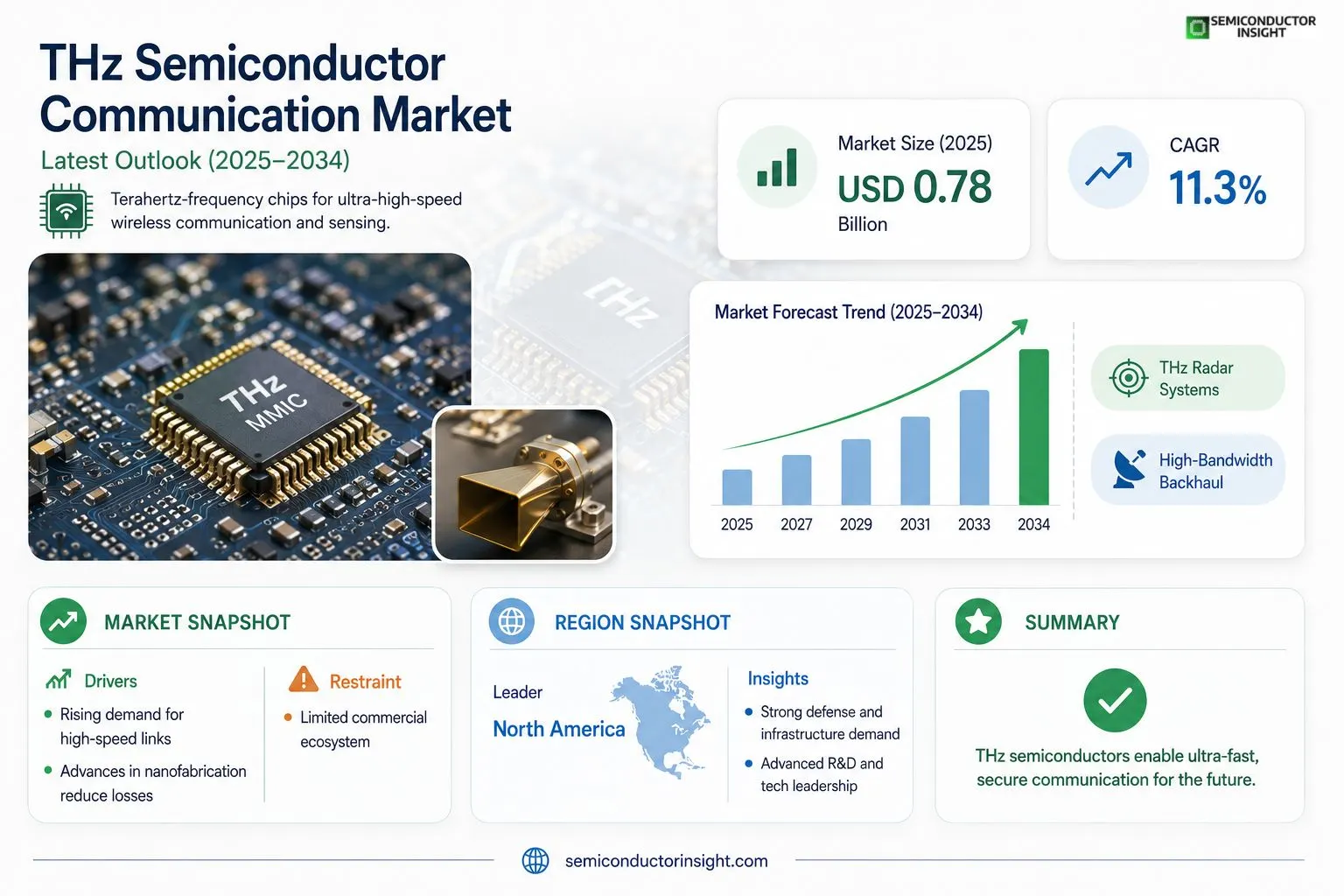
Global THz Semiconductor Communication Market size was valued at USD 0.78 billion in 2025. The market is projected to grow from USD 0.85 billion in 2025 to USD 2 12 billion by 2034, exhibiting a CAGR of 11.3% during the forecast period.
THz semiconductor communication refers to the use of terahertz‑frequency (0.1–10 THz) electronic components for ultra‑high‑speed data transmission and sensing applications. These devices enable line‑of‑sight wireless links exceeding tens of gigabits per second and are integral to emerging sectors such as autonomous vehicles, secure communications, and non‑destructive imaging.The sector is experiencing rapid expansion because defense spending on next‑generation radar systems is increasing, while commercial demand for bandwidth‑intensive services drives adoption in data centers and satellite backhaul.
Furthermore, advances in silicon‑based THz sources reduce cost barriers, encouraging broader deployment.
Key players,including Intel Corp., NXP Semiconductors, Qorvo Inc., and Rohde & Schwarz,are accelerating product roadmaps through strategic partnerships and joint R&D programs.
MARKET DRIVERS
Rising Demand for High‑Speed Wireless Links
The exponential growth of data traffic, projected to exceed 200 EB per year by 2030, is pushing network operators toward ultra‑wideband solutions. THz Semiconductor Communication Market players are capitalizing on the ability of terahertz bands to deliver multi‑gigabit per second links for back‑haul, data‑center interconnects, and emerging 6G services.
Advancements in Nanofabrication Techniques
Recent breakthroughs in CMOS‑compatible nanolithography have reduced waveguide losses to below 1 dB/cm, enabling mass production of compact THz transceivers. These manufacturing gains are driving cost reductions and fostering broader adoption across automotive radar and aerospace communications.
➤ THz devices are now achieving bandwidths exceeding 100 GHz, unlocking new applications in secure, short‑range communications.
Combined, stronger demand and scalable production are creating a robust growth engine for THz Semiconductor Communication Market, positioning it as a pivotal technology in next‑generation wireless ecosystems.
MARKET CHALLENGES
Regulatory and Safety Constraints
Governments worldwide are still defining exposure limits for terahertz radiation, which introduces uncertainty for product certification. The precautionary approach adopted by many regulatory bodies can delay market entry and increase compliance costs.
Other Challenges
Cost of Production
The specialized materials and precision assembly required for THz modules keep unit prices high, limiting penetration in price‑sensitive consumer segments and slowing overall market momentum.
MARKET RESTRAINTS
Limited Commercial Ecosystem
The current supplier base for terahertz components remains narrow, with only a handful of firms offering qualified MMICs and integrated modules. This lack of a diversified ecosystem hampers economies of scale and restricts innovation pipelines.
MARKET OPPORTUNITIES
Emerging Applications in Secure Communications
Governments and defense agencies are exploring THz bands for ultra‑secure, line‑of‑sight links that are resistant to conventional eavesdropping. Additionally, satellite constellations are evaluating terahertz inter‑satellite links to dramatically increase data throughput, presenting a lucrative avenue for market expansion.
THz Semiconductor Communication Market Trends
Rising Defense and Infrastructure Adoption
THz Semiconductor Communication Market is experiencing a pronounced shift toward defense‑driven applications. Modern radar systems increasingly rely on terahertz‑frequency components to achieve finer resolution and faster target tracking, prompting national security budgets to prioritize procurement of THz‑enabled modules. Simultaneously, large‑scale infrastructure projects, such as high‑capacity satellite backhaul and next‑generation data‑center interconnects, are integrating THz links to alleviate bandwidth constraints. This dual pressure is accelerating product qualification cycles and prompting manufacturers to certify components against stringent military standards, thereby creating a feedback loop that elevates overall market momentum.
Other Trends
Silicon‑Based THz Source Advances
Recent breakthroughs in silicon photonics have lowered the cost barrier for THz source fabrication. By leveraging CMOS‑compatible processes, suppliers can embed terahertz oscillators directly onto silicon wafers, reducing both die size and power consumption. These advances enable mass‑production of THz transmitters suitable for commercial data‑center environments, where energy efficiency is a critical metric. Moreover, the integration of silicon‑based sources with existing silicon‑on‑insulator platforms simplifies supply‑chain logistics, allowing OEMs to source parts from established semiconductor foundries rather than niche specialty fabs. The ripple effect is a broader ecosystem of design tools and testing equipment that supports rapid prototyping and short‑time‑to‑market cycles.
Strategic Partnerships and Joint R&D
Key players in THz Semiconductor Communication Market are reinforcing their development pipelines through collaborative agreements. Partnerships between chipset manufacturers and telecommunications firms focus on co‑designing THz transceivers that meet the stringent latency requirements of autonomous vehicle networks. Concurrently, joint research programs with academic institutions are exploring novel materials, such as graphene and indium phosphide, to push carrier frequencies beyond the traditional 0.1‑10 THz window. These alliances not only distribute risk but also accelerate technology transfer, ensuring that breakthroughs transition from laboratory proof‑of‑concept to field‑ready products within realistic timeframes. As a result, the market is poised to sustain an upward trajectory driven by validated engineering progress and coordinated industry effort.
COMPETITIVE LANDSCAPEKey Industry Players
Competitive Dynamics in THz Semiconductor Communication Market
THz Semiconductor Communication Market is anchored by a handful of globally recognized semiconductor giants that dominate both research investment and product roll‑out. Intel Corp., leveraging its advanced silicon‑on‑insulator (SOI) platform, has pioneered integrated THz transceiver modules for data‑center interconnects, while NXP Semiconductors secures a strong position in automotive radar and secure‑link applications through its mixed‑signal THz ASICs. Qorvo Inc. and Rohde & Schwarz complement this core with high‑power THz sources and precision test equipment, respectively, establishing a tier‑one ecosystem that drives the market’s scale‑up. These leaders benefit from deep R&D budgets, strategic defense contracts, and extensive IP portfolios, shaping a market structure where early‑stage innovations rapidly transition to commercial deployments, thereby setting the performance and pricing benchmarks for the entire segment.Beyond the tier‑one cohort, a diverse set of niche innovators contributes critical capabilities that enrich the competitive landscape. Keysight Technologies supplies calibrated measurement solutions essential for product validation, whereas Analog Devices focuses on low‑noise THz amplifiers for sensing and imaging. Skyworks Solutions and Murata Manufacturing target compact, antenna‑integrated modules for 5G‑adjacent use cases. Emerging specialists such as Terahertz Technologies, Toptica Photonics, and STMicroelectronics bring breakthrough source technologies and wafer‑scale integration approaches, fostering a vibrant supply chain that supports both defense‑grade and consumer‑oriented applications. This breadth of specialised players ensures a robust pipeline of differentiated solutions, intensifying competition on performance, cost, and time‑to‑market.
List of Key THz Semiconductor Communication Market Companies Profiled
- Intel Corp.
- NXP Semiconductors
- Qorvo Inc.
- Rohde & Schwarz
- Keysight Technologies
- Analog Devices
- Skyworks Solutions
- Murata Manufacturing
- Terahertz Technologies
- Toptica Photonics
- STMicroelectronics
- Texas Instruments
Segment Analysis:
| Segment Category | Sub-Segments | Key Insights |
| By Type |
|
Photonic THz Emitters are gaining prominence because they:
|
| By Application |
|
High‑Speed Wireless Backhaul is the leading application because it:
|
| By End User |
|
Defense & Aerospace leads the end‑user segment because it:
|
| By Frequency Band |
|
Mid‑Band emerges as the dominant frequency band because it:
|
| By Technology Platform |
|
Silicon‑Based THz Devices are considered the leading platform because they:
|
Regional Analysis: North America
North America
North America’s defense and aerospace sectors are key drivers for THz semiconductor communication advancements, focusing on secure and resilient communication networks for critical operations.
The automotive industry is exploring THz technology for advanced driver-assistance systems (ADAS), in-vehicle communication, and autonomous driving capabilities, demanding high-speed, low-latency connectivity.
Telecommunication companies are evaluating THz for next-generation wireless networks, aiming to increase network capacity and improve user experience with ultra-fast data speeds.
The demand for secure communication solutions is prompting the adoption of THz technology due to its inherent security features and ability to resist eavesdropping.
Europe
Europe is witnessing steady growth in THz Semiconductor Communication Market, with a strong emphasis on research collaborations and the development of specialized applications. European nations are actively investing in THz technology for advanced sensing, industrial automation, and high-performance computing. A key focus remains on fostering innovation through public-private partnerships and supporting the development of THz-enabled devices and systems. The automotive sector in Europe is increasingly exploring THz for advanced safety and connectivity features, aligning with the region’s stringent automotive regulations. Furthermore, the aerospace industry in Europe is leveraging THz for secure communication and advanced radar systems. The region’s commitment to sustainable technologies also presents opportunities for THz applications in energy monitoring and grid optimization, although these areas are still in early stages of development.
Asia-Pacific
Asia-Pacific is emerging as a rapidly expanding market for THz semiconductor communication, driven by robust economic growth, rapid technological advancements, and increasing government initiatives to promote innovation. Countries like China, Japan, and South Korea are leading the way in THz research and development, with significant investments in THz-enabled devices and systems. The telecommunications sector in Asia-Pacific is a major driver, with operators actively exploring THz for next-generation wireless networks and high-speed data transfer. The automotive industry in the region is also embracing THz technology for autonomous driving, advanced driver-assistance systems (ADAS), and in-vehicle communication. Furthermore, the defense and aerospace sectors in Asia-Pacific are investing in THz for secure communication and advanced radar systems. The region’s strong manufacturing base provides a competitive advantage for THz semiconductor companies, enabling cost-effective production and widespread adoption.
South America
South America presents a nascent but promising market for THz semiconductor communication. Initial adoption is primarily focused on specialized applications within the telecommunications, defense, and research sectors. Governments in the region are beginning to recognize the potential of THz technology to enhance communication infrastructure and drive economic growth. The telecommunications market in countries like Brazil and Argentina is gradually exploring THz for improved network capacity and faster data speeds. The increasing demand for high-speed internet access is expected to further accelerate the adoption of THz technology in the years to come. However, challenges related to infrastructure development and regulatory frameworks may hinder the rapid growth of the market in the short term.
Middle East & Africa
The Middle East & Africa region represents an emerging market for THz semiconductor communication, with growing investments in telecommunications infrastructure and defense applications. Countries in the region are seeking to modernize their communication networks and enhance security capabilities, creating opportunities for THz technology. The telecommunications sector in countries like the UAE, Saudi Arabia, and South Africa is exploring THz for improved network performance and data transfer speeds. The defense industry in the region is also investing in THz for secure communication and advanced radar systems. The increasing adoption of 5G and upcoming 6G networks is expected to drive demand for THz-enabled devices and systems in the coming years. However, challenges related to high initial costs and limited awareness of the technology may hinder the widespread adoption of THz in the region.
Report Scope
This market research report provides a comprehensive analysis of the THz Semiconductor Communication Market , covering the forecast period 2026–2034. It offers detailed insights into market dynamics, technological advancements, competitive landscape, and key trends shaping the industry.
Key focus areas of the report include:
- Market Overview: The report begins with an overview outlining its current market scenario, key growth indicators, and industry transformation drivers. It discusses macroeconomic factors, demand–supply balance, regulatory landscape, and the strategic role of semiconductors in powering advancements across industries such as automotive, telecommunications, consumer electronics, and industrial automation.
- Market Size & Forecast: Historical data and future projections for revenue, unit shipments, and market value across major regions and segments.
- Segmentation Analysis: Detailed breakdown by product type, technology, application, and end-user industry to identify high-growth segments and investment opportunities.
- Regional Insights: Insights into market performance across North America, Europe, Asia-Pacific, Latin America, and the Middle East & Africa, including country-level analysis where relevant.
- Competitive Landscape: Profiles of leading market participants, including their product offerings, R&D focus, manufacturing capacity, pricing strategies, and recent developments such as mergers, acquisitions, and partnerships.
- Technology Trends & Innovation: Assessment of emerging technologies, integration of AI/IoT, semiconductor design trends, fabrication techniques, and evolving industry standards.
- Market Drivers & Restraints: Evaluation of factors driving market growth along with challenges, supply chain constraints, regulatory issues, and market-entry barriers.
- Stakeholder Insights: Insights for component suppliers, OEMs, system integrators, investors, and policymakers regarding the evolving ecosystem and strategic opportunities.
Primary and secondary research methods are employed, including interviews with industry experts, data from verified sources, and real-time market intelligence to ensure the accuracy and reliability of the insights presented.
FREQUENTLY ASKED QUESTIONS:
What is the current market size of THz Semiconductor Communication Market?
-> THz Semiconductor Communication Market was valued at USD 0.78 billion in 2025 and is expected to reach USD 2.12 billion by 2034, exhibiting a CAGR of 11.3% during the forecast period.
Which key companies operate in THz Semiconductor Communication Market?
-> Key players include Intel Corp., NXP Semiconductors, Qorvo Inc., and Rohde & Schwarz.
What are the key growth drivers?
-> Key growth drivers include increased defense spending on next‑generation radar, rising demand for high‑bandwidth services in data centers and satellite backhaul, and cost reductions from silicon‑based THz source technologies.
Which region dominates the market?
-> Adoption is widespread globally, with strong presence in North America and Europe, while Asia‑Pacific shows rapid growth potential.
What are the emerging trends?
-> Emerging trends include advancements in silicon‑based THz emitters, integration of THz communication with AI‑driven network management, and expanding applications in autonomous vehicles and secure communications.
Get Sample Report PDF for Exclusive Insights
Report Sample Includes
- Table of Contents
- List of Tables & Figures
- Charts, Research Methodology, and more...
 Download Sample Report PDF