MARKET INSIGHTS
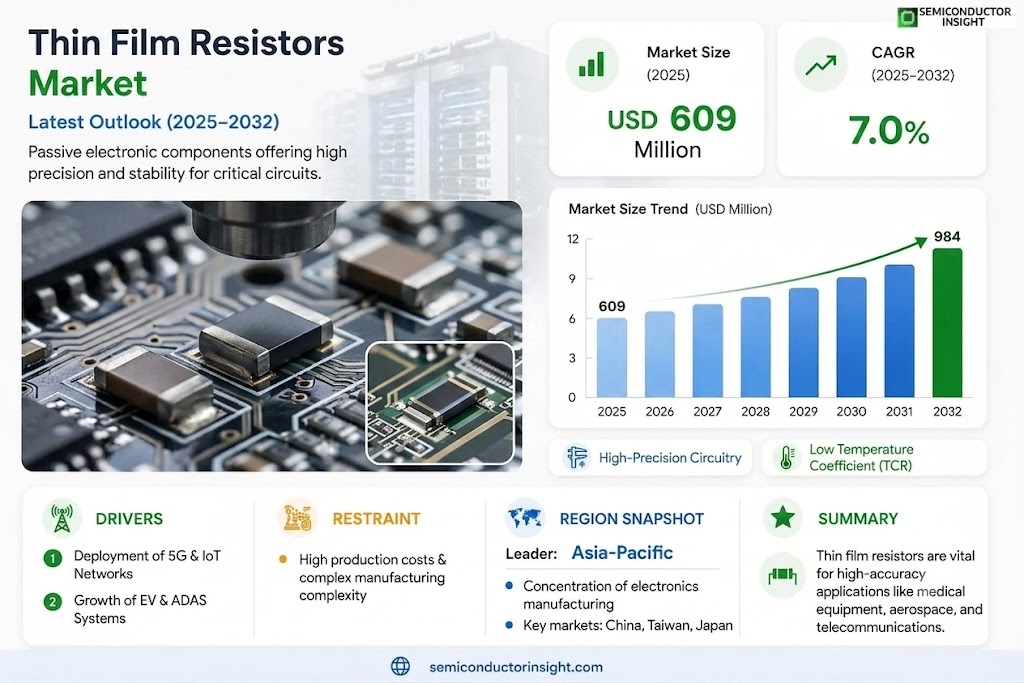
The global Thin Film Resistors Market was valued at 609 million in 2024 and is projected to reach US$ 984 million by 2032, at a CAGR of 7.0% during the forecast period.
Thin film resistors are precision electronic components manufactured by sputtering a uniform metallic film, typically a nickel-chromium alloy (Nichrome), approximately 0.1 micrometers thick onto a ceramic base. This dense, uniform layer is then precisely trimmed using photo etching or laser techniques to achieve high-accuracy resistance values. These components are fundamental in applications demanding exceptional stability, low noise, and minimal temperature coefficient of resistance (TCR).
The market growth is primarily driven by the escalating demand for high-precision instrumentation across various sectors, including medical equipment, industrial measurement systems, and automotive electronics. Furthermore, the expansion of communication infrastructure and the proliferation of advanced automotive electronics are significant contributors. The market is highly concentrated, with Vishay holding a dominant 29.96% revenue share in 2024. Geographically, Asia Pacific is the largest market, accounting for over 28.71% of global consumption, with China alone representing 27.09% of global sales volume.
MARKET DYNAMICS
MARKET DRIVERS
Expansion of High-Precision Electronics to Drive Market Growth
The global thin film resistors market is experiencing robust growth driven by the increasing demand for high-precision electronic components across multiple industries. These resistors offer superior performance characteristics including tolerances as low as 0.05%, temperature coefficients below 25 ppm/°C, and excellent high-frequency response, making them indispensable in applications requiring extreme accuracy. The medical equipment sector, which accounted for approximately 18% of market revenue in 2024, continues to expand rapidly due to aging global populations and increased healthcare spending. Industrial and measurement equipment applications represented the largest segment at 32% market share, driven by the need for precise control systems in manufacturing automation and test instrumentation. The automotive electronics segment is growing at approximately 9% annually as electric vehicles and advanced driver-assistance systems incorporate more sophisticated electronic controls requiring stable, reliable resistor performance.
Advancements in Communication Infrastructure to Boost Market Demand
The rapid deployment of 5G networks and expansion of IoT infrastructure are creating substantial demand for thin film resistors in communication devices, which represented 22% of the market in 2024. These resistors provide critical performance advantages in high-frequency applications where low parasitic inductance and capacitance are essential. The global rollout of 5G infrastructure requires massive investment in base stations and network equipment, each containing hundreds of precision resistors. Additionally, the proliferation of IoT devices, projected to exceed 29 billion connected devices by 2030, necessitates compact, reliable components that can operate in diverse environmental conditions. Thin film resistors meet these requirements while offering the stability needed for long-term operation in smart city infrastructure, industrial IoT applications, and consumer connected devices.
Growing Automotive Electronics Complexity to Fuel Market Expansion
Automotive electronics represent one of the fastest-growing segments for thin film resistors, with projected annual growth of 8.5% through 2032. The automotive industry’s transition toward electric vehicles, autonomous driving systems, and advanced infotainment requires sophisticated electronic control units that depend on precision components. Modern vehicles contain thousands of resistors, with premium models incorporating over 10,000 electronic components. The stringent reliability requirements of automotive applications, including operation across temperature ranges from -40°C to 150°C and resistance to vibration and humidity, make thin film resistors the preferred choice. The global electric vehicle market, which grew by 35% in 2023, particularly drives demand for high-reliability components in battery management systems, power conversion units, and motor control systems.
MARKET RESTRAINTS
High Production Costs and Complex Manufacturing to Limit Market Penetration
Despite their performance advantages, thin film resistors face significant market restraints due to their substantially higher production costs compared to thick film alternatives. The manufacturing process involves vacuum deposition techniques, precision laser trimming, and specialized materials that increase production expenses by 300-500% over thick film resistors. The sophisticated equipment required for thin film deposition, including high-vacuum sputtering systems costing millions of dollars, creates substantial barriers to entry for new manufacturers. Additionally, the yield rates in thin film resistor production typically range between 85-92%, compared to 95-98% for thick film resistors, further increasing per-unit costs. These cost factors make thin film resistors economically viable only in applications where their performance advantages are absolutely necessary, limiting their market penetration in cost-sensitive segments.
Technical Complexity and Specialized Material Requirements to Hinder Market Growth
The technical complexity of thin film resistor manufacturing presents significant challenges to market expansion. The process requires extremely controlled environments with cleanliness standards exceeding Class 100 cleanrooms and temperature stability within ±0.5°C. Material selection is critical, with nickel-chromium alloys representing approximately 65% of the market but requiring precise composition control to achieve desired resistivity and temperature coefficient characteristics. The deposition process must maintain film thickness uniformity within 5% across substrates, while laser trimming operations demand positioning accuracy of ±1 micron. These technical requirements necessitate highly specialized equipment and personnel, with experienced process engineers commanding premium salaries in the competitive electronics manufacturing sector. The complexity of scaling production while maintaining quality consistency has limited the number of manufacturers capable of producing commercial-grade thin film resistors at volume.
Competition from Alternative Technologies to Constrain Market Development
Thin film resistors face increasing competition from alternative technologies that offer improving performance at lower costs. Advanced thick film resistors now achieve tolerances of 0.5% and temperature coefficients of 50 ppm/°C, sufficient for many applications that previously required thin film components. Metal foil resistors, while more expensive, provide superior stability and lower noise characteristics for ultra-precision applications. The development of integrated passive devices and semiconductor-based resistor arrays also threatens the traditional discrete resistor market. Additionally, the trend toward miniaturization has driven development of chip resistors with dimensions below 01005 size (0.4mm × 0.2mm), where thick film technology maintains cost advantages. These competitive pressures force thin film resistor manufacturers to continuously innovate while facing price erosion in established market segments.
MARKET CHALLENGES
Supply Chain Vulnerabilities and Material Availability to Challenge Market Stability
The thin film resistor market faces significant supply chain challenges due to its reliance on specialized materials and equipment. Nickel-chromium alloys, tantalum nitride, and other thin film materials require precise composition control and specialized manufacturing processes. Global supply disruptions affecting precious metals and rare earth elements have caused price volatility exceeding 40% annually for some resistor materials. The specialized equipment market is dominated by a few manufacturers, creating single-source dependencies for critical production machinery. Lead times for advanced sputtering systems can exceed 12 months, complicating capacity expansion plans. Additionally, the ceramic substrates used in thin film resistors require high-purity alumina with specific surface characteristics, with supply constraints periodically affecting production schedules and costs.
Other Challenges
Technical Standardization Issues
The absence of universal technical standards across different manufacturers creates compatibility challenges for design engineers. While basic parameters like resistance value and tolerance are standardized, characteristics such as pulse handling capability, long-term stability under load, and performance at extreme temperatures vary significantly between manufacturers. This lack of standardization complicates second-source qualification processes and increases design validation costs for customers incorporating thin film resistors into critical applications.
Environmental Regulation Compliance
Increasing environmental regulations regarding hazardous materials used in manufacturing present ongoing compliance challenges. Restrictions on lead, cadmium, and other substances require continuous reformulation of materials and processes. The REACH and RoHS directives in particular have forced manufacturers to invest significantly in developing alternative materials that maintain performance characteristics while meeting environmental requirements, adding to development costs and time-to-market for new products.
MARKET OPPORTUNITIES
Emerging Applications in Renewable Energy and Power Electronics to Create Growth Opportunities
The rapid expansion of renewable energy infrastructure presents substantial growth opportunities for thin film resistors. Solar inverters, wind turbine control systems, and energy storage systems require precision resistors capable of operating in harsh environmental conditions while maintaining long-term stability. The global renewable energy market is projected to grow at 8.5% annually, driving demand for reliable electronic components. Power electronics applications, particularly in electric vehicle charging infrastructure and industrial motor drives, require resistors with high pulse handling capability and excellent temperature stability. Thin film resistors are increasingly specified in these applications due to their superior performance compared to thick film alternatives, particularly in high-frequency switching applications where parasitic effects must be minimized.
Advancements in Aerospace and Defense Electronics to Drive Premium Segment Growth
Aerospace and defense applications represent a high-value growth opportunity for thin film resistor manufacturers. These sectors require components that meet stringent reliability standards, including MIL-PRF-55342 and other military specifications, while offering extreme environmental stability. The increasing electronic content in modern aircraft, including fly-by-wire systems, avionics, and communication equipment, drives demand for precision resistors. Defense applications in radar systems, electronic warfare equipment, and guidance systems require components with tight tolerance, low noise, and stability under mechanical stress. The global defense electronics market is projected to exceed $250 billion by 2028, creating sustained demand for high-reliability thin film resistors. Manufacturers capable of meeting these demanding specifications can command premium pricing and establish long-term supply relationships.
Development of Advanced Packaging Technologies to Enable New Applications
Innovations in electronic packaging technologies are creating new opportunities for thin film resistor integration. The development of embedded component technology allows resistors to be incorporated within printed circuit board layers, saving space and improving performance. System-in-package and multi-chip module approaches increasingly incorporate thin film resistors directly onto semiconductor substrates. These advanced packaging techniques are particularly valuable in medical implants, wearable electronics, and space-constrained applications where every millimeter matters. The global advanced packaging market is growing at approximately 8% annually, driven by demands for miniaturization and improved performance. Thin film resistor manufacturers that develop capabilities for integration into these advanced packaging platforms can access new market segments and applications beyond traditional discrete components.
THIN FILM RESISTORS MARKET TRENDS
Advancements in High-Frequency and Miniaturized Electronics to Emerge as a Trend in the Market
The relentless push towards higher frequency applications and component miniaturization is fundamentally reshaping the thin film resistors market. These precision components are increasingly critical in 5G infrastructure, advanced driver-assistance systems (ADAS), and high-speed data communication equipment, where their superior performance over thick film alternatives is non-negotiable. The inherent low parasitic inductance and capacitance of thin film technology make it indispensable for signals operating in the gigahertz range, a capability that is becoming standard rather than exceptional. Furthermore, the drive for miniaturization, exemplified by the proliferation of 01005 and 0201 chip sizes, demands the precise and stable characteristics that only thin film deposition processes can provide consistently. This trend is further amplified by the integration of these resistors into complex system-in-package (SiP) and multi-chip module (MCM) designs, where space is at an absolute premium and electrical performance cannot be compromised. The market is responding with innovations in laser trimming accuracy, allowing for tolerances as tight as ±0.01%, and the development of new alloy compositions to achieve even lower temperature coefficients of resistance (TCR), often below 5 ppm/°C.
Other Trends
Expansion in Automotive Electronics and Electrification
The automotive sector’s transformation towards electrification and autonomy is creating substantial, sustained demand for high-reliability thin film resistors. These components are essential in battery management systems (BMS) for electric vehicles, where they must provide precise voltage monitoring and current sensing with minimal drift over extreme temperature ranges and the vehicle’s entire lifespan. Similarly, ADAS modules, LiDAR systems, and infotainment units rely on the stability and low noise of thin film resistors to ensure accurate signal processing and system safety. The automotive industry’s stringent quality and longevity requirements, such as AEC-Q200 certification, align perfectly with the inherent reliability of thin film technology. This has led to a notable shift where these components, once reserved for niche high-end applications, are now being designed into mass-market vehicle platforms, significantly expanding their total addressable market.
Growing Demand in Medical and Industrial Precision Equipment
Beyond consumer and automotive electronics, the medical and industrial instrumentation sectors continue to be cornerstone consumers of thin film resistors. The need for extreme accuracy and long-term stability in devices like patient monitoring systems, diagnostic imaging equipment, laboratory analyzers, and precision test and measurement instruments fuels consistent market growth. In medical technology, the absolute reliability of a component can be critical to patient safety, making the performance pedigree of thin film resistors a key selection criterion. In industrial settings, these resistors are deployed in process control systems, sensor interfaces, and power supplies where measurement integrity directly impacts operational efficiency and product quality. The market is witnessing a trend towards custom-designed resistor networks and arrays that offer matched TCR and resistance values, providing system designers with optimized performance in a single package. This demand for application-specific solutions, coupled with the general growth in global healthcare expenditure and industrial automation, ensures a robust and stable foundation for the thin film resistors market.
COMPETITIVE LANDSCAPE
Key Industry Players
Companies Focus on Precision and Innovation to Maintain Market Leadership
The global thin film resistors market exhibits a semi-consolidated structure, characterized by the presence of several established multinational corporations alongside numerous specialized regional manufacturers. Market leadership is heavily influenced by technological prowess, manufacturing scale, and the ability to serve high-growth end-markets like automotive electronics, medical equipment, and communication devices.
Vishay Intertechnology, Inc. is the undisputed market leader, commanding a significant 29.96% revenue share in 2024. This dominance is primarily attributed to its extensive and advanced product portfolio, which includes ultra-precision resistors with tolerances as low as 0.05%. The company’s strong global distribution network and longstanding reputation for reliability in precision applications solidify its top position. Furthermore, Vishay’s continuous investment in R&D for new materials and laser trimming technologies ensures its products meet the evolving demands for miniaturization and performance.
Following Vishay, Susumu Co., Ltd. and KOA Speer Electronics, Inc. are also major forces, holding revenue shares of approximately 12.26% and 9.48% respectively. These companies have carved out strong niches; Susumu is renowned for its high-quality chip resistors used in automotive and industrial applications, while KOA Speer is a key supplier to the consumer electronics and telecommunications sectors. Their growth is fueled by consistent product innovation and strategic focus on high-volume, precision-driven markets.
Additionally, these leading players are actively pursuing growth through strategic initiatives. Geographic expansion into emerging economies in Asia Pacific, particularly China and Southeast Asia, is a common tactic to capture new demand. Concurrently, new product launches featuring lower temperature coefficients and enhanced high-frequency performance are critical for maintaining technological competitiveness and market share over the forecast period.
Meanwhile, other significant participants like Yageo Corporation and Panasonic Corporation are strengthening their market presence through aggressive mergers and acquisitions, as well as significant capital investments in automated production facilities. This allows them to compete effectively on both cost and technology, particularly in the rapidly growing automotive electronics segment where reliability is paramount. TE Connectivity and Bourns, Inc. are also notable for their deep expertise in providing customized resistor solutions for specific client needs, further enriching the competitive dynamics of the market.
List of Key Thin Film Resistor Companies Profiled
- Vishay Intertechnology, Inc. (U.S.)
- Susumu Co., Ltd. (Japan)
- KOA Speer Electronics, Inc. (U.S.)
- Viking Tech Corporation (Taiwan)
- Yageo Corporation (Taiwan)
- Panasonic Corporation (Japan)
- Walsin Technology Corporation (Taiwan)
- Ta-I Technology Co., Ltd. (Taiwan)
- Bourns, Inc. (U.S.)
- UniOhm Co., Ltd. (China)
- TE Connectivity Ltd. (Switzerland)
- Samsung Electro-Mechanics (South Korea)
- Ralec Electronics Corporation (Taiwan)
- Ever Ohms Technology Co., Ltd. (Taiwan)
Segment Analysis:
By Tolerance
Ultra Precision 0.05% Tolerance Segment Leads Due to Critical Demand in High-Accuracy Applications
The market is segmented based on tolerance into:
- Ultra Precision 0.05% Tolerance
- 0.1% Tolerance
- 1% Tolerance
- Others
By Application
Industrial and Measurement Equipment Segment Dominates Owing to Extensive Use in Precision Instrumentation
The market is segmented based on application into:
- Industrial and Measurement Equipment
- Medical Equipment
- Automotive Electronics
- Communication Device
- Others
By Product Form
Chip/SMD Resistors Hold Majority Share Driven by Miniaturization Trends in Electronics
The market is segmented based on product form into:
- Chip/SMD Resistors
- Axial Lead Resistors
- Network Resistors
By Material
Nichrome (NiCr) Alloy Segment Prevails Due to Excellent Stability and TCR Performance
The market is segmented based on material into:
- Nichrome (NiCr)
- Tantalum Nitride (TaN)
- Silicon Chromium (SiCr)
- Others
Regional Analysis: Thin Film Resistors Market
Asia-Pacific
The Asia-Pacific region is the undisputed leader in the global thin film resistors market, both in terms of production and consumption. This dominance is primarily driven by China, which alone accounted for 27.09% of global sales volume in 2024. The region’s robust electronics manufacturing ecosystem, encompassing everything from consumer electronics to advanced automotive systems, creates massive, sustained demand for high-precision components. Countries like Japan and South Korea are hubs for technological innovation, producing ultra-high-precision resistors for medical and measurement equipment. While cost sensitivity in certain segments keeps thick-film resistors relevant, the relentless push toward miniaturization, higher performance, and improved reliability in devices is fueling a strong and steady shift toward thin film technology. Furthermore, government initiatives supporting semiconductor and electronics self-sufficiency, particularly in China and India, are catalyzing local production and R&D investments, ensuring the region’s continued market leadership.
North America
North America represents a significant and technologically advanced market for thin film resistors, holding over 28.71% of global consumption. The demand is heavily concentrated in high-value applications where precision and reliability are non-negotiable. The United States, with its strong aerospace, defense, and medical technology sectors, is a primary consumer. These industries require components that can perform under extreme conditions with minimal tolerance for error, making thin film resistors the preferred choice. Furthermore, advancements in automotive electronics, particularly in electric and autonomous vehicles which rely on sophisticated sensor and control systems, are providing a substantial growth vector. The market is characterized by a demand for cutting-edge products with very low tolerances (such as 0.1% and 0.05%) and high stability, driving innovation among both local and international suppliers serving this region.
Europe
Europe’s market is shaped by its strong industrial and automotive manufacturing base, particularly in Germany, France, and the UK. The region has a pronounced demand for thin film resistors in industrial and measurement equipment, medical devices, and automotive electronics, adhering to strict quality and performance standards. European Union regulations, including those concerning electronic waste (WEEE) and hazardous substances (RoHS), indirectly influence material choices and manufacturing processes, favoring reliable and long-lasting components that thin film resistors provide. The presence of major automotive OEMs and a thriving industrial automation sector drives the need for precision electronic components that ensure accuracy and durability in end products. Innovation is focused on developing resistors that meet these high performance criteria while also aligning with the region’s sustainability goals.
South America
The thin film resistors market in South America is emerging and is currently characterized by its nascency compared to other regions. Growth is primarily fueled by the gradual modernization of industrial infrastructure and the expanding automotive sector in countries like Brazil and Argentina. However, the market’s development is tempered by economic volatility, which impacts capital investment in advanced manufacturing and high-tech industries. While there is a recognized need for precision components in certain applications, cost constraints often lead to a higher reliance on thick film resistors for more price-sensitive projects. The adoption of thin film technology is therefore gradual, growing in tandem with the region’s economic stability and the increasing sophistication of its local manufacturing capabilities.
Middle East & Africa
The Middle East and Africa region presents a developing market for thin film resistors, with potential anchored in specific industrial and infrastructure development projects. Demand is primarily driven by the oil and gas industry, which requires reliable measurement and control systems, and by telecommunications infrastructure expansion. However, the market is still in its early stages of adoption. The focus tends to be on durable components for harsh environments rather than the ultra-high precision that defines more mature markets. Growth is inconsistent across the region, with more developed nations like Israel, Saudi Arabia, and the UAE showing stronger adoption rates due to their investments in technology and diversification efforts. Overall, the market potential is long-term, dependent on broader economic diversification and industrial growth.
Report Scope
This market research report provides a comprehensive analysis of the global and regional Thin Film Resistors markets, covering the forecast period 2025–2032. It offers detailed insights into market dynamics, technological advancements, competitive landscape, and key trends shaping the industry.
Key focus areas of the report include:
- Market Size & Forecast: Historical data and future projections for revenue, unit shipments, and market value across major regions and segments.
- Segmentation Analysis: Detailed breakdown by tolerance level, application, and end-user industry to identify high-growth segments and investment opportunities.
- Regional Outlook: Insights into market performance across North America, Europe, Asia-Pacific, Latin America, and the Middle East & Africa, including country-level analysis where relevant.
- Competitive Landscape: Profiles of leading market participants, including their product offerings, R&D focus, manufacturing capacity, pricing strategies, and recent developments such as mergers, acquisitions, and partnerships.
- Technology Trends & Innovation: Assessment of emerging fabrication techniques, integration of AI/IoT in precision electronics, semiconductor design trends, and evolving industry standards.
- Market Drivers & Restraints: Evaluation of factors driving market growth along with challenges, supply chain constraints, regulatory issues, and market-entry barriers.
- Stakeholder Analysis: Insights for component suppliers, OEMs, system integrators, investors, and policymakers regarding the evolving ecosystem and strategic opportunities.
Primary and secondary research methods are employed, including interviews with industry experts, data from verified sources, and real-time market intelligence to ensure the accuracy and reliability of the insights presented.
FREQUENTLY ASKED QUESTIONS:
What is the current market size of Global Thin Film Resistors Market?
-> Thin Film Resistors Market was valued at 609 million in 2024 and is projected to reach US$ 984 million by 2032, at a CAGR of 7.0% during the forecast period.
Which key companies operate in Global Thin Film Resistors Market?
-> Key players include Vishay, Susumu, KOA Speer Electronics, Viking Tech, Yageo, Panasonic, Walsin Technology, Ta-I Technology, Bourns, and UniOhm, among others.
What are the key growth drivers?
-> Key growth drivers include increasing demand for precision instruments, growth in medical equipment manufacturing, and expansion of automotive electronics and communication devices.
Which region dominates the market?
-> Asia-Pacific is the largest consumption region, with China alone accounting for 27.09% of global sales volume, while North America holds the second-largest market share.
What are the emerging trends?
-> Emerging trends include advancements in laser trimming technology, development of ultra-high precision resistors with 0.05% tolerance, and increased integration in IoT and AI-enabled devices.

Get Sample Report PDF for Exclusive Insights
Report Sample Includes
- Table of Contents
- List of Tables & Figures
- Charts, Research Methodology, and more...
 Download Sample Report PDF