MARKET INSIGHTS
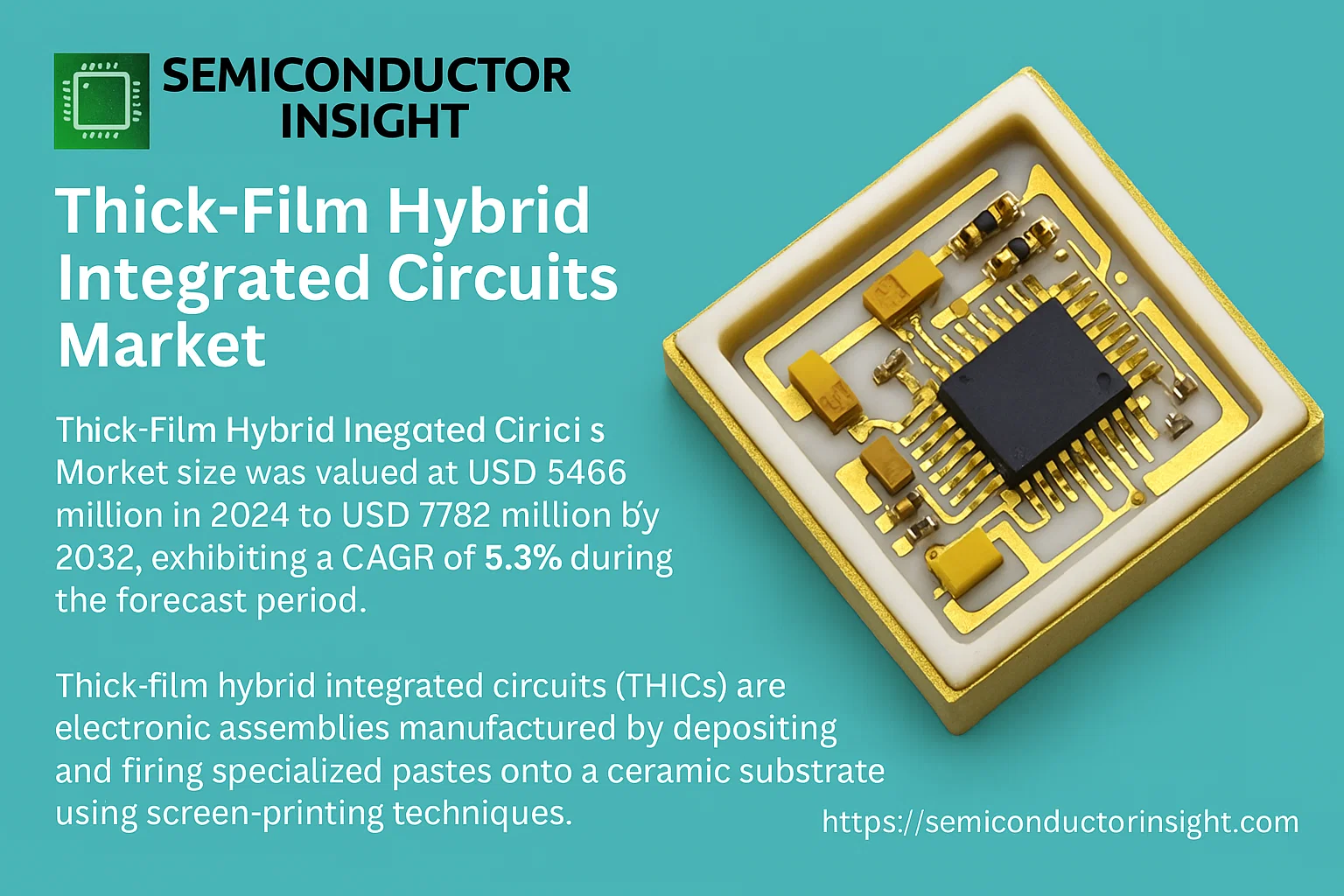
Global Thick-Film Hybrid Integrated Circuits Market size was valued at USD 5466 million in 2024 to USD 7782 million by 2032, exhibiting a CAGR of 5.3% during the forecast period.
Thick-film hybrid integrated circuits (THICs) are electronic assemblies manufactured by depositing and firing specialized pastes onto a ceramic substrate using screen-printing techniques. This process creates a robust, high-density passive network, which is then populated with active components like semiconductor chips or monolithic ICs to form a complete circuit module. A key characteristic of THICs is their superior performance in demanding applications; they offer high reliability, excellent thermal stability, and can withstand high voltages and power levels more effectively than many alternative technologies.
The market growth is primarily driven by increasing demand from the automotive industry for advanced driver-assistance systems (ADAS) and electric vehicle power management, alongside sustained requirements from aviation and defense sectors for ruggedized electronics. Furthermore, the expansion of telecommunications infrastructure and industrial automation continues to fuel demand. While semiconductor ICs dominate in mass-produced digital logic, thick-film hybrids maintain a competitive edge in specialized areas such as high-power circuits, RF/microwave applications, and precision analog systems where their material properties and design flexibility are critical.
MARKET DRIVERS
Growing Demand for Miniaturization and High Reliability in Electronics
The relentless push for smaller, lighter, and more reliable electronic components across industries is a primary driver for thick-film hybrid integrated circuits (HICs). These circuits, fabricated by screen-printing and firing conductive, resistive, and dielectric pastes onto a ceramic substrate, offer excellent performance in harsh environments. Their ability to integrate passive components and semiconductor dies into a single, robust package makes them indispensable in applications where space is constrained and failure is not an option, such as in **automotive electronics, aerospace, and medical devices**. The technology’s inherent durability and stable performance over wide temperature ranges align perfectly with the demands of modern electronics.
Expansion in Automotive and Industrial Automation Sectors
The automotive industry’s rapid transition towards electric vehicles (EVs), advanced driver-assistance systems (ADAS), and greater electronic content per vehicle is creating substantial demand. Thick-film HICs are widely used in engine control units, sensor interfaces, power management systems, and LED lighting drivers due to their high-power handling capability and resistance to thermal and mechanical stress. Similarly, the growth of industrial automation and the Industrial Internet of Things (IIoT) requires robust control and sensor modules that can operate reliably in factory settings, further propelling market growth.
Advancements in materials science, particularly the development of advanced pastes with higher conductivity and improved thermal properties, are also enhancing the performance and expanding the application scope of thick-film technology, making it competitive with alternative solutions.
MARKET CHALLENGES
Competition from Alternative Technologies
A significant challenge for the thick-film HIC market is the intense competition from other integration technologies, primarily thin-film and printed circuit board (PCB) assemblies. Thin-film technology offers higher precision and better performance for high-frequency applications, while advanced PCBs can often provide a lower-cost solution for less demanding applications. Convincing designers to choose thick-film technology requires demonstrating a clear value proposition regarding **reliability, power density, and customizability** for specific harsh-environment use cases.
Other Challenges
Supply Chain Volatility for Raw Materials
The production of thick-film pastes relies on specific metals and ceramics, such as silver, palladium, and alumina substrates. Fluctuations in the prices and availability of these raw materials can lead to increased production costs and supply chain disruptions, posing a challenge for manufacturers in maintaining stable pricing and delivery schedules.
Technical Complexity and Skilled Labor Shortage
The thick-film fabrication process involves precise screen printing, drying, and high-temperature firing steps that require significant expertise. A shortage of highly skilled technicians and process engineers can hinder production scalability and innovation, potentially limiting market growth for specialized, high-performance applications.
MARKET RESTRAINTS
High Initial Setup and Tooling Costs
The capital investment required for establishing a thick-film hybrid integrated circuit production line is substantial. This includes the cost of screen printers, furnaces for firing, and testing equipment. Furthermore, the process often requires custom tooling, such as screens and stencils, for each unique circuit design. These high initial costs can be a barrier to entry for new players and may discourage small to medium-sized enterprises from adopting this technology for lower-volume applications, thereby restraining market expansion.
Limitations in Integration Density
While thick-film technology is excellent for integrating passive components and a limited number of semiconductor dies, it faces limitations compared to monolithic integrated circuits (ICs) or advanced packaging techniques like System-in-Package (SiP) when it comes to ultra-high component density. For applications demanding extreme miniaturization with a vast number of active components, designers may opt for alternative technologies, which acts as a restraint on the market’s addressable scope.
MARKET OPPORTUNITIES
Emerging Applications in Renewable Energy and 5G Infrastructure
Global push for renewable energy and the rollout of 5G networks present significant growth opportunities. Thick-film HICs are ideal for power conditioning units in solar inverters, battery management systems, and RF power amplifiers in 5G base stations. Their ability to handle high power and operate reliably in outdoor and thermally challenging environments makes them a strong candidate for these high-growth sectors, opening new revenue streams for market players.
Advancements in Additive Manufacturing and Customization
The convergence of thick-film technology with advanced additive manufacturing techniques offers opportunities for greater design flexibility and rapid prototyping. The ability to produce highly customized circuits for low-volume, high-value applications—such as specialized medical implants, defence systems, and test equipment—is a key opportunity. This trend towards customization allows manufacturers to move up the value chain and cater to niche markets with specialized requirements.
Thick-Film Hybrid Integrated Circuits Market Trends
Robust Global Growth and Regional Market Dynamics
Global Thick-Film Hybrid Integrated Circuits market is on a strong growth trajectory, with its value projected to rise from 5466 million USD in 2024 to 7782 million USD by 2032. This expansion, representing a compound annual growth rate (CAGR) of 5.3% during the forecast period, is driven by the component’s unique benefits. Thick-Film Hybrid Integrated Circuits (THICs) offer superior characteristics compared to discrete component circuits, including high density, high reliability, and enhanced electrical performance. Their design flexibility and suitability for high-voltage and high-power applications create sustained demand across multiple industries. The market is geographically concentrated, with the Asia Pacific and North America regions collectively accounting for approximately 60% of the global market share, highlighting significant regional dependencies for sales and manufacturing.
Other Trends
Diverse Application Sectors Driving Demand
The application landscape for Thick-Film Hybrid Integrated Circuits is broad and critical to its market stability. Key sectors include Aviation and National Defense, the Automotive Industry, Telecommunication and Computer systems, and Consumer Electronics. In aviation and defense, the high reliability and performance under extreme conditions of THICs are paramount. The automotive industry’s increasing use of sophisticated electronic systems for safety, navigation, and powertrain control is a major growth driver. The relentless demand for efficient and powerful telecommunication infrastructure and computing hardware further fuels market expansion. This diversification across essential industries insulates the market from sector-specific downturns and ensures consistent growth.
Material and Competitive Landscape Evolution
The market is segmented by the type of substrate used, including Al2O3 Ceramic, BeO Ceramic, and AIN Substrates, each selected for specific thermal and electrical properties required by different applications. The competitive environment includes a mix of established international players and regional specialists. Key companies such as International Rectifier (Infineon), Crane Interpoint, and GE Aviation hold significant market shares. The competitive dynamics are characterized by a focus on technological innovation, particularly in enhancing circuit performance, miniaturization, and thermal management to meet the evolving demands of high-performance applications in various end-user industries.
COMPETITIVE LANDSCAPE
Key Industry Players
A fragmented market driven by specialized applications and global manufacturing capabilities
Global Thick-Film Hybrid Integrated Circuits (THIC) market is characterized by a mix of large multinational corporations and specialized niche manufacturers. The competitive landscape is fragmented, with the global top five companies accounting for a significant but not dominant share of the total market valuation, which was estimated at $5466 million in 2024. Leading players, such as International Rectifier (now part of Infineon) and Crane Interpoint, leverage their strong technological heritage and extensive product portfolios to serve high-reliability sectors like aviation, defense, and automotive. These companies compete on the basis of technical expertise, product reliability, and the ability to meet stringent quality standards required by critical applications. The market structure involves intense competition around innovation in substrates (like Al2O3, BeO, and AlN) and the ability to provide custom solutions for specific application needs, from high-voltage circuits to microwave applications.
Beyond the major international players, a considerable number of specialized manufacturers hold significant positions in specific regional markets or application segments. Companies like China Electronics Technology Group Corporation (CETC) and Fenghua Advanced Technology Holding Co., Ltd. are prominent forces in the Asia-Pacific region, which is a major sales hub alongside North America. Other significant participants, such as VPT (a HEICO company), MDI, and MSK (Anaren), excel in niche areas like space-grade electronics, power conversion, and RF/microwave circuits. These players often compete by offering high-precision, small-batch production runs and flexible design services that larger semiconductor IC manufacturers may not prioritize. The presence of numerous specialized suppliers ensures a dynamic market where competition is driven by application-specific performance, customer service, and cost-effectiveness.
List of Key Thick-Film Hybrid Integrated Circuits Companies Profiled
- International Rectifier (Infineon)
- Crane Interpoint
- GE Aviation
- VPT (HEICO)
- MDI
- MSK (Anaren)
- Technograph Microcircuits
- Cermetek Microelectronics
- Midas Microelectronics
- NAURA Technology Group Co., Ltd.
- JRM
- International Sensor Systems
- Zhenhua Microelectronics Ltd.
- Xin Jingchang Electronics Co.,Ltd
- China Electronics Technology Group Corporation
Segment Analysis:
| Segment Category | Sub-Segments | Key Insights |
| By Type |
|
Al2O3 Ceramic Substrate remains the dominant segment due to its excellent balance of thermal performance, mechanical strength, and cost-effectiveness, making it the preferred choice for a wide array of standard applications across industries. Its well-established manufacturing ecosystem and proven reliability under various operating conditions further solidify its leading position in the market. |
| By Application |
|
Automotive Industry represents a key growth area, driven by the increasing integration of advanced electronics for safety systems, powertrain control, and infotainment, where the circuits’ high reliability and ability to withstand harsh environments are paramount. The ongoing evolution towards electric and autonomous vehicles is creating significant new demand, establishing this as a leading and strategically vital application segment. |
| By End User |
|
Original Equipment Manufacturers (OEMs) constitute the largest end-user base, as they directly integrate thick-film hybrid circuits into their final products for markets like automotive, aerospace, and industrial equipment. Their demand is characterized by high-volume requirements and stringent quality standards, compelling suppliers to maintain robust and reliable supply chains to meet the precise specifications and production schedules of these major clients. |
| By Performance Specification |
|
High-Voltage and High-Power Circuits are a leading segment where thick-film technology demonstrates distinct advantages over alternatives, particularly in industrial motor drives, power supplies, and energy systems. The technology’s ability to handle significant power loads and thermal stress makes it indispensable for applications requiring robustness and long-term operational stability, driving consistent demand from sectors prioritizing performance reliability. |
| By Design Flexibility |
|
Custom/Application-Specific designs are particularly significant, as the thick-film process excels in creating tailored solutions for unique performance needs that standard semiconductor ICs cannot address. This flexibility is a critical value proposition for manufacturers in specialized fields like defense and medical technology, where circuit parameters and form factors must be precisely engineered, fostering strong customer loyalty and niche market dominance. |
Regional Analysis: Thick-Film Hybrid Integrated Circuits Market
Asia-Pacific’s dominance is underpinned by a mature and highly integrated electronics manufacturing supply chain. The availability of raw materials, skilled labor, and specialized production facilities creates a significant competitive advantage, enabling rapid prototyping and large-scale production of thick-film hybrid circuits tailored to diverse application needs.
The rapid expansion of the automotive industry, especially the electric vehicle segment, is a primary growth driver. Thick-film circuits are essential for various automotive applications, including safety systems, infotainment, and powertrain controls, with local manufacturers deeply integrated into global automotive supply chains.
High consumption of smartphones, televisions, and home appliances fuels constant demand for reliable and cost-effective thick-film components. Local manufacturers excel at producing high volumes of circuits for power management, LED drivers, and audio amplifiers, meeting the specifications of leading global brands.
Strong governmental policies, such as “Made in China 2025” and similar initiatives in other countries, actively support the domestic semiconductor and advanced electronics sectors. This is complemented by substantial investments in research institutions focused on advancing thick-film materials and printing technologies.
North America
North America remains a critical and technologically advanced market for thick-film hybrid integrated circuits, characterized by high-value, specialized applications. The region’s strength lies in its demanding aerospace, defense, and medical sectors, where reliability, precision, and performance under extreme conditions are paramount. Leading companies invest heavily in R&D to develop circuits with enhanced thermal management and durability for use in avionics, military communication systems, and sophisticated medical diagnostic equipment. While production volumes may be lower compared to Asia-Pacific, the focus on cutting-edge technology and compliance with stringent regulatory standards ensures a strong, stable market. Collaboration between manufacturers, academic institutions, and defense contractors drives continuous innovation in materials science and circuit design.
Europe
The European market for thick-film hybrid integrated circuits is distinguished by its strong automotive and industrial automation sectors. Germany, in particular, is a powerhouse, with its automotive industry demanding high-quality circuits for advanced driver-assistance systems (ADAS) and efficient power electronics. The region exhibits a strong emphasis on quality, environmental regulations, and energy efficiency, influencing circuit design towards more sustainable and reliable solutions. A well-established industrial base supports the production of circuits for factory automation, renewable energy systems, and telecommunications infrastructure. European companies often specialize in niche, high-performance applications, competing on technological sophistication rather than cost, supported by collaborative EU-funded research projects.
South America
The thick-film hybrid integrated circuit market in South America is a developing landscape with growth potential primarily linked to the industrial and automotive sectors in countries like Brazil and Argentina. The market is characterized by a reliance on imports for high-end components, but there is a growing presence of local assembly and customization operations to serve regional needs. Demand is driven by the modernization of industrial machinery, agricultural equipment, and telecommunications infrastructure. Market growth is often contingent on economic stability and foreign investment, with challenges including fluctuating currencies and underdeveloped local supply chains. However, the region represents a growing opportunity for manufacturers targeting price-sensitive industrial applications.
Middle East & Africa
The Middle East & Africa region presents an emerging but fragmented market for thick-film hybrid integrated circuits. Growth is primarily fueled by infrastructure development, particularly in the Gulf Cooperation Council (GCC) countries, where investments in telecommunications, oil and gas instrumentation, and renewable energy projects create demand. The African market is more nascent, with potential linked to the gradual expansion of its electronics manufacturing base and telecommunications networks. The region largely depends on imports, with limited local production capabilities. Market dynamics are influenced by economic diversification efforts in oil-rich nations and the gradual industrialization of larger African economies, pointing towards slow but steady long-term growth.
Report Scope
This market research report provides a comprehensive analysis of the Thick-Film Hybrid Integrated Circuits Market , covering the forecast period 2025–2032. It offers detailed insights into market dynamics, technological advancements, competitive landscape, and key trends shaping the industry.
Key focus areas of the report include:
- Market Overview: The report begins with an overview outlining its current market scenario, key growth indicators, and industry transformation drivers. It discusses macroeconomic factors, demand–supply balance, regulatory landscape, and the strategic role of semiconductors in powering advancements across industries such as automotive, telecommunications, consumer electronics, and industrial automation.
- Market Size & Forecast: Historical data and future projections for revenue, unit shipments, and market value across major regions and segments.
- Segmentation Analysis: Detailed breakdown by product type, technology, application, and end-user industry to identify high-growth segments and investment opportunities.
- Regional Insights: Insights into market performance across North America, Europe, Asia-Pacific, Latin America, and the Middle East & Africa, including country-level analysis where relevant.
- Competitive Landscape: Profiles of leading market participants, including their product offerings, R&D focus, manufacturing capacity, pricing strategies, and recent developments such as mergers, acquisitions, and partnerships.
- Technology Trends & Innovation: Assessment of emerging technologies, integration of AI/IoT, semiconductor design trends, fabrication techniques, and evolving industry standards.
- Market Drivers & Restraints: Evaluation of factors driving market growth along with challenges, supply chain constraints, regulatory issues, and market-entry barriers.
- Stakeholder Insights: Insights for component suppliers, OEMs, system integrators, investors, and policymakers regarding the evolving ecosystem and strategic opportunities.
Primary and secondary research methods are employed, including interviews with industry experts, data from verified sources, and real-time market intelligence to ensure the accuracy and reliability of the insights presented.
FREQUENTLY ASKED QUESTIONS:
What is the current market size of Thick-Film Hybrid Integrated Circuits Market?
-> Thick-Film Hybrid Integrated Circuits Market size was valued at USD 5466 million in 2024 to USD 7782 million by 2032, exhibiting a CAGR of 5.3% during the forecast period.
Which key companies operate in Thick-Film Hybrid Integrated Circuits Market?
-> Key players include International Rectifier (Infineon), Crane Interpoint, GE Aviation, VPT (HEICO), MDI, MSK (Anaren), and NAURA Technology Group Co., Ltd., among others.
What are the key growth drivers?
-> Key growth drivers include the demand for high-density, high-reliability circuits with superior electrical performance across industries like aviation, automotive, telecommunications, and consumer electronics.
Which region dominates the market?
-> Asia Pacific and North America are the main sales regions, together occupying about 60% of the global market share.
What are the emerging trends?
-> Emerging trends include the integration of thick-film hybrid ICs in high-performance applications such as low-noise circuits, high-frequency linear circuits, microwave circuits, high-voltage and high-power circuits, and the ongoing miniaturization and design flexibility compared to monolithic integrated circuits.

Get Sample Report PDF for Exclusive Insights
Report Sample Includes
- Table of Contents
- List of Tables & Figures
- Charts, Research Methodology, and more...
 Download Sample Report PDF