Market Insights
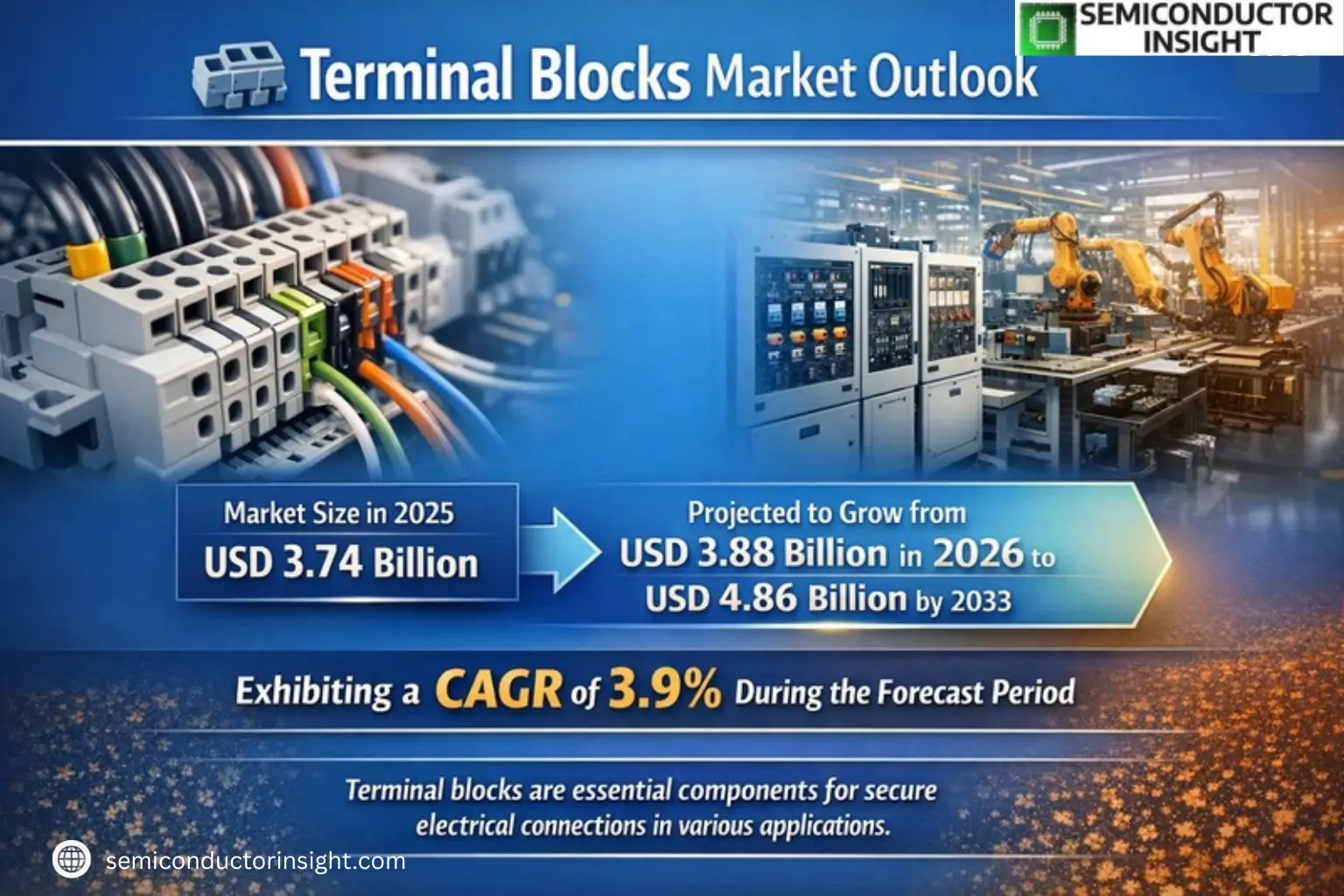
Global Terminal Blocks Market size was valued at USD 3.74 billion in 2025. The market is projected to grow from USD 3.88 billion in 2026 to USD 4.86 billion by 2033, exhibiting a CAGR of 3.9% during the forecast period.
Terminal blocks are fundamental components used to establish secure electrical connections in various applications. These modular, insulated blocks serve as fixed interfaces for connecting wires, appliances, and control boards, simplifying wiring processes while ensuring reliability and safety. They are categorized under connectors in industrial applications and come in multiple types, including screw-type, spring-cage type, push-in type, and others.
The market growth is driven by increasing industrialization, automation trends, and the rising demand for efficient power distribution systems across sectors such as electricity, mechanical equipment, and rail transport. Asia-Pacific dominates the market with a 49% share due to rapid infrastructure development and manufacturing expansion. Key players like Phoenix Contact, Weidmuller, and WAGO collectively hold approximately 39% of the global market share.
MARKET DRIVERS
Growing Industrial Automation Demand
Global Terminal Blocks Market is witnessing significant growth driven by increasing adoption of industrial automation across manufacturing sectors. Automation systems require secure and reliable electrical connections, making terminal blocks a critical component in control panels and machinery. The market is projected to grow at a CAGR of 5.8% from 2023 to 2028, with Asia Pacific leading the demand.
Renewable Energy Sector Expansion
Growth in renewable energy installations is creating substantial demand for terminal blocks in solar and wind power systems. These components are essential for safe electrical connections in photovoltaic arrays and turbine control systems. The renewable sector accounted for 28% of terminal blocks sales in 2022, with projections indicating this will rise to 35% by 2026.
Advancements in terminal block technology are enabling faster installation and maintenance, particularly in time-sensitive industrial environments.
MARKET CHALLENGES
Supply Chain Vulnerabilities
Terminal Blocks Market faces persistent challenges from global supply chain disruptions affecting raw material availability, particularly copper and thermoplastic resins. Lead times for certain terminal block types extended to 16 weeks in 2022, though they have since stabilized to 8-10 weeks in most regions.
Other Challenges
Miniaturization Demands
As control panels become more compact, manufacturers must develop smaller terminal blocks without compromising current-carrying capacity or safety standards. This technical challenge has increased R&D costs by approximately 15% across the industry.
MARKET RESTRAINTS
Pricing Pressure from Alternatives
Direct wiring solutions and busbar systems continue to compete with terminal blocks in cost-sensitive applications. In commercial construction projects, terminal blocks face 10-15% price competition from alternative connection methods. However, their safety advantages maintain dominance in industrial settings.
MARKET OPPORTUNITIES
Smart Terminal Block Development
The integration of IoT capabilities into terminal blocks presents significant growth potential. Smart terminal blocks with built-in sensing and communication functions could capture 20% of the industrial market by 2026. These advanced versions enable predictive maintenance and real-time monitoring of electrical systems.
Terminal Blocks Market Trends
Sustainable Growth in Terminal Blocks Market
Global Terminal Blocks Market continues to demonstrate steady expansion, valued at USD 3.7 billion in 2025 with projections reaching USD 4.9 billion by 2033. This represents a compound annual growth rate (CAGR) of 3.9%, driven by increasing electrical infrastructure demands across industries. Terminal blocks serve as critical components for safe and efficient electrical connections in industrial, commercial and residential applications.
Other Trends
Regional Market Dynamics
Asia-Pacific dominates with 49% market share, followed by Europe (26%) and North America (17%). This distribution reflects the concentration of manufacturing activity and infrastructure development in Asian economies. Countries like China, Japan and India are driving adoption through industrial automation projects and energy sector investments.
Technological Advancements in Terminal Block Design
Innovation focuses on improving safety and ease of installation. Push-in and spring-cage connection types are gaining traction, offering faster wiring compared to traditional screw-type blocks. Leading manufacturers are integrating smart connectivity features to support Industry 4.0 applications, with terminal blocks becoming components in IoT-enabled electrical systems.
Competitive Landscape Evolution
Three companies – Phoenix Contact, Weidmuller and WAGO – collectively hold 39% market share. Competition is intensifying with Asian manufacturers increasing their global presence through cost-effective solutions. The market remains moderately consolidated, with strategic acquisitions shaping the competitive environment.
Application-Specific Growth Segments
Electricity distribution accounts for the largest application segment, followed by mechanical equipment and rail transport. Renewable energy installations and electric vehicle charging infrastructure are emerging as key growth verticals requiring specialized terminal block solutions.
COMPETITIVE LANDSCAPE
Key Industry Players
A Concentrated Market with Strong Growth Potential
Terminal Blocks Market is dominated by three major players – Phoenix Contact, Weidmüller, and WAGO – which collectively hold about 39% of the global market share. Phoenix Contact leads the industry with its comprehensive product portfolio and strong distribution network across all major regions. These top three companies have established themselves through continuous innovation in screw-type, spring-cage, and push-in terminal blocks while maintaining superior product quality and reliability standards.
Several regional players have carved out significant niches in specific markets. Chinese manufacturers like CHNT, Dinkle, and CNNT have gained strong footholds in cost-sensitive Asian markets through competitive pricing. Meanwhile, European and American firms like ABB and Rockwell Automation maintain leadership in industrial automation applications through technical differentiation. Emerging players are focusing on specialized segments such as rail transportation and renewable energy projects to challenge established brands.
List of Key Terminal Blocks Companies Profiled
- Phoenix Contact
- Weidmüller
- WAGO
- ABB
- Rockwell Automation
- Amphenol (FCI)
- Omron
- Wieland Electric
- CHNT
- Dinkle
- CNNT
- Leipole
- Shanghai Gkoncy Electric
- Yaowa
- UPUN
Segment Analysis:
| Segment Category | Sub-Segments | Key Insights |
| By Type |
|
Screw Type dominates due to:
|
| By Application |
|
Electricity Sector leads with:
|
| By End User |
|
Industrial Manufacturing shows strongest demand because:
|
| By Material |
|
Thermoplastic preferred due to:
|
| By Sales Channel |
|
Distributors dominate because:
|
Regional Analysis: Terminal Blocks Market
China accounts for the largest terminal blocks consumption in Asia-Pacific, supported by its massive electronics manufacturing sector. Special economic zones concentrate terminal block usage in automation equipment production. The government’s Made in China 2026 initiative continues to drive industrial upgrades requiring advanced wiring components.
Japanese manufacturers focus on high-performance terminal blocks for precision applications in automotive and robotics industries. The country leads in innovations like spring-loaded and pluggable terminal blocks that reduce installation time. Strong emphasis on product reliability meets stringent industrial safety requirements in harsh operating environments.
India’s Terminal Blocks Market grows alongside infrastructure development and renewable energy projects. Local manufacturers are expanding production capacities to meet rising demand from electricity distribution upgrades. The Make in India program encourages domestic terminal block manufacturing while still relying on imports for specialized variants.
Vietnam, Thailand, and Malaysia show increasing terminal block adoption as electronics manufacturing shifts to these markets. Industrial automation investments and new power generation facilities create sustained demand. Multinational terminal block brands are establishing regional distribution hubs to serve these growing markets efficiently.
Europe
Europe maintains a strong position in the Terminal Blocks Market with emphasis on high-quality industrial applications. Germany stands out as the regional leader, with its robust manufacturing sector requiring reliable electrical connection solutions. The region sees growing adoption of modular terminal blocks in renewable energy systems and building automation projects. Strict CE certification requirements ensure terminal blocks meet rigorous safety and environmental standards. Eastern European countries are experiencing above-average growth as industrial modernization programs upgrade outdated electrical infrastructure.
North America
The North American Terminal Blocks Market benefits from technological innovation and replacement demand across industrial facilities. The United States leads in developing smart terminal blocks with connectivity features for Industry 4.0 applications. Oil & gas operations in the Gulf region drive demand for explosion-proof terminal block solutions. Renewable energy projects and grid modernization investments create additional growth opportunities for terminal block suppliers across the region.
Middle East & Africa
Middle Eastern countries are investing heavily in infrastructure that requires terminal blocks for power distribution and control systems. Gulf Cooperation Council nations lead regional demand through massive construction projects and industrial city developments. Africa shows emerging potential with electricity access expansion programs, though the market remains fragmented. Terminal block adoption grows alongside industrialization in key African economies like South Africa and Nigeria.
South America
South America’s Terminal Blocks Market grows steadily with industrial development in Brazil, Argentina, and Chile. Mining operations and power generation projects drive demand for robust terminal block solutions. Economic volatility sometimes affects market growth, but infrastructure needs maintain baseline demand. Local manufacturers compete with imported products, particularly for standard terminal block configurations.
Report Scope
This market research report provides a comprehensive analysis of the Terminal Blocks Market , covering the forecast period 2026–2033. It offers detailed insights into market dynamics, technological advancements, competitive landscape, and key trends shaping the industry.
Key focus areas of the report include:
- Market Overview: The report begins with an overview outlining its current market scenario, key growth indicators, and industry transformation drivers. It discusses macroeconomic factors, demand–supply balance, regulatory landscape, and the strategic role of terminal blocks in powering advancements across industries such as electricity, mechanical equipment, and rail transit.
- Market Size & Forecast: Historical data and future projections for revenue, unit shipments, and market value across major regions and segments.
- Segmentation Analysis: Detailed breakdown by product type, technology, application, and end-user industry to identify high-growth segments and investment opportunities.
- Regional Insights: Insights into market performance across North America, Europe, Asia-Pacific, Latin America, and the Middle East & Africa, including country-level analysis where relevant.
- Competitive Landscape: Profiles of leading market participants, including their product offerings, R&D focus, manufacturing capacity, pricing strategies, and recent developments such as mergers, acquisitions, and partnerships.
- Technology Trends & Innovation: Assessment of emerging technologies, evolving industry standards, and fabrication techniques.
- Market Drivers & Restraints: Evaluation of factors driving market growth along with challenges, supply chain constraints, regulatory issues, and market-entry barriers.
- Stakeholder Insights: Insights for component suppliers, OEMs, system integrators, investors, and policymakers regarding the evolving ecosystem and strategic opportunities.
Primary and secondary research methods are employed, including interviews with industry experts, data from verified sources, and real-time market intelligence to ensure the accuracy and reliability of the insights presented.
FREQUENTLY ASKED QUESTIONS:
What is the current market size of Terminal Blocks Market?
-> Terminal Blocks Market size was valued at USD 3.74 billion in 2025. The market is projected to grow from USD 3.88 billion in 2026 to USD 4.86 billion by 2033, exhibiting a CAGR of 3.9% during the forecast period.
Which key companies operate in Terminal Blocks Market?
-> Key players include Phoenix Contact, Weidmuller, WAGO, ABB, Rockwell Automation, and Amphenol (FCI), among others.
What are the key growth drivers?
-> Key growth drivers include rising demand for electrical connectivity solutions, industrial automation trends, and infrastructure development.
Which region dominates the market?
-> Asia-Pacific is the largest market with a 49% share, followed by Europe and North America with 26% and 17% shares respectively.
What is the projected CAGR for Terminal Blocks Market?
-> The market is projected to grow at a 3.9% CAGR during the forecast period 2025-2033.

Get Sample Report PDF for Exclusive Insights
Report Sample Includes
- Table of Contents
- List of Tables & Figures
- Charts, Research Methodology, and more...
 Download Sample Report PDF