
MARKET INSIGHTS
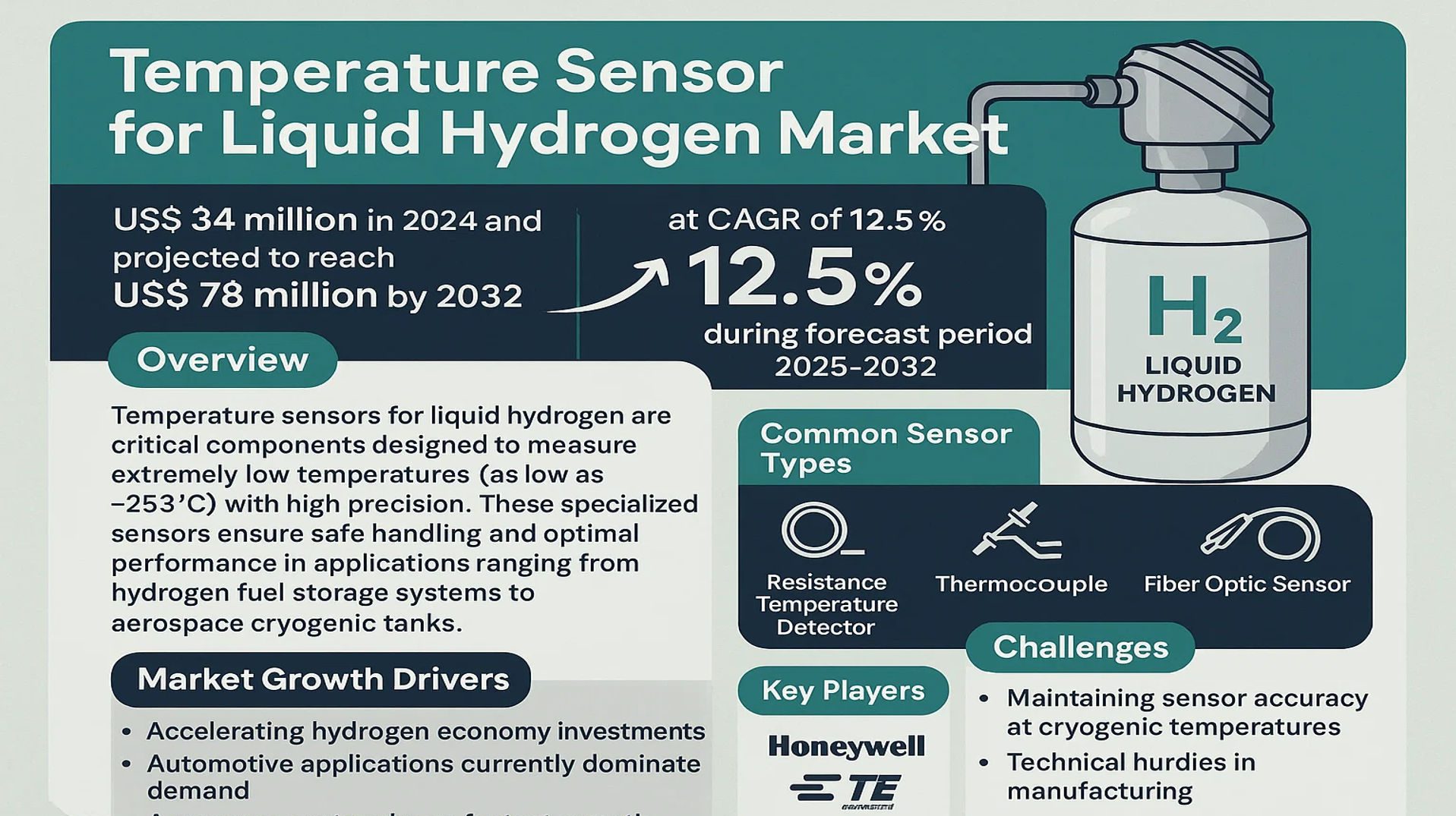
The global Temperature Sensor for Liquid Hydrogen Market size was valued at US$ 34 million in 2024 and is projected to reach US$ 78 million by 2032, at a CAGR of 12.5% during the forecast period 2025-2032.
Temperature sensors for liquid hydrogen are critical components designed to measure extremely low temperatures (as low as -253°C) with high precision. These specialized sensors ensure safe handling and optimal performance in applications ranging from hydrogen fuel storage systems to aerospace cryogenic tanks. Common sensor types include resistance temperature detectors (RTDs), thermocouples, and fiber optic sensors, each offering unique advantages for extreme low-temperature environments.
The market growth is primarily driven by accelerating hydrogen economy investments, particularly in clean energy applications. While automotive applications currently dominate demand due to fuel cell vehicle adoption, the aerospace sector shows fastest growth potential because of increasing space exploration activities. However, technical challenges in maintaining sensor accuracy at cryogenic temperatures present ongoing hurdles for manufacturers. Leading players like Honeywell and TE Connectivity are addressing these challenges through advanced materials research and IoT-enabled monitoring solutions.
MARKET DYNAMICS
MARKET DRIVERS
Rising Adoption of Hydrogen Fuel Cells to Accelerate Market Growth
The global shift toward clean energy solutions is driving substantial demand for liquid hydrogen applications, particularly in fuel cell technology. Hydrogen fuel cells are gaining prominence across automotive, aerospace, and industrial sectors as sustainable alternatives to fossil fuels. These systems require precise temperature monitoring to maintain optimal performance and safety, creating significant opportunities for liquid hydrogen temperature sensors. The automotive sector alone witnessed over 50% growth in hydrogen fuel cell vehicle deployments last year, highlighting the accelerating adoption rate. As governments worldwide implement stricter emissions regulations, this trend is expected to continue, directly benefiting temperature sensor manufacturers.
Advancements in Cryogenic Temperature Sensing Technologies
Recent technological breakthroughs in cryogenic sensor design are revolutionizing liquid hydrogen monitoring capabilities. Modern sensors now achieve measurement accuracy within ±0.1°C at temperatures as low as -253°C, addressing critical safety requirements for hydrogen storage and transportation. Innovations in thin-film RTD sensors and fiber-optic temperature probes have significantly improved reliability in extreme conditions. For instance, recent product launches featuring self-calibrating capabilities and wireless data transmission are transforming operational efficiencies in hydrogen refueling stations. These advancements not only enhance safety protocols but also reduce maintenance costs, making them increasingly attractive for large-scale hydrogen infrastructure projects.
Government Initiatives Boosting Hydrogen Infrastructure Development
Substantial public sector investments in hydrogen economies worldwide are creating robust growth opportunities. Multiple countries have allocated over $70 billion collectively toward hydrogen infrastructure development through 2030, with significant portions dedicated to safe handling systems. These initiatives explicitly mandate stringent temperature monitoring standards for liquid hydrogen applications. New regulatory frameworks in the European Union and North America now require real-time temperature tracking with redundant sensor systems in all commercial hydrogen facilities. Such policy developments are compelling operators to upgrade their monitoring equipment, thereby driving market expansion for specialized temperature sensors.
MARKET RESTRAINTS
High Development Costs and Complex Certification Processes
The specialized nature of liquid hydrogen applications presents significant barriers to market entry. Developing sensors capable of withstanding cryogenic temperatures requires expensive materials like platinum resistance elements and specialized hermetic seals, increasing unit costs by 300-400% compared to standard industrial sensors. Furthermore, obtaining necessary safety certifications for hydrogen applications often takes 12-18 months due to rigorous testing protocols. These factors collectively elevate total cost of ownership, particularly for small and medium enterprises looking to enter the hydrogen value chain.
Technical Limitations in Extreme Operating Conditions
While temperature sensor technology has advanced significantly, several technical challenges persist in liquid hydrogen environments. Sensor drift remains a critical concern, with many devices showing calibration deviations after prolonged exposure to cryogenic temperatures. Additionally, the boil-off effect in hydrogen storage systems creates rapid temperature fluctuations that can compromise measurement accuracy. These technical limitations require frequent recalibration and maintenance, increasing operational costs for end-users. The industry continues to seek solutions that balance precision with long-term reliability under such demanding conditions.
MARKET CHALLENGES
Standardization Gaps Across Regional Markets
The lack of unified global standards for liquid hydrogen temperature monitoring presents substantial implementation challenges. Different regions currently enforce varying technical specifications for sensor accuracy, response time, and safety certifications. This fragmentation forces manufacturers to develop region-specific product variants, increasing R&D expenditures and complicating supply chain logistics. The absence of harmonized standards also creates uncertainty for multinational hydrogen projects, potentially delaying deployments until compliance issues are resolved across all jurisdictions.
Material Compatibility Issues in Hydrogen Environments
Hydrogen embrittlement remains a persistent challenge for sensor components exposed to liquid hydrogen. Certain metals commonly used in sensor construction become brittle and prone to failure when subjected to cryogenic temperatures and hydrogen permeation. This necessitates the use of premium-grade materials that significantly increase production costs. Furthermore, finding materials that maintain stable electrical characteristics across extreme temperature ranges while resisting hydrogen diffusion presents ongoing engineering challenges that limit rapid product innovation.
MARKET OPPORTUNITIES
Emerging Applications in Space Exploration Programs
The expanding space sector presents lucrative opportunities for advanced temperature monitoring solutions. Liquid hydrogen serves as a primary rocket fuel, with space agencies planning over 150 launch vehicles requiring cryogenic temperature monitoring systems through 2030. These applications demand ultra-reliable sensors capable of withstanding extreme vibration and thermal cycling. Recent contracts for lunar and Mars missions have specifically highlighted the need for next-generation hydrogen temperature sensors, creating a premium market segment for manufacturers with space-qualified technologies.
Integration with Industry 4.0 and Predictive Maintenance Systems
The convergence of industrial IoT with hydrogen infrastructure opens new avenues for smart sensor solutions. Modern temperature sensors equipped with wireless connectivity and advanced diagnostics enable predictive maintenance models for hydrogen facilities. These systems can reduce unplanned downtime by up to 40% through early fault detection in cryogenic storage systems. As hydrogen plants increasingly adopt digital transformation strategies, demand is growing for sensors with embedded analytics capabilities that integrate seamlessly with plant-wide monitoring platforms.
TEMPERATURE SENSOR FOR LIQUID HYDROGEN MARKET TRENDS
Advancements in Cryogenic Sensor Technologies to Drive Market Growth
The demand for high-precision temperature sensors in liquid hydrogen applications has surged due to their critical role in ensuring operational safety and efficiency. Cryogenic temperature sensors are engineered to withstand extreme low-temperature ranges (down to -253°C), making them indispensable in hydrogen fuel cells, space propulsion systems, and energy storage solutions. Recent advancements include the development of thin-film resistive temperature detectors (RTDs) and fiber-optic sensors, which offer superior accuracy and faster response times. Furthermore, the integration of solid-state sensors with IoT-enabled monitoring systems provides real-time data analytics, reducing downtime in industrial applications.
Other Trends
Hydrogen Energy Infrastructure Expansion
The global push toward carbon neutrality has accelerated investments in hydrogen-based energy solutions. Governments and private stakeholders are actively developing hydrogen refueling stations, which require reliable temperature monitoring for liquid hydrogen storage. In automotive applications, the adoption of fuel cell electric vehicles (FCEVs) is projected to grow at a CAGR of over 30% in the next decade, further amplifying the need for robust sensor technologies that ensure safe cryogenic conditions during hydrogen storage and transfer.
Increasing Focus on Aerospace and Defense Applications
The aerospace sector is emerging as a critical driver for liquid hydrogen temperature sensors, particularly with the rise of hydrogen-powered propulsion systems in satellites and unmanned aerial vehicles (UAVs). Precision thermal management is crucial in space missions, where liquid hydrogen is used as a cryogenic propellant. Market leaders are investing in ceramic-based thermocouples and silicon diode sensors, which exhibit minimal drift at cryogenic temperatures. Regulatory standards, such as NASA’s guidelines for cryogenic fluid handling, are also pushing manufacturers to innovate solutions that meet stringent safety benchmarks.
COMPETITIVE LANDSCAPE
Key Industry Players
Innovation and Precision Drive Competition in the Liquid Hydrogen Sensing Market
The global temperature sensor market for liquid hydrogen is moderately fragmented, with established engineering firms competing alongside specialized sensor manufacturers. Honeywell International Inc. has emerged as a market leader, leveraging its extensive experience in cryogenic sensor technology and strategic partnerships with aerospace manufacturers. The company holds approximately 18% of the market share as of 2024, according to industry estimates.
TE Connectivity and Analog Devices have significantly expanded their market presence through continuous R&D investment, particularly in developing robust sensor solutions for extreme low-temperature applications (-253°C). These companies are benefiting from growing demand in both the automotive and aerospace sectors, where accurate temperature monitoring is critical for hydrogen fuel cell safety and efficiency.
Market expansion strategies are increasingly focused on miniaturization and IoT integration. Texas Instruments recently launched a new MEMS-based temperature sensor platform specifically designed for hydrogen applications, demonstrating the industry’s shift toward smarter, more compact solutions. This technological evolution is expected to reshape competitive dynamics through the forecast period.
List of Key Temperature Sensor Manufacturers
- Variohm EuroSensor (UK)
- Meiyo Electric (Japan)
- Okazaki Manufacturing Company (Japan)
- Honeywell International Inc. (U.S.)
- TE Connectivity (Switzerland)
- Analog Devices, Inc. (U.S.)
- Vishay Beyschlag (Germany)
- Texas Instruments (U.S.)
- STMicroelectronics (Switzerland)
- NXP Semiconductors (Netherlands)
- ABB Ltd (Switzerland)
Segment Analysis:
By Type
Button Shape Segment Leads Due to Compact Design and Ease of Integration
The market is segmented based on type into:
- Button Shape
- Sheath Shape
By Application
Automotive Sector Dominates Due to Rising Adoption of Hydrogen Fuel Cells in Vehicles
The market is segmented based on application into:
- Automotive
- Aerospace
- Other (Energy Storage, Industrial Processes)
By Technology
Resistance Temperature Detectors (RTDs) Gain Traction for their High Accuracy in Cryogenic Environments
The market is segmented based on technology into:
- Resistance Temperature Detectors (RTDs)
- Thermocouples
- Thermistors
By End User
Industrial Applications Show Strong Demand for Safety Compliance in Hydrogen Handling
The market is segmented based on end user into:
- Industrial
- Research & Development
- Energy & Power
Regional Analysis: Temperature Sensor for Liquid Hydrogen Market
Asia-Pacific
The Asia-Pacific region is leading the global Temperature Sensor for Liquid Hydrogen market, driven primarily by China’s aggressive hydrogen energy initiatives and Japan’s advanced fuel cell technology. With China accounting for over 60% of global hydrogen projects under development, the demand for cryogenic temperature sensors for liquid hydrogen storage and transportation is surging. Japan’s established fuel cell vehicle ecosystem, backed by government subsidies and R&D investments, further strengthens market growth. South Korea is also emerging as a key player with its Hydrogen Economy Roadmap targeting 2.9 million fuel cell vehicles by 2040. While the region shows strong adoption across automotive and industrial applications, precise temperature monitoring remains critical due to hydrogen’s extremely low boiling point (-252.8°C), creating robust demand for specialized sensors.
North America
North America represents the second-largest market, with the U.S. Department of Energy allocating $9.5 billion for clean hydrogen initiatives under the Bipartisan Infrastructure Law. Stringent safety regulations from OSHA and ASTM for hydrogen handling drive demand for certified temperature measurement solutions. California’s zero-emission vehicle mandate and expanding hydrogen refueling infrastructure are creating strong demand from the automotive sector. However, the market faces challenges from high sensor certification costs and the need for extreme low-temperature calibration capabilities (-269°C to +200°C operational range). Major aerospace applications, particularly for NASA and private space companies, provide additional growth opportunities for specialized liquid hydrogen temperature monitoring systems.
Europe
Europe’s market is propelled by the EU’s Hydrogen Strategy targeting 40GW of renewable hydrogen electrolyzers by 2030. Germany leads regionally with its National Hydrogen Strategy allocating €9 billion for hydrogen technologies. Strict ATEX and IECEx certifications for explosive environments create a premium market for intrinsically safe sensors. The region shows particularly strong demand from the industrial sector for process control in hydrogen liquefaction plants. However, fragmented regulatory standards across EU member states create compliance challenges for sensor manufacturers. The growing hydrogen-powered train and maritime applications present new opportunities for ruggedized temperature monitoring solutions.
Middle East & Africa
The market in this region is in nascent stages but shows promising growth potential as countries like Saudi Arabia invest in green hydrogen projects under their Vision 2030 plan. The NEOM hydrogen project (USD 5 billion) represents the world’s largest green hydrogen facility currently under development, requiring sophisticated cryogenic measurement solutions. While current demand remains concentrated in oil refining applications, desalination plants and future hydrogen export terminals will drive adoption. Challenges include harsh environmental conditions requiring specially hardened sensors and limited local technical expertise for installation and maintenance.
South America
South America’s market is developing gradually, with Chile emerging as a potential green hydrogen hub due to its renewable energy resources. The Chilean government’s National Green Hydrogen Strategy targets 25GW of electrolysis capacity by 2030. Brazil’s growing fuel cell bus projects in São Paulo present localized demand. However, market growth is constrained by limited hydrogen infrastructure, economic volatility affecting investment capabilities, and dependence on imported sensor technologies. The region shows potential in the longer term as hydrogen becomes economically viable for mining and heavy industry applications.
Report Scope
This market research report provides a comprehensive analysis of the global and regional Temperature Sensor for Liquid Hydrogen markets, covering the forecast period 2025–2032. It offers detailed insights into market dynamics, technological advancements, competitive landscape, and key trends shaping the industry.
Key focus areas of the report include:
- Market Size & Forecast: Historical data and future projections for revenue, unit shipments, and market value across major regions and segments. The global market was valued at US$ 34 million in 2024 and is projected to reach US$ 78 million by 2032 at a CAGR of 12.5%.
- Segmentation Analysis: Detailed breakdown by product type (Button Shape, Sheath Shape), application (Automotive, Aerospace, Others), and end-user industry to identify high-growth segments and investment opportunities.
- Regional Outlook: Insights into market performance across North America (USD 68 million in 2024), Europe, Asia-Pacific (fastest growing at 7.3% CAGR), Latin America, and the Middle East & Africa, including country-level analysis.
- Competitive Landscape: Profiles of 15+ leading market participants including Variohm EuroSensor, Honeywell, and Texas Instruments, covering their product offerings, market share (top 5 players held 42% in 2024), and recent developments.
- Technology Trends & Innovation: Assessment of cryogenic sensor technologies, IoT integration in hydrogen infrastructure, and advancements in measurement accuracy (±0.1°C).
- Market Drivers & Restraints: Evaluation of factors including hydrogen fuel cell adoption (global shipments reached 1.2 GW in 2023) and challenges like material limitations at cryogenic temperatures.
- Stakeholder Analysis: Insights for sensor manufacturers, hydrogen infrastructure developers, automotive OEMs, and policymakers regarding the evolving clean energy ecosystem.
Primary and secondary research methods are employed, including interviews with industry experts, data from verified sources, and real-time market intelligence to ensure the accuracy and reliability of the insights presented.
FREQUENTLY ASKED QUESTIONS:
What is the current market size of Global Temperature Sensor for Liquid Hydrogen Market?
-> Temperature Sensor for Liquid Hydrogen Market size was valued at US$ 34 million in 2024 and is projected to reach US$ 78 million by 2032, at a CAGR of 12.5% during the forecast period 2025-2032.
Which key companies operate in Global Temperature Sensor for Liquid Hydrogen Market?
-> Key players include Variohm EuroSensor, Honeywell, Texas Instruments, TE Connectivity, and Analog Devices, among others.
What are the key growth drivers?
-> Key growth drivers include hydrogen fuel cell adoption, clean energy investments, and aerospace applications requiring cryogenic temperature monitoring.
Which region dominates the market?
-> North America currently leads the market, while Asia-Pacific is projected as the fastest-growing region.
What are the emerging trends?
-> Emerging trends include miniaturized sensors, wireless monitoring solutions, and advanced materials for extreme temperature ranges.

Get Sample Report PDF for Exclusive Insights
Report Sample Includes
- Table of Contents
- List of Tables & Figures
- Charts, Research Methodology, and more...
 Download Sample Report PDF


