MARKET INSIGHTS
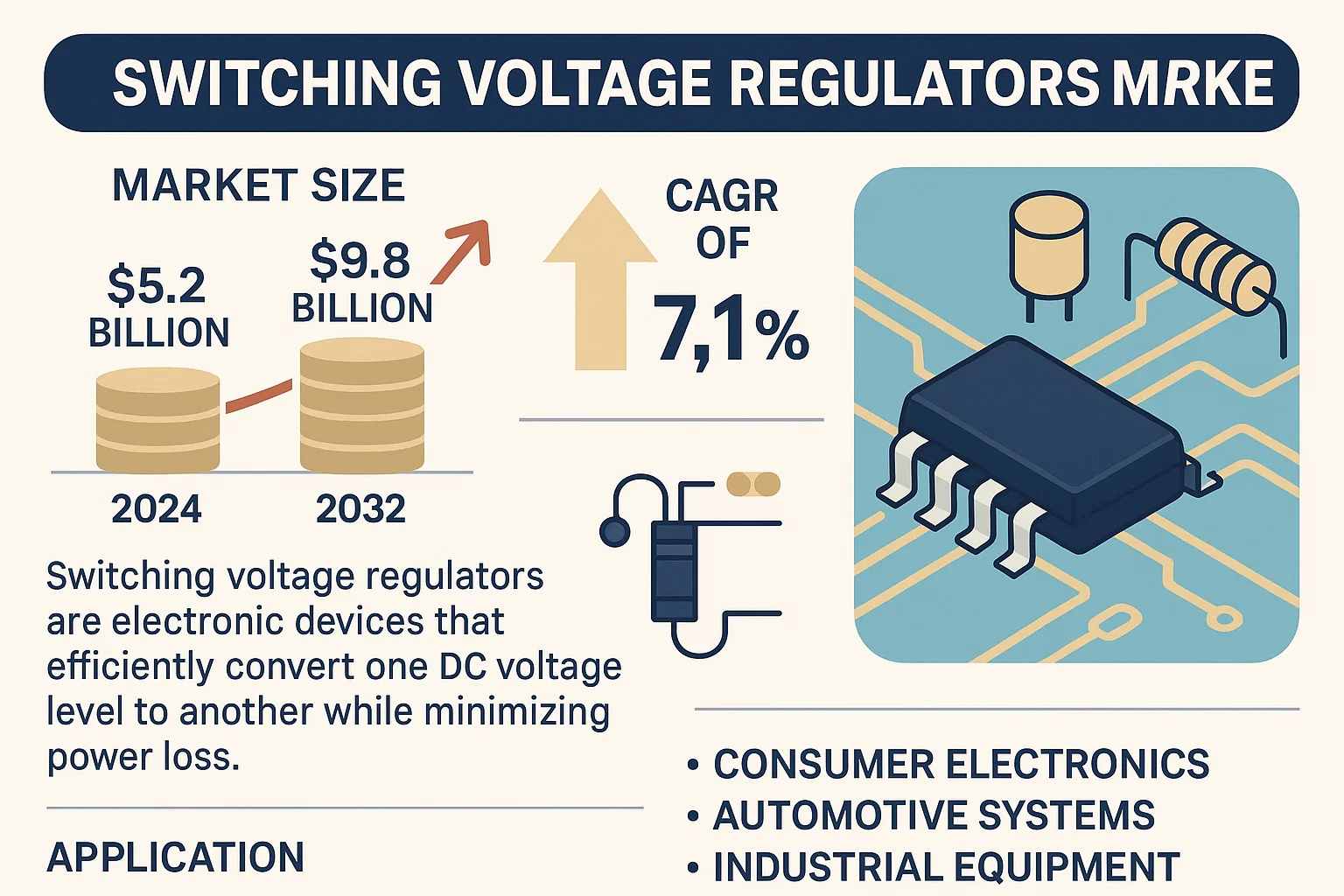
The global Switching Voltage Regulators Market size was valued at USD 5.2 billion in 2024 to USD 9.8 billion by 2032, exhibiting a CAGR of 7.1% during the forecast period.
Switching voltage regulators are electronic devices that efficiently convert one DC voltage level to another while minimizing power loss. These regulators operate by rapidly switching a power transistor on and off, adjusting the duty cycle to maintain a stable output voltage. They are widely used in applications requiring energy efficiency, such as consumer electronics, automotive systems, and industrial equipment.
The market is driven by increasing demand for power-efficient solutions across industries, particularly in battery-powered devices and renewable energy systems. The shift toward miniaturization and IoT-enabled devices further fuels adoption. However, design complexities and electromagnetic interference challenges pose hurdles for manufacturers. Leading players like TI, Analog Devices, and On Semiconductor are addressing these challenges through advanced regulator designs with higher switching frequencies and integrated solutions.
MARKET DYNAMICS
MARKET DRIVERS
Proliferation of Energy-Efficient Electronics to Drive Market Expansion
The global push toward energy efficiency and sustainability is significantly accelerating the adoption of switching voltage regulators. These components are essential in modern electronics due to their superior efficiency compared to linear regulators, often achieving conversion efficiencies exceeding 90%. This high efficiency is critical for reducing power loss and heat generation in applications ranging from smartphones to data centers. The consumer electronics sector, which is projected to ship over 1.5 billion smartphones annually, relies heavily on these regulators to extend battery life and support advanced features. Furthermore, stringent global energy regulations, such as the European Union’s Energy-related Products Directive, mandate lower standby power consumption, which directly fuels demand for advanced switching regulator solutions across various electronic devices.
Rapid Electrification in Automotive Sector to Boost Market Growth
The automotive industry’s rapid transition toward electrification is a major catalyst for the switching voltage regulators market. Modern vehicles incorporate numerous electronic control units (ECUs), infotainment systems, and advanced driver-assistance systems (ADAS), all requiring stable and efficient power management. The shift to electric vehicles (EVs) is particularly impactful, as EVs utilize high-voltage battery systems that must be efficiently stepped down to power lower-voltage electronics. With global EV sales surpassing 10 million units annually and projected to grow at a compound annual growth rate of over 20%, the demand for robust and efficient voltage regulation solutions is intensifying. These regulators are indispensable for managing power distribution, battery management systems, and onboard charging, making them a cornerstone of automotive electrification.
Expansion of 5G and IoT Infrastructure to Propel Demand
The massive deployment of 5G networks and Internet of Things (IoT) devices is creating substantial opportunities for switching voltage regulators. 5G infrastructure, including base stations and small cells, requires highly efficient power conversion to handle increased data throughput while minimizing energy consumption. Similarly, the proliferation of IoT devices, estimated to exceed 30 billion connected units globally, depends on compact and efficient power management solutions to maximize operational lifespan, especially in battery-powered applications. The need for miniaturization without sacrificing performance drives innovation in integrated and module-based switching regulators, enabling smaller form factors and higher power density essential for next-generation communication and IoT ecosystems.
Furthermore, continuous advancements in semiconductor technology, such as the adoption of wide-bandgap materials like gallium nitride (GaN) and silicon carbide (SiC), are enhancing the performance and efficiency of switching regulators. These materials allow for higher switching frequencies, reduced size, and improved thermal management, meeting the evolving demands of high-performance computing, telecommunications, and industrial applications.
MARKET RESTRAINTS
Electromagnetic Interference (EMI) Challenges to Hinder Market Adoption
Switching voltage regulators, while highly efficient, generate significant electromagnetic interference (EMI) due to their high-frequency switching operation. This EMI can adversely affect the performance of sensitive electronic circuits and lead to compliance issues with stringent international electromagnetic compatibility (EMC) standards. Designing systems that mitigate EMI often requires additional components such as filters and shields, which increase the overall cost, complexity, and board space. In applications like medical devices, automotive electronics, and aerospace systems, where signal integrity is paramount, managing EMI becomes a critical and costly design constraint. These challenges can slow down adoption in noise-sensitive applications and necessitate extensive testing and validation processes.
Complexity in Design and Integration to Act as a Barrier
The design and integration of switching voltage regulators are considerably more complex than those of linear regulators. Engineers must carefully consider factors such as loop stability, component selection, layout optimization, and thermal management to ensure reliable operation. This complexity requires specialized expertise and extended development cycles, which can be a significant barrier for smaller companies or projects with tight timelines. Additionally, the need for external passive components like inductors and capacitors increases the bill of materials and occupies valuable PCB real estate. As electronic systems become more compact and multifunctional, integrating these regulators without compromising performance or reliability presents a persistent challenge, potentially limiting their use in space-constrained applications.
Supply Chain Vulnerabilities and Component Shortages to Impede Growth
The global electronics supply chain has faced significant disruptions, including shortages of critical components such as semiconductors, passive elements, and substrates. Switching voltage regulators rely on a variety of these components, and any disruption can lead to extended lead times, increased costs, and production delays. The automotive industry, in particular, has experienced severe impacts, with production halts due to chip shortages affecting millions of vehicles. Such vulnerabilities make it difficult for manufacturers to meet demand consistently and can deter investment in new projects that depend on stable component supply. Ensuring a resilient supply chain has become a major concern, influencing design choices and potentially slowing market growth.
MARKET CHALLENGES
Thermal Management Issues to Challenge Performance in High-Power Applications
Despite their high efficiency, switching voltage regulators still generate heat, especially in high-current applications. Managing this heat is crucial to maintaining performance and reliability, as excessive temperatures can degrade components and reduce lifespan. In high-power-density designs, such as those found in servers, telecommunications equipment, and power supplies, effective thermal management often requires heat sinks, fans, or advanced cooling techniques, which add cost and complexity. The challenge is exacerbated in environments with limited airflow or high ambient temperatures. Overcoming thermal limitations without compromising size or efficiency remains a significant engineering hurdle, particularly as power demands continue to rise.
Other Challenges
Cost Sensitivity in Price-Competitive Markets
While switching regulators offer long-term energy savings, their initial cost is higher than that of linear regulators due to more complex circuitry and additional components. In highly price-sensitive markets, such as consumer electronics and cost-driven industrial applications, this cost differential can be a deterrent. Manufacturers must continuously innovate to reduce production costs while maintaining performance, often through higher integration and economies of scale, to remain competitive.
Rapid Technological Obsolescence
The semiconductor industry evolves rapidly, with new technologies and standards emerging frequently. This pace can lead to quick obsolescence of existing regulator designs, necessitating constant research and development to keep products relevant. Companies must invest significantly in innovation to stay ahead, which can strain resources and impact profitability, especially for smaller players lacking extensive R&D capabilities.
MARKET OPPORTUNITIES
Growth in Renewable Energy and Energy Storage Systems to Unlock New Avenues
The global transition toward renewable energy sources, such as solar and wind, along with the expansion of energy storage systems, presents significant opportunities for switching voltage regulators. These systems require efficient power conversion to manage variable input voltages from renewable sources and to interface with grids and batteries. Switching regulators are essential in maximum power point tracking (MPPT) charge controllers, inverters, and battery management systems, enabling higher efficiency and reliability. With investments in renewable energy projects exceeding $1.5 trillion annually and energy storage deployments growing at a compound annual growth rate of over 30%, the demand for advanced power management solutions is set to rise substantially.
Advancements in Wide-Bandgap Semiconductors to Create High-Performance Opportunities
The adoption of wide-bandgap semiconductors like gallium nitride (GaN) and silicon carbide (SiC) is revolutionizing the switching voltage regulator market. These materials enable higher switching frequencies, reduced size, and improved efficiency compared to traditional silicon-based devices. GaN-based regulators, for instance, can operate at frequencies above 1 MHz, allowing for smaller passive components and higher power density. This is particularly beneficial for applications in data centers, telecommunications, and aerospace, where space and efficiency are critical. With the GaN power device market projected to grow at a compound annual growth rate of over 40%, these technological advancements are opening new frontiers for high-performance, compact power solutions.
Expansion of Artificial Intelligence and Edge Computing to Drive Innovation
The proliferation of artificial intelligence (AI) and edge computing is driving demand for advanced power management solutions. AI processors and edge devices require precise voltage regulation to handle dynamic workloads while minimizing power consumption. Switching regulators with features like adaptive voltage scaling and digital control are becoming essential to meet these demands. The edge computing market, expected to grow at a compound annual growth rate of over 20%, relies on efficient, reliable power supplies to operate in diverse environments. This trend encourages innovation in multi-phase regulators, power management integrated circuits (PMICs), and module-based solutions, creating lucrative opportunities for market players to develop specialized products tailored to AI and edge applications.
SWITCHING VOLTAGE REGULATORS MARKET TRENDS
Rising Demand for High-Efficiency Power Management in Electronics to Emerge as a Key Trend
The global push towards energy efficiency and miniaturization in electronic devices is significantly driving the adoption of switching voltage regulators. These components, which offer superior efficiency—often exceeding 90%—compared to their linear counterparts, are becoming indispensable in power management systems. This trend is particularly pronounced in the consumer electronics and automotive sectors, where the need to extend battery life and reduce heat dissipation is paramount. The proliferation of 5G infrastructure and Internet of Things (IoT) devices, which require robust and efficient power solutions in compact form factors, further accelerates this demand. The market is responding with innovative regulator designs that feature higher switching frequencies, enabling the use of smaller passive components and thus supporting the ongoing trend of device miniaturization.
Other Trends
Automotive Electrification
The rapid transition towards electric vehicles (EVs) and advanced driver-assistance systems (ADAS) is creating substantial growth opportunities for switching voltage regulators. Modern vehicles incorporate a vast array of electronic control units (ECUs), infotainment systems, and sensors, all requiring stable and efficient power delivery. The high-voltage battery systems in EVs necessitate sophisticated power management architectures, including multiple isolated and non-isolated regulators, to efficiently step down voltages for various low-voltage subsystems. This sector’s expansion is a primary catalyst, with the automotive segment projected to be one of the fastest-growing application areas for these components.
Integration of Advanced Control and Wide Bandgap Semiconductors
A pivotal trend shaping the market is the integration of advanced digital control loops and the adoption of wide bandgap (WBG) semiconductors like silicon carbide (SiC) and gallium nitride (GaN). Digital control allows for more precise regulation, programmability, and enhanced telemetry, enabling smarter power management that can adapt to dynamic load conditions. Concurrently, the use of WBG materials is revolutionizing regulator design by allowing operation at much higher frequencies and temperatures than traditional silicon-based switches. This combination leads to significant improvements in power density and efficiency, which is critical for applications in data centers, renewable energy systems, and industrial equipment. The development of modules that integrate controllers, drivers, and power FETs into single packages is also gaining traction, simplifying design and accelerating time-to-market for OEMs.
COMPETITIVE LANDSCAPE
Key Industry Players
Leading Companies Focus on Innovation and Strategic Expansion to Maintain Market Position
The global switching voltage regulators market is characterized by a highly competitive and semi-consolidated structure, dominated by a mix of large multinational semiconductor corporations and specialized medium-sized players. This intense competition is driven by the critical need for energy-efficient power management solutions across a vast range of applications, from consumer electronics to industrial automation and automotive systems. Companies are continuously engaged in research and development to enhance product efficiency, reduce form factors, and integrate advanced features like digital control and programmability.
Texas Instruments (TI) stands as a preeminent leader in this space, commanding a significant portion of the global revenue share. Its dominance is largely attributable to its extensive and diverse product portfolio, which includes a wide array of buck, boost, and buck-boost converters catering to virtually every voltage and current requirement. The company’s stronghold is further solidified by its massive global manufacturing scale, robust distribution network, and deep customer relationships across all key end-markets. Similarly, Analog Devices, Inc. (ADI) and ON Semiconductor are major forces, each holding substantial market share. Their growth is propelled by a relentless focus on innovation, particularly in developing high-performance regulators for demanding applications in automotive electrification, 5G infrastructure, and advanced industrial systems.
These leading players are aggressively pursuing growth through strategic initiatives. This includes significant capital investments in expanding production capacity to meet rising demand, as well as targeted mergers and acquisitions to bolster their technological capabilities and market reach. For instance, the integration of acquired technologies allows companies to offer more comprehensive power management solutions. Furthermore, consistent new product launches featuring higher efficiency ratings, such as those exceeding 95%, and smaller package sizes are critical strategies to differentiate their offerings and capture additional market share from competitors.
Meanwhile, other key participants like STMicroelectronics, Infineon Technologies, and ROHM Semiconductor are strengthening their positions through specialized expertise and focused market strategies. ROHM, for example, has a strong presence in the automotive sector, providing AEC-Q100 qualified regulators. These companies compete effectively by leveraging deep application knowledge, forming strategic partnerships with major OEMs, and excelling in specific regional markets or product niches, ensuring the competitive landscape remains dynamic and innovation-driven.
List of Key Switching Voltage Regulator Companies Profiled
- Texas Instruments Inc. (TI) (U.S.)
- Analog Devices, Inc. (ADI) (U.S.)
- ON Semiconductor (U.S.)
- Renesas Electronics Corporation (Japan)
- Microchip Technology Inc. (U.S.)
- ROHM Semiconductor (Japan)
- Vicor Corporation (U.S.)
- NXP Semiconductors N.V. (Netherlands)
- MaxLinear, Inc. (U.S.)
- STMicroelectronics N.V. (Switzerland)
- Infineon Technologies AG (Germany)
Segment Analysis:
By Type
Isolated Switching Voltage Regulators Segment Dominates Due to Critical Safety and Noise Isolation Requirements
The market is segmented based on type into:
- Isolated Switching Voltage Regulators
- Subtypes: Flyback, Forward, Push-Pull, and others
- Non-isolated Switching Voltage Regulators
- Subtypes: Buck, Boost, Buck-Boost, and others
By Application
Electronics Segment Leads Due to Pervasive Use in Consumer Devices and Computing Hardware
The market is segmented based on application into:
- Automotive
- Electronics
- Industrial
- Others
By Topology
Buck Converters Hold Significant Share Owing to High Efficiency in Step-Down Applications
The market is segmented based on topology into:
- Buck Converters
- Boost Converters
- Buck-Boost Converters
- Flyback Converters
- Others
By Output Voltage
Low Voltage Regulators are Prevalent Driven by Demand for Portable and Miniaturized Electronics
The market is segmented based on output voltage into:
- Low Output Voltage (Below 5V)
- Medium Output Voltage (5V to 24V)
- High Output Voltage (Above 24V)
Regional Analysis: Switching Voltage Regulators Market
Asia-Pacific
The Asia-Pacific region dominates the global switching voltage regulators market, accounting for over 45% of total consumption. This leadership is driven by China’s massive electronics manufacturing sector, which produces approximately 70% of the world’s consumer electronics. The region benefits from robust demand across automotive, industrial automation, and telecommunications sectors. While cost-competitive non-isolated regulators remain prevalent, there is a clear trend toward higher-efficiency isolated regulators to meet stringent energy standards. Japan and South Korea contribute significantly through their advanced semiconductor industries and focus on miniaturization and power density. However, the market faces challenges from intense price competition and supply chain volatility, though ongoing infrastructure investments and 5G rollout continue to drive sustained growth.
North America
North America represents a high-value market characterized by demand for advanced, high-performance switching regulators. The United States, estimated to hold a market size of approximately $1.2 billion in 2024, is a key innovator. Demand is heavily driven by the aerospace, defense, and data center industries, which require highly reliable and efficient power management solutions. Strict energy efficiency standards, such as those from the Department of Energy and ENERGY STAR programs, push manufacturers toward developing more efficient topologies. The presence of leading semiconductor companies like Texas Instruments and Analog Devices fosters a strong environment for research and development, particularly in areas like wide-bandgap semiconductors (GaN and SiC) which are being integrated into next-generation regulators for improved performance.
Europe
Europe’s market is shaped by stringent regulatory frameworks and a strong industrial base. The EU’s Ecodesign Directive and other energy-related product regulations compel manufacturers to develop highly efficient power conversion solutions. Germany, as the region’s industrial powerhouse, drives significant demand for robust switching regulators used in automotive electronics, factory automation, and renewable energy systems. The automotive sector’s shift toward electrification is a major growth driver, requiring advanced voltage regulation for battery management systems and onboard chargers. While innovation is high, the market growth is tempered by economic uncertainties and complex regulatory compliance requirements, though the focus on sustainability and energy efficiency continues to create opportunities for advanced product segments.
South America
The South American market is emerging, with growth primarily fueled by industrial expansion and infrastructure development. Brazil and Argentina are the key contributors, with increasing demand from the automotive and consumer electronics sectors. However, the market is constrained by economic volatility, which impacts investment in new manufacturing capabilities and limits the adoption of premium, high-efficiency regulator solutions. Price sensitivity often leads to a preference for older, more cost-effective technologies, though there is a gradual shift as local manufacturers seek to meet international export standards. The renewable energy sector, particularly solar and wind, presents a growing application area for switching regulators, offering a pathway for future market development.
Middle East & Africa
This region presents a developing market with potential driven by infrastructure projects and urbanization. The telecommunications sector is a primary driver, with investments in network expansion and 5G deployment creating demand for power management components. The oil and gas industry also utilizes switching regulators for instrumentation and control systems. However, the market growth is hindered by limited local manufacturing and a reliance on imports, which affects product availability and cost. While the demand for durable and reliable components is rising, the adoption of the latest technologies is slower compared to other regions, focusing instead on proven, cost-effective solutions for basic power regulation needs.
Report Scope
This market research report provides a comprehensive analysis of the global and regional Switching Voltage Regulators markets, covering the forecast period 2025–2032. It offers detailed insights into market dynamics, technological advancements, competitive landscape, and key trends shaping the industry.
Key focus areas of the report include:
- Market Size & Forecast: Historical data and future projections for revenue, unit shipments, and market value across major regions and segments.
- Segmentation Analysis: Detailed breakdown by product type, technology, application, and end-user industry to identify high-growth segments and investment opportunities.
- Regional Outlook: Insights into market performance across North America, Europe, Asia-Pacific, Latin America, and the Middle East & Africa, including country-level analysis where relevant.
- Competitive Landscape: Profiles of leading market participants, including their product offerings, R&D focus, manufacturing capacity, pricing strategies, and recent developments such as mergers, acquisitions, and partnerships.
- Technology Trends & Innovation: Assessment of emerging technologies, integration of AI/IoT, semiconductor design trends, fabrication techniques, and evolving industry standards.
- Market Drivers & Restraints: Evaluation of factors driving market growth along with challenges, supply chain constraints, regulatory issues, and market-entry barriers.
- Stakeholder Analysis: Insights for component suppliers, OEMs, system integrators, investors, and policymakers regarding the evolving ecosystem and strategic opportunities.
Primary and secondary research methods are employed, including interviews with industry experts, data from verified sources, and real-time market intelligence to ensure the accuracy and reliability of the insights presented.
FREQUENTLY ASKED QUESTIONS:
What is the current market size of Global Switching Voltage Regulators Market?
-> Switching Voltage Regulators Market size was valued at USD 5.2 billion in 2024 to USD 9.8 billion by 2032, exhibiting a CAGR of 7.1% during the forecast period.
Which key companies operate in Global Switching Voltage Regulators Market?
-> Key players include Texas Instruments, Analog Devices, Infineon Technologies, STMicroelectronics, ON Semiconductor, Renesas Electronics, Microchip Technology, ROHM Semiconductor, Vishay Intertechnology, and Maxim Integrated, among others.
What are the key growth drivers?
-> Key growth drivers include increasing demand for energy-efficient power management solutions, proliferation of IoT devices, automotive electrification, and growth in industrial automation.
Which region dominates the market?
-> Asia-Pacific dominates the market with over 45% revenue share in 2024, driven by strong electronics manufacturing in China, Taiwan, South Korea, and Japan.
What are the emerging trends?
-> Emerging trends include integration of wide-bandgap semiconductors (SiC/GaN), development of digital power management ICs, miniaturization of components, and increased adoption in renewable energy systems.

Get Sample Report PDF for Exclusive Insights
Report Sample Includes
- Table of Contents
- List of Tables & Figures
- Charts, Research Methodology, and more...
 Download Sample Report PDF