
MARKET INSIGHTS
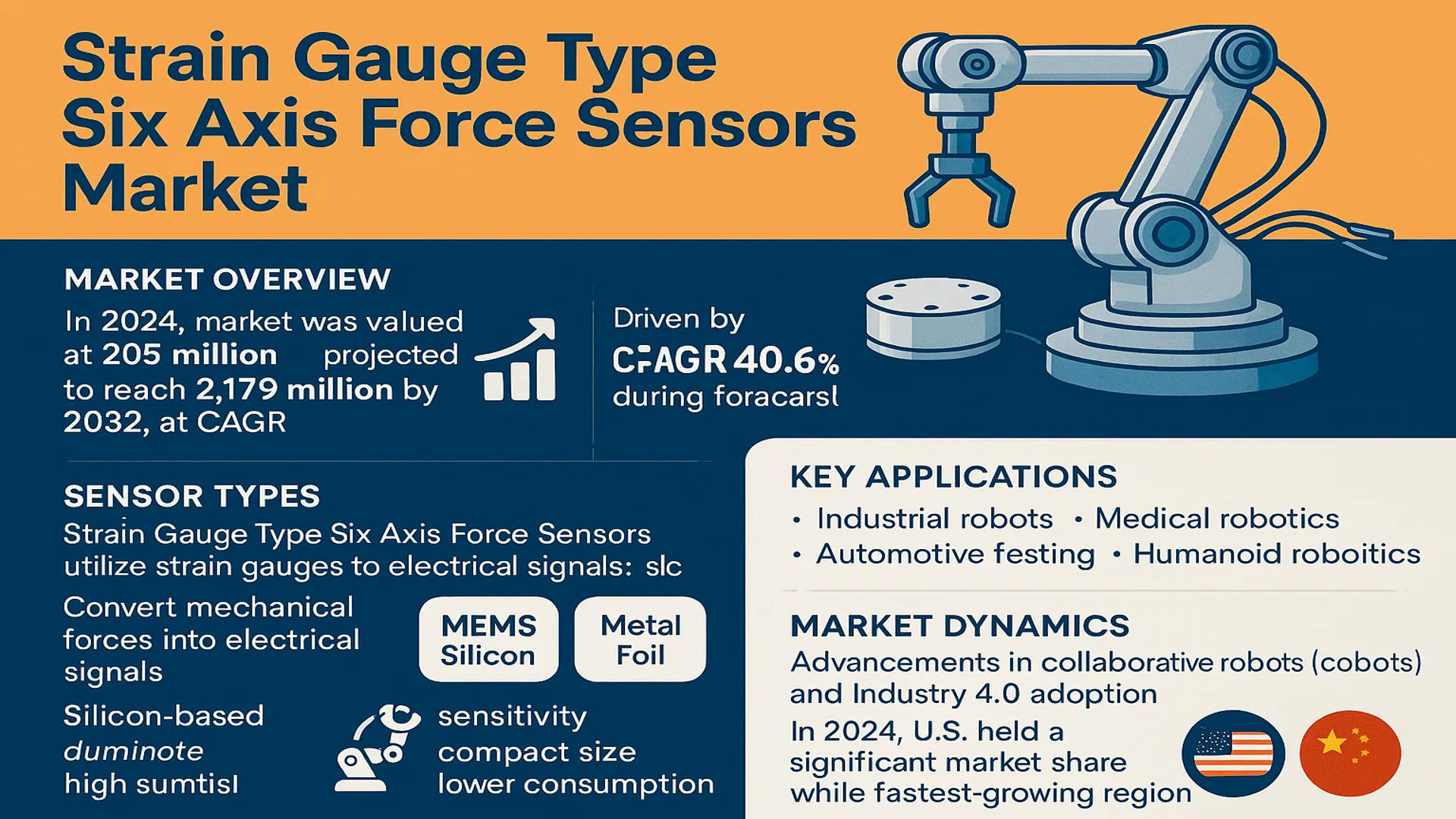
The global Strain Gauge Type six Axis Force Sensors Market was valued at 205 million in 2024 and is projected to reach US$ 2179 million by 2032, at a CAGR of 40.6% during the forecast period. This remarkable growth is driven by increasing automation in industries like robotics, automotive, and healthcare, where precision force measurement is critical.
Strain Gauge Type Six Axis Force Sensors utilize strain gauges to measure deformation in elastic elements, converting mechanical forces into electrical signals. These sensors are categorized into MEMS silicon strain gauge sensors and metal foil strain gauge sensors. Silicon-based sensors dominate due to their superior sensitivity (50–100x higher than metal variants), compact size, and lower power consumption. Key applications include industrial robots, medical robotics, automotive testing, and emerging humanoid robotics.
The market expansion is further fueled by advancements in collaborative robots (cobots) and Industry 4.0 adoption. In 2024, the U.S. held a significant market share, while China emerged as the fastest-growing region. Leading players like ATI Industrial Automation, Schunk, and FANUC are investing in R&D to enhance sensor accuracy and durability, addressing challenges such as temperature sensitivity and calibration complexity. For instance, ATI’s recent 6-axis F/T sensor series launched in Q1 2024 offers improved overload protection, catering to heavy-duty robotic applications.
MARKET DYNAMICS
MARKET DRIVERS
Expansion of Robotics and Automation Spurs Demand for Precision Sensing
The global push toward industrial automation and robotics is accelerating the adoption of strain gauge type six-axis force sensors. These sensors play a critical role in enabling precise force and torque measurements across all axes, which is essential for robotic applications requiring delicate manipulation or heavy payload handling. The industrial robotics sector is projected to grow at a compound annual growth rate exceeding 12%, creating substantial demand for high-precision force measurement solutions. Semiconductor strain gauge sensors, with their superior sensitivity and compact form factor, are becoming the preferred choice for next-generation robotic systems demanding higher accuracy in smaller packages.
Advancements in Medical Robotics Create New Application Frontiers
Medical robotics represents one of the fastest-growing applications for six-axis force sensors, with the surgical robotics market expected to surpass $12 billion by 2027. Strain gauge sensors enable haptic feedback in robotic-assisted surgery systems, allowing surgeons to “feel” tissue resistance during minimally invasive procedures. The development of new MEMS-based silicon strain gauges has enabled sensor miniaturization to previously unattainable levels, making them ideal for integration into delicate surgical instruments. This technological evolution is driving adoption across both established surgical robotics platforms and emerging rehabilitation robotics applications, where precise force measurement is critical for patient safety and treatment efficacy.
Furthermore, regulatory approvals for robotic surgical systems incorporating advanced force sensing capabilities continue to accelerate market growth.
➤ Recent product launches demonstrate how leading manufacturers are integrating high-sensitivity semiconductor strain gauges into surgical robots to achieve force resolution below 0.1N across all axes.
The convergence of robotics with artificial intelligence is creating additional demand for sophisticated force feedback systems, positioning strain gauge sensors as essential enabling components in next-generation intelligent robotics platforms.
MARKET RESTRAINTS
High Development Costs and Complex Calibration Requirements Limit Adoption
While the technology offers significant advantages, strain gauge type six-axis sensors face substantial barriers to widespread adoption. The sophisticated multi-axis calibration process often requires specialized equipment and trained technicians, adding considerable cost to sensor deployment. Complex signal conditioning electronics needed to process outputs from multiple strain gauge bridges can increase total system costs by 30-40% compared to simpler single-axis solutions. These cost factors make the technology prohibitive for price-sensitive applications, particularly in developing markets where budget constraints are more pronounced.
Additional challenges include the need for periodic recalibration in harsh operating environments, where temperature fluctuations and mechanical stresses can affect measurement accuracy over time.
MARKET CHALLENGES
Tight Integration Requirements in Compact Systems Create Design Hurdles
As robotics and automation systems become more sophisticated, the challenge of integrating six-axis force sensors into increasingly compact designs grows more pronounced. The need to maintain precise alignment of multiple strain gauges while minimizing package size creates significant engineering challenges. This is particularly true for collaborative robots (cobots) and medical devices, where space constraints are most severe. The market faces additional challenges from competing technologies such as optical and capacitive force sensors, which offer alternative approaches to multi-axis force measurement.
Other Technical Challenges
Crosstalk Between Axes
Achieving true six-axis independence in force measurements remains technically demanding, with even premium sensors typically exhibiting 2-5% crosstalk between axes that requires sophisticated software compensation.
Long-term Stability
Ensuring measurement stability over thousands of operating hours presents material challenges, particularly in high-cycle applications where mechanical fatigue can degrade sensor performance.
MARKET OPPORTUNITIES
Emerging Applications in Humanoid Robotics and Autonomous Systems Present Growth Frontiers
The rapid development of humanoid robotics and advanced autonomous systems is creating new growth opportunities for six-axis force sensor manufacturers. As these systems evolve beyond simple mobility to incorporate sophisticated manipulation capabilities, the need for integrated force sensing in end effectors and limbs is becoming critical. The humanoid robot market is projected to experience explosive growth through 2030, with force sensors expected to represent a significant portion of the total bill of materials for advanced models.
Concurrent advancements in sensor fusion algorithms and edge computing are enabling new applications where real-time, multi-axis force data is combined with other sensor inputs to create more responsive and adaptive robotic systems. This technological convergence is opening opportunities in areas ranging from precision agriculture to space exploration, where reliable force measurement under challenging conditions is paramount.
Strategic partnerships between sensor manufacturers and robotics developers are accelerating product innovation, with recent collaborations focusing on customized sensor solutions optimized for specific robotic architectures and use cases.
STRAIN GAUGE TYPE SIX AXIS FORCE SENSORS MARKET TRENDS
Increasing Adoption in Robotics and Automation to Drive Market Growth
The global strain gauge type six-axis force sensors market is experiencing significant growth, primarily driven by the increasing adoption of robotics and automation across industrial and medical sectors. These sensors, which measure multi-directional forces and moments, are crucial for applications requiring high precision, such as robotic assembly, surgical robots, and force feedback systems. The robotics sector alone is expected to contribute over 35% of the total demand by 2032, with industrial robots leading in deployment. The shift toward collaborative robots (cobots) utilizing force-torque sensing capabilities is further accelerating this trend, as manufacturers seek safer and more adaptive automation solutions.
Other Trends
Semiconductor Strain Gauge Sensors Gaining Traction
Advancements in MEMS-based silicon strain gauge sensors are reshaping the market with their superior sensitivity, compact size, and lower power consumption compared to traditional metal foil variants. These sensors, preferred for high-precision applications like surgical robotics and aerospace testing, are projected to grow at a CAGR exceeding 45% from 2024 to 2032. Their ability to integrate seamlessly with IoT-enabled systems for real-time force monitoring is a key differentiator, particularly in smart manufacturing environments.
Expansion into Emerging Applications: Humanoid Robots and Wearable Tech
The market is witnessing diversification into next-generation applications, including humanoid robots and rehabilitation wearables. Humanoid robotics, though still nascent, demands sophisticated force feedback systems for balance and object manipulation—functions enabled by six-axis force sensors. Meanwhile, in healthcare, sensor-equipped exoskeletons and prosthetics are leveraging strain gauge technology to provide adaptive force modulation. North America and Asia-Pacific dominate these innovations, accounting for over 60% of R&D investments in sensor-enabled robotics as of 2024.
Challenges: Calibration Complexity and Cost Sensitivity
Despite advancements, challenges such as calibration complexity and high unit costs (ranging from $3,000 to $15,000 per sensor) restrain wider adoption among SMEs. Manufacturers are addressing this through modular designs and AI-driven self-calibration tools. Additionally, supply chain disruptions for rare-earth materials used in sensor fabrication pose a risk, with lead times extending by 20–30% post-2022. Strategic collaborations, like those between ATI Industrial Automation and robotics OEMs, aim to mitigate these barriers through localized production.
COMPETITIVE LANDSCAPE
Key Industry Players
Innovative Product Development and Strategic Collaborations Drive Market Competition
The global strain gauge type six-axis force sensors market exhibits a dynamic competitive landscape characterized by both established multinational players and emerging regional competitors. ATI Industrial Automation leads the market with its technologically advanced force/torque sensors and robust distribution network across North America, Europe, and Asia-Pacific. The company’s latest product innovations, including miniature multi-axis sensors for robotic applications, have strengthened its market position.
Schunk and FANUC maintain significant market shares through their comprehensive product portfolios targeting industrial automation and robotics sectors. Both companies have demonstrated consistent growth by integrating strain gauge sensors with smart factory solutions and collaborative robot systems. Schunk’s focus on high-precision measurement technology for industrial gripping systems complements FANUC’s dominance in robotic force sensing applications.
The market also shows increasing participation from Chinese manufacturers such as Kunwei Beijing Technology and Hypersen Technologies, which are gaining traction through competitive pricing and localized support services. While their technology previously lagged behind Western counterparts, these companies are rapidly closing the gap through strategic R&D investments and partnerships with academic institutions.
Specialized players like Bota Systems are carving out significant niches by developing compact, high-performance sensors for emerging applications in medical robotics and aerospace. The company’s recent introduction of waterproof six-axis force sensors has expanded its presence in challenging operational environments, demonstrating how focused innovation can create competitive advantages in specific verticals.
Europe-based ME-Meßsysteme continues to excel in custom sensor solutions, particularly for automotive testing and research applications. The company’s strength lies in its ability to tailor sensor specifications to exact customer requirements while maintaining German engineering precision – a strategy that has created strong customer loyalty in technical end-markets.
Market competition is further intensified by the entry of AI-focused startups integrating machine learning with force sensing capabilities. While these new entrants currently hold minimal market share, their disruptive potential is prompting established players to accelerate their own digital transformation initiatives and smart sensor development programs.
List of Key Strain Gauge Type Six Axis Force Sensor Companies Profiled
- ATI Industrial Automation (U.S.)
- Schunk GmbH (Germany)
- Advanced Mechanical Technology, Inc. (U.S.)
- Sunrise Instruments (SRI) (China)
- ME-Meßsysteme GmbH (Germany)
- Kunwei Beijing Technology Co., Ltd. (China)
- Bota Systems AG (Switzerland)
- FANUC Corporation (Japan)
- Hypersen Technologies (China)
- Shenzhen Xinjingcheng Sensing Technology Co., Ltd. (China)
- Blue Point Touch (Beijing) Technology Co., Ltd. (China)
- Changzhou Right Measurement and Control System Co., Ltd. (China)
Segment Analysis:
By Type
MEMS Silicon Strain Gauge Sensor Segment Leads Due to High Sensitivity and Compact Design
The market is segmented based on type into:
- MEMS Silicon Strain Gauge Sensor
- Subtypes: Piezoresistive, Capacitive, and others
- Metal Foil Strain Gauge Sensor
- Subtypes: Tool steel, Stainless steel, Aluminum alloy, Beryllium copper
By Application
Industrial Robots Segment Dominates Owing to Automation Growth in Manufacturing
The market is segmented based on application into:
- Industrial Robots
- Medical Robots
- Automotive Field
- Humanoid Robots
- Others
By Technology
Wireless Connectivity Gains Traction for Remote Monitoring Applications
The market is segmented based on technology into:
- Wired
- Wireless
- Subtypes: Bluetooth, WiFi, Zigbee, and others
Regional Analysis: Strain Gauge Type Six-Axis Force Sensors Market
Asia-Pacific
The Asia-Pacific region dominates the strain gauge type six-axis force sensors market, primarily driven by China, Japan, and South Korea. China holds the largest market share due to its aggressive industrial automation initiatives and expanding robotics sector, with the country accounting for over 40% of global industrial robot installations in 2023. Key Chinese manufacturers like Kunwei Beijing Technology and Shenzhen Xinjingcheng Sensing Technology are gaining prominence with competitive pricing strategies while maintaining ISO-certified quality standards. Japan maintains strong demand for high-precision sensors in automotive and electronics manufacturing, with leading players like FANUC and Sintokogio leveraging advanced semiconductor strain gauge technology. South Korea’s market benefits from substantial R&D investments in collaborative robotics, particularly for medical and electronics applications. While cost sensitivity remains a factor, the region’s growing emphasis on Industry 4.0 and smart manufacturing continues to push adoption rates upward.
North America
North America represents the second-largest market, characterized by technological leadership and high-value applications. The United States accounts for over 75% of regional demand, with ATI Industrial Automation being the dominant player offering specialized sensors for aerospace, defense, and advanced manufacturing sectors. Strict regulatory requirements in medical robotics (FDA compliance) and aerospace (FAA standards) drive the need for highly accurate and reliable force sensors. The region shows particularly strong growth in surgical robotics, where six-axis sensors enable haptic feedback systems in minimally invasive procedures. Canada’s market is expanding through academic-industrial collaborations, with universities like Waterloo and Toronto partnering with sensor manufacturers for next-generation robotic research. However, higher product costs compared to Asian alternatives sometimes limit broader industrial adoption.
Europe
Europe maintains a robust market with Germany at its core, contributing approximately 30% of regional revenues. German engineering firms like Schunk and ME-Meßsysteme lead in developing specialized sensors for automotive testing and industrial robotics, often integrating IoT capabilities for predictive maintenance. The EU’s emphasis on collaborative robotics (cobots) under its Industry 5.0 framework is creating new opportunities, particularly in small-to-medium enterprises. Medical applications are growing steadily, with Switzerland and Sweden emerging as key markets for surgical and rehabilitation robotics. European manufacturers face competition from Asian suppliers but differentiate through superior materials science and customization capabilities. Regulatory pressures regarding electromagnetic compatibility (EMC) and workplace safety continue to shape product development priorities across the region.
South America
The South American market remains nascent but shows promising growth in Brazil and Argentina. Brazil’s automotive sector, representing nearly 60% of regional demand, utilizes six-axis sensors for quality control and assembly line automation. Economic volatility and currency fluctuations sometimes hinder capital investments in advanced sensor technologies, leading many manufacturers to opt for refurbished or lower-cost alternatives. Argentina’s market benefits from government incentives for industrial automation in agritech and food processing. While local manufacturing capabilities are limited, partnerships with North American and European firms are gradually strengthening the supply chain. The lack of standardized testing facilities and certification bodies remains a challenge for quality assurance across the region.
Middle East & Africa
This region represents the smallest but fastest-growing market, with growth centered in Israel, Saudi Arabia, and the UAE. Israel’s thriving medical technology sector drives demand for precision force sensors in surgical robotics, supported by strong academic research at institutions like Technion. The UAE focuses on automation in construction and logistics, with Dubai’s smart city initiatives incorporating sensor-enabled robotic systems. Saudi Arabia’s Vision 2030 is fueling investments in industrial diversification, creating opportunities in oil & gas robotics and renewable energy applications. Africa’s market remains constrained by limited industrialization, though South Africa shows gradual uptake in mining automation. Across the region, the absence of local manufacturing compels reliance on imports, while high customs duties in some countries inflate end-user costs.
Report Scope
This market research report provides a comprehensive analysis of the global Strain Gauge Type Six Axis Force Sensors market, covering the forecast period 2024–2032. It offers detailed insights into market dynamics, technological advancements, competitive landscape, and key trends shaping the industry.
Key focus areas of the report include:
- Market Size & Forecast: Historical data and future projections for revenue, unit shipments, and market value across major regions and segments. The global market was valued at USD 205 million in 2024 and is projected to reach USD 2179 million by 2032, growing at a CAGR of 40.6%.
- Segmentation Analysis: Detailed breakdown by product type (MEMS Silicon Strain Gauge Sensor, Metal Foil Strain Gauge Sensor) and application (Industrial Robots, Medical Robots, Automotive Field, Humanoid Robots, Others) to identify high-growth segments.
- Regional Outlook: Insights into market performance across North America, Europe, Asia-Pacific, Latin America, and Middle East & Africa. The U.S. and China are key markets driving growth.
- Competitive Landscape: Profiles of leading market participants including ATI Industrial Automation, Schunk, FANUC, Bota Systems, and others, with analysis of their market share, product portfolios, and strategic initiatives.
- Technology Trends & Innovation: Assessment of semiconductor strain gauge advancements, miniaturization trends, and integration with robotics and automation systems.
- Market Drivers & Restraints: Evaluation of factors such as robotics adoption, Industry 4.0 implementation, and precision measurement requirements versus challenges like high costs and calibration complexities.
- Stakeholder Analysis: Strategic insights for sensor manufacturers, robotics companies, system integrators, and investors regarding market opportunities and challenges.
The report employs primary and secondary research methodologies, including interviews with industry experts and analysis of verified market data, to ensure accuracy and reliability.
FREQUENTLY ASKED QUESTIONS:
What is the current market size of Global Strain Gauge Type Six Axis Force Sensors Market?
-> Strain Gauge Type six Axis Force Sensors Market was valued at 205 million in 2024 and is projected to reach US$ 2179 million by 2032, at a CAGR of 40.6% during the forecast period.
Which key companies operate in this market?
-> Key players include ATI Industrial Automation, Schunk, FANUC, Bota Systems, Advanced Mechanical Technology, ME-Meßsysteme, and several Chinese manufacturers including Kunwei Beijing Technology and Shenzhen Xinjingcheng.
What are the key growth drivers?
-> Key growth drivers include increasing robotics adoption, demand for precision force measurement in manufacturing, and advancements in semiconductor strain gauge technology.
Which region dominates the market?
-> Asia-Pacific shows the fastest growth, particularly China, while North America and Europe remain technologically advanced markets.
What are the emerging trends?
-> Emerging trends include miniaturization of sensors, integration with collaborative robots, and development of more durable semiconductor strain gauges.

Get Sample Report PDF for Exclusive Insights
Report Sample Includes
- Table of Contents
- List of Tables & Figures
- Charts, Research Methodology, and more...
 Download Sample Report PDF


