Strain Gauge for Load Cell Market Insights
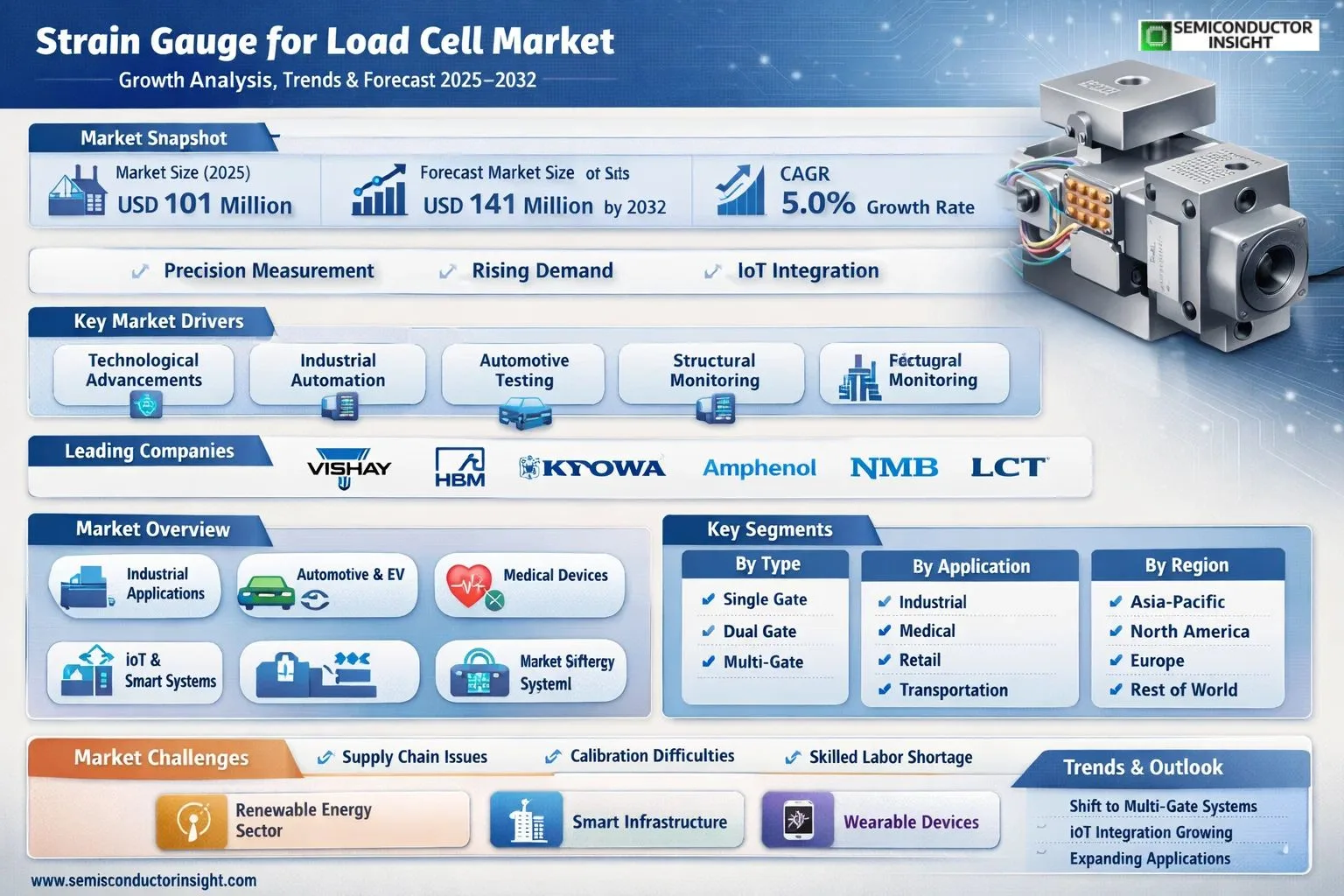
Global Strain Gauge for Load Cell market size was valued at USD 101 million in 2025. The market is projected to reach USD 141 million by 2032, exhibiting a CAGR of 5.0% during the forecast period.
A Strain Gauge for Load Cell is a specialized sensing element used within a load cell to measure force or weight by detecting strain (deformation) in the load cell’s structure. When a force is applied, the load cell deforms slightly, and the strain gauge converts this deformation into an electrical signal proportional to the applied load.
The market is experiencing steady growth due to several factors, including heightened demand for precision measurement in industrial automation, automotive testing, and structural monitoring applications. Furthermore, advancements in high-sensitivity materials and integration with IoT-enabled systems for real-time data acquisition are driving further expansion. Initiatives by key players, such as ongoing R&D in durable foil gauges and compact designs, continue to fuel innovation. VISHAY, HBM, KYOWA, Amphenol, NMB, LCT, Omega, TML, BCM, and Piezo-Metrics are some of the key players operating in the market with comprehensive portfolios.
MARKET DRIVERS
Technological Advancements Driving Precision
Strain Gauge for Load Cell Market is propelled by innovations in strain gauge technology, including foil and semiconductor types that offer enhanced sensitivity and durability. These advancements enable precise force measurement in demanding environments, supporting the growth of industrial automation where load cells are integral. With the global push towards Industry 4.0, integration of strain gauges with digital interfaces has increased accuracy to levels below 0.05% full scale, boosting adoption across sectors.
Expanding Industrial Applications
Rising demand from automotive, aerospace, and healthcare industries fuels market expansion, as electric vehicles require advanced load cells for battery management and weight distribution. In construction and material testing, strain gauges provide real-time structural integrity data, contributing to a projected CAGR of 5.8% through 2030 for Strain Gauge for Load Cell Market. Healthcare devices like patient lifts and infusion pumps further amplify this trend.
➤ IoT integration allows wireless load monitoring, reducing downtime by up to 30% in manufacturing
These drivers collectively enhance efficiency and reliability, positioning the market for sustained growth amid digital transformation.
MARKET CHALLENGES
Supply Chain Vulnerabilities
Persistent semiconductor shortages have disrupted production of strain gauges essential for load cells, leading to delays in Strain Gauge for Load Cell Market. Manufacturers face extended lead times of up to 20 weeks, impacting sectors like automotive assembly lines reliant on precise weighing systems.
Other Challenges
Calibration and Environmental Sensitivity
Strain gauges require frequent recalibration due to temperature fluctuations and humidity, complicating deployments in harsh industrial settings. This increases operational costs by 15-20%, challenging widespread adoption.Additionally, skilled labor shortages for installation and maintenance hinder scalability, as complex load cell systems demand expertise in sensor alignment and signal processing.
MARKET RESTRAINTS
Regulatory and Standardization Barriers
Stringent regulations from bodies like ISO and OIML mandate rigorous testing for load cells, slowing market entry for new Strain Gauge for Load Cell innovations. Compliance costs can exceed 25% of development budgets, deterring smaller players.Competition from alternative technologies, such as optical and piezoelectric sensors, restricts growth as they offer wireless capabilities with fewer calibration needs, capturing 12% market share in high-precision applications.Intellectual property constraints limit customization, as patented designs dominate, impeding rapid adaptation to niche demands in emerging economies.Overall, these restraints cap expansion despite technological promise.
MARKET OPPORTUNITIES
Renewable Energy and Smart Infrastructure
Strain Gauge for Load Cell Market holds potential in wind turbine monitoring and solar panel load testing, where precise measurements ensure longevity. With renewables projected to add 500 GW capacity annually, demand for robust sensors rises sharply.Smart cities initiatives create avenues for urban weighing systems in logistics, supporting IoT-enabled load cells for traffic and waste management. This could unlock a 7.2% CAGR segment through 2032.Advancements in miniaturization open doors for wearable medical devices and drones, expanding applications beyond traditional industries.Strategic partnerships with automation leaders can accelerate penetration into high-growth areas like robotics.
Strain Gauge for Load Cell Market Trends
Shift Towards Multi-Gate Configurations
Strain Gauge for Load Cell Market is witnessing a notable shift towards multi-gate configurations from traditional single-gate and dual-gate types. Multi-gate strain gauges offer superior sensitivity and accuracy in detecting minute deformations within load cells, making them ideal for applications requiring precise force measurement. This transition is driven by demands for higher performance in complex structural monitoring and heavy-duty weighing systems. Manufacturers are increasingly focusing on refining these configurations to enhance signal-to-noise ratios and durability under varying environmental conditions, thereby supporting broader adoption across diverse sectors.
Other Trends
Dominance of Key Manufacturers
Leading players such as VISHAY, HBM, KYOWA, Amphenol, and NMB continue to shape Strain Gauge for Load Cell Market through innovation and market share leadership. These top companies invest heavily in research and development to introduce advanced foil and semiconductor-based strain gauges tailored for load cells. Their strategies include expanding production capacities and forming strategic partnerships to maintain competitive edges. Recent developments highlight improved calibration techniques and integration with digital interfaces, enabling seamless connectivity in modern automation setups. This competitive landscape fosters continuous enhancements in product reliability and customization options for end-users.
Expansion in Diverse Applications
Application diversification represents a key growth trajectory in Strain Gauge for Load Cell Market, extending beyond core industrial uses into medical, retail, transportation, and other areas. In industrial settings, strain gauges enable robust process control and quality assurance in manufacturing. Medical applications leverage their precision for patient weight monitoring and prosthetic force feedback systems. Retail benefits from accurate point-of-sale scales, while transportation sectors utilize them for axle load measurement and structural health monitoring in vehicles. This broadening scope underscores the versatility of strain gauge technology, with ongoing adaptations addressing specific regulatory and performance standards in each field. Regional variations further influence these trends, with Asia showing rapid uptake in transportation due to infrastructure development, complemented by steady industrial dominance in North America and Europe.
COMPETITIVE LANDSCAPE
Key Industry Players
Top Strain Gauge for Load Cell Manufacturers and Market Share Leaders
Strain Gauge for Load Cell Market features a competitive landscape dominated by a few leading global players, with VISHAY, HBM, and KYOWA holding substantial market positions due to their technological expertise, extensive product portfolios, and strong distribution networks. These top-tier companies leverage advanced foil and semiconductor strain gauge technologies to cater to high-precision demands in industrial weighing and force measurement applications. In 2025, the global top five players collectively accounted for a significant revenue share, underscoring an oligopolistic structure amid steady market growth from $101 million to a projected $141 million by 2032 at a 5.0% CAGR. Their dominance is bolstered by innovations in multi-gate configurations and integration with IoT-enabled load cells, enhancing accuracy in automotive and aerospace sectors.
Complementing the market leaders, a range of niche and regional players such as Amphenol, NMB, LCT, Omega, TML, and BCM provide specialized strain gauge solutions tailored for medical devices, retail scales, and transportation systems. Emerging Asian manufacturers including Zhonghang Electronic Measuring Instruments, Xiamen Loadcell Technology, and Zhejiang Huangyan Testing Instrument Factory are intensifying competition through cost-competitive offerings and rapid customization for local markets, particularly in China and Southeast Asia. Players like Piezo-Metrics and Shandong Jinzhong Technology Group focus on high-sensitivity applications, fostering innovation in dual-gate and single-gate segments while addressing challenges like miniaturization and environmental durability, thereby diversifying the competitive dynamics.
List of Key Strain Gauge for Load Cell Companies Profiled
- VISHAY
- HBM
- KYOWA
- Amphenol
- NMB
- LCT
- Omega
- TML
- BCM
- Piezo-Metrics
- Zhonghang Electronic Measuring Instruments
- Xiamen Loadcell Technology
- Zhejiang Huangyan Testing Instrument Factory
- Shandong Jinzhong Technology Group
- Guangdong South China Sea Electronic Measuring Technology
Segment Analysis:
| Segment Category | Sub-Segments | Key Insights |
| By Type |
|
Single Gate
|
| By Application |
|
Industrial
|
| By End User |
|
OEM Manufacturers
|
| By Resistance |
|
350 Ohms
|
| By Bridge Configuration |
|
Full Bridge
|
Regional Analysis: Strain Gauge for Load Cell Market
Asia-Pacific
Asia-Pacific’s robust manufacturing base fuels Strain Gauge for Load Cell Market, with clusters in China and Japan enabling high-volume production. Seamless integration with assembly lines in electronics and machinery sectors drives demand for durable, accurate sensors, supported by skilled labor and advanced fabrication techniques.
The automotive industry’s shift toward electrification and automation amplifies need for strain gauges in load cells for vehicle testing and component weighing. Regional leaders invest in precision technologies, enhancing safety and performance in production processes across passenger and commercial vehicles.
Rapid embrace of IoT-enabled load cells in smart factories transforms monitoring capabilities, with Asia-Pacific firms pioneering real-time data analytics for predictive maintenance. This convergence boosts efficiency in logistics and warehousing, positioning the region at the forefront of digital transformation.
Strong export orientation strengthens Strain Gauge for Load Cell Market, with diversified suppliers ensuring continuity amid global challenges. Local innovations in materials science enhance product reliability, making Asia-Pacific a preferred source for international markets seeking cost-effective solutions.
North America
North America’s strain gauge for load cell market thrives on advanced technological innovation and stringent quality standards, particularly in aerospace, healthcare, and pharmaceuticals. The U.S. leads with R&D investments driving developments in high-precision, miniature sensors for medical devices and aircraft structural testing. Regulatory frameworks emphasize reliability, spurring adoption in regulated industries. Key players collaborate on next-generation materials for extreme environments, enhancing durability. Growing focus on automation in food processing and logistics further propels demand. Supply chains benefit from proximity to tech hubs, enabling rapid prototyping. The region’s emphasis on customization caters to niche applications, solidifying its role in high-value segments of Strain Gauge for Load Cell Market despite competitive pressures from lower-cost regions.
Europe
Europe’s strain gauge for load cell market excels in precision engineering and sustainability-driven applications, anchored by Germany, France, and the UK. Automotive and renewable energy sectors dominate, with wind and solar installations requiring robust load monitoring. EU directives on emissions and safety accelerate integration in manufacturing equipment. Firms prioritize eco-friendly production, innovating biodegradable coatings and energy-efficient designs. Collaborative research consortia foster breakthroughs in multi-axis sensing for robotics. Mature infrastructure supports seamless upgrades in legacy systems. The market’s focus on quality over quantity ensures steady growth, positioning Europe as a benchmark for sophisticated strain gauge for load cell solutions amid evolving industrial paradigms.
South America
South America’s strain gauge for load cell market is emerging, propelled by mining, agriculture, and infrastructure projects in Brazil and Chile. Demand surges for heavy-duty sensors in ore weighing and crop management systems. Local adaptation to harsh terrains drives ruggedized designs. Investments in agrotech enhance precision in silo and harvest monitoring. Economic diversification from commodities fuels industrial automation. Partnerships with global suppliers bridge technology gaps, promoting skill development. Despite logistical hurdles, rising FDI supports market maturation, establishing South America as a growth pocket in the strain gauge for load cell landscape with untapped potential in resource-intensive sectors.
Middle East & Africa
The Middle East & Africa strain gauge for load cell market gains traction in oil & gas, construction, and logistics, led by UAE, Saudi Arabia, and South Africa. Harsh climate adaptations prioritize corrosion-resistant gauges for pipeline integrity and crane overload detection. Mega-projects in smart cities integrate advanced load cells for structural health. Regional hubs invest in training for maintenance excellence. Diversification efforts into renewables spur demand in solar farm monitoring. Supply partnerships mitigate import dependencies, fostering local assembly. This market’s resilience amid volatility highlights its strategic importance in energy and infrastructure-driven strain gauge for load cell applications.
Report Scope
This market research report provides a comprehensive analysis of Strain Gauge for Load Cell Market, covering the forecast period 2025–2032. It offers detailed insights into market dynamics, technological advancements, competitive landscape, and key trends shaping the industry.
Key focus areas of the report include:
- Market Overview: The report begins with an overview outlining its current market scenario, key growth indicators, and industry transformation drivers. It discusses macroeconomic factors, demand–supply balance, regulatory landscape, and the strategic role of strain gauges in powering advancements across industries such as industrial, medical, retail, transportation, and others.
- Market Size & Forecast: Historical data and future projections for revenue, unit shipments, and market value across major regions and segments.
- Segmentation Analysis: Detailed breakdown by product type, technology, application, and end-user industry to identify high-growth segments and investment opportunities.
- Regional Insights: Insights into market performance across North America, Europe, Asia-Pacific, Latin America, and the Middle East & Africa, including country-level analysis where relevant.
- Competitive Landscape: Profiles of leading market participants, including their product offerings, R&D focus, manufacturing capacity, pricing strategies, and recent developments such as mergers, acquisitions, and partnerships.
- Technology Trends & Innovation: Assessment of emerging technologies, integration of AI/IoT, strain gauge design trends, fabrication techniques, and evolving industry standards.
- Market Drivers & Restraints: Evaluation of factors driving market growth along with challenges, supply chain constraints, regulatory issues, and market-entry barriers.
- Stakeholder Insights: Insights for component suppliers, OEMs, system integrators, investors, and policymakers regarding the evolving ecosystem and strategic opportunities.
Primary and secondary research methods are employed, including interviews with industry experts, data from verified sources, and real-time market intelligence to ensure the accuracy and reliability of the insights presented.
FREQUENTLY ASKED QUESTIONS:
What is the current market size of Strain Gauge for Load Cell Market?
-> Global Strain Gauge for Load Cell market was valued at USD 101 million in 2025 and is projected to reach USD 141 million by 2032, at a CAGR of 5.0% during the forecast period.
Which key companies operate in Strain Gauge for Load Cell Market?
-> Key players include VISHAY, HBM, KYOWA, Amphenol, NMB, LCT, Omega, TML, BCM, and Piezo-Metrics, among others.
What are the key growth drivers?
-> Key growth drivers include demand for precise force and weight measurement in industrial, medical, retail, and transportation applications.
Which region dominates the market?
-> Asia is the fastest-growing region, while North America remains a dominant market.
What are the emerging trends?
-> Emerging trends include advancements in single gate, dual gate, and multi-gate configurations, along with integration in various industry applications.

Get Sample Report PDF for Exclusive Insights
Report Sample Includes
- Table of Contents
- List of Tables & Figures
- Charts, Research Methodology, and more...
 Download Sample Report PDF