MARKET INSIGHTS
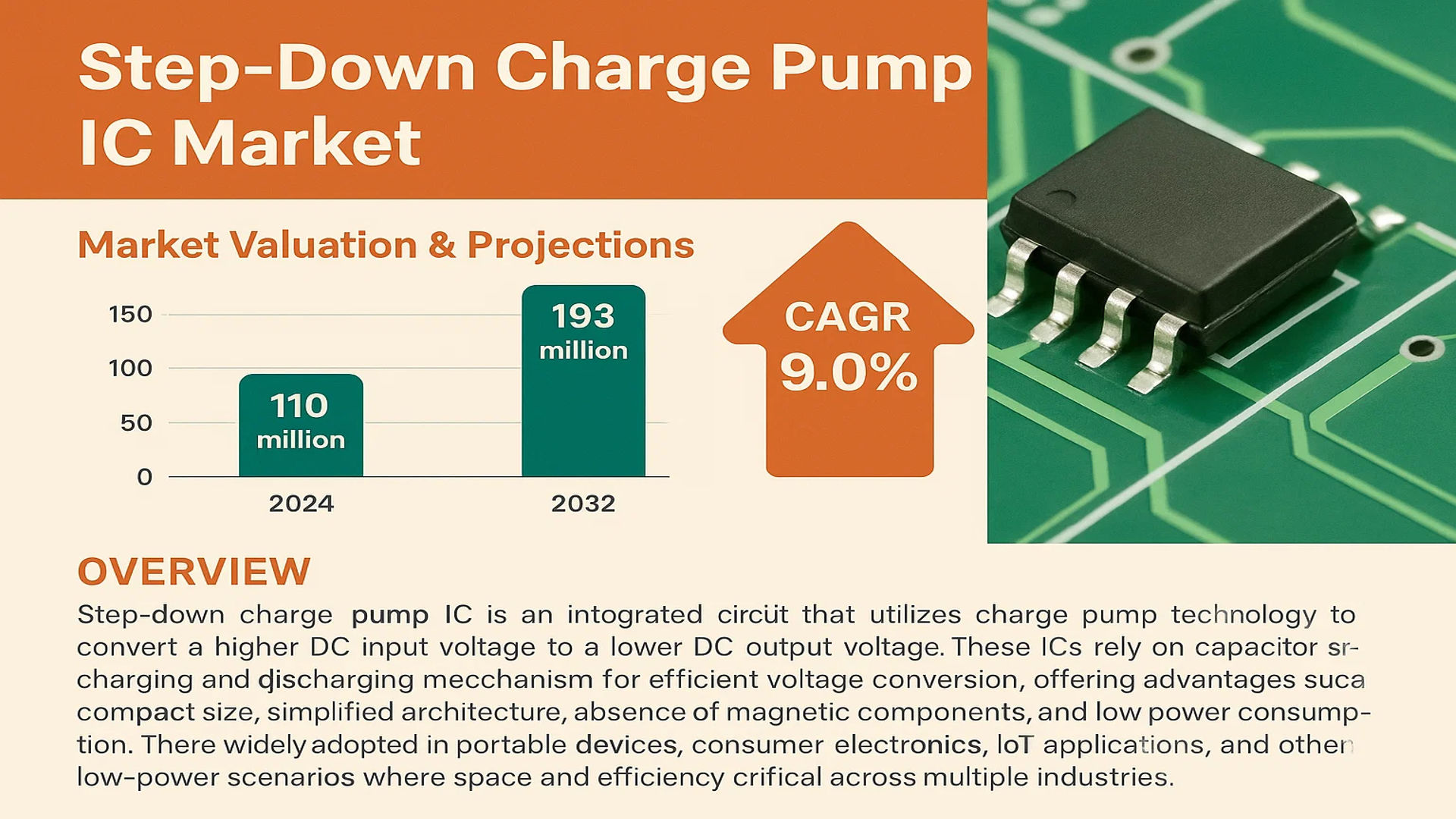
The global Step-Down Charge Pump IC Market was valued at 110 million in 2024 and is projected to reach US$ 193 million by 2032, at a CAGR of 9.0% during the forecast period.
A step-down charge pump IC is an integrated circuit that utilizes charge pump technology to convert a higher DC input voltage to a lower DC output voltage. These ICs rely on capacitor charging and discharging mechanisms for efficient voltage conversion, offering advantages such as compact size, simplified architecture, absence of magnetic components, and low power consumption. They are widely adopted in portable devices, consumer electronics, IoT applications, and other low-power scenarios where space and efficiency are critical.
The market growth is driven by increasing demand for energy-efficient power management solutions across multiple industries. Consumer electronics remains the dominant application segment, while IoT devices are emerging as the fastest-growing sector due to rapid digital transformation. The U.S. currently leads in market share, followed closely by China, which is expected to witness accelerated growth. Leading manufacturers including Analog Devices, TI, and Onsemi are investing heavily in R&D to enhance power efficiency and integration capabilities, further propelling market expansion.
MARKET DYNAMICS
MARKET DRIVERS
Rising Demand for Energy-Efficient Electronics Fuels Market Expansion
The global push toward energy-efficient electronic devices is significantly propelling the step-down charge pump IC market. With the increasing adoption of portable electronics, IoT devices, and battery-powered systems, the need for compact voltage regulators that minimize power loss has surged. Charge pumps offer high efficiency (typically above 90%) without requiring bulky inductors, making them ideal for space-constrained applications. The consumer electronics sector alone is expected to account for nearly 40% of total step-down charge pump IC demand by 2030, driven by smartphones, wearables, and other compact gadgets requiring efficient power management solutions.
Automotive Electronics Evolution Creates Robust Growth Opportunities
Modern vehicles increasingly rely on electronic systems, from infotainment to advanced driver-assistance systems (ADAS), all requiring stable power supplies. Step-down charge pump ICs play a crucial role in voltage regulation for these applications due to their noise-free operation and reliability. The automotive electronics market is projected to grow at approximately 7% annually through 2030, directly benefiting charge pump IC suppliers. Furthermore, electric vehicle adoption amplifies this trend, with power management ICs becoming critical components in battery monitoring and onboard charging systems.
Advancements in power management technology are accelerating market growth. New charge pump designs with higher conversion efficiency (some exceeding 95%) and multi-phase operation capabilities are enabling broader adoption in industrial and communication equipment. The integration of digital control interfaces allows for smarter power management in complex systems.
➤ Some manufacturers have successfully reduced power losses by 20% in their latest charge pump generations through advanced switching technologies and low-resistance semiconductor materials.
Geographical expansion by leading IC manufacturers into emerging markets further stimulates consumption. Several companies have established design centers and production facilities in Asia to better serve local electronics manufacturers, creating a more competitive and accessible marketplace.
MARKET RESTRAINTS
Limitations in Current Density Capabilities Constrain Certain Applications
While step-down charge pumps offer numerous advantages, their current handling limitations present challenges for high-power applications. Most commercial charge pump ICs max out at several hundred milliamps, making them unsuitable for applications requiring multi-amp current delivery. This restricts their use in power-hungry devices, where traditional buck converters maintain dominance. Even with recent improvements, the technology continues to face thermal management hurdles when scaled for higher currents.
Input voltage range constraints create another barrier. Many step-down charge pump ICs operate within relatively narrow input voltage windows, typically between 2.7V to 5.5V for standard models. While some specialized devices support wider ranges, these often come with trade-offs in efficiency or additional cost. This limitation becomes particularly relevant in industrial and automotive applications where input voltages may fluctuate significantly.
Other Challenges
Frequency Limitations
Switching frequencies typically range between 500kHz to 3MHz for most charge pump ICs. While sufficient for many applications, these speeds fall short for certain high-performance computing and communication systems that require faster response times and cleaner power delivery.
EMI Concerns
Although charge pumps generate less electromagnetic interference than inductive converters, high-frequency switching can still produce noise that affects sensitive analog circuits. Careful PCB layout and additional filtering components may be necessary, adding complexity and cost to system designs.
MARKET OPPORTUNITIES
Medical Device Miniaturization Opens New Application Horizons
The expanding market for portable and implantable medical devices presents significant growth potential for step-down charge pump ICs. Modern healthcare technology increasingly demands ultra-compact power solutions for devices like hearing aids, wearable monitors, and drug delivery systems. Charge pump ICs, with their magnetic-free design and low noise characteristics, are uniquely positioned to serve this market segment.
Emerging 5G infrastructure deployments create substantial opportunities. Small cell base stations and network equipment require efficient power management in space-constrained environments. Charge pump ICs facilitate compact voltage regulation for RF power amplifiers and other critical components. The ongoing global 5G rollout is projected to drive millions of units in demand for specialized power management ICs through the decade.
Additional Growth Areas
IoT Expansion
The proliferation of battery-powered IoT sensors and edge devices continues to accelerate. Energy harvesting systems often incorporate charge pump ICs to manage the variable voltages from solar, thermal, or kinetic energy sources. With the IoT device installed base expected to triple by 2030, this represents a massive addressable market.
Advanced Packaging
Innovations in 3D IC packaging and system-in-package (SiP) technologies enable closer integration of charge pump ICs with other components. This trend supports the development of more compact and efficient power delivery networks for next-generation electronics.
MARKET CHALLENGES
Semiconductor Supply Chain Volatility Impacts Market Stability
The step-down charge pump IC market faces ongoing challenges from global semiconductor supply chain disruptions. While conditions have improved from peak pandemic shortages, lead times for certain analog ICs remain extended compared to historical norms. Price volatility for raw materials and fabrication capacity continues to affect product availability and margins. Several manufacturers reported 20-30% longer than normal lead times for power management ICs throughout 2023.
Integration competition from alternative technologies presents another obstacle. Some system designers opt for fully integrated power management units (PMUs) that combine multiple regulator types rather than discrete charge pump solutions. While this approach increases complexity, it can reduce total solution size in some applications. This competitive pressure forces charge pump IC vendors to continuously improve performance and integration capabilities.
Technical Hurdles
Achieving simultaneous high efficiency across wide load ranges remains technically challenging. Many charge pump designs experience significant efficiency drops at very light or very heavy loads, limiting their appeal for applications with dynamic power requirements. Research into adaptive switching algorithms and hybrid converter architectures aims to address this limitation but adds development costs.
STEP-DOWN CHARGE PUMP IC MARKET TRENDS
Growing Demand for Energy-Efficient Power Solutions in Portable Electronics
The global step-down charge pump IC market is witnessing significant growth due to the increasing demand for compact and energy-efficient power solutions in portable electronics. These ICs are widely used in smartphones, tablets, and wearable devices to efficiently step down voltage while minimizing power loss. The market was valued at $110 million in 2024, with projections indicating a rise to $193 million by 2032, driven by a CAGR of 9.0%. One of the key factors bolstering this trend is the consumer shift toward lightweight, high-performance devices that require efficient power management solutions. Additionally, the adoption of Internet of Things (IoT) devices is accelerating the need for low-power components, further expanding the market footprint of step-down charge pump ICs.
Other Trends
Advancements in Automotive Electronics
The automotive industry is increasingly integrating step-down charge pump ICs into advanced driver assistance systems (ADAS), infotainment systems, and electric vehicle power management solutions. The rise of electric and hybrid vehicles has necessitated energy-efficient voltage regulators to maximize battery life and optimize power delivery. In regions like North America and Asia-Pacific, stringent fuel efficiency norms and government incentives for EVs are accelerating R&D investments in intelligent power management ICs. The global automotive electronics segment is expected to register a strong growth rate, further propelling demand for step-down charge pumps with enhanced thermal performance and reliability.
Expansion in IoT and Industrial Automation Applications
The proliferation of IoT devices and industrial automation has amplified the need for efficient power conversion solutions in smart sensors, edge computing devices, and robotics. Step-down charge pump ICs are preferred for their ability to operate in low-power modes, reducing energy consumption in battery-operated systems. Companies are also focusing on developing high-efficiency, multi-output ICs to meet the rising demand for compact power solutions in Industry 4.0 applications. The industrial control segment alone is projected to grow steadily, supported by increased automation in manufacturing processes and smart infrastructure development across emerging economies.
COMPETITIVE LANDSCAPE
Key Industry Players
Innovation and Strategic Partnerships Drive Market Leadership in Step-Down Charge Pump IC Segment
The global Step-Down Charge Pump IC market features a dynamic competitive environment dominated by established semiconductor manufacturers and specialized power management IC vendors. Analog Devices and Texas Instruments (TI) collectively hold a significant market share, driven by their extensive product portfolios and strong R&D capabilities in voltage regulation technologies. These industry leaders benefit from vertical integration advantages and established distribution channels across North America, Europe, and Asia-Pacific regions.
Mid-sized players such as ON Semiconductor (Onsemi) and Microchip Technology have been gaining traction through focused product differentiation strategies. Their success stems from developing application-specific solutions for emerging sectors like IoT devices and automotive electronics, where compact power management solutions are in high demand. Recent product launches featuring ultra-low quiescent current (<1µA) have particularly strengthened their market position in battery-powered applications.
Japanese component manufacturer Murata demonstrates robust growth in the sector, leveraging its expertise in miniaturized power solutions. The company’s recent collaboration with major smartphone manufacturers has accelerated adoption of its step-down charge pump ICs in mobile devices. Similarly, Richtek Technology (a subsidiary of MediaTek) continues to expand its market share through cost-competitive offerings tailored for consumer electronics manufacturers in China and Southeast Asia.
Emerging players face challenges in competing with established brands on price and performance, but several are making strategic inroads. SGMICRO has successfully penetrated the industrial automation sector with high-reliability ICs featuring wide operating temperature ranges. Meanwhile, TOREX Semiconductor has differentiated itself through proprietary noise reduction techniques that appeal to medical device manufacturers.
List of Key Step-Down Charge Pump IC Manufacturers
- Analog Devices, Inc. (U.S.)
- Texas Instruments (TI) (U.S.)
- ON Semiconductor (Onsemi) (U.S.)
- Murata Manufacturing Co., Ltd. (Japan)
- Microchip Technology Inc. (U.S.)
- Ninebea Mitsumi (Japan)
- TOREX Semiconductor Ltd. (Japan)
- Elmos Semiconductor SE (Germany)
- Richtek Technology Corporation (Taiwan)
- SGMICRO Corporation (China)
- Season Hong Kong Group (China)
Segment Analysis:
By Type
Number of Outputs:1 Segment Leads Due to High Demand in Compact Device Designs
The market is segmented based on type into:
- Number of Outputs:1
- Number of Outputs:2
By Application
Consumer Electronics Segment Dominates Owing to Widespread Adoption in Portable Devices
The market is segmented based on application into:
- Communication Equipment
- Consumer Electronics
- Medical Devices
- Industrial Control
- Automotive Electronics
- Internet of Things (IoT)
By Power Efficiency
High-Efficiency ICs Gain Traction in Battery-Powered Applications
The market is segmented based on power efficiency into:
- Low Power (≤50mA)
- Medium Power (50mA-500mA)
- High Power (>500mA)
By Input Voltage Range
Wide Input Range ICs Preferred for Versatile Power Management
The market is segmented based on input voltage range into:
- 2.5V-5.5V
- 5V-12V
- 12V-24V
Regional Analysis: Step-Down Charge Pump IC Market
Asia-Pacific
The Asia-Pacific region dominates the global Step-Down Charge Pump IC market, driven by rapid technological adoption and strong manufacturing ecosystems in countries like China, Japan, and South Korea. Accounting for over 40% of global demand, the region benefits from extensive production of consumer electronics, IoT devices, and automotive components. China’s semiconductor industry investments, valued at $150 billion under its 14th Five-Year Plan, further propel innovation in power management ICs. Local players such as Richtek and Sgmicro compete aggressively with multinational corporations, focusing on cost-optimized solutions for mid-range applications. However, supply chain vulnerabilities and intellectual property concerns remain persistent challenges.
North America
North America is a hub for high-performance Step-Down Charge Pump IC development, with the U.S. contributing nearly 30% of regional revenue. Demand stems from advanced applications in medical devices, aerospace, and electric vehicles, where efficiency and miniaturization are critical. Companies like Analog Devices and TI lead innovation, with recent product launches emphasizing ultra-low-power designs for wearable tech. Regulatory standards, including FCC emissions compliance, drive R&D investments. The Chips and Science Act’s $52 billion funding allocation is expected to bolster domestic semiconductor production, reducing dependency on Asian suppliers.
Europe
Europe’s market is characterized by stringent energy efficiency regulations (e.g., EU Ecodesign Directive) and growing adoption of industrial automation solutions. Germany and France are key contributors, with automotive giants integrating charge pump ICs for infotainment and ADAS systems. The region sees increasing collaboration between academia and manufacturers to develop eco-friendly power solutions, though slower adoption in Eastern Europe due to cost sensitivity tempers overall growth. Recent breakthroughs in gallium nitride (GaN)-based charge pumps by companies like Elmos signal a shift toward next-generation materials.
South America
This emerging market shows potential, particularly in Brazil’s consumer electronics and renewable energy sectors. Local assembly of smartphones and IoT gateways creates steady demand, but economic instability and import dependencies constrain market expansion. Manufacturers prioritize cost-effective single-output ICs, with limited penetration of advanced multi-output variants. Government incentives for electronics manufacturing, such as Brazil’s Rota 2030 program, could stimulate long-term growth if sustained.
Middle East & Africa
The region exhibits nascent demand concentrated in GCC countries and South Africa, primarily for telecommunications infrastructure and oil/gas applications. While lacking local IC production, partnerships with Asian suppliers are increasing. UAE’s focus on smart city initiatives and Saudi Arabia’s Vision 2030 industrial diversification present opportunities, though low-volume purchases and logistical challenges keep growth moderate. The market remains price-driven, with preference for entry-level ICs over premium solutions.
Report Scope
This market research report provides a comprehensive analysis of the Global Step-Down Charge Pump IC market, covering the forecast period 2024–2032. It offers detailed insights into market dynamics, technological advancements, competitive landscape, and key trends shaping the industry.
Key focus areas of the report include:
- Market Size & Forecast: Historical data and future projections for revenue, unit shipments, and market value across major regions and segments. The global market was valued at USD 110 million in 2024 and is projected to reach USD 193 million by 2032, growing at a CAGR of 9.0%.
- Segmentation Analysis: Detailed breakdown by product type (Number of Outputs:1, Number of Outputs:2), application (Communication Equipment, Consumer Electronics, Medical Devices, Industrial Control, Automotive Electronics, IoT, Others), and end-user industry.
- Regional Outlook: Insights into market performance across North America, Europe, Asia-Pacific, Latin America, and Middle East & Africa. Asia-Pacific leads in market share, driven by China’s electronics manufacturing sector.
- Competitive Landscape: Profiles of leading players including Analog Devices, TI, Onsemi, Murata, and Microchip, covering their market share (top 5 players held approximately 45% revenue share in 2024), product portfolios, and strategic initiatives.
- Technology Trends: Analysis of innovations in charge pump IC design, efficiency improvements, and integration with IoT devices and portable electronics.
- Market Drivers & Restraints: Evaluation of growth drivers (increasing demand for portable electronics, IoT expansion) and challenges (supply chain constraints, design complexity for advanced applications).
- Stakeholder Analysis: Strategic insights for semiconductor manufacturers, electronics OEMs, component suppliers, and investors regarding market opportunities and competitive positioning.
The research methodology combines primary interviews with industry experts and analysis of verified market data from semiconductor industry reports and company financial disclosures.
FREQUENTLY ASKED QUESTIONS:
What is the current market size of Global Step-Down Charge Pump IC Market?
->Step-Down Charge Pump IC Market was valued at 110 million in 2024 and is projected to reach US$ 193 million by 2032, at a CAGR of 9.0% during the forecast period.
Which key companies operate in this market?
-> Major players include Analog Devices, Texas Instruments (TI), Onsemi, Murata, Microchip Technology, Ninebea Mitsumi, and TOREX.
What are the key growth drivers?
-> Growth is driven by increasing demand for portable electronics, expansion of IoT devices, and need for efficient power management in automotive electronics.
Which region dominates the market?
-> Asia-Pacific leads the market due to strong electronics manufacturing in China, Japan, and South Korea, while North America shows significant growth in automotive and industrial applications.
What are the emerging trends?
-> Emerging trends include integration with AI-powered devices, development of ultra-low-power ICs for wearables, and adoption in electric vehicle power systems.

Get Sample Report PDF for Exclusive Insights
Report Sample Includes
- Table of Contents
- List of Tables & Figures
- Charts, Research Methodology, and more...