Static Flat Panel Detector Market Insights
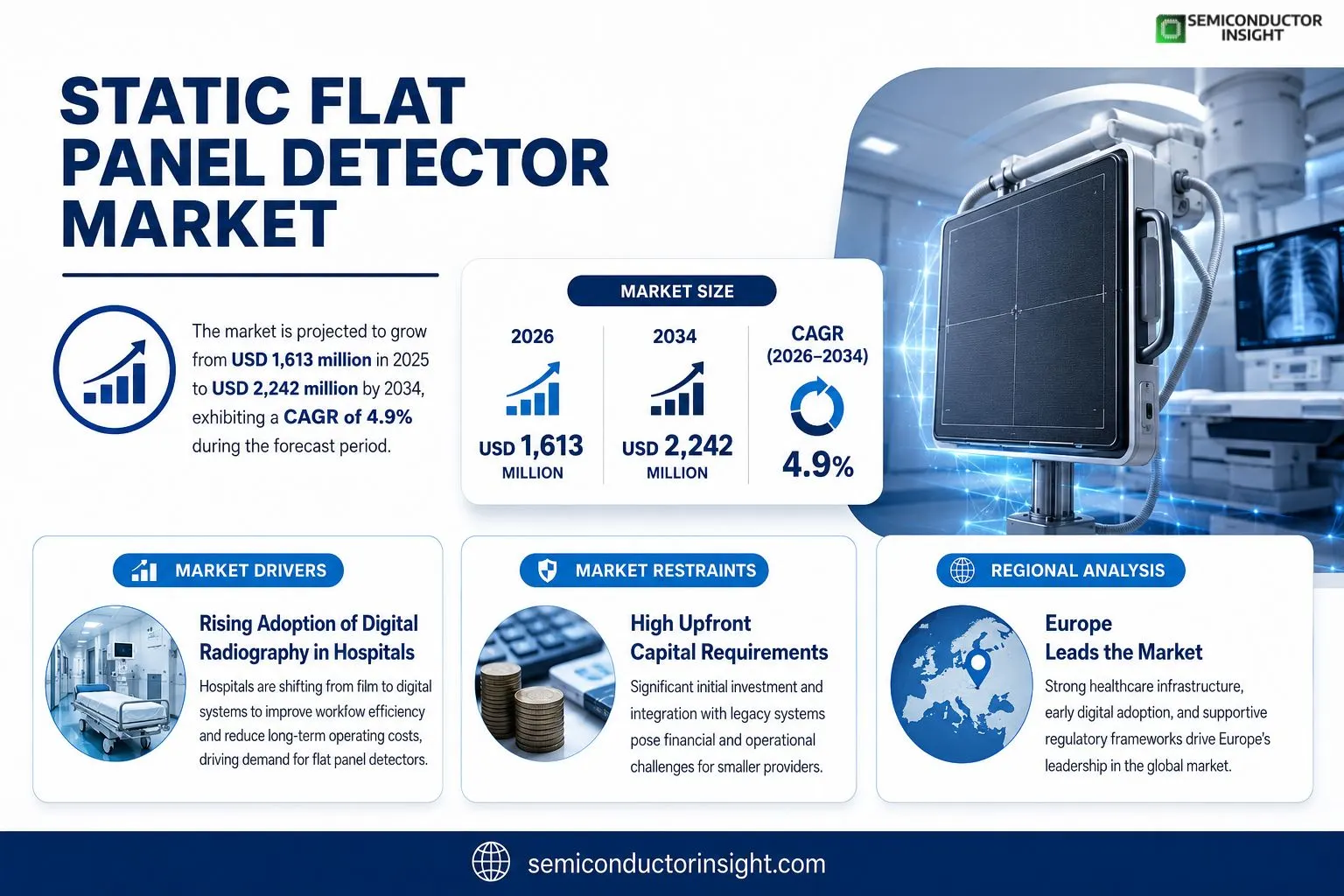
Global Static Flat Panel Detector market size was valued at USD 1,613 million in 2025. The market is projected to grow from USD 1,613 million in 2025 to USD 2,242 million by 2034, exhibiting a CAGR of 4.9 % during the forecast period.
A static flat panel detector is the core imaging component of a digital radiography system. It converts X‑ray energy that has passed through a patient or inspected object into digital signals in a single or sequential exposure, delivering high‑quality images while enabling low‑dose operation. Current offerings span general DR, mammography, dental panoramic, mobile radiography, long‑length orthopedic, surgical, veterinary and industrial non‑destructive testing applications. Technical routes include indirect conversion using cesium iodide or GOS coupled with amorphous silicon or CMOS backplanes and direct conversion based on amorphous selenium.Market expansion is driven by hospital equipment renewal programsparticularly China’s 2024 policygrowing demand for portable imaging in primary‑care and emergency settings, and the shift toward wireless cassette‑type detectors that improve workflow efficiency. Leading suppliers such as Konica Minolta, Varex, Rayence and Canon are focusing on lightweight glass‑free designs, higher protection ratings and integrated features like automatic exposure detection and onboard storage, which are increasingly decisive for OEMs and end users alike.
MARKET DRIVERS
Rising Adoption of Digital Radiography in Hospitals
Healthcare providers are replacing conventional X‑ray film systems with digital solutions to shorten patient throughput and lower long‑term consumable costs. The transition fuels demand for static flat panel detectors because they integrate seamlessly with existing picture‑archiving systems, delivering consistent image quality across a broad spectrum of clinical applications.
Advancements in Detector Sensitivity and Low‑Dose Imaging
Recent sensor‑material innovations have pushed quantum efficiency higher, allowing clinicians to obtain diagnostically reliable images at reduced exposure levels. This improvement addresses growing concerns about cumulative radiation dose, creating a compelling value proposition for facilities seeking to enhance patient safety while maintaining diagnostic confidence.
➤ “The ability to cut exposure by up to 30 % without compromising image clarity is reshaping procurement criteria for many radiology departments.”
Combined, these technical gains and workflow efficiencies are prompting capital‑expenditure cycles that prioritize static flat panel detector units, thereby accelerating the overall growth trajectory of Static Flat Panel Detector Market.
MARKET CHALLENGES
High Upfront Capital Requirements
Even though operational savings accrue over time, the initial purchase price of a full‑featured detector system remains a barrier for smaller clinics and emerging market hospitals. Financing structures are still evolving, and many institutions hesitate to allocate large budgets without clear short‑term ROI evidence.
Other Challenges
Integration with Legacy Imaging Infrastructure
Older X‑ray machines often lack the necessary interfaces to accept modern detector outputs, forcing providers to invest in supplementary conversion hardware or undertake complete system replacements, which can delay adoption timelines.
MARKET RESTRAINTS
Regulatory Compliance and Certification Hurdles
Static flat panel detectors must satisfy stringent medical device regulations in each target market. The certification process, especially in regions with evolving standards, can extend time‑to‑market and increase development costs, discouraging new entrants.Additionally, post‑sale service requirementssuch as periodic calibration and warranty supportadd ongoing operational overhead that can limit the willingness of some operators to transition from proven analog systems.
MARKET OPPORTUNITIES
Emerging Applications in Orthopedic and Dental Imaging
Beyond conventional radiography, static flat panel detectors are gaining traction in niche segments such as intra‑oral dental scans and high‑resolution orthopedic assessments. These use‑cases demand fine spatial resolution and low noise, attributes that modern detectors deliver, opening revenue streams beyond traditional hospital purchases.Manufacturers that tailor software bundlesincorporating AI‑driven image enhancement and automated workflow toolsstand to capture additional market share by offering differentiated solutions that address specific clinical workflows.Strategic partnerships with equipment integrators and regional distributors can accelerate penetration in underserved geographies, where infrastructure upgrades are underway but local expertise remains limited.
Static Flat Panel Detector Market Trends
Integration of Imaging Workflow Enhancements
Manufacturers are converging on detector designs that do more than simply capture X‑ray images. Recent releases combine wireless data transfer, onboard storage, and automatic exposure detection in a single cassette‑sized unit. This integration shortens the time between acquisition and diagnosis, which hospitals value as it frees radiology staff to handle higher patient volumes. The move also aligns with the broader push for digital‑first imaging departments, where legacy film and CR processes have already been phased out. By embedding performance‑boosting features directly into the detector, vendors create a compelling value proposition that resonates with both system OEMs and end‑users seeking to reduce turnaround time while maintaining low‑dose image quality.
Other Trends
Expansion Into Diverse Imaging Scenarios
While general radiography remains the dominant use case, the detector platform is steadily entering specialties such as mammography, dental CBCT, and intra‑operative C‑arm imaging. In parallel, industrial non‑destructive testing applications are adopting the same hardware because of its high spatial resolution and flexible form factor. This cross‑sector applicability allows original equipment manufacturers to amortize development costs across multiple product lines, encouraging a wave of hybrid models that serve both medical and industrial customers. The broadened scope also mitigates reliance on traditional hospital replacement cycles, introducing new growth channels in mobile health clinics, veterinary practices, and emerging‑market screening programs.
Competitive Focus on Durability and Total Cost of Ownership
Vendor roadmaps now prioritize ruggedized housings, glass‑free substrates, and protective ratings that exceed standard laboratory environments. Companies such as Konica Minolta, Varex, and Canon are marketing detectors that survive drops, liquid exposure, and continuous transportfeatures that directly impact the purchasing calculus of mobile radiography providers and field service technicians. At the same time, pricing strategies are shifting from pure image‑quality premiums to holistic cost‑of‑ownership packages that bundle service contracts, firmware upgrades, and integration support. Buyers therefore evaluate proposals on a matrix of image fidelity, device resilience, and lifecycle expenses, rather than on a single technical metric. This nuanced decision framework rewards suppliers who can demonstrate consistent performance across diverse operating conditions while maintaining predictable maintenance costs.
COMPETITIVE LANDSCAPE
Key Industry Players
Static Flat Panel Detector Market – Competitive Overview
The market is anchored by a handful of multinational firms that combine deep sensor‑fabrication expertise with integrated system‑level services. Konica Minolta leverages its long‑standing digital radiography heritage to supply lightweight, glass‑free detectors that meet demanding low‑dose imaging criteria, while Varex Imaging dominates the cassette‑type segment through a portfolio that spans amorphous‑silicon and CMOS back‑plane technologies. Both companies operate extensive OEM networks in North America, Europe and Asia, allowing them to capture large‑scale hospital contracts and to provide after‑sale firmware upgrades that extend product life‑cycles. Their scale also grants access to regulated supply chains for high‑purity cesium‑iodide and selenium layers, reinforcing barriers for newcomers. Consequently, the competitive hierarchy is less about headline‑pixel size and more about the ability to bundle detector hardware with turnkey image‑processing software, remote diagnostics and flexible financing models that align with hospital capital‑budget cycles.Beyond the tier‑one leaders, a diverse set of niche innovators is reshaping application‑specific value. Rayence and Detection Technology Oyj specialize in direct‑conversion selenium sensors aimed at mammography and dental CBCT, where spatial resolution outweighs cost considerations. Asian manufacturers such as iRayTechnology, Vieworks and PIXXGEN have accelerated shipments by targeting mobile radiography and veterinary markets, often coupling detectors with rugged, battery‑operated housings. European firms like Agfa‑Gevaert and Carestream focus on integrated workflow solutions for large‑scale imaging labs, embedding automatic exposure detection and onboard storage to reduce turnaround times. The growing importance of industrial non‑destructive testing has opened doors for companies like Moxtek and DRTECH, which adapt medical‑grade detectors for high‑speed, high‑resolution inspection lines. This stratification creates a competitive environment where differentiation hinges on vertical integration, application‑tailored features and the capacity to satisfy stringent regulatory pathways across multiple regions.
List of Key Static Flat Panel Detector Companies Profiled
- Konica Minolta
- Varex Imaging
- Canon
- GE Healthcare
- Fujifilm Medical Systems
- Rayence
- Detection Technology Oyj
- Teledyne DALSA
- Agfa‑Gevaert Group
- Analogic Corporation
- DRTECH
- iRayTechnology
- Vieworks
- Hamamatsu Corporation
- Carestream Health
- Moxtek Inc
Segment Analysis:
| Segment Category | Sub-Segments | Key Insights |
| By Type |
|
Amorphous Silicon (TFT) remains the dominant technology because it balances image quality with mature manufacturing processes.
|
| By Application |
|
General Radiography stays the core usage scenario, driving continuous improvements in detector speed and durability.
|
| By End User |
|
Large Hospitals drive premium specifications, emphasizing durability, integrated workflow features, and support for high‑throughput imaging suites.
|
| By Conversion Method |
|
Indirect Conversion continues to dominate due to its established manufacturing base and proven image quality.
|
| By Installation Form |
|
Wireless Portable Detectors are gaining traction as healthcare providers expand imaging to point‑of‑care and remote environments.
|
Regional Analysis: Static Flat Panel Detector Market
Europe
The EU Medical Device Regulation imposes rigorous performance criteria, compelling manufacturers to substantiate image quality claims. This environment nurtures a culture of incremental validation, which, while lengthening development cycles, yields detectors with consistently higher reliabilitya trait prized by large hospital systems.
Recent mergers among European imaging firms have created entities with broader product portfolios, enabling cross‑selling of flat panel detectors alongside complementary diagnostic platforms. The resulting scale enhances bargaining power with component suppliers, subtly reshaping cost structures across the market.
Collaborative projects funded by Horizon Europe accelerate material science breakthroughs, particularly in scintillator coatings. These advances translate into detectors that deliver finer spatial resolution, meeting the exacting demands of interventional radiology units across the continent.
Manufacturers have diversified sourcing of silicon wafers, mitigating disruptions observed in other technology sectors. Coupled with localized assembly hubs in the Benelux region, this strategy buffers Static Flat Panel Detector Market against geopolitical shocks.
North America
North America’s position is underpinned by a robust research ecosystem and generous capital investment in tertiary care centers. U.S. hospitals prioritize workflow efficiency, prompting procurement officers to favor detectors that integrate seamlessly with existing RIS/PACS architectures. Canadian providers, meanwhile, focus on cost‑effectiveness, driving demand for modular systems that can be upgraded incrementally. The competitive arena features both global giants and niche innovators, each leveraging advanced analytics to justify premium pricing. Service contracts remain a pivotal differentiator, as rapid-response support minimizes downtime in busy imaging suites, preserving revenue streams for healthcare operators.
Asia-Pacific
In Asia‑Pacific, the market is shaped by rapid urbanization and expanding private hospital networks. Nations such as China and India exhibit a pronounced appetite for modern imaging equipment as they upgrade from film‑based systems to digital solutions. Local manufacturers are gaining traction by offering cost‑competitive flat panel detectors tailored to regional pricing sensitivities, while multinational players counter with superior image fidelity and comprehensive training programs. Governments increasingly allocate funds toward rural health initiatives, creating ancillary demand for portable detector units that can be deployed in remote clinics.
South America
South American adoption reflects a blend of public‑sector modernization drives and private‑sector expansion in Brazil and Argentina. Fiscal constraints compel healthcare administrators to evaluate total cost of ownership, emphasizing detectors with extended service life and low maintenance overhead. Partnerships between local distributors and overseas OEMs facilitate technology transfer, gradually elevating the region’s technical expertise. However, inconsistent regulatory harmonization can slow approval timelines, prompting some institutions to postpone upgrades until clear guidance emerges.
Middle East & Africa
The Middle East & Africa region showcases divergent trajectories. Wealthier Gulf Cooperation Council states invest heavily in flagship medical campuses, seeking cutting‑edge flat panel detectors to support high‑volume interventional procedures. Conversely, sub‑Saharan markets prioritize basic diagnostic capacity, often opting for entry‑level detectors that balance affordability with acceptable performance. International suppliers navigate this split by offering tiered product lines and flexible financing arrangements, ensuring relevance across the economic spectrum while fostering long‑term market penetration.
Report Scope
This market research report provides a comprehensive analysis of the Static Flat Panel Detector Market , covering the forecast period 2026–2034. It offers detailed insights into market dynamics, technological advancements, competitive landscape, and key trends shaping the industry.
Key focus areas of the report include:
- Market Overview: The report begins with an overview outlining its current market scenario, key growth indicators, and industry transformation drivers. It discusses macroeconomic factors, demand–supply balance, regulatory landscape, and the strategic role of semiconductors in powering advancements across industries such as automotive, telecommunications, consumer electronics, and industrial automation.
- Market Size & Forecast: Historical data and future projections for revenue, unit shipments, and market value across major regions and segments.
- Segmentation Analysis: Detailed breakdown by product type, technology, application, and end-user industry to identify high-growth segments and investment opportunities.
- Regional Insights: Insights into market performance across North America, Europe, Asia-Pacific, Latin America, and the Middle East & Africa, including country-level analysis where relevant.
- Competitive Landscape: Profiles of leading market participants, including their product offerings, R&D focus, manufacturing capacity, pricing strategies, and recent developments such as mergers, acquisitions, and partnerships.
- Technology Trends & Innovation: Assessment of emerging technologies, integration of AI/IoT, semiconductor design trends, fabrication techniques, and evolving industry standards.
- Market Drivers & Restraints: Evaluation of factors driving market growth along with challenges, supply chain constraints, regulatory issues, and market-entry barriers.
- Stakeholder Insights: Insights for component suppliers, OEMs, system integrators, investors, and policymakers regarding the evolving ecosystem and strategic opportunities.
Primary and secondary research methods are employed, including interviews with industry experts, data from verified sources, and real-time market intelligence to ensure the accuracy and reliability of the insights presented.
FREQUENTLY ASKED QUESTIONS:
What is the current market size of Static Flat Panel Detector Market?
-> Static Flat Panel Detector Market was valued at USD 1613 million in 2025 and is expected to reach USD 2242 million by 2034, growing at a CAGR of 4.9% during the forecast period.
Which key companies operate in Static Flat Panel Detector Market?
-> Key players include Varex Imaging, Trixell, Canon, Konica Minolta, Inc, Fujifilm Medical Systems, Rayence, Detection Technology Oyj, Teledyne Dalsa, Agfa‑Gevaert Group, Analogic Corporation, GE Healthcare, DRTECH, iRayTechnology, Vieworks, Hamamatsu Corporation, Carestream Health, Moxtek Inc, among others.
What are the key growth drivers?
-> Key growth drivers include hospital equipment renewal programs, expanding primary‑care and mobile healthcare services, increasing demand for low‑dose high‑resolution imaging, cross‑scenario reuse capability across medical and industrial applications, and supportive policies such as China’s 2024 equipment renewal policy and WHO imaging accessibility initiatives.
Which region dominates the market?
-> North America, particularly the United States, holds the largest market share, while Europe remains a strong secondary market due to mature healthcare infrastructure and advanced OEM presence.
What are the emerging trends?
-> Emerging trends include lightweight and glass‑free detector designs, 100‑micron‑class pixel resolution, higher protection ratings, onboard image storage, automatic exposure detection, stitched and single‑exposure long‑length imaging, dual‑energy imaging, and the shift toward flexible substrate technologies that enable new clinical and industrial use cases.

Get Sample Report PDF for Exclusive Insights
Report Sample Includes
- Table of Contents
- List of Tables & Figures
- Charts, Research Methodology, and more...