Dynamic Flat Panel Detector Market Insights
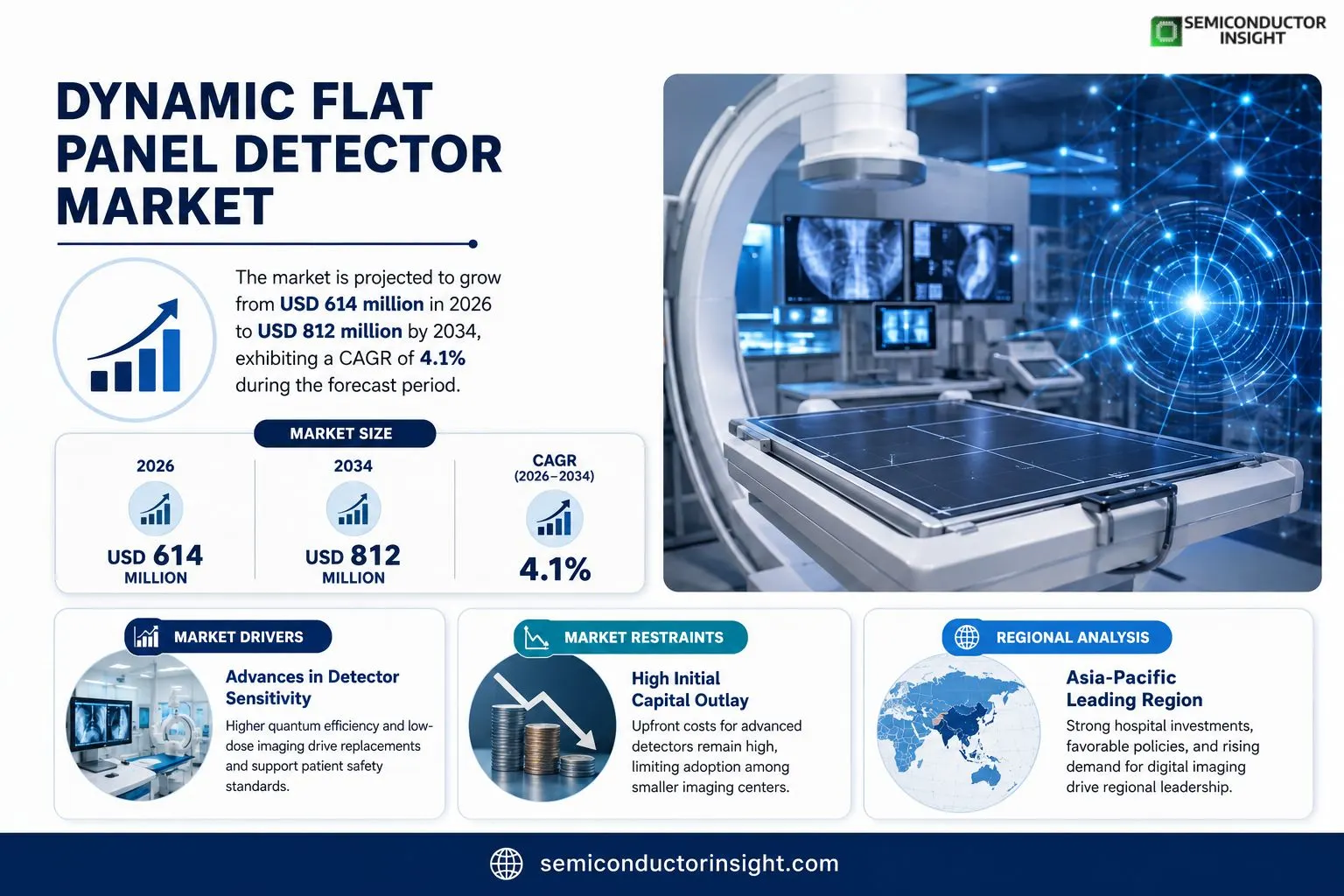
Dynamic Flat Panel Detector market size was valued at USD 614 million in 2025. The market is projected to grow from USD 614 million in 2025 to USD 812 million by 2034, exhibiting a CAGR of 4.1% during the forecast period.
A dynamic flat panel detector serves as the core digital component in continuous X‑ray imaging systems. Its primary function is to convert X‑rays that pass through a patient or inspected object into real‑time dynamic images that can be displayed instantly, acquired continuously, and sent for post‑processing. This capability overcomes the limitations of traditional image intensifiers and static flat panels, such as geometric distortion, high dose requirements, and low frame‑rate acquisition. Current product families span fluoroscopy, radiography‑fluoroscopy hybrids, surgical C‑arms, interventional and cardiovascular imaging, cone‑beam CT (CBCT), dental panoramic and cephalometric systems, radiotherapy positioning devices, and industrial non‑destructive testing equipment. The dominant technology routesamorphous silicon thin‑film transistor (a‑Si TFT), IGZO TFT, and CMOSare typically paired with scintillators like CsI or GOS and supported by high‑speed readout architectures, region‑of‑interest (ROI) processing, real‑time correction algorithms, and low‑latency interfaces that enable seamless dynamic image output.
MARKET DRIVERS
Advances in Detector Sensitivity
The latest silicon‑on‑insulator (SOI) architectures have lifted quantum efficiency by roughly 12 % relative to legacy designs. This technical uplift translates into clearer X‑ray images at lower dose levels, prompting hospitals to replace conventional tubes with Dynamic Flat Panel Detector Market solutions in order to meet stricter patient‑safety guidelines.
Shift Toward Portable Imaging
Mobile C‑arm units now integrate lightweight flat‑panel modules that weigh under 5 kg, a factor that has accelerated adoption in emergency departments and field clinics. The reduction in system footprint also opens new revenue streams for service providers who can now rent compact units to remote facilities.
➤ Hospitals that upgraded to the newest detector arrays reported a 15 % reduction in repeat‑scan rates, directly improving throughput and bottom‑line performance.
These dynamics are further reinforced by an expanding ecosystem of software platforms that exploit the high‑frame‑rate capabilities of modern panels, enabling real‑time image processing and AI‑driven diagnostics.
MARKET CHALLENGES
High Initial Capital Outlay
While the total cost of ownership is improving, the upfront purchase price for a 30 cm detector still averages around $150,000, a sum that can deter smaller imaging centers from immediate investment. Financing arrangements are emerging, yet the cash‑flow impact remains a decisive barrier for many operators.
Other Challenges
Supply‑Chain Volatility
Component shortages in high‑purity silicon wafers and disruptions in logistics have lengthened lead times from six to twelve months, complicating project schedules for OEMs and end‑users alike.In addition, the steep learning curve associated with integrating advanced flat‑panel technology into legacy PACS environments can delay full operational benefit, requiring dedicated engineering support that adds to total expense.
MARKET RESTRAINTS
Regulatory Compliance Hurdles
Regional certification processes for medical imaging equipment have tightened, with the EU MDR and US FDA 510(k) pathways demanding extensive clinical data. The time and resources needed to satisfy these requirements extend product launch timelines, particularly for smaller manufacturers.The need for periodic software validation to maintain compliance further increases lifecycle costs, eroding the price advantage of newer panels over established analog alternatives.Moreover, stringent radiation‑safety standards force manufacturers to invest heavily in shielding and dose‑optimization features, which can raise bill‑of‑materials costs and compress margins.
MARKET OPPORTUNITIES
Emerging AI‑Driven Diagnostics
Artificial‑intelligence algorithms that require high‑resolution, high‑frame‑rate input are gaining traction in musculoskeletal and interventional radiology. Dynamic Flat Panel Detector Market is uniquely positioned to supply the data quality needed for these models, opening licensing and service‑contract revenue streams for equipment vendors.Another avenue lies in the expansion of point‑of‑care imaging within primary‑care networks. Compact flat‑panel units can be coupled with tele‑radiology platforms, allowing rural clinics to offer specialist‑grade diagnostics without the cost of a full‑size suite.Finally, the rollout of 5G connectivity is expected to facilitate real‑time transmission of large image datasets, reducing latency for remote image analysis and broadening the market for cloud‑based imaging solutions that leverage flat‑panel outputs.
Dynamic Flat Panel Detector Market Trends
Escalating Performance Requirements Shape Product Roadmaps
Dynamic Flat Panel Detector Market has moved beyond the stage of proving continuous imaging capability. Current flagship models from Varex, iRay and Vieworks deliver frame rates exceeding 80 fps on active areas larger than 40 cm, while concurrently halving the radiation dose needed for comparable image quality. This shift reflects hospitals’ demand for procedures that can be completed faster without compromising patient safety, and industrial users’ need for high‑speed inspection lines where downtime translates directly into lost revenue. Manufacturers are therefore allocating a larger share of R&D budgets to IGZO‑TFT and CMOS sensors, advanced ROI readouts, and on‑board correction algorithms. The practical outcome is a new class of detectors that act as the performance bottleneck for whole imaging systems, making them a decisive factor in winning OEM contracts.
Other Trends
Diversification of Application Portfolio
While fluoroscopy and radiography remain the core revenue pillars, the market’s elasticity is now being generated by surgical C‑arms, cardiovascular interventional suites, dental CBCT units and industrial non‑destructive testing platforms. Small‑format, high‑speed detectors have found rapid acceptance in dental panoramic and cephalometric devices, where the combination of low dose and compact size addresses both clinician workflow and patient comfort. In parallel, manufacturers such as Teledyne and Hamamatsu are promoting detector modules for battery pack inspection and precision electronics testing, creating a secondary growth curve that is insulated from the cyclical nature of hospital capital expenditures. This broadened application base not only smooths demand fluctuations but also incentivizes vendors to design modular architectures that can be repurposed across medical and industrial lines.
Geographic Realignment and Supply‑Chain Resilience
Supply‑side dynamics have produced a multi‑center competitive landscape spanning Europe, North America, Japan, Korea and China. Chinese firms, buoyed by recent equipment‑renewal policies, are accelerating shipments of mid‑range detectors for domestic hospitals and rapidly gaining market share in regional industrial sectors. Meanwhile, established Western players preserve leadership in high‑end interventional and radiotherapy segments, where legacy performance metrics and integrated software ecosystems retain strong customer loyalty. The coexistence of these regional forces enhances supply‑chain flexibility: OEMs can source high‑volume modules from China to control cost, while they turn to European or North American suppliers for specialized high‑frame‑rate units. This dual‑track sourcing model is expected to reinforce the overall health of Dynamic Flat Panel Detector Market, ensuring that both innovation pipelines and price competition remain vigorous.
COMPETITIVE LANDSCAPEKey Industry Players
Dynamic Flat Panel Detector Market: Competitive Overview
The market is anchored by a handful of established OEMs that command the high‑end segment through integrated system offerings and deep R&D pipelines. Varex Imaging leads with a portfolio that pairs large‑area a‑Si TFT panels with proprietary read‑out electronics, enabling frame rates above 80 fps for interventional suites. Fujifilm Medical Systems leverages its strong presence in radiography to deliver hybrid fluoroscopy / radiography modules that emphasize dose efficiency, while GE Healthcare differentiates itself by embedding advanced image‑processing algorithms into CMOS‑based detectors for cardiovascular applications. Canon and Agfa‑Gevaert Group occupy the mid‑range tier, where cost‑competitiveness and reliable supply chains drive adoption in regional hospitals. Together these firms shape a tiered structure: a premium tier that supplies flagship surgical C‑arms, a mid tier serving general fluoroscopy, and a commodity tier feeding volume‑driven industrial NDT lines.Beyond the headline names, a diverse set of niche innovators is expanding the technology frontier. iRay Technology focuses on compact, high‑speed detectors tailored for dental CBCT and cephalometric imaging, where pixel shrinkage and low‑dose operation are paramount. Detection Technology Oyj and Vieworks push IGZO TFT development, offering superior uniformity for large‑area detectors used in radiotherapy positioning. Hamamatsu Photonics supplies high‑sensitivity scintillator‑CMOS hybrids prized by precision electronics inspection firms. Chinese entrants such as Trixell, CareRay Digital Medical Technologies, and Chengdu Sensview Technology Co., Ltd. are rapidly scaling production capacity, targeting both domestic hospital renewal programs and export opportunities in emerging markets. Their aggressive pricing and localized engineering support make them attractive partners for system manufacturers seeking to diversify supply risk.
List of Key Dynamic Flat Panel Detector Companies Profiled
- Varex Imaging
- Fujifilm Medical Systems
- GE Healthcare
- Canon
- Agfa‑Gevaert Group
- iRay Technology Co., Ltd.
- Detection Technology Oyj
- Vieworks
- Hamamatsu Photonics K.K.
- CareRay Digital Medical Technologies
- Trixell
- DRTECH
- Teledyne DALSA
- Carestream Health
- Chengdu Sensview Technology Co., Ltd.
Segment Analysis:
| Segment Category | Sub-Segments | Key Insights |
| By Type |
|
Fluoroscopy Detectors
|
| By Application |
|
Surgical C‑Arm Systems
|
| By End User |
|
Hospital Imaging Departments
|
| By Technology |
|
IGZO TFT & CMOS Innovations
|
| By Business Model |
|
OEM Supply & Integration
|
Regional Analysis: Dynamic Flat Panel Detector Market
North America
Hospital networks are consolidating imaging suites, favoring detectors that integrate seamlessly with PACS and AI‑enhanced workflows. The drive for lower patient dose and faster turnaround times aligns tightly with the technical strengths of dynamic flat panel technology, prompting procurement decisions that prioritize these attributes.
The FDA’s risk‑based classification system provides clear pathways for device approval, while post‑market surveillance requirements encourage manufacturers to maintain rigorous quality controls. This stability reduces uncertainty for capital‑intensive hospital buyers.
Advances in scintillator materials and ASIC design have raised detective quantum efficiency, allowing clinicians to capture high‑contrast images with fewer exposures. These improvements are compelling arguments for replacing older detector arrays.
A handful of established OEMs dominate the market, but niche innovators are entering through partnerships that bundle detectors with AI analytics platforms, reshaping the value proposition for end users.
Europe
European hospitals are navigating a fragmented reimbursement landscape, where individual country policies dictate the pace of equipment upgrades. Nevertheless, the region benefits from strong public‑funded research programs that trial novel detector configurations, especially in Germany and the United Kingdom. Stringent EU medical device directives enforce high safety standards, which can lengthen approval timelines but also reassure purchasers about long‑term reliability. As health systems aim to reduce waiting lists for diagnostic imaging, there is an increasing appetite for detectors that deliver fast readout without compromising image quality. Vendors are responding with localized service networks to offset concerns about maintenance downtime, thereby reinforcing market confidence.
Asia‑Pacific
In Asia‑Pacific, rapid hospital construction in emerging economies creates a sizable pipeline of first‑time purchasers. Countries such as China, India, and South Korea are investing heavily in digital health infrastructure, and the dynamic flat panel detector is positioned as a cornerstone technology for modern radiology departments. Yet, price sensitivity remains a dominant factor; lower‑cost alternatives compete fiercely, pushing manufacturers to tailor offerings that balance performance with affordability. Regulatory heterogeneity, where some markets still rely on legacy approval processes, adds complexity to market entry strategies, prompting firms to adopt phased rollout plans that align with local certification timelines.
South America
South American markets exhibit a cautious adoption pattern, largely influenced by macro‑economic volatility and fluctuating public health budgets. Brazil and Argentina host the majority of advanced imaging facilities, but procurement cycles are often tied to multi‑year government contracts. The region’s clinicians value detectors that can operate reliably in environments with variable power quality, leading manufacturers to highlight ruggedized designs. Partnerships with regional distributors that provide on‑site training and after‑sales support are becoming critical differentiators for vendors seeking sustainable market share.
Middle East & Africa
The Middle East & Africa present a mixed picture, with affluent Gulf Cooperation Council states rapidly modernizing their diagnostic capabilities, while sub‑Saharan nations face resource constraints. In the UAE and Saudi Arabia, private hospital groups drive demand for state‑of‑the‑art detectors that underpin premium imaging services for medical tourism. Conversely, in many African markets, limited funding channels prioritize cost‑effective solutions, often extending the lifespan of older equipment. Companies that can offer flexible financing models and localized technical assistance stand to capture a growing share of this diverse region.
Report Scope
This market research report provides a comprehensive analysis of the Dynamic Flat Panel Detector Market , covering the forecast period 2026–2034. It offers detailed insights into market dynamics, technological advancements, competitive landscape, and key trends shaping the industry.
Key focus areas of the report include:
- Market Overview: The report begins with an overview outlining its current market scenario, key growth indicators, and industry transformation drivers. It discusses macroeconomic factors, demand–supply balance, regulatory landscape, and the strategic role of semiconductors in powering advancements across industries such as automotive, telecommunications, consumer electronics, and industrial automation.
- Market Size & Forecast: Historical data and future projections for revenue, unit shipments, and market value across major regions and segments.
- Segmentation Analysis: Detailed breakdown by product type, technology, application, and end-user industry to identify high-growth segments and investment opportunities.
- Regional Insights: Insights into market performance across North America, Europe, Asia-Pacific, Latin America, and the Middle East & Africa, including country-level analysis where relevant.
- Competitive Landscape: Profiles of leading market participants, including their product offerings, R&D focus, manufacturing capacity, pricing strategies, and recent developments such as mergers, acquisitions, and partnerships.
- Technology Trends & Innovation: Assessment of emerging technologies, integration of AI/IoT, semiconductor design trends, fabrication techniques, and evolving industry standards.
- Market Drivers & Restraints: Evaluation of factors driving market growth along with challenges, supply chain constraints, regulatory issues, and market-entry barriers.
- Stakeholder Insights: Insights for component suppliers, OEMs, system integrators, investors, and policymakers regarding the evolving ecosystem and strategic opportunities.
Primary and secondary research methods are employed, including interviews with industry experts, data from verified sources, and real-time market intelligence to ensure the accuracy and reliability of the insights presented.
FREQUENTLY ASKED QUESTIONS:
What is the current market size of Dynamic Flat Panel Detector Market?
-> Dynamic Flat Panel Detector Market was valued at USD 614 million in 2025 and is expected to reach USD 812 million by 2034, at a CAGR of 4.1%.
Which key companies operate in Dynamic Flat Panel Detector Market?
-> Key players include Varex Imaging, Trixell, Canon, Konica Minolta, Inc, Fujifilm Medical Systems, Detection Technology Oyj, Teledyne DALSA, Agfa‑Gevaert Group, GE Healthcare, DRTECH, iRay Technology Co., Ltd., Vieworks, Hamamatsu Photonics K.K., Carestream Health, CareRay Digital Medical Technologies, Chengdu Sensview Technology Co., Ltd..
What are the key growth drivers?
-> Key growth drivers include higher frame rates, lower radiation dose, miniaturization of pixel size, expanding applications in dental and industrial sectors, and supportive regional policies that boost equipment renewal.
Which region dominates the market?
-> Asia‑Pacific is the fastest‑growing region, while Europe remains a dominant market due to a mature OEM base and high‑end product adoption.
What are the emerging trends?
-> Emerging trends include advances in IGZO and CMOS sensor technologies, AI‑enabled real‑time image processing, and multi‑scenario platform integration that combines fluoroscopy, radiography and industrial inspection.

Get Sample Report PDF for Exclusive Insights
Report Sample Includes
- Table of Contents
- List of Tables & Figures
- Charts, Research Methodology, and more...