Spiking neural network for event-based sensor processing Market Insights
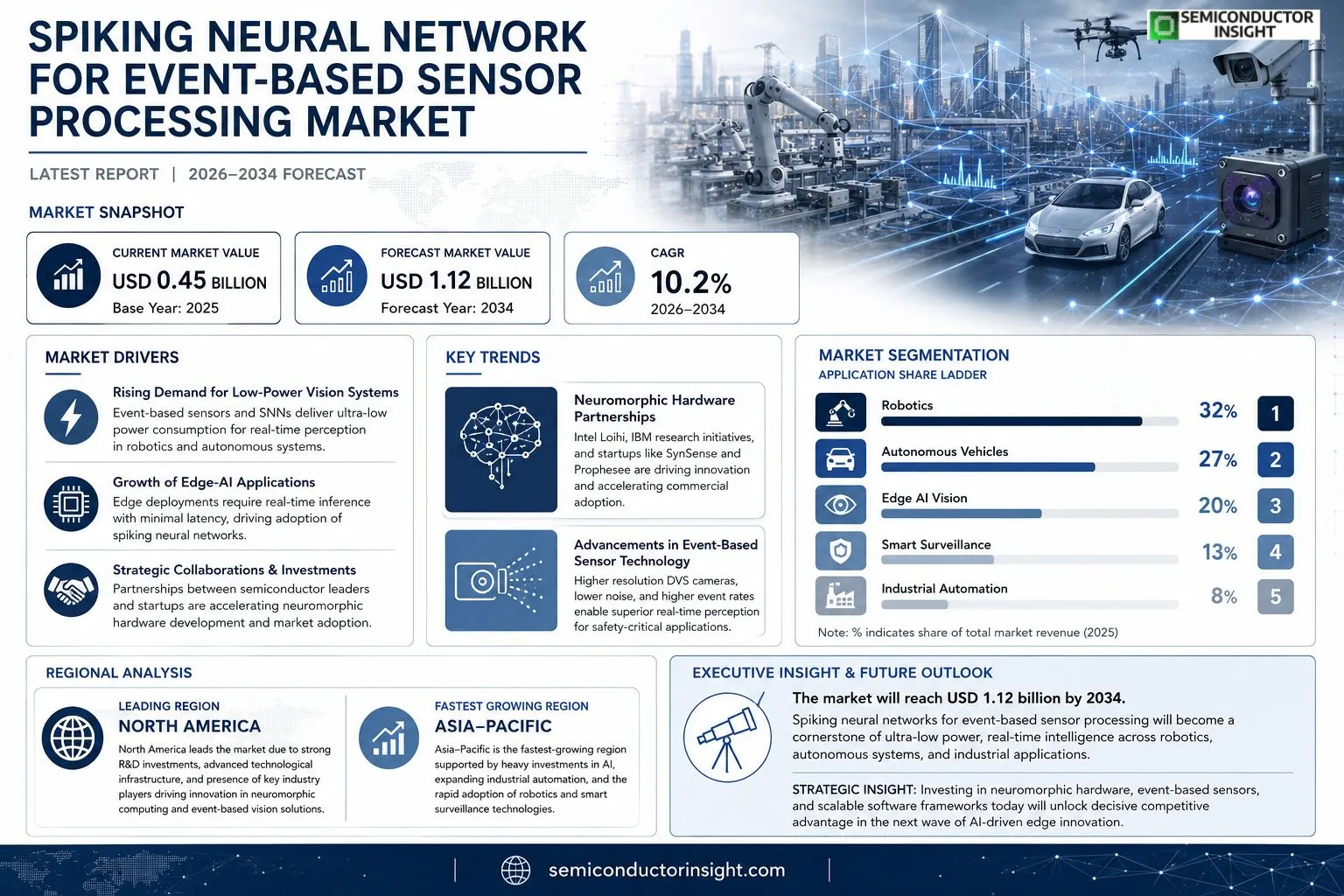
Spiking neural network for event-based sensor processing market size was valued at USD 0.45 billion in 2025. The market is projected to grow from USD 0.48 billion in 2026 to USD 1.12 billion by 2034, exhibiting a CAGR of 10.2% during the forecast period.
Spiking neural networks (SNNs) are bio‑inspired computing models that process asynchronous events generated by neuromorphic sensors such as Dynamic Vision Sensors (DVS). By leveraging temporal spikes instead of continuous frames, SNNs enable ultra‑low latency and energy‑efficient perception, making them ideal for robotics, autonomous vehicles, and edge AI applications.The market is experiencing rapid growth due to rising investments in neuromorphic hardware, increasing demand for real‑time vision systems, and advancements in event‑based camera technology. Furthermore, collaborations between semiconductor leaderssuch as Intel’s Loihi platform and IBM’s research initiativesand specialized startups like SynSense and Prophesee are accelerating adoption across industrial automation and smart surveillance sectors.
MARKET DRIVERS
Rising Demand for Low‑Power Vision Systems
Spiking neural network for event‑based sensor processing Market is being propelled by the need for ultra‑low‑power vision solutions in autonomous drones and robotics. Event‑based sensors generate data only when changes occur, dramatically reducing energy consumption compared with frame‑based cameras.
Growth of Edge‑AI Applications
Edge‑AI deployments in smart cities and industrial IoT are increasingly adopting spiking architectures because they enable real‑time inference with minimal latency. This trend is expected to expand the market base across multiple verticals.
➤ Industry analysts note that integration of spiking networks with neuromorphic hardware can cut inference power by up to 70% relative to conventional deep‑learning accelerators.
These technical advantages are translating into higher adoption rates, positioning Spiking neural network for event‑based sensor processing Market for sustained growth over the next five years.
MARKET CHALLENGES
Complexity of Algorithm Development
Designing efficient spiking algorithms that fully exploit event‑based data remains a formidable challenge. The lack of standardized development frameworks leads to longer time‑to‑market for new solutions.
Other Challenges
Talent Shortage
There is a limited pool of engineers skilled in neuromorphic computing, which restricts rapid scaling of product pipelines.
MARKET RESTRAINTS
High Initial Capital Expenditure
Adopting neuromorphic hardware incurs significant upfront costs, deterring small and medium‑size enterprises from entering Spiking neural network for event‑based sensor processing Market. This financial barrier can slow overall market diffusion.
MARKET OPPORTUNITIES
Emerging Standards for Event‑Based Data Formats
Standardization initiatives are expected to simplify integration across sensors, processors, and application layers. This harmonization will lower development complexity and open new revenue streams for vendors.Furthermore, collaborations between semiconductor manufacturers and AI research institutes are driving the creation of next‑generation neuromorphic chips, which could accelerate adoption in automotive safety systems and augmented‑reality devices.
Spiking neural network for event-based sensor processing Market Trends
Growing Adoption in Edge AI and Robotics
Spiking neural network for event-based sensor processing Market is witnessing a clear acceleration driven by the migration of vision workloads to neuromorphic platforms. Global market valuation reached USD 0.45 billion in 2025 and is expected to rise to USD 0.48 billion in 2026, climbing further to USD 1.12 billion by 2034. The compound annual growth rate of 10.2 % reflects strong demand from autonomous vehicle manufacturers, industrial robotics integrators, and edge‑AI solution providers that value the ultra‑low latency and energy‑efficient inference offered by spike‑based processing. This trend is reinforced by the expanding ecosystem of DVS cameras and the proven capability of spiking networks to handle asynchronous event streams without the overhead of frame‑based pipelines.
Other Trends
Neuromorphic Hardware Partnerships
Collaborations between semiconductor leaders and specialized startups are a defining catalyst for market expansion. Intel’s Loihi platform has entered joint development programs with robotics firms to embed spiking inference directly into motion‑control loops. IBM’s research initiatives partner with academic labs to co‑design SNN accelerators that align with the power envelopes of edge devices. Meanwhile, emerging companies such as SynSense and Prophesee supply event‑based sensor arrays that feed high‑frequency spikes into these hardware back‑ends. The combined effect of hardware availability and software stack integration reduces time‑to‑market for applications ranging from smart surveillance to precision manufacturing, enabling broader commercial adoption.
Advancements in Event‑Based Sensor Technology
Recent breakthroughs in Dynamic Vision Sensor (DVS) design have lowered pixel noise and increased spatial resolution, directly enhancing the quality of data fed to spiking neural networks. These sensors now support higher event rates, which, when paired with optimized SNN algorithms, deliver real‑time perception for safety‑critical systems such as collision‑avoidance in autonomous vehicles. The convergence of sensor fidelity and neuromorphic compute is prompting OEMs to reconsider traditional vision pipelines, positioning Spiking neural network for event-based sensor processing Market as a core component of next‑generation intelligent systems. Continued investment in sensor R&D is expected to sustain this upward trajectory through the remainder of the forecast period.
COMPETITIVE LANDSCAPEKey Industry Players
Rapid growth driven by neuromorphic hardware and edge‑AI innovation
The Spiking Neural Network (SNN) market for event‑based sensor processing is currently anchored by a handful of large semiconductor innovators that provide both hardware platforms and integrated software stacks. Intel’s Loihi neuromorphic chip leads the space with a robust ecosystem that attracts collaborations from academia and automotive OEMs. IBM’s research‑focused initiatives complement this landscape by delivering scalable SNN frameworks that run on its Power architecture. These leaders shape market structure through extensive R&D investments, strategic patents, and partnerships with vision‑sensor manufacturers, establishing a clear hierarchy where tier‑one chip makers dominate the high‑performance segment.Beyond the dominant tier, a diverse set of niche players contributes critical specialized capabilities. Start‑ups such as SynSense and Prophesee have commercialized ultra‑low‑latency event cameras that pair directly with SNN algorithms, unlocking real‑time perception for robotics and smart surveillance. Companies like BrainChip, Qualcomm, and Sony bring proprietary neuromorphic processors and advanced DVS sensors that target edge devices and consumer electronics. Emerging firms including HPE (through its Edge Computing unit), Samsung, and Inceptio add depth to the ecosystem by offering cloud‑linked training platforms, memory‑centric architectures, and AI‑optimized development tools. This multi‑layered player mix fosters rapid innovation and broad adoption across industrial automation, autonomous vehicles, and wearable AI.
List of Key Spiking Neural Network for Event-Based Sensor Processing Companies Profiled
- Intel
- IBM
- SynSense
- Prophesee
- BrainChip
- Qualcomm
- Sony
- Samsung
- HPE
- Inceptio
- Microsoft
- Apple
- Analog Devices
- STMicroelectronics
Segment Analysis:
| Segment Category | Sub-Segments | Key Insights |
| By Type |
|
Event‑driven SNNs are the principal segment because they exploit the native sparsity of event‑based sensors, delivering ultra‑low latency and energy‑efficient inference.
|
| By Application |
|
Robotics drives the most compelling use‑cases for event‑based SNNs, where rapid reaction to dynamic environments is critical.
|
| By End User |
|
Industrial Automation emerges as the leading end‑user segment because event‑driven perception aligns with the deterministic timing requirements of modern factories.
|
| By Technology Stack |
|
Neuromorphic Chips dominate the technology stack as they are purpose‑built for spike‑based computation.
|
| By Deployment Model |
|
On‑premise Edge Devices are the most influential deployment model for event‑based SNNs.
|
Regional Analysis: North America
North America
The integration of spiking neural networks for event-based sensor processing is gaining traction in autonomous driving. The ability to efficiently process high-speed data from cameras and LiDAR sensors offers a significant advantage in real-time object detection and scene understanding.
Spiking neural networks are revolutionizing industrial automation by enabling sophisticated real-time monitoring and control systems. The technology’s efficiency and responsiveness are particularly well-suited for applications in predictive maintenance and quality control.
The healthcare sector is exploring the potential of spiking neural networks for event-based sensor processing in areas like medical imaging and wearable health monitoring. The technology’s ability to process complex physiological signals with low power consumption is highly valuable.
The increasing adoption of edge computing is driving demand for efficient AI processing solutions. Spiking neural networks for event-based sensor processing are well-suited for deployment on edge devices due to their low power consumption and real-time capabilities.
Europe
Europe is witnessing a steady rise in the adoption of spiking neural networks for event-based sensor processing. Significant government initiatives supporting AI research and development are fostering innovation. The region’s strong focus on sustainable technologies is creating opportunities for applications in energy efficiency and environmental monitoring. Key players in Europe are concentrating on developing specialized hardware and software solutions tailored to this emerging technology. The automotive industry in Europe is also actively exploring the use of event-based vision systems.
Asia-Pacific
Asia-Pacific presents a dynamic market for spiking neural networks for event-based sensor processing. Countries like China and Japan are heavily investing in AI and sensor technologies, driving market growth. The burgeoning consumer electronics market and the expanding industrial sector are creating significant demand. The region also benefits from a large pool of skilled engineers and a robust manufacturing infrastructure. Applications in robotics, smart cities, and healthcare are particularly promising.
South America
South America is an emerging market with considerable potential for spiking neural networks for event-based sensor processing. The increasing adoption of IoT devices and the growing focus on infrastructure development are creating opportunities. Pilot projects in agriculture and environmental monitoring are gaining traction. While the market is still relatively nascent, the potential for growth is substantial.
Middle East & Africa
The Middle East and Africa represent a developing market for spiking neural networks for event-based sensor processing. Investments in smart infrastructure and the growing adoption of autonomous vehicle technologies are driving demand. The region’s focus on renewable energy and resource management is also creating opportunities for sensor-based applications.
Report Scope
This market research report provides a comprehensive analysis of the Spiking neural network for event-based sensor processing Market , covering the forecast period 2026–2034. It offers detailed insights into market dynamics, technological advancements, competitive landscape, and key trends shaping the industry.
Key focus areas of the report include:
- Market Overview: The report begins with an overview outlining its current market scenario, key growth indicators, and industry transformation drivers. It discusses macroeconomic factors, demand–supply balance, regulatory landscape, and the strategic role of semiconductors in powering advancements across industries such as automotive, telecommunications, consumer electronics, and industrial automation.
- Market Size & Forecast: Historical data and future projections for revenue, unit shipments, and market value across major regions and segments.
- Segmentation Analysis: Detailed breakdown by product type, technology, application, and end-user industry to identify high-growth segments and investment opportunities.
- Regional Insights: Insights into market performance across North America, Europe, Asia-Pacific, Latin America, and the Middle East & Africa, including country-level analysis where relevant.
- Competitive Landscape: Profiles of leading market participants, including their product offerings, R&D focus, manufacturing capacity, pricing strategies, and recent developments such as mergers, acquisitions, and partnerships.
- Technology Trends & Innovation: Assessment of emerging technologies, integration of AI/IoT, semiconductor design trends, fabrication techniques, and evolving industry standards.
- Market Drivers & Restraints: Evaluation of factors driving market growth along with challenges, supply chain constraints, regulatory issues, and market-entry barriers.
- Stakeholder Insights: Insights for component suppliers, OEMs, system integrators, investors, and policymakers regarding the evolving ecosystem and strategic opportunities.
Primary and secondary research methods are employed, including interviews with industry experts, data from verified sources, and real-time market intelligence to ensure the accuracy and reliability of the insights presented.
FREQUENTLY ASKED QUESTIONS:
What is the current market size of Spiking neural network for event-based sensor processing Market?
-> Spiking neural network for event-based sensor processing Market was valued at USD 0.45 billion in 2025 and is expected to reach USD 1.12 billion by 2034.
Which key companies operate in Spiking neural network for event-based sensor processing Market?
-> Key players include Intel, IBM, SynSense, Prophesee, among others.
What are the key growth drivers?
-> Key growth drivers include rising investments in neuromorphic hardware, increasing demand for real‑time vision systems, advancements in event‑based camera technology, and strategic collaborations between semiconductor leaders and specialized startups.
Which region dominates the market?
-> North America holds the largest market share, while Asia‑Pacific is emerging as the fastest‑growing region.
What are the emerging trends?
-> Emerging trends include development of dedicated neuromorphic chips (e.g., Intel Loihi), integration of SNNs with edge AI platforms, and increasing adoption of event‑based vision solutions in robotics and autonomous vehicles.
Get Sample Report PDF for Exclusive Insights
Report Sample Includes
- Table of Contents
- List of Tables & Figures
- Charts, Research Methodology, and more...