Specialty DDR4 Market Insights
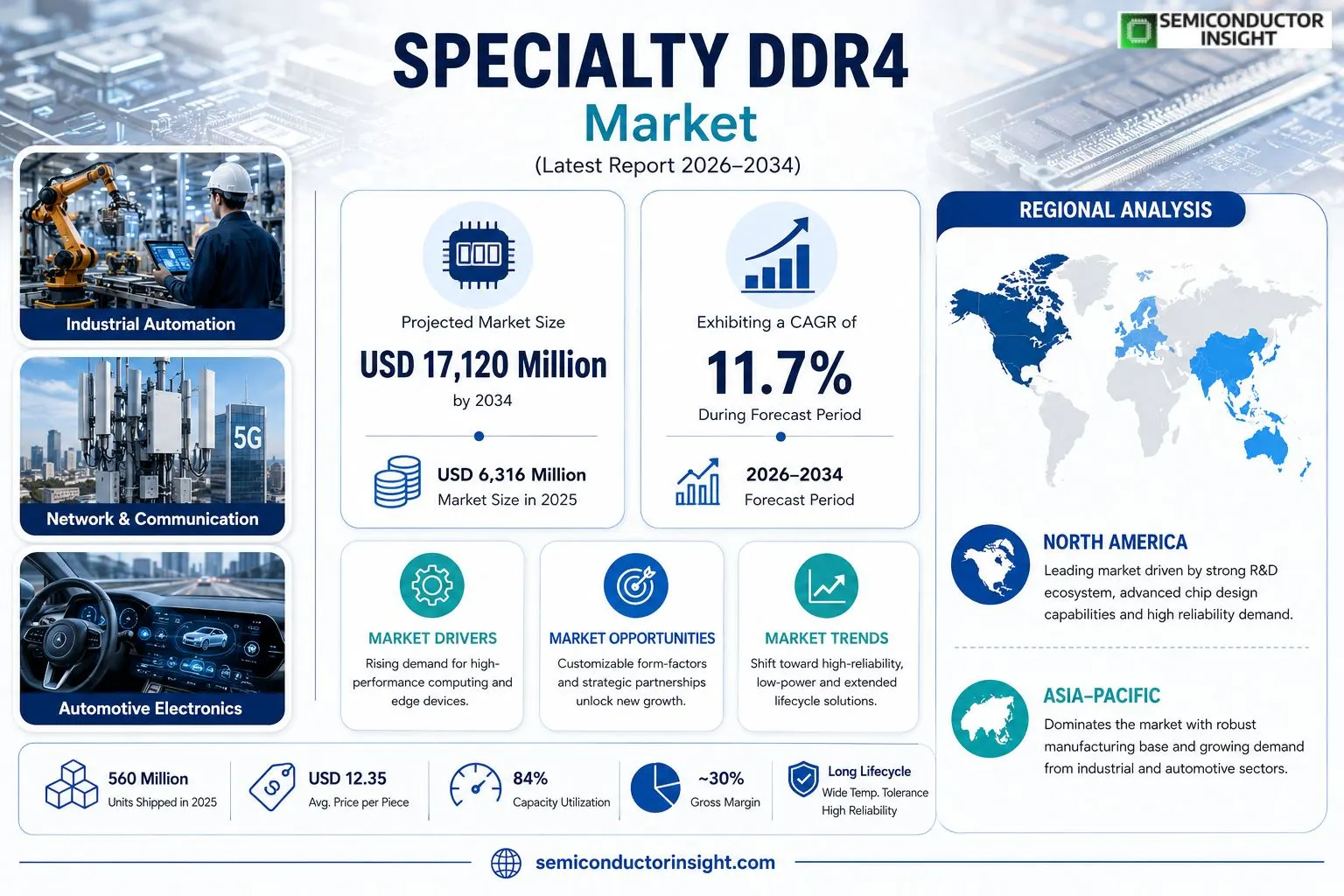
Specialty DDR4 market was valued at USD 6,316 million in 2025 and will grow to USD 17,120 million by 2034, reflecting an implied CAGR of about 11.7 % over the forecast horizon.
Specialty DDR4 refers to dynamic random‑access memory optimized for niche applications such as industrial control systems, network‑communication gear, automotive electronics, smart‑home devices and embedded platforms that demand long‑life‑cycle supply, wide temperature tolerance and high reliability rather than peak performance. In 2025 the segment shipped roughly 560 million units at an average price of USD 12.35 per piece, achieving an 84 % capacity utilisation and a gross margin near 30 %. The value chain spans DRAM wafer fabs, packaging‑testing services and material suppliers upstream; mid‑stream chip‑packaging and module assemblers; downstream OEMs across industrial automation, communications equipment manufacturers, automotive suppliers and system integrators.
MARKET DRIVERS
Increasing Demand for High‑Performance Computing
Enterprises that run artificial‑intelligence workloads, scientific simulations, or real‑time analytics are gravitating toward memory modules that guarantee low latency and deterministic timing. Specialty DDR4 Market benefits because system integrators specify parts that exceed the baseline specifications of standard DDR4, creating a premium niche.
Growth in Edge‑Device Deployments
Edge servers embedded in factories, autonomous vehicles, and 5G base stations require memory that endures temperature swings while sustaining high bandwidth. Manufacturers are engineering DDR4 variants with extended temperature ranges and error‑correction features, prompting OEMs to allocate a larger portion of their bill‑of‑materials to these specialized products.
➤ Specialty DDR4 modules now command an average price premium of roughly 18 % over commodity parts, reflecting the added engineering and testing investments.
Regulatory scrutiny on data integrity in mission‑critical infrastructures has also nudged providers toward memory that meets stricter compliance standards. Consequently, Specialty DDR4 Market is seeing a shift from cost‑only purchasing decisions to value‑based evaluations centered on reliability and performance guarantees.
MARKET CHALLENGES
Supply‑Chain Volatility
The semiconductor ecosystem continues to grapple with raw‑material shortages and logistics bottlene‑cks, which disproportionately affect low‑volume, high‑specification product lines. As a result, lead times for specialty DDR4 kits can exceed six months, unsettling system‑design schedules.
Other Challenges
Cost Sensitivity
Because specialty memory commands higher prices, price‑pressured customers in consumer‑electronics sometimes opt for standard DDR4 alternatives, limiting the addressable market despite technical merits.
MARKET RESTRAINTS
Limited Design Adoption
System architects unfamiliar with the nuanced benefits of extended‑temperature or error‑correcting DDR4 often default to legacy components. This knowledge gap slows the diffusion of specialty parts, especially in mid‑size enterprises that lack dedicated hardware engineering resources.Furthermore, the rapid emergence of DDR5 has siphoned some investment away from DDR4 enhancements, leaving certain OEMs uncertain about the long‑term viability of dedicating resources to a technology that may be superseded within a few product cycles.
MARKET OPPORTUNITIES
Customizable Form‑Factors for Niche Applications
Clients in aerospace, defense, and medical imaging are seeking memory solutions that can be tailored to unconventional board layouts or that meet stringent electromagnetic‑compatibility criteria. Offering modular design servicessuch as on‑demand stack heights or specialty thermal‑interface materialscreates a differentiated revenue stream within Specialty DDR4 Market.
Strategic Partnerships with Foundries
Collaborations that lock in capacity for low‑volume, high‑mix production can mitigate supply‑chain risks while delivering cost efficiencies. Foundries that invest in process‑qualification for extended‑temperature DDR4 can command a premium pricing tier, attracting OEMs looking for reliable, long‑term supply.
Specialty DDR4 Market Trends
Supply‑chain Resilience and Extended Lifecycle Demand
The Specialty DDR4 segment has shifted from a niche curiosity to a cornerstone for manufacturers that require predictable performance over long periods. Customers in industrial control, automotive electronics, and network equipment increasingly specify parts that can survive harsh temperature ranges and maintain a steady supply for ten‑plus years. This preference is not driven by raw speed but by the cost of redesigning systems whenever a component reaches end‑of‑life. As a result, vendors are prioritizing long‑run wafer contracts and investing in redundant fab capacity, which cushions the downstream ecosystem against sudden shortages. The practical upshot for suppliers is a higher gross marginaround 30 %and a utilization rate that regularly exceeds 80 %.
Other Trends
Application‑driven Growth in Industrial Automation
Industrial automation accounts for the largest slice of specialty demand, with factories modernizing control panels and robotics that rely on deterministic memory behavior. Unlike consumer PCs, these installations cannot tolerate latency spikes, so designers choose DDR4 parts that have been qualified for extended‑temperature operation and offer verified reliability. The ripple effect is visible in the supply chain: packaging firms are adopting high‑reliability FBGA formats (78‑FBGA and 96‑FBGA) to meet stress‑test requirements, while testing facilities report yield improvements of roughly 12 % after adopting low‑power process tweaks. For system integrators, the promise of a stable component base translates into lower total cost of ownership, encouraging them to lock‑in multi‑year purchase agreements.
Technology Maturation and Cost‑optimization
Recent advances in DDR4 process nodes have lowered per‑bit production cost, allowing manufacturers to shrink the wafer‑cost share from historically higher levels to about 55 % of total expense. Packaging and testing now represent roughly 18 % of the bill‑of‑materials, while R&D amortization sits near 12 %. These shifts enable price points that hover around $12 per chip, making specialty parts competitive against generic alternatives for price‑sensitive projects. Simultaneously, policy initiatives that promote domestic sourcing of critical components are nudging regional playersparticularly in the United States and Chinato expand local fabs, thereby reducing exposure to geopolitical supply shocks. The combined effect of tighter process control and strategic policy support is a more defensible market position for incumbents and a clearer entry path for newcomers focusing on high‑reliability, customized DDR4 solutions.
COMPETITIVE LANDSCAPEKey Industry Players
Specialty DDR4 Market: Competitive Overview and Strategic Positioning
Winbond Electronics stands out as the dominant supplier in the specialty DDR4 segment, leveraging its long‑standing DRAM expertise and a vertically integrated manufacturing network that encompasses wafer fabrication, packaging, and test operations. This depth enables the company to guarantee the extended lifecycles and temperature tolerances demanded by industrial and automotive customers, while maintaining a gross margin that comfortably exceeds the sector average. Winbond’s pricing discipline and consistent capacity utilization of roughly 84 % have allowed it to capture a sizable slice of the $6.3 billion market in 2025, positioning the firm as the reference point for reliability‑focused memory solutions. Its strategic investments in low‑power process refinements and high‑reliability packaging further reinforce its ability to meet the stringent qualification standards of equipment OEMs, creating a barrier to entry for newer entrants.Beyond the market leader, a cluster of Asian manufacturers has cultivated distinct niche strengths that collectively shape the competitive fabric. Nanya Technology and GigaDevice focus on high‑volume production for network‑equipment cache, capitalizing on cost‑effective wafer sources in Taiwan and China. ISSI and UniSemicon have carved out a reputation for customized error‑correction features tailored to embedded controllers in smart‑home gateways. Eastsoft and Elite Semiconductor Microelectronics concentrate on 78‑FBGA and 96‑FBGA form factors that satisfy automotive ECU requirements, while Etron Technology offers a portfolio that blends extended temperature grades with modest capacity footprints. Shanghai Belling and ChangXin Memory Technologies, both Chinese‑based, are leveraging domestic policy incentives to expand domestic supply chains, reducing reliance on overseas sources. This mosaic of specialized capabilities ensures that end‑users can source memory that aligns precisely with reliability, lifecycle, and cost parameters, while keeping the overall market fragmented and competitive.
List of Key Specialty DDR4 Companies Profiled
- Winbond Electronics
- Nanya Technology
- GigaDevice
- ISSI
- UniSemicon
- Eastsoft
- Elite Semiconductor Microelectronics
- Etron Technology, Inc.
- Shanghai Belling Co., Ltd.
- ChangXin Memory Technologies
- Micron Technology (via specialized division)
- SK Hynix (specialty DDR4 line)
Segment Analysis:
| Segment Category | Sub-Segments | Key Insights |
| By Type |
|
Industrial DDR4
|
| By Application |
|
Industrial Control
|
| By End User |
|
Industrial Automation Enterprises
|
| By Reliability |
|
Extended Temperature Range
|
| By Supply Chain |
|
Packaging & Testing Services
|
Regional Analysis: Specialty DDR4 Market
North America
Firms in the leading region prioritize architectural flexibility, enabling them to tailor timing parameters and voltage envelopes for niche workloads. This focus on custom shim stacks and tiered ranking schemes creates memory modules that can be fine‑tuned for latency‑critical AI inference or dense storage caching, reinforcing the region’s reputation for engineering depth.
A diversified supplier base, spanning domestic wafer fabs to overseas packaging partners, cushions the region against geopolitical shocks. Collaborative forecasting between OEMs and foundries allows capacity buffers to be built proactively, preserving delivery reliability for high‑value Specialty DDR4 projects.
Regulatory frameworks that incentivize low‑power electronics and data‑security compliance shape product specifications. Certification pathways for aerospace and defense applications push manufacturers to embed encryption and error‑correction features directly into DDR4 silicon, opening premium pricing tiers.
Concentrated R&D spend and a culture of rapid prototyping give North American firms a first‑mover edge. By leveraging intellectual‑property portfolios around high‑speed signaling and thermal management, they sustain a differentiated stance against global rivals.
Europe
European players bring a strong emphasis on sustainability and standards alignment to Specialty DDR4 Market. Industry consortia promote eco‑design guidelines that encourage lower leakage currents and recyclable packaging, aligning memory solutions with EU environmental directives. This regulatory focus drives manufacturers to incorporate green‑process techniques, which, while adding design complexity, unlock access to procurement contracts that prioritize carbon‑footprint metrics. Moreover, a well‑established automotive supply chain in the region fuels demand for ruggedized DDR4 modules capable of withstanding temperature extremes, reinforcing Europe’s niche in automotive‑grade memory. Collaborative research initiatives between universities and chipmakers nurture a pipeline of talent skilled in mixed‑signal integration, ensuring that product innovation remains closely tied to emerging use‑cases such as industrial IoT gateways.
Asia‑Pacific
The Asia‑Pacific arena is distinguished by its manufacturing scale and a growing appetite for customized memory in consumer electronics. While price sensitivity remains high, OEMs increasingly request performance‑tuned DDR4 variants to differentiate flagship smartphones and gaming consoles. Local fabs have honed fast‑turnaround capabilities, allowing them to iterate designs within tight product cycles. At the same time, regional governments are supporting advanced packaging research, which gradually raises the technical ceiling for specialty memory. This combination of cost efficiency, rapid prototyping, and strategic policy support positions the Asia‑Pacific market as a critical source of volume while still offering pathways for differentiated, performance‑oriented offerings.
South America
South American demand for Specialty DDR4 memory is driven largely by the expansion of telecommunications infrastructure and a nascent data‑center sector. Mobile network upgrades to 5G require edge‑computing nodes that rely on low‑latency, high‑throughput memory, prompting local carriers to source tailor‑made DDR4 solutions. Although the overall market size is modest, the region’s focus on connectivity creates a niche for memory vendors that can deliver rugged modules with extended temperature ranges suitable for tropical environments. Partnerships between regional system integrators and overseas memory specialists are beginning to shape a supply network that balances cost constraints with the need for reliability.
Middle East & Africa
In the Middle East & Africa, Specialty DDR4 Market is shaped by investments in smart‑city initiatives and defense projects. Governments are allocating resources to build data hubs that support cloud‑based services, creating a requirement for memory that can sustain high transactional loads under variable power conditions. Defense contractors, in particular, seek memory with enhanced security features and hardened packaging to meet mission‑critical standards. While the region lacks extensive local fabrication capacity, it compensates through strategic import agreements and joint ventures that bring advanced design expertise to market, enabling firms to meet the specialized specifications demanded by public‑sector customers.
Report Scope
This market research report provides a comprehensive analysis of the Specialty DDR4 Market , covering the forecast period 2026–2034. It offers detailed insights into market dynamics, technological advancements, competitive landscape, and key trends shaping the industry.
Key focus areas of the report include:
- Market Overview: The report begins with an overview outlining its current market scenario, key growth indicators, and industry transformation drivers. It discusses macroeconomic factors, demand–supply balance, regulatory landscape, and the strategic role of semiconductors in powering advancements across industries such as automotive, telecommunications, consumer electronics, and industrial automation.
- Market Size & Forecast: Historical data and future projections for revenue, unit shipments, and market value across major regions and segments.
- Segmentation Analysis: Detailed breakdown by product type, technology, application, and end-user industry to identify high-growth segments and investment opportunities.
- Regional Insights: Insights into market performance across North America, Europe, Asia-Pacific, Latin America, and the Middle East & Africa, including country-level analysis where relevant.
- Competitive Landscape: Profiles of leading market participants, including their product offerings, R&D focus, manufacturing capacity, pricing strategies, and recent developments such as mergers, acquisitions, and partnerships.
- Technology Trends & Innovation: Assessment of emerging technologies, integration of AI/IoT, semiconductor design trends, fabrication techniques, and evolving industry standards.
- Market Drivers & Restraints: Evaluation of factors driving market growth along with challenges, supply chain constraints, regulatory issues, and market-entry barriers.
- Stakeholder Insights: Insights for component suppliers, OEMs, system integrators, investors, and policymakers regarding the evolving ecosystem and strategic opportunities.
Primary and secondary research methods are employed, including interviews with industry experts, data from verified sources, and real-time market intelligence to ensure the accuracy and reliability of the insights presented.
FREQUENTLY ASKED QUESTIONS:
What is the current market size of Specialty DDR4 Market?
-> Specialty DDR4 Market was valued at USD 6,316 million in 2025 and is expected to reach USD 13,247 million by 2032 at a CAGR of 11.7%.
Which key companies operate in Specialty DDR4 Market?
-> Key players include Winbond (TW), Nanya (TW), GigaDevice (CN), ISSI (CN), UniSemicon (CN), Eastsoft (CN), Elite Semiconductor Microelectronics Tech Inc (TW), Etron Technology, Inc. (TW), Shanghai Belling Co., Ltd. (CN), ChangXin Memory Technologies (CN), among others.
What are the key growth drivers?
-> Policy drivers such as industrial digital transformation and domestic substitution policies, technological innovation drivers including improved DDR4 process maturity, low‑power design optimization and high‑reliability packaging, and rising consumer demand for higher stability, longer lifecycle supply and lower total cost of ownership.
Which region dominates the market?
-> Asia–Pacific dominates the market, with significant contributions from China, Japan, South Korea and other Asian economies.
What are the emerging trends?
-> Shift towards high‑reliability and customized DDR4 solutions, low‑power designs, and advanced high‑reliability packaging technologies.
Get Sample Report PDF for Exclusive Insights
Report Sample Includes
- Table of Contents
- List of Tables & Figures
- Charts, Research Methodology, and more...
 Download Sample Report PDF