Specialty DDR4 and DDR5 Market Insights
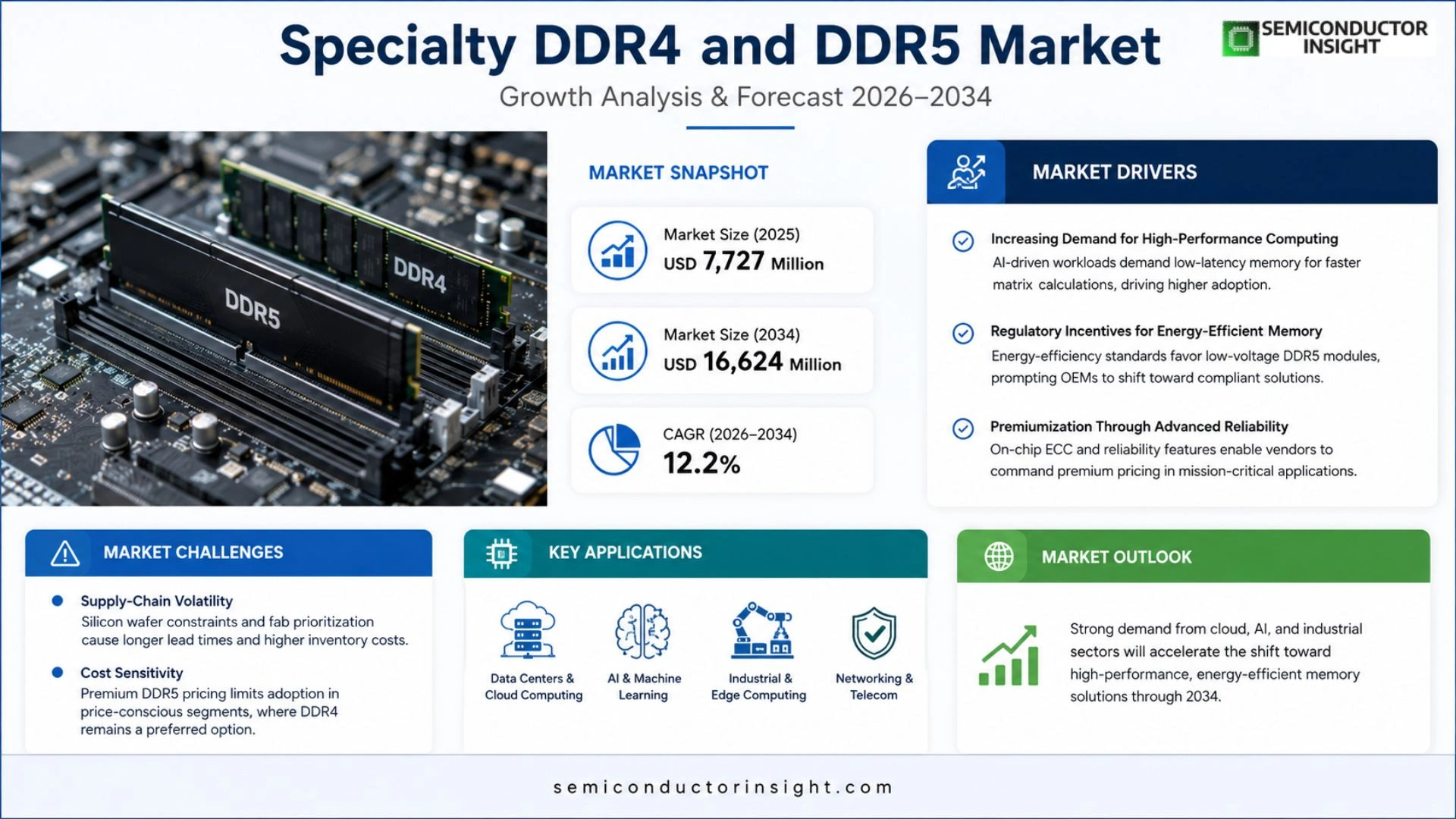
Global Specialty DDR4 and DDR5 market size was valued at USD 7,727 million in 2025. The market is forecasted to reach USD 16,624 million by 2034, reflecting a CAGR of about 12.2 % over the period.
Specialty DDR4 and DDR5 refer to dynamic random‑access memory modules engineered for niche applications. DDR4, a mature generation, serves long‑life‑cycle sectors such as industrial control, communications gear, automotive electronics and embedded systems. DDR5 delivers higher bandwidth and lower power consumption for AI servers, high‑performance computing, edge computing and premium networking equipment. Together they form the core supply structure during the inter‑generational transition phase.
Growth is supported by rising demand for high‑speed memory in AI‑driven workloads, policy initiatives encouraging semiconductor self‑sufficiency and ongoing advances in low‑power design and advanced packaging of DDR5. Meanwhile, established DDR4 continues to benefit from its proven reliability and cost advantage in legacy equipment, sustaining a parallel demand stream across diverse end markets.
MARKET DRIVERS
Increasing Demand for High‑Performance Computing
Enterprises upgrading to AI‑infused workloads are turning to Specialty DDR4 and DDR5 Market because the latency‑optimized modules enable faster matrix calculations. Manufacturers that can certify low‑jitter performance are gaining contracts with data‑center operators seeking to shave milliseconds off inference times. This pressure fuels a steady uptick in order volumes across North America and Europe.
Regulatory Incentives for Energy‑Efficient Memory
Recent energy‑efficiency standards in the EU and China reward systems that achieve sub‑1.2 V operating voltage. Specialty DDR5 modules, which incorporate on‑die voltage regulators, meet those thresholds, prompting OEMs to favour them over legacy parts. Supply chains are adjusting by reallocating production capacity toward these compliant variants.
➤ Companies that integrate on‑chip error‑correction codes now command premium pricing, reflecting the added reliability demanded by mission‑critical applications.
The convergence of cloud‑native architectures and edge‑AI deployments creates a twin‑track demand curve. While hyperscalers buy in bulk, niche industrial players order smaller, customized batches, keeping Specialty DDR4 and DDR5 Market diversified and resilient.
MARKET CHALLENGES
Supply‑Chain Volatility
Fluctuations in silicon wafer availability have lengthened lead times for specialty memory chips. When fabs prioritize high‑volume consumer DRAM, specialty orders are deferred, forcing system integrators to hold higher inventory buffers. This friction raises total cost of ownership for end users.
Other Challenges
Cost Sensitivity
The premium pricing of low‑latency DDR5 modules restrains adoption in price‑conscious segments such as mid‑range servers, where generic DDR4 solutions remain viable. Vendors must balance performance claims with competitive pricing to avoid market fragmentation.
MARKET RESTRAINTS
Technical Compatibility Barriers
Older motherboard chipsets lack the signaling support required for the tighter timing windows of specialty DDR5 modules. This incompatibility forces customers to upgrade entire platforms, a cost that many small‑to‑medium enterprises deem prohibitive. Consequently, the market experiences a slower transition rate despite favorable performance metrics.
MARKET OPPORTUNITIES
Expansion into Autonomous Systems
Automotive manufacturers are embedding high‑speed memory into lidar processing units and in‑vehicle AI cores. Specialty DDR4 and DDR5 Market can capture this niche by offering radiation‑hardened, temperature‑tolerant packages designed for automotive qualification. Early entrants stand to secure long‑term supply contracts as vehicle electrification accelerates.
Specialty DDR4 and DDR5 Market Trends
DDR5 Adoption Accelerates in AI‑Focused Computing
The shift toward DDR5 in AI servers and high‑performance computing nodes is reshaping Specialty DDR4 and DDR5 Market. Customers are demanding bandwidths that exceed 50 GB/s per channel while keeping power envelopes below 1.5 V, a combination that DDR5 uniquely satisfies through its doubled prefetch architecture and on‑die ECC. Advanced packaging, particularly 96‑FBGA, has lowered signal loss, allowing designers to populate multi‑rank modules without compromising latency. As a consequence, inventory turnover for DDR5‑centric modules has risen, prompting suppliers to increase capacity utilization to roughly 86 % in 2025. The higher gross margin,about 48 % on average,encourages manufacturers to prioritize R&D investments in low‑power design techniques, reinforcing the upward pressure on DDR5 shipments.
Other Trends
DDR4 Remains Vital for Long‑Life‑Cycle Industrial Applications
While DDR5 captures attention in data‑center environments, DDR4 continues to dominate sectors where reliability and proven supply chains are paramount. Industrial control systems, automotive electronic control units, and legacy communication gear rely on DDR4’s mature process node, which keeps wafer costs near 56 % of total product expense. The lower per‑unit price of approximately $20 also aligns with cost‑sensitive OEM budgets. Because DDR4 modules generally employ 78‑FBGA packaging, manufacturers can achieve higher yields, sustaining a gross profit rate that remains healthy despite tighter pricing. The stability of DDR4 supply, coupled with its compatibility with extended temperature ranges, ensures it will retain a solid foothold in applications that cannot tolerate the relatively newer DDR5 validation cycles.
Supply‑Chain Realignment and Regional Policy Influence
Upstream, wafer fabs in East Asia dominate, but policy initiatives aimed at semiconductor self‑sufficiency are prompting diversification. Governments in the United States and China are subsidizing packaging and testing facilities, thereby reducing the 17 % cost share attributed to those stages. This rebalancing modestly lifts the overall cost structure for specialty memory, yet it also creates localized inventory buffers that can dampen price volatility. Downstream, the rise of edge‑computing deployments in smart‑factory environments is blurring the line between DDR4‑driven legacy equipment and DDR5‑enabled next‑generation nodes, encouraging distributors to stock mixed‑technology portfolios. The net effect is a more segmented market where DDR5 acts as the performance engine for emerging workloads, while DDR4 delivers the consistency needed for entrenched industrial ecosystems, together sustaining a balanced growth trajectory for Specialty DDR4 and DDR5 Market.
COMPETITIVE LANDSCAPE
Key Industry Players
Specialty DDR4 & DDR5 Competitive Overview
Specialty DDR4 and DDR5 segment is anchored by a handful of global manufacturers whose scale and vertical integration shape pricing and capacity discipline. Micron Technology (US) leverages its advanced 10‑nm DRAM fab line to supply both high‑reliability DDR4 for industrial control and bandwidth‑intensive DDR5 for AI servers, allowing it to capture a sizable share of the intergenerational transition. Samsung Electronics and SK Hynix, both headquartered in South Korea, command the bulk of wafer output; their economies of scale and aggressive roadmap for DDR5 densities translate into competitive unit costs that pressure mid‑size rivals. These three firms together control roughly half of the worldwide specialty memory revenue, dictating supply‑chain terms for packaging partners and downstream system integrators, while also investing heavily in advanced‑packaging technologies that enhance thermal performance for edge‑computing deployments.
Beyond the tier‑one giants, a dense cluster of niche players sustains the market’s breadth and regional diversification. Taiwan’s Winbond and Nanya specialize in DDR4 parts optimized for automotive electronics, where long life‑cycle support and robust error‑correction are paramount. Chinese firms such as GigaDevice, ISSI, UniSemicon, Eastsoft, and Elite Semiconductor focus on customized low‑power DDR5 modules for domestic AI accelerators, benefitting from policy incentives aimed at semiconductor self‑sufficiency. Etron Technology and Shanghai Belling add depth in high‑volume packaging services, while ChangXin Memory Technologies pursues a rapid DDR5 uptake strategy targeting high‑performance computing clusters. This mosaic of manufacturers creates a competitive environment where differentiation relies on application‑specific engineering, supply reliability, and the ability to navigate fluctuating wafer pricing.
List of Key Specialty DDR4 and DDR5 Companies Profiled
- Micron Technology
- Samsung Electronics
- SK Hynix
- Winbond Electronics
- Nanya Technology
- GigaDevice Semiconductor
- Integrated Silicon Solution Inc. (ISSI)
- UniSemicon
- Eastsoft
- Elite Semiconductor Microelectronics Tech Inc.
- Etron Technology, Inc.
- Shanghai Belling Co., Ltd.
- ChangXin Memory Technologies
Segment Analysis:
| Segment Category | Sub-Segments | Key Insights |
| By Type |
|
Specialty DDR5
|
| By Application |
|
AI Servers
|
| By End User |
|
Cloud Computing & AI Enterprises
|
| By Architecture |
|
x16 Architecture
|
| By Packaging |
|
96‑FBGA
|
Regional Analysis: Specialty DDR4 and DDR5 Market
North America
Large‑scale cloud providers leverage Specialty DDR4 and DDR5 to meet latency‑sensitive service level agreements, particularly in AI inference clusters. Their purchasing power enables negotiated price tiers that smaller players cannot achieve, reinforcing a market hierarchy where enterprise demand drives product iteration cycles.
Engineering teams integrate bespoke timing profiles into motherboard designs, extracting marginal efficiency gains that cumulatively lower total cost of ownership. This iterative optimization is facilitated by close proximity between memory fabs and North American design houses.
A dense network of test labs and component distributors accelerates qualification timelines. Vendors capitalize on this infrastructure by offering modular firmware updates that align with regional compliance checks, shortening time‑to‑market for specialty memory solutions.
Energy‑efficiency standards articulated by federal agencies influence design trade‑offs, prompting manufacturers to prioritize low‑power states without sacrificing throughput, a nuance that resonates with sustainability‑focused procurement policies.
Europe
European enterprises exhibit a cautious yet progressive stance toward Specialty DDR4 and DDR5 adoption, often aligning purchases with cross‑border research consortia. The region’s emphasis on data sovereignty encourages local assembly of memory modules, fostering niche supply chains that cater to defense and automotive sectors. Regulatory frameworks that stress environmental impact have nudged designers to embed power‑management features early in the development lifecycle, creating a market segment where eco‑efficiency is as valued as raw performance.
Asia‑Pacific
In Asia‑Pacific, the market is shaped by a blend of rapid product cycles and intense price competition. While manufacturers race to introduce cost‑effective variants, tier‑one customers such as telecommunications carriers demand bespoke reliability characteristics for edge‑computing deployments. The prevailing culture of collaborative standard‑setting among regional industry bodies accelerates consensus on testing methodologies, ensuring that specialty memory offerings remain compatible across diverse hardware ecosystems.
South America
South American firms are increasingly recognizing the strategic advantage of specialty memory in latency‑critical analytics platforms used in mining and agritech. Limited domestic fabrication capabilities mean that most components are imported, prompting a focus on long‑term supply contracts that mitigate geopolitical risk. Market participants are also exploring localized firmware customization to address unique power‑grid variability, a factor that differentiates regional deployment strategies.
Middle East & Africa
The Middle East & Africa region is witnessing a modest ascent in Specialty DDR4 and DDR5 uptake, primarily driven by sovereign cloud initiatives and burgeoning fintech ecosystems. Investors prioritize vendors that can guarantee extended warranty periods, reflecting concerns over logistics and after‑sales support. Moreover, governmental incentives for high‑performance computing clusters spur demand for memory solutions that balance endurance with operational cost, shaping a niche yet influential market segment.
Report Scope
This market research report provides a comprehensive analysis of the Specialty DDR4 and DDR5 Market , covering the forecast period 2026–2034. It offers detailed insights into market dynamics, technological advancements, competitive landscape, and key trends shaping the industry.
Key focus areas of the report include:
- Market Overview: The report begins with an overview outlining its current market scenario, key growth indicators, and industry transformation drivers. It discusses macroeconomic factors, demand–supply balance, regulatory landscape, and the strategic role of semiconductors in powering advancements across industries such as automotive, telecommunications, consumer electronics, and industrial automation.
- Market Size & Forecast: Historical data and future projections for revenue, unit shipments, and market value across major regions and segments.
- Segmentation Analysis: Detailed breakdown by product type, technology, application, and end-user industry to identify high-growth segments and investment opportunities.
- Regional Insights: Insights into market performance across North America, Europe, Asia-Pacific, Latin America, and the Middle East & Africa, including country-level analysis where relevant.
- Competitive Landscape: Profiles of leading market participants, including their product offerings, R&D focus, manufacturing capacity, pricing strategies, and recent developments such as mergers, acquisitions, and partnerships.
- Technology Trends & Innovation: Assessment of emerging technologies, integration of AI/IoT, semiconductor design trends, fabrication techniques, and evolving industry standards.
- Market Drivers & Restraints: Evaluation of factors driving market growth along with challenges, supply chain constraints, regulatory issues, and market-entry barriers.
- Stakeholder Insights: Insights for component suppliers, OEMs, system integrators, investors, and policymakers regarding the evolving ecosystem and strategic opportunities.
Primary and secondary research methods are employed, including interviews with industry experts, data from verified sources, and real-time market intelligence to ensure the accuracy and reliability of the insights presented.
FREQUENTLY ASKED QUESTIONS:
What is the current market size of Specialty DDR4 and DDR5 Market?
-> Specialty DDR4 and DDR5 Market was valued at USD 7,727 million in 2025 and is expected to reach USD 16,624 million by 2034, growing at a CAGR of 12.2% during the forecast period.
Which key companies operate in Specialty DDR4 and DDR5 Market?
-> Key players include Micron (US), Samsung Electronics (KR), SK Hynix (KR), Winbond (TW), Nanya (TW), GigaDevice (CN), ISSI (CN), UniSemicon (CN), Eastsoft (CN), Elite Semiconductor Microelectronics Tech Inc (TW), among others.
What are the key growth drivers?
-> Key growth drivers include policy support for semiconductor independence and domestic substitution, high‑bandwidth evolution of DDR5, low‑power design optimization, advanced packaging technologies, and rising demand for higher bandwidth and lower power consumption in AI servers, high‑performance computing, edge computing, and high‑end networking equipment.
Which region dominates the market?
-> Asia‑Pacific dominates Specialty DDR4 and DDR5 market, driven by strong manufacturing bases in China, South Korea, Taiwan and rapidly expanding AI and edge‑computing deployments.
What are the emerging trends?
-> Emerging trends include accelerated adoption of DDR5 for AI‑driven workloads, convergence of DDR4 and DDR5 in niche high‑reliability applications, increased focus on energy‑efficient memory solutions, and the development of advanced packaging to boost performance and density.
Get Sample Report PDF for Exclusive Insights
Report Sample Includes
- Table of Contents
- List of Tables & Figures
- Charts, Research Methodology, and more...
 Download Sample Report PDF