Space Solar Cells Market Insights
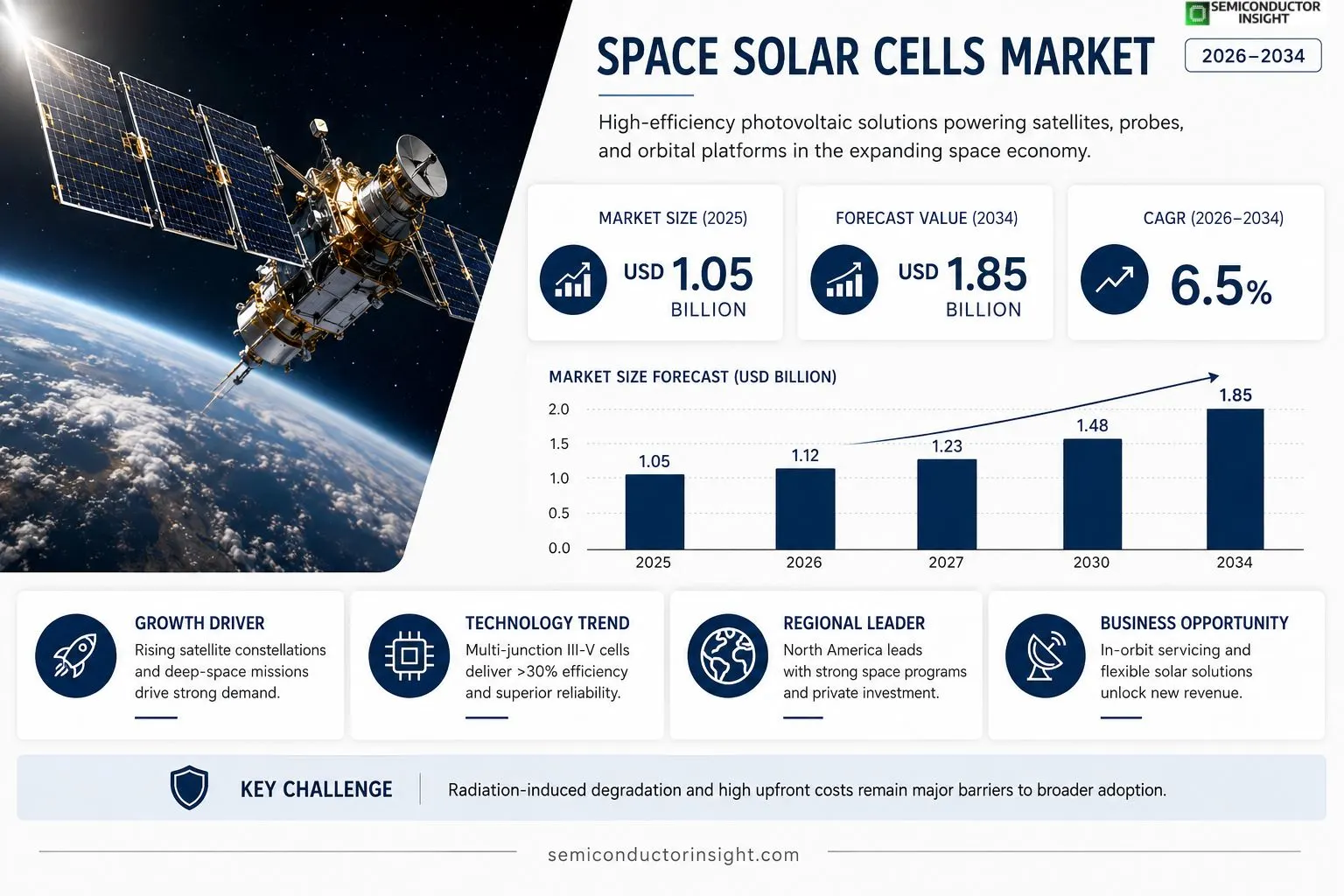
Global space solar cells market size was valued at USD 1.05 billion in 2025. The market is projected to grow from USD 1.12 billion in 2026 to USD 1.85 billion by 2034, exhibiting a CAGR of 6.5% during the forecast period.
Space solar cells are high‑efficiency photovoltaic modules engineered for the harsh conditions of outer space. They convert sunlight into electrical power for satellites, deep‑space probes, and orbital platforms, often employing multi‑junction III‑V semiconductor technologies such as GaAs/InGaP that achieve efficiencies above 30%.The market is accelerating because satellite constellations are expanding rapidly, governmental programs like NASA’s Space Solar Power Initiative are receiving increased funding, and commercial players are seeking lighter‑weight, higher‑output panels for long‑duration missions. Moreover, advances in radiation‑hardening and manufacturing techniques are reducing costs, further spurring adoption across both public and private sectors.
MARKET DRIVERS
Growing Demand for On‑Orbit Power Generation
Space Solar Cells Market is being propelled by an increasing need for reliable power sources on satellites and deep‑space missions. Photovoltaic efficiency improvements and lighter cell architectures enable longer mission lifespans, encouraging agencies to adopt newer technologies.
Government and Commercial Investment
National space programs and private launch providers are allocating higher budgets toward next‑generation solar modules, driven by the strategic importance of autonomous power in low‑Earth orbit constellations. This financial backing accelerates research and lowers unit costs.
➤ Advances in multi‑junction cell design are delivering efficiencies above 30%, making space‑based solar power increasingly viable for high‑energy payloads.
In addition, the trend toward reusable launch vehicles reduces overall launch expenses, allowing more frequent deployment of solar‑powered assets and expanding the addressable market size.
MARKET CHALLENGES
Radiation‑Induced Degradation
Exposure to high‑energy particles in space degrades cell performance over time, posing a reliability challenge for long‑duration missions. Mitigation techniques such as radiation‑hardened coatings add cost and complexity.
Other Challenges
Thermal Management
Efficient heat dissipation is critical; insufficient thermal control can reduce conversion efficiency and shorten system life, requiring advanced materials and design approaches.Supply chain constraints for high‑purity silicon and specialty alloys also limit the rapid scaling of production, especially for small‑satellite manufacturers seeking cost‑effective solutions.
MARKET RESTRAINTS
High Initial Capital Expenditure
The upfront investment required for research, testing, and certification of space‑qualified solar cells remains a significant barrier, especially for emerging market entrants lacking deep‑pocket funding.Regulatory compliance with international space debris mitigation guidelines adds additional design constraints, increasing development timelines and costs.Limited availability of qualified manufacturing facilities capable of meeting the stringent reliability standards further restrains rapid market expansion.
MARKET OPPORTUNITIES
In‑Orbit Servicing and Refurbishment
Emerging capabilities for on‑orbit servicing create an opportunity to upgrade aging solar arrays, extending satellite lifecycles and generating recurring revenue streams for service providers.Integration of lightweight, flexible solar fabrics into CubeSat platforms opens new market segments, enabling constellations to scale without proportional cost increases.Strategic partnerships between telecom operators and renewable‑energy firms are fostering the development of space‑based solar power stations, presenting a long‑term growth avenue for Space Solar Cells Market.
Space Solar Cells Market Trends
Rapid Expansion of Satellite Constellations
Space Solar Cells Market is being reshaped by the accelerated deployment of large‑scale satellite constellations. Operators are seeking power solutions that combine high specific power with long‑term reliability, prompting a shift toward multi‑junction III‑V photovoltaic modules. These modules routinely exceed 30 % conversion efficiency, enabling smaller, lighter panels that free valuable launch mass for additional payload. The trend is reinforced by governmental programs that prioritize orbital infrastructure, creating a feedback loop where demand for efficient cells drives further investment in constellation growth.
Other Trends
Radiation‑Hardening Breakthroughs
Recent advances in radiation‑hardening techniques have elevated the resilience of space‑grade solar cells. By integrating defect‑tolerant semiconductor designs and employing refined encapsulation materials, manufacturers are reducing degradation rates caused by high‑energy particles. This improvement extends mission lifetimes and lowers the total cost of ownership for satellite operators, making Space Solar Cells Market more attractive to both public agencies and commercial enterprises seeking durable power sources for deep‑space probes and orbital platforms.
Cost Reduction via New Manufacturing Techniques
Manufacturing innovations are lowering the price per watt for space‑qualified photovoltaics. Roll‑to‑roll deposition of III‑V layers and the adoption of epitaxial lift‑off processes have streamlined production while maintaining the high‑efficiency characteristics required for space applications. These cost efficiencies are translating into broader adoption across a range of mission profiles, from low‑Earth‑orbit constellations to lunar gateway concepts. As Space Solar Cells Market matures, the convergence of performance gains and price competitiveness is expected to drive even greater penetration in upcoming space endeavors.
COMPETITIVE LANDSCAPEKey Industry Players
Space Solar Cells Market Competitive Landscape Overview
Space Solar Cells Market is dominated by a few large aerospace and semiconductor firms that control the majority of high‑efficiency multi‑junction cell production for government and commercial satellite programs. Boeing’s Spectrolab unit and Airbus Defence and Space lead in supplying GaAs‑based multi‑junction modules for high‑orbit platforms, leveraging long‑standing relationships with NASA, ESA and national defense agencies. Their scale enables cost reductions through advanced epitaxial growth and radiation‑hardening processes, establishing a de‑facto tier‑one supply chain for orbital power needs. Parallel to these incumbents, Northrop Grumman and Lockheed Martin act as system integrators, bundling solar cell arrays with spacecraft bus designs, which further entrenches the market structure around a few vertically integrated players.Beyond the tier‑one manufacturers, a vibrant niche segment of specialized firms drives innovation in ultra‑light, high‑efficiency cells. SolAero Technologies, a spin‑out from the U.S. Department of Energy, focuses on thin‑film III‑V cells for small‑satellite constellations. Japanese conglomerates such as Mitsubishi Electric and IHI Aerospace contribute Japan’s expertise in high‑temperature solar cell processing. European startups like NanoPower and the German‑based PCE‑Solar develop next‑generation perovskite‑based space photovoltaics targeting lower‑cost missions. Emerging Chinese players, including China Aerospace Science and Industry Corporation (CASIC) and Chengdu Aerospace Solar, are scaling production to serve the rapidly growing domestic satellite constellation market. Collectively, these niche companies expand the technology frontier and create competitive pressure on the established tier‑one suppliers.
List of Key Space Solar Cells Companies Profiled
- Spectrolab (Boeing)
- Airbus Defence and Space
- Northrop Grumman
- Lockheed Martin
- SolAero Technologies
- Mitsubishi Electric
- IHI Aerospace
- NanoPower
- PCE‑Solar
- China Aerospace Science and Industry Corporation (CASIC)
- Chengdu Aerospace Solar
- SpaceX (Solar Power Division)
- Radiant Energy
- Thales Alenia Space
- Honeywell Aerospace
Segment Analysis:
| Segment Category | Sub-Segments | Key Insights |
| By Type |
|
Multi‑Junction Cells
|
| By Application |
|
Satellite Power
|
| By End User |
|
Government Space Agencies
|
| By Technology |
|
III‑V Semiconductor
|
| By Mission Profile |
|
Deep Space Exploration Missions
|
Regional Analysis: North America
United States
Federal agencies like NASA and the Department of Defense are actively funding research and development in space solar power, fostering innovation and creating a supportive market environment.
Significant private sector investment in companies specializing in space solar cell development and deployment indicates strong market confidence and a proactive approach to capitalizing on the growing demand.
Ongoing advancements in solar cell efficiency, materials science, and lightweight construction are crucial for reducing the cost and increasing the performance of space solar arrays, making them more economically viable.
The development of robust launch capabilities and in-space infrastructure is essential for the successful deployment and operation of space solar power systems, representing a key area of strategic development.
Europe
Europe is emerging as a significant player in Space Solar Cells Market, characterized by a strong emphasis on collaborative research and development initiatives. Several European Space Agency (ESA) programs are actively exploring the potential of space solar power, focusing on technological feasibility and long-term sustainability. The region’s established aerospace industry and strong engineering capabilities provide a solid foundation for advancing space solar cell technology. A key driver is the commitment to reducing reliance on terrestrial power sources for space missions, enhancing mission autonomy and resilience.
Asia-Pacific
The Asia-Pacific region is witnessing rapid growth in Space Solar Cells Market, driven by increasing investments in space programs by countries like China and India. The focus on developing indigenous space capabilities fuels the demand for advanced power solutions, including space solar cells. Furthermore, the region’s burgeoning satellite constellations and growing commercial space activities contribute to the market’s expansion. Strategic partnerships and collaborative projects are also playing a vital role in accelerating technological advancements and market penetration.
South America
South America represents a nascent but promising market for Space Solar Cells. With growing national space programs and increasing investment in satellite infrastructure, the demand for reliable and sustainable power generation in space is expected to rise. Opportunities exist for collaborative ventures with established players in the global Space Solar Cells Market, leveraging regional expertise and resources.
Middle East & Africa
The Middle East and Africa region presents a long-term growth opportunity for Space Solar Cells Market. As space programs in these regions expand and satellite deployments increase, the need for efficient and autonomous power solutions will become more critical. Strategic investments in space technology and infrastructure are expected to drive demand in the coming years.
Report Scope
This market research report provides a comprehensive analysis of the Space Solar Cells Market , covering the forecast period 2026–2034. It offers detailed insights into market dynamics, technological advancements, competitive landscape, and key trends shaping the industry.
Key focus areas of the report include:
- Market Overview: The report begins with an overview outlining its current market scenario, key growth indicators, and industry transformation drivers. It discusses macroeconomic factors, demand–supply balance, regulatory landscape, and the strategic role of semiconductors in powering advancements across industries such as automotive, telecommunications, consumer electronics, and industrial automation.
- Market Size & Forecast: Historical data and future projections for revenue, unit shipments, and market value across major regions and segments.
- Segmentation Analysis: Detailed breakdown by product type, technology, application, and end-user industry to identify high-growth segments and investment opportunities.
- Regional Insights: Insights into market performance across North America, Europe, Asia-Pacific, Latin America, and the Middle East & Africa, including country-level analysis where relevant.
- Competitive Landscape: Profiles of leading market participants, including their product offerings, R&D focus, manufacturing capacity, pricing strategies, and recent developments such as mergers, acquisitions, and partnerships.
- Technology Trends & Innovation: Assessment of emerging technologies, integration of AI/IoT, semiconductor design trends, fabrication techniques, and evolving industry standards.
- Market Drivers & Restraints: Evaluation of factors driving market growth along with challenges, supply chain constraints, regulatory issues, and market-entry barriers.
- Stakeholder Insights: Insights for component suppliers, OEMs, system integrators, investors, and policymakers regarding the evolving ecosystem and strategic opportunities.
Primary and secondary research methods are employed, including interviews with industry experts, data from verified sources, and real-time market intelligence to ensure the accuracy and reliability of the insights presented.
FREQUENTLY ASKED QUESTIONS:
What is the current market size of Space Solar Cells Market?
-> Space Solar Cells Market was valued at USD 1.05 billion in 2025 and is expected to reach USD 1.85 billion by 2034, exhibiting a CAGR of 6.5% during the forecast period.
Which key companies operate in Space Solar Cells Market?
-> Key players include leading aerospace and satellite manufacturers such as Boeing, Lockheed Martin, Airbus, SpaceX, and other specialized space‑technology firms.
What are the key growth drivers?
-> Growth is driven by rapid expansion of satellite constellations, increased funding for governmental programmes like NASA’s Space Solar Power Initiative, demand for lighter‑weight high‑output panels, and advances in radiation‑hardening and cost‑effective manufacturing techniques.
Which region dominates the market?
-> The market is globally distributed, with North America and Europe showing strong adoption due to mature space programmes, while Asia‑Pacific is emerging rapidly.
What are the emerging trends?
-> Emerging trends include multi‑junction III‑V semiconductor technologies achieving >30 % efficiency, integration of AI/IoT for panel health monitoring, and development of radiation‑hardened, lightweight photovoltaic systems for deep‑space missions.

Get Sample Report PDF for Exclusive Insights
Report Sample Includes
- Table of Contents
- List of Tables & Figures
- Charts, Research Methodology, and more...
 Download Sample Report PDF