MARKET INSIGHTS
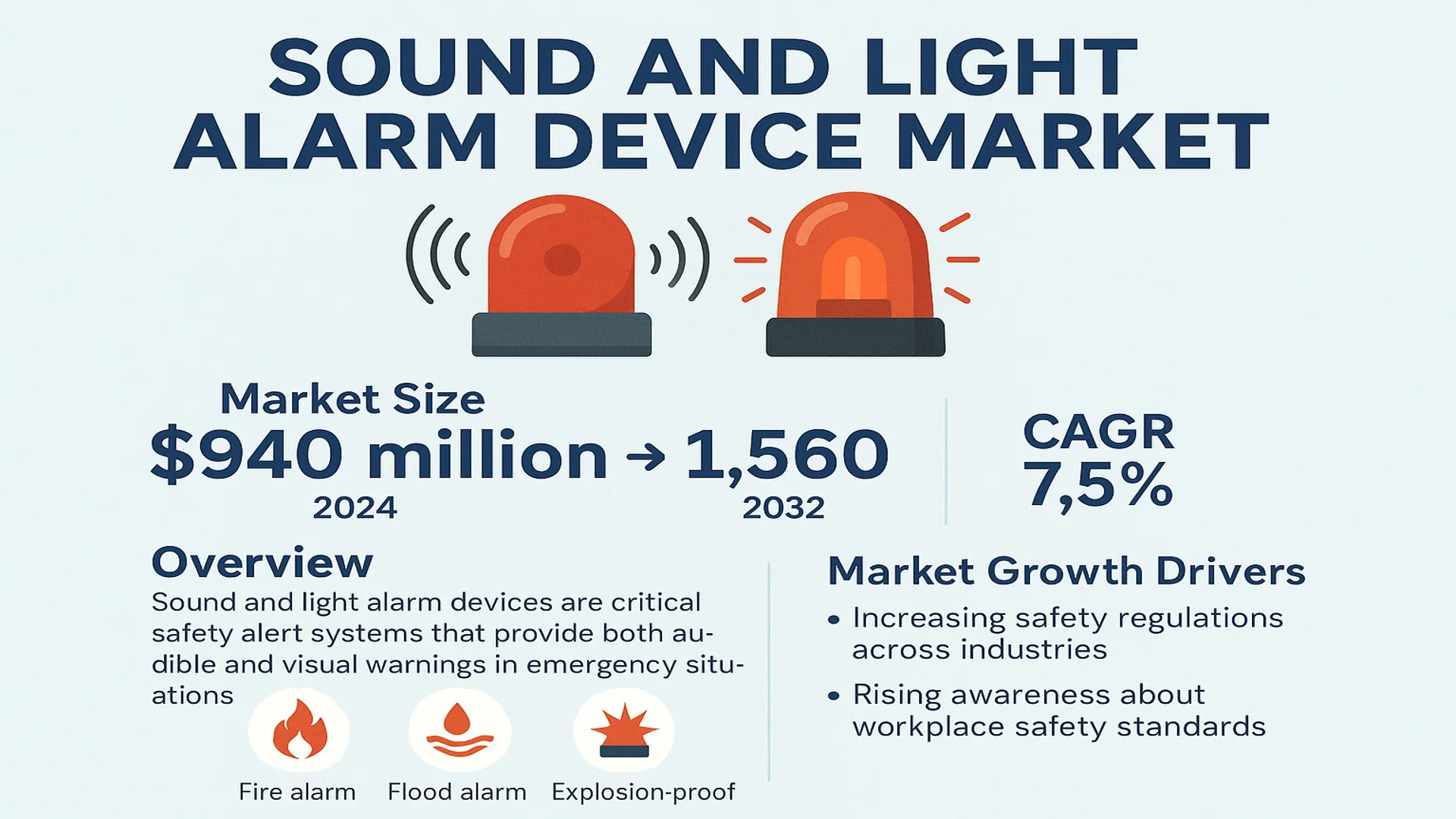
The global Sound and Light Alarm Device Market size was valued at US$ 940 million in 2024 and is projected to reach US$ 1,560 million by 2032, at a CAGR of 7.5% during the forecast period 2025-2032.
Sound and light alarm devices are critical safety alert systems designed to provide both audible and visual warnings in emergency situations. These devices combine high-decibel alarms with bright flashing lights to ensure maximum visibility and awareness across various environments including industrial facilities, commercial buildings, and residential areas. Key product variants include fire alarms, flood alarms, and specialized explosion-proof models for hazardous locations.
The market growth is driven by increasing safety regulations across industries and rising awareness about workplace safety standards. The industrial sector accounted for 42% of market share in 2023, while technological advancements like IoT-enabled smart alarms are creating new growth opportunities. Major players like Siemens and Rubezh are expanding their product portfolios with wireless and multi-sensor alarm systems to capitalize on this demand.
MARKET DYNAMICS
MARKET DRIVERS
Rising Safety Regulations and Standards to Fuel Market Demand
Stringent workplace safety regulations across industries are driving significant growth in the sound and light alarm device market. Governments worldwide have implemented rigorous safety protocols mandating the installation of alarm systems in industrial and commercial facilities. For example, OSHA’s updated guidelines on workplace safety in 2023 have pushed companies to invest in advanced warning systems, with sound and light alarms being a critical compliance requirement. This regulatory pressure is leading to increased adoption rates, particularly in high-risk sectors like manufacturing and oil & gas. Many facilities are now upgrading older alarm systems to meet these new standards, creating sustained market demand.
Technological Advancements in Alarm Systems to Accelerate Market Growth
The integration of IoT and smart technologies into alarm systems is transforming the sound and light alarm market. Modern devices now offer features like remote monitoring, wireless connectivity, and integration with building management systems. This technological evolution has expanded applications beyond traditional safety warnings to include facility management functions. Recent product launches have demonstrated improved detection accuracy and faster response times, with some models capable of differentiating between different types of emergency situations. These innovations are particularly attractive to smart city projects and industrial automation initiatives, where intelligent alarm systems form part of larger safety ecosystems.
MARKET RESTRAINTS
High Installation and Maintenance Costs to Limit Market Penetration
While demand grows, the market faces constraints from significant installation and upkeep expenses. Comprehensive alarm system deployments often require professional installation, wiring modifications, and regular maintenance checks, creating substantial upfront and ongoing costs. This financial barrier particularly affects small and medium enterprises with limited safety budgets. In developing markets where price sensitivity is high, these cost factors significantly slow adoption rates. Additionally, specialized maintenance requirements for industrial-grade systems create further challenges, as qualified technicians are often scarce in emerging economies.
Technical Limitations in Extreme Conditions to Challenge Reliability
Alarm performance in harsh industrial environments remains a persistent challenge. Many standard devices struggle to maintain functionality in extreme temperatures, high-noise areas, or locations with heavy dust/pollution. This reliability gap creates hesitation among potential buyers in industries like mining or heavy manufacturing. While explosion-proof models exist, their premium pricing puts them out of reach for many cost-conscious operations. These technical constraints are particularly evident in emerging markets where environmental conditions are often more demanding and budgets more constrained.
MARKET OPPORTUNITIES
Expansion into Smart Home and Building Automation to Create New Growth Avenues
The residential segment presents substantial untapped potential as smart home adoption accelerates. While traditionally focused on industrial applications, alarm manufacturers are now developing home-friendly models with quieter operation and aesthetic designs. Integration with home automation systems allows these devices to serve multiple functions beyond emergency alerts, including security warnings and household notifications. This expansion into consumer markets could drive significant volume growth, particularly in developed economies where smart home penetration exceeds 30% and continues rising.
Development of Solar-Powered and Wireless Models to Enable Market Expansion
Innovations in power supply and connectivity are opening new application areas. Solar-powered alarms eliminate wiring requirements, making them ideal for remote locations and temporary installations. Wireless models similarly reduce installation complexity while improving flexibility. These technological solutions directly address key market barriers, particularly in developing regions where electrical infrastructure may be unreliable. Recent product developments show promising results, with some solar models achieving months of operation without sunlight and wireless systems offering robust connectivity in challenging environments.
MARKET CHALLENGES
Intense Price Competition to Squeeze Manufacturer Margins
The market faces growing pricing pressures as new entrants, particularly from Asian manufacturers, introduce competitively priced alternatives. This price erosion makes it difficult for established brands to maintain premium pricing while achieving acceptable margins. Many manufacturers are responding by cutting R&D budgets, potentially slowing innovation in the sector. The situation is particularly acute in the mid-range product segment, where buyers show high sensitivity to price differences between competing offerings. These competitive dynamics threaten to suppress market revenues even as unit sales continue growing.
Regulatory Complexity and Certification Delays to Hinder Product Launches
Meeting diverse regional certification requirements presents an ongoing challenge for manufacturers. Products often need multiple certifications to be sold in different markets, with approval processes taking months to complete. This regulatory complexity particularly impacts smaller innovators trying to bring new technologies to market. Inconsistent standards between regions also force manufacturers to maintain multiple product variants, increasing production costs. These factors combine to slow the introduction of innovative features and delay market entry for new participants.
SOUND AND LIGHT ALARM DEVICE MARKET TRENDS
Integration of IoT and AI Technologies Transforming Alarm Systems
The global sound and light alarm device market is experiencing a notable transformation due to the increasing integration of Internet of Things (IoT) and Artificial Intelligence (AI) technologies. Smart alarms leveraging these advancements offer features such as predictive threat analysis, remote monitoring, and automated emergency response. For instance, modern systems can now distinguish between false alarms and real emergencies with higher accuracy, reducing unnecessary disruptions. Additionally, AI-driven alarms are being optimized for industrial environments to detect hazardous situations proactively, such as gas leaks or fire outbreaks, with a response time improvement of over 30% compared to traditional systems. These innovations are driving demand, particularly in sectors like manufacturing, construction, and smart city infrastructure.
Other Trends
Expansion of Smart Building Solutions
The rise of smart buildings equipped with automated security and safety systems is significantly contributing to market growth. Property developers and facility managers increasingly prefer sound and light alarms that integrate seamlessly with building management systems (BMS). These devices often come with wireless connectivity, ensuring easier installation and maintenance while offering real-time alerts via mobile applications. The adoption rate of such alarms in commercial buildings has surged by approximately 25% over the past five years, driven by stricter safety regulations and insurance requirements for property safety compliance.
Growing Investments in Industrial Safety Infrastructure
Governments and private enterprises worldwide are ramping up investments in industrial safety infrastructure, further fueling the sound and light alarm device market. Industries such as oil & gas, mining, and chemical manufacturing face stringent regulatory standards, mandating advanced alarm systems to mitigate workplace hazards. For example, occupational safety agencies in North America and Europe now require explosion-proof sound and light alarms in high-risk environments, boosting sales of specialized industrial-grade devices. Emerging economies in Asia-Pacific are also witnessing rapid adoption due to industrial expansion and increasing workplace safety awareness, with the market projected to grow at a CAGR of 7.3% in the region by 2032.
COMPETITIVE LANDSCAPE
Key Industry Players
Global Leaders and Niche Specialists Drive Innovation in Safety Alarms
The global sound and light alarm device market features a diverse competitive ecosystem, blending multinational corporations with regional specialists. Siemens emerges as a dominant force, leveraging its industrial automation expertise to deliver integrated alarm solutions across manufacturing plants and smart buildings. With operations spanning over 200 countries, the company’s diversified product portfolio gives it a strategic advantage in both developed and emerging markets.
Rubezh and CPVAN have solidified their positions as technical leaders, particularly in hazardous environment applications. These companies differentiate through patented explosion-proof designs and certifications complying with ATEX and IECEx standards – crucial for oil & gas and chemical industry clients. Their focus on ruggedized devices capable of operating in extreme temperatures (-40°C to +80°C) has driven adoption in Middle Eastern and Eurasian markets.
Chinese manufacturers like Nanjing AIYI Technologies and Wofu Fire & Security Equipment are reshaping the competitive dynamics through cost-optimized solutions. By localizing 85-90% of their supply chains, these players offer alarm systems at 20-30% lower price points than Western counterparts, fueling rapid adoption across Asia-Pacific construction projects and manufacturing facilities.
The market also sees increasing competition from smart solution providers integrating IoT capabilities. Shenzhen Waytronic Security Technology recently launched AI-enabled alarms with predictive maintenance features, signaling the industry’s shift toward connected safety ecosystems. Such innovations are forcing traditional players to accelerate R&D investments, with the global market expected to allocate over $420 million annually toward product development by 2026.
List of Key Sound and Light Alarm Device Manufacturers
- Siemens AG (Germany)
- Rubezh (Russia)
- CPVAN (China)
- Nanjing AIYI Technologies Co., Ltd. (China)
- Wofu Fire & Security Equipment Co., Ltd. (China)
- Zuden Technology (HK) Co., Limited (Hong Kong)
- Jiangsu Zhaochang Explosion-Proof Electric Appliance Co., Ltd. (China)
- Shenzhen Waytronic Security Technology Co., Ltd (China)
- Wenzhou Senben Security Equipment Co., Ltd (China)
Segment Analysis:
By Type
Fire Sound and Light Alarm Segment Dominates the Market Due to High Demand for Fire Safety Solutions
The market is segmented based on type into:
- Fire Sound and Light Alarm
- Subtypes: Industrial-grade, Commercial-grade, Residential-grade
- Flood Sound and Light Alarm
- Intrusion Detection Alarms
- Gas Leakage Alarms
- Others
By Application
Industrial Applications Lead the Market Due to Stringent Safety Regulations
The market is segmented based on application into:
- Ferrous Metallurgy
- Construction Machinery
- Transportation
- Wind Power
- Ocean-going Ship
- Others
By End User
Commercial Sector Shows Strong Adoption Due to Increased Safety Investments
The market is segmented based on end user into:
- Commercial
- Industrial
- Residential
- Government
By Technology
Smart Alarms Gaining Traction with IoT Integration
The market is segmented based on technology into:
- Conventional Alarms
- Smart Alarms
- Subtypes: WiFi-enabled, Bluetooth-enabled, GSM-enabled
Regional Analysis: Sound and Light Alarm Device Market
Asia-Pacific
The Asia-Pacific region dominates the global sound and light alarm device market, accounting for over 42% of total revenue in 2024. This leadership position stems from rapid industrialization in China and India, coupled with stringent workplace safety regulations. China’s National Fire Protection Association mandates alarm installations in all commercial buildings, driving a 15% annual growth in industrial alarm sales. Japan’s advanced manufacturing sector requires high-precision alarms for machinery safety, while Southeast Asian nations are seeing increased adoption in construction and maritime sectors. The region’s cost-competitive manufacturing ecosystem enables local producers like Nanjing AIYI Technologies to supply 60% of regional demand.
North America
North America’s mature market prioritizes advanced alarm technologies, with the U.S. contributing 78% of regional sales. Strict OSHA standards and NFPA codes mandate specific decibel levels and visual signaling requirements across industries. Canadian mining operations and U.S. oil refineries drive demand for explosion-proof models, with Siemens and local players competing in this high-margin segment. The residential sector shows growing adoption, particularly in states like California where wildfire alarms are now legally required. Migration to IP-connected smart alarms is accelerating, with 30% of new installations featuring IoT capabilities.
Europe
European adoption focuses on compliance with EN 54 standards and sustainability features. Germany leads in industrial applications, accounting for 28% of regional shipments, particularly for automotive manufacturing safety systems. The EU’s Machinery Directive 2006/42/EC drives innovation in equipment-integrated alarms. Western markets show preference for low-power, recyclable devices, while Eastern Europe sees rising demand from infrastructure projects. Notable is the UK’s shift to voice-assisted alarms in public buildings following the Grenfell Tower tragedy. Regional players like Rubezh compete through specialized solutions for offshore wind farms and chemical plants.
Middle East & Africa
This emerging market is growing at 12% CAGR, led by Gulf Cooperation Council nations implementing strict fire codes in megaprojects. UAE’s Dubai Civil Defense requires dual-alarm systems in all high-rises, creating a $45 million annual market. African adoption remains concentrated in mining and oil sectors, though inconsistent enforcement limits growth. Saudi Arabia’s NEOM project specifications mandate next-generation alarms with AI threat detection, attracting global suppliers. Challenges include price sensitivity in non-oil economies and lack of standardized regulations across the region.
South America
Market growth is uneven, with Brazil accounting for 65% of regional demand through its manufacturing and energy sectors. Argentina’s economic volatility constrains market expansion despite safety regulation improvements. Mining operations in Chile and Peru drive need for ruggedized alarms in extreme environments. The region shows potential for growth in residential and commercial segments as insurance providers begin mandating alarm installations. However, counterfeit products comprising 18% of the market undermine quality standards and safety outcomes.
Report Scope
This market research report provides a comprehensive analysis of the global and regional Sound and Light Alarm Device markets, covering the forecast period 2025–2032. It offers detailed insights into market dynamics, technological advancements, competitive landscape, and key trends shaping the industry.
Key focus areas of the report include:
- Market Size & Forecast: Historical data and future projections for revenue, unit shipments, and market value across major regions and segments.
- Segmentation Analysis: Detailed breakdown by product type (Fire Sound & Light Alarm, Flood Sound & Light Alarm), application (Ferrous Metallurgy, Construction Machinery, Transportation, Wind Power, Ocean-going Ship, Others), and end-user industry.
- Regional Outlook: Insights into market performance across North America, Europe, Asia-Pacific, Latin America, and the Middle East & Africa, including country-level analysis.
- Competitive Landscape: Profiles of leading market participants, including their product offerings, R&D focus, manufacturing capacity, and recent developments.
- Technology Trends & Innovation: Assessment of emerging technologies, including smart connectivity, IoT integration, and advanced sensing capabilities.
- Market Drivers & Restraints: Evaluation of factors such as increasing safety regulations, industrial automation trends, and cost sensitivity in developing markets.
- Stakeholder Analysis: Insights for manufacturers, distributors, system integrators, and end-users regarding market opportunities and challenges.
The research methodology combines primary interviews with industry experts and secondary data from verified sources to ensure accuracy and reliability of market insights.
FREQUENTLY ASKED QUESTIONS:
What is the current market size of Global Sound and Light Alarm Device Market?
->Sound and Light Alarm Device Market size was valued at US$ 940 million in 2024 and is projected to reach US$ 1,560 million by 2032, at a CAGR of 7.5% during the forecast period 2025-2032.
Which key companies operate in Global Sound and Light Alarm Device Market?
-> Key players include Siemens, Rubezh, CPVAN, Nanjing AIYI Technologies, Wofu Fire & Security Equipment, Zuden Technology, and Jiangsu Zhaochang Explosion-Proof Electric Appliance, among others.
What are the key growth drivers?
-> Key growth drivers include stringent safety regulations, increasing industrial automation, growing demand from commercial buildings, and technological advancements in alarm systems.
Which region dominates the market?
-> Asia-Pacific holds the largest market share (38% in 2024), driven by rapid industrialization in China and India, while North America leads in technological adoption.
What are the emerging trends?
-> Emerging trends include wireless alarm systems, integration with smart home/building automation, voice-enabled alerts, and solar-powered devices.

Get Sample Report PDF for Exclusive Insights
Report Sample Includes
- Table of Contents
- List of Tables & Figures
- Charts, Research Methodology, and more...
 Download Sample Report PDF