Key Statistics
Key Takeaways
- Market size and growth: the market is valued at USD 967.0 million in 2025 and is projected to reach USD 1.444 billion by 2034, representing a 4.6% CAGR over 2026–2034.
- Panel Mount leads by type because panel-mounted SSRs handle the broadest range of industrial heating, motor and power-control currents while integrating easily with heat sinks and control cabinets.
- Industrial Equipment leads application demand because automation, process heating and machinery require frequent, silent and maintenance-free switching with long operating life.
- North America is the largest regional market, while Asia Pacific has the strongest incremental growth profile.
- Primary driver: industrial automation, building controls and energy systems increasingly require silent, high-cycle and maintenance-free electronic switching
- Principal restraint: semiconductor on-state losses create heat and can make SSRs more expensive or thermally complex than electromechanical relays
Market Overview
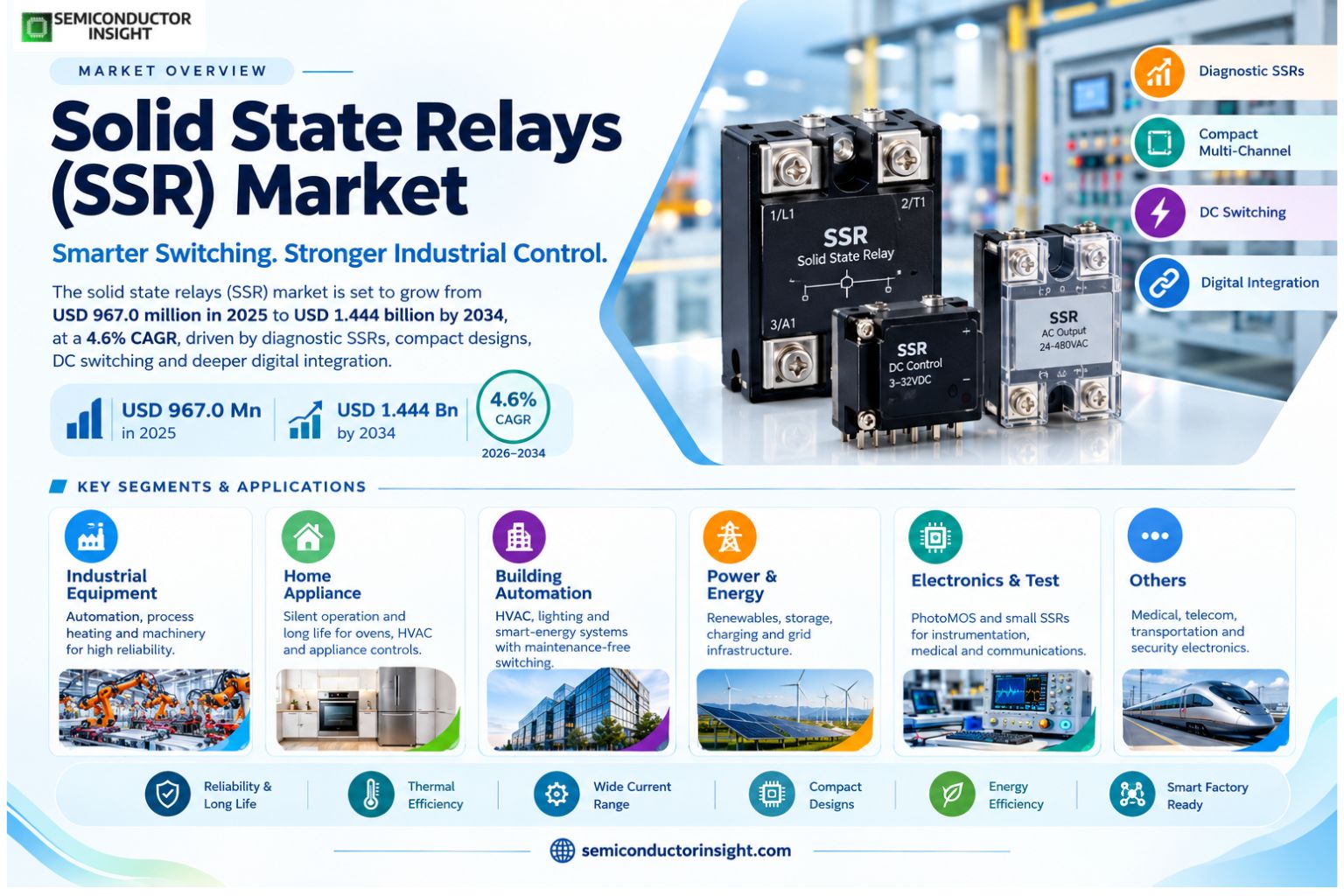
The solid state relays SSR market was valued at USD 967.0 million in 2025 and is projected to reach USD 1.444 billion by 2034, expanding at a 4.6% CAGR over 2026–2034. North America leads in 2025, while the market is being reshaped by diagnostic SSRs, compact multi-channel designs, DC switching, higher current ratings and deeper integration with digital industrial control.. Commercial decisions therefore balance performance, qualification, lifecycle support and total system cost rather than relying on one headline specification.
Solid state relays use semiconductor switches and optical or electronic isolation to control AC or DC loads without the moving contacts found in electromechanical relays. This architecture eliminates contact bounce and mechanical wear and enables silent, high-cycle operation, which is valuable in heaters, automation, building controls and power systems. OMRON’s current G3NA family spans 5–90 A output currents with AC versions extending into high line voltages, illustrating the broad operating envelope available in mainstream industrial SSRs when correct heat sinking and derating are applied.
Product design is strongly influenced by thermal management because semiconductor output devices dissipate power continuously while carrying current. Sensata Crydom’s Series 1 panel-mount SSR uses a direct-bonded-copper substrate for thermal performance and supports 10–125 A loads, while celduc offers AC, DC, three-phase and multi-channel solid-state switching families. These products show why panel-mounted SSRs remain important in high-current industrial systems: the relay, heat sink, protection and cabinet layout must be engineered together to maintain acceptable junction temperature and reliable field operation.
The market also extends into smaller signal and board-level relays. Panasonic PhotoMOS uses MOSFET outputs for AC or DC load control in instrumentation, metering, medical and communications equipment, while Vishay offers compact optical MOSFET SSRs with high isolation and low on-resistance. This broadens demand beyond factory power control into electronic test, security and embedded systems, creating a market that spans sub-amp signal switching through high-current industrial contactors with very different package, thermal, isolation and lifecycle requirements.
Segment Analysis: By Type
By type, the market is segmented into PCB Mount, Panel Mount, DIN Rail Mount. Panel Mount holds the leading position because panel-mounted SSRs handle the broadest range of industrial heating, motor and power-control currents while integrating easily with heat sinks and control cabinets. Commercial decisions therefore balance performance, qualification, lifecycle support and total system cost rather than relying on one headline specification. As deployment scales, repeatable manufacturing, application engineering and supplier support become increasingly important to customer confidence and ownership economics.
| Type | Function / role | Market position |
|---|---|---|
| PCB Mount | Compact board-level SSRs for embedded control, appliances and electronics. | High-volume small-form-factor segment with moderate current ratings. |
| Panel Mount | Power SSRs mounted to panels or external heat sinks. | Leading type because it serves the widest industrial current and voltage range. |
| DIN Rail Mount | Cabinet-ready modules for automation and building-control panels. | Growing through easier installation, service and integrated protection. |
Commercial implications by type
Mounting type is closely tied to thermal path and service model. PCB-mounted SSRs prioritize compactness and low control power, while panel-mounted devices use external heat sinks to handle much larger loads. DIN-rail products add installation convenience and can integrate status indicators, diagnostics or protection, making them attractive in modern control cabinets. The market therefore does not move uniformly toward one format; each category optimizes a different combination of current, size, thermal management, installation labor and field replaceability.
Segment Analysis: By Application
By application, demand is segmented into Industrial Equipment, Home Appliance, Building Automation, Power & Energy, Others. Industrial Equipment leads because automation, process heating and machinery require frequent, silent and maintenance-free switching with long operating life. Commercial decisions therefore balance performance, qualification, lifecycle support and total system cost rather than relying on one headline specification. As deployment scales, repeatable manufacturing, application engineering and supplier support become increasingly important to customer confidence and ownership economics. This combination is shaping product roadmaps, procurement priorities and investment decisions across both established customers and newer application segments.
| Application | Demand characteristics |
|---|---|
| Industrial Equipment | Largest application across heaters, machinery, packaging, robotics and process control. |
| Home Appliance | Silent switching and long life support ovens, HVAC and appliance controls. |
| Building Automation | HVAC, lighting and smart-energy systems use maintenance-free electronic switching. |
| Power & Energy | Renewables, storage, charging and grid equipment require reliable frequent switching. |
| Others | Medical, test, telecom, transportation and security electronics add specialist demand. |
By Output
| Output | Commercial relevance |
|---|---|
| AC Output | Triac or SCR outputs dominate industrial heating and line-voltage loads. |
| DC Output | MOSFET or IGBT designs serve batteries, power conversion and DC motors. |
| AC/DC Signal SSR | Back-to-back MOSFET devices handle low-current bidirectional signal switching. |
By Switching Mode
| Switching Mode | Commercial relevance |
|---|---|
| Zero-Cross | Reduces electrical noise when switching resistive AC loads near zero voltage. |
| Random / Instantaneous | Provides fast turn-on for inductive, phase-control or time-sensitive loads. |
| Proportional / Phase-Angle | Controls delivered power rather than simple on-off switching. |
By End User
| End User | Commercial relevance |
|---|---|
| Manufacturing & Process Industry | High switching cycles and uptime needs favor SSRs. |
| Building Systems | HVAC and lighting benefit from silent operation and long life. |
| Energy & Infrastructure | Storage, renewable and charging systems create DC and AC switching demand. |
| Electronics & Test | PhotoMOS and small SSRs provide isolation and signal switching. |
Regional Analysis
North America leads the market because the report identifies North America as the largest region with a 32% share, supported by industrial automation, semiconductor equipment, HVAC and building systems. Asia Pacific has the strongest growth profile as demand expands through China, Japan and South Korea combine electronics manufacturing, factory automation and expanding industrial-control infrastructure. Commercial decisions therefore balance performance, qualification, lifecycle support and total system cost rather than relying on one headline specification. As deployment scales, repeatable manufacturing, application engineering and supplier support become increasingly important to customer confidence and ownership economics.
How does regional demand differ across this market?
North America leads current value through industrial automation, HVAC, semiconductor equipment and high-value control systems, while Asia Pacific offers the strongest volume growth through manufacturing and electronics. Europe is a mature market with strong industrial heating, machinery and building-automation demand, supported by specialist SSR manufacturers. South America and the Middle East & Africa remain project-driven, where lifecycle savings can justify SSR adoption when maintenance access is difficult or switching cycles are too frequent for electromechanical relays. Thermal design remains a universal requirement across all regions.
| Region | Position | Growth outlook | Demand profile | Supplier selection |
|---|---|---|---|---|
| North America | Largest | Strong | Automation and industrial power | Reliability, current rating, certification |
| Asia Pacific | Second | Fastest | Factory automation and electronics | Cost, compactness, scale |
| Europe | Third | Moderate | Industrial heating and automation | Efficiency, diagnostics, standards |
| South America | Smaller | Moderate | Industrial process and HVAC | Cost, service, availability |
| Middle East & Africa | Emerging | Moderate | Infrastructure and process industry | Thermal design, ruggedness, service |
Competitive Landscape
Competition spans industrial power SSR specialists and semiconductor-relay suppliers, with differentiation centered on thermal performance, current rating, package density, isolation and diagnostic features. Commercial decisions therefore balance performance, qualification, lifecycle support and total system cost rather than relying on one headline specification. As deployment scales, repeatable manufacturing, application engineering and supplier support become increasingly important to customer confidence and ownership economics. This combination is shaping product roadmaps, procurement priorities and investment decisions across both established customers and newer application segments.
OMRON, Panasonic, Sensata Crydom, celduc and Vishay cover different parts of the SSR spectrum. OMRON’s G3NA family reaches 90 A in industrial panel-mount formats, Sensata Crydom’s Series 1 reaches 125 A with direct-bonded-copper thermal substrates, and celduc offers AC, DC, three-phase and multi-channel power families. These suppliers compete on thermal engineering and industrial approvals because reliable current handling depends on the complete package and heat-sink interface, not only the semiconductor switch selected inside the relay.
Board-level solid-state relays form a distinct competitive segment. Panasonic PhotoMOS and Vishay optical MOSFET relays target instrumentation, communications, security and electronic test applications where low leakage, isolation, small package size and bounce-free switching matter more than tens of amperes of load current. This part of the market benefits from semiconductor miniaturization and can replace mechanical signal relays in high-cycle systems, but designers must manage on-resistance, output capacitance and off-state leakage for sensitive measurement paths and precision analog circuits.
Diagnostics are emerging as a differentiator in industrial SSRs. celduc’s recent product and technical updates highlight integrated diagnostic functions and multi-channel architectures intended to support more autonomous machines and real-time monitoring. As factories adopt predictive maintenance, a relay that reports load faults, overtemperature or switching state can create more value than a basic isolated switch. This trend shifts competition toward intelligent modules, compact cabinet integration and machine connectivity rather than commodity hockey-puck products alone. Commercial decisions therefore balance performance, qualification, lifecycle support and total system cost rather than relying on one headline specification.
| Competitive group | Representative participants | Competitive focus |
|---|---|---|
| Industrial power SSR leaders | OMRON, Sensata Crydom, celduc | High-current panel, DIN rail and multi-phase switching |
| Board-level semiconductor relays | Panasonic PhotoMOS, Vishay | Compact MOSFET SSRs for signal and moderate-load switching |
| Automation and control suppliers | Carlo Gavazzi and regional vendors | Application-specific industrial switching and control integration |
Companies Profiled
The companies profiled include Panasonic, OMRON, Sensata Crydom, celduc relais, Vishay, Carlo Gavazzi. They span materials, semiconductor design, component manufacturing, packaging or system integration depending on the market. Competitive positions differ by technology depth, manufacturing scale, customer qualification and geographic reach, so the strongest suppliers combine differentiated engineering with repeatable volume production, application support and long-term product availability. Commercial decisions therefore balance performance, qualification, lifecycle support and total system cost rather than relying on one headline specification.
Production Capacity Analysis
Production combines optical isolation or driver circuitry, SCR, triac, MOSFET or IGBT output devices, ceramic or DBC thermal substrates, molding, isolation test and final current-temperature characterization. Commercial decisions therefore balance performance, qualification, lifecycle support and total system cost rather than relying on one headline specification. As deployment scales, repeatable manufacturing, application engineering and supplier support become increasingly important to customer confidence and ownership economics. This combination is shaping product roadmaps, procurement priorities and investment decisions across both established customers and newer application segments.
High-current SSR capacity depends on power-semiconductor die supply and the ability to attach those dies to substrates that spread heat efficiently. Sensata Crydom’s use of a direct-bonded-copper substrate illustrates the thermal engineering needed to carry tens or hundreds of amperes without excessive junction temperature. Assembly lines must also maintain electrical isolation between the low-voltage control side and high-voltage load side, so creepage, insulation materials, terminal spacing and dielectric test are integral manufacturing steps rather than optional packaging features.
Board-level PhotoMOS production uses smaller MOSFETs and optical isolation in semiconductor-style packages, allowing higher unit volumes and automated assembly. The challenge is maintaining consistent on-resistance, leakage, isolation and switching time across large production runs, especially for instrumentation or medical uses. Industrial power SSRs have lower unit volume but require more thermal mass, larger terminals and application-specific current testing, so manufacturers often maintain separate product and test flows for miniature PCB relays and panel-mounted high-current devices.
Market Dynamics
The market is evolving from simple contact replacement toward smarter electronic switching that integrates diagnostics, protection and higher-density multi-channel control. Commercial decisions therefore balance performance, qualification, lifecycle support and total system cost rather than relying on one headline specification. As deployment scales, repeatable manufacturing, application engineering and supplier support become increasingly important to customer confidence and ownership economics. This combination is shaping product roadmaps, procurement priorities and investment decisions across both established customers and newer application segments.
SSRs win where switching cycles, acoustic noise or maintenance burden make mechanical contacts undesirable, but they do not replace electromechanical relays everywhere because semiconductor outputs have continuous on-state loss and leakage. The strongest growth therefore occurs in automation, heating, energy and electronic-test systems where high cycle life or fast switching has measurable value. New diagnostic and multi-channel products improve the lifecycle case by reducing wiring, enabling predictive maintenance and simplifying control architectures while giving suppliers additional value beyond the basic isolated switching function.
Market Drivers
Drivers Impact Analysis
| Driver | Impact | Commercial mechanism |
|---|---|---|
| Industrial automation | High | Automated factories use heaters, valves, motors and process loads that may switch thousands or millions of times during equipment life. A solid-state relay avoids contact wear and bounce, reducing maintenance while supporting precise digital control. OMRON, Crydom and celduc maintain broad industrial portfolios because these applications reward long cycle life and predictable switching behavior, particularly in semiconductor, packaging, food-processing and plastics equipment where unplanned downtime can cost far more than the relay itself. |
| Building and HVAC control | High | Heating, ventilation, lighting and smart-building systems value silent operation and frequent switching without mechanical wear. Zero-cross AC SSRs can reduce electrical noise for resistive heating loads, while DIN-rail and panel formats fit conventional cabinets. As building-management systems become more sensor-driven, electronic switching allows faster control and easier automation, although designers must account for continuous power dissipation and provide adequate heat sinking for high-current HVAC or heater circuits to preserve relay life. |
| Energy and storage systems | Medium | Battery storage, solar inverters, smart meters and charging equipment create both AC and DC switching requirements that benefit from long electrical life. Panasonic positions PhotoMOS in energy-related control applications, while industrial suppliers offer high-voltage DC MOSFET and IGBT relay families for power-conversion loads. Growth in distributed energy therefore expands the market beyond traditional industrial heaters, especially where frequent switching, galvanic isolation and remote maintenance are more important than the lowest initial component cost. |
| Electronic test and instrumentation | Medium | Automated test equipment and measurement systems can require many low-current switching channels with high isolation and no contact bounce. PhotoMOS and optical MOSFET SSRs are well suited because they offer small packages, low control power and long operational life without mechanical noise. Vishay and Panasonic both target instrumentation and communications applications, supporting continued board-level growth even when the broader industrial SSR market is dominated by much larger panel-mounted devices and cabinet-installed power relays. |
Industrial automation
Automated factories use heaters, valves, motors and process loads that may switch thousands or millions of times during equipment life. A solid-state relay avoids contact wear and bounce, reducing maintenance while supporting precise digital control. OMRON, Crydom and celduc maintain broad industrial portfolios because these applications reward long cycle life and predictable switching behavior, particularly in semiconductor, packaging, food-processing and plastics equipment where unplanned downtime can cost far more than the relay itself. Commercial decisions therefore balance performance, qualification, lifecycle support and total system cost rather than relying on one headline specification.
Building and HVAC control
Heating, ventilation, lighting and smart-building systems value silent operation and frequent switching without mechanical wear. Zero-cross AC SSRs can reduce electrical noise for resistive heating loads, while DIN-rail and panel formats fit conventional cabinets. As building-management systems become more sensor-driven, electronic switching allows faster control and easier automation, although designers must account for continuous power dissipation and provide adequate heat sinking for high-current HVAC or heater circuits to preserve relay life. Commercial decisions therefore balance performance, qualification, lifecycle support and total system cost rather than relying on one headline specification.
Energy and storage systems
Battery storage, solar inverters, smart meters and charging equipment create both AC and DC switching requirements that benefit from long electrical life. Panasonic positions PhotoMOS in energy-related control applications, while industrial suppliers offer high-voltage DC MOSFET and IGBT relay families for power-conversion loads. Growth in distributed energy therefore expands the market beyond traditional industrial heaters, especially where frequent switching, galvanic isolation and remote maintenance are more important than the lowest initial component cost. Commercial decisions therefore balance performance, qualification, lifecycle support and total system cost rather than relying on one headline specification.
Electronic test and instrumentation
Automated test equipment and measurement systems can require many low-current switching channels with high isolation and no contact bounce. PhotoMOS and optical MOSFET SSRs are well suited because they offer small packages, low control power and long operational life without mechanical noise. Vishay and Panasonic both target instrumentation and communications applications, supporting continued board-level growth even when the broader industrial SSR market is dominated by much larger panel-mounted devices and cabinet-installed power relays. Commercial decisions therefore balance performance, qualification, lifecycle support and total system cost rather than relying on one headline specification.
Market Restraints
Restraints Impact Analysis
| Restraint | Impact | Commercial mechanism |
|---|---|---|
| Thermal dissipation | High | Unlike an ideal mechanical contact, an SSR output semiconductor has an on-state voltage drop or resistance that generates heat while current flows. OMRON specifies load-current derating with ambient temperature, and high-current products often require dedicated heat sinks or thermally efficient substrates. Incorrect thermal design can shorten relay life or force significant current derating, so SSR adoption is more complicated than replacing a mechanical relay with the same nominal current rating in an existing control panel. |
| Higher upfront cost | High | Solid-state relays generally cost more than basic electromechanical relays, particularly when the application also requires a heat sink or thermal interface. The premium is justified when frequent switching, noise, maintenance or lifetime matters, but low-cycle applications may never recover the higher initial expense. This limits adoption in cost-sensitive appliances and simple control circuits where mechanical contacts can operate for the full product life without significant maintenance, cycle-life or reliability penalties. |
| Off-state leakage | Medium | Semiconductor outputs do not provide the same perfect open circuit as mechanical contacts because small leakage current can flow when the SSR is off. In sensitive loads, indicator lamps or high-impedance circuits, this current can create unexpected voltage or prevent a load from fully de-energizing. Designers may need bleeder resistors or alternative relay types, reducing the simplicity advantage and keeping mechanical relays relevant in applications requiring true physical contact separation or exceptionally low off-state leakage. |
| Surge and load sensitivity | Medium | Motors, transformers, lamps and capacitive loads can produce inrush currents far above steady-state current, so SSRs must be selected for surge capability rather than nameplate load alone. OMRON and Sensata publish detailed load and inrush guidance because semiconductor junctions can fail quickly if transient energy exceeds ratings. Protection with varistors, snubbers or fuses may be required, adding design cost and creating a knowledge barrier for users accustomed to more forgiving electromechanical contacts. |
Thermal dissipation
Unlike an ideal mechanical contact, an SSR output semiconductor has an on-state voltage drop or resistance that generates heat while current flows. OMRON specifies load-current derating with ambient temperature, and high-current products often require dedicated heat sinks or thermally efficient substrates. Incorrect thermal design can shorten relay life or force significant current derating, so SSR adoption is more complicated than replacing a mechanical relay with the same nominal current rating in an existing control panel.
Higher upfront cost
Solid-state relays generally cost more than basic electromechanical relays, particularly when the application also requires a heat sink or thermal interface. The premium is justified when frequent switching, noise, maintenance or lifetime matters, but low-cycle applications may never recover the higher initial expense. This limits adoption in cost-sensitive appliances and simple control circuits where mechanical contacts can operate for the full product life without significant maintenance, cycle-life or reliability penalties. Commercial decisions therefore balance performance, qualification, lifecycle support and total system cost rather than relying on one headline specification.
Off-state leakage
Semiconductor outputs do not provide the same perfect open circuit as mechanical contacts because small leakage current can flow when the SSR is off. In sensitive loads, indicator lamps or high-impedance circuits, this current can create unexpected voltage or prevent a load from fully de-energizing. Designers may need bleeder resistors or alternative relay types, reducing the simplicity advantage and keeping mechanical relays relevant in applications requiring true physical contact separation or exceptionally low off-state leakage.
Surge and load sensitivity
Motors, transformers, lamps and capacitive loads can produce inrush currents far above steady-state current, so SSRs must be selected for surge capability rather than nameplate load alone. OMRON and Sensata publish detailed load and inrush guidance because semiconductor junctions can fail quickly if transient energy exceeds ratings. Protection with varistors, snubbers or fuses may be required, adding design cost and creating a knowledge barrier for users accustomed to more forgiving electromechanical contacts. Commercial decisions therefore balance performance, qualification, lifecycle support and total system cost rather than relying on one headline specification.
Market Opportunities
Diagnostic SSRs
Integrated current, load and temperature diagnostics can turn a relay into a condition-monitoring node rather than a simple switch. celduc’s recent updates emphasize diagnostic functions intended to help machine builders detect faults and create more autonomous equipment. This aligns SSRs with predictive-maintenance strategies and can justify a higher selling price when a diagnostic relay prevents unplanned downtime or reduces external sensors, wiring and PLC input channels, giving suppliers a path to higher value within mature industrial switching markets.
Multi-channel modules
Packaging several independent SSR channels into one enclosure reduces cabinet space, wiring and installation labor in machines with many heaters or actuators. celduc’s multi-channel products demonstrate this direction, while board-level PhotoMOS arrays follow a similar logic at lower current. The opportunity is strongest where channel density and commissioning time matter, but thermal coupling between channels must be managed carefully because simultaneous high-current operation can raise enclosure temperature and force derating if module cooling is not properly engineered.
High-voltage DC switching
Battery storage, EV charging, rail and renewable-energy systems increasingly need reliable DC switching at voltages where arcing makes mechanical contacts difficult. MOSFET- and IGBT-based SSRs can provide fast, silent operation without contact erosion, and specialist suppliers offer DC products for high-voltage power-conversion loads. The segment requires careful fault-current protection and low conduction loss, but it can grow faster than traditional AC heating applications as electrification expands across transport, industrial and energy infrastructure. Commercial decisions therefore balance performance, qualification, lifecycle support and total system cost rather than relying on one headline specification.
Compact PhotoMOS replacement
Instrumentation, medical and communications equipment can replace signal relays with tiny optical MOSFET devices that provide isolation, bounce-free switching and long electrical life. Panasonic and Vishay offer broad small-package portfolios, including low-capacitance parts suitable for measurement paths. As automated test channel counts increase and electronics become more compact, these products can gain share where mechanical relay wear, acoustic noise or package height is limiting, creating a distinct semiconductor-style growth segment within the broader SSR market.
Supply Chain Analysis
SCRs, triacs, MOSFETs and IGBTs
Optocouplers, photovoltaic drivers and control circuits
DBC substrates, copper bases, molding and heat sinks
Panels, DIN rail, PCB assembly and automation controls
Semiconductor switches
The output device determines whether an SSR is optimized for AC, DC, signal or high-power switching. Triacs and SCRs dominate many AC heater relays, MOSFETs support low-leakage or DC outputs, and IGBTs can serve higher-voltage DC applications. Suppliers choose die size and technology to balance conduction loss, surge current and switching speed, making semiconductor sourcing a central determinant of relay performance, thermal design, package size and overall cost. Commercial decisions therefore balance performance, qualification, lifecycle support and total system cost rather than relying on one headline specification.
Isolation and drivers
Optical isolation separates low-voltage control electronics from hazardous load circuits and is one of the defining features of many SSR architectures. The driver must provide enough gate or trigger energy while maintaining low input current, fast switching and strong dielectric isolation. PhotoMOS designs use optical energy to control MOSFET outputs, while larger industrial relays may use optotriacs or driver circuits, so isolation technology varies materially with power level, load type and switching requirements. Commercial decisions therefore balance performance, qualification, lifecycle support and total system cost rather than relying on one headline specification.
Thermal packaging
High-current SSRs need efficient heat spreading from the output semiconductor into a panel or external heat sink. Direct-bonded-copper ceramic substrates, metal bases, thermal compounds and mechanical mounting pressure all affect junction temperature, so packaging is an active part of electrical rating. Manufacturers must characterize current versus ambient temperature and publish derating curves because the same relay can safely carry very different loads depending on enclosure airflow, heat-sink size and installation conditions. Commercial decisions therefore balance performance, qualification, lifecycle support and total system cost rather than relying on one headline specification.
System integration
End users install SSRs inside PCB assemblies, DIN-rail cabinets, heater controllers and machine panels, so terminal style, mounting pitch and diagnostic interfaces matter as much as the semiconductor die. Industrial suppliers add protective covers, status indicators, varistors and pre-mounted heat sinks to reduce integration risk. Strong vendors therefore compete through application guidance and accessory ecosystems as well as relay specifications because correct load selection and thermal installation determine field reliability and customer satisfaction. Commercial decisions therefore balance performance, qualification, lifecycle support and total system cost rather than relying on one headline specification.
Recent Developments
September 2026 — OMRON updates G3NA industrial SSR data
The current data sheet covers the broad 5–90 A G3NA family used in heater and industrial control. Source
2026 — celduc expands diagnostic and multi-channel SSR offerings
Recent product updates include diagnostic functions and multi-channel architectures for industrial automation. Source
Current — Sensata Crydom Series 1 supports up to 125 A
The current panel-mount family uses DBC thermal substrates and serves heavy industrial AC loads. Source
Report Scope & Segmentation
| Attribute | Coverage |
|---|---|
| Market | Solid State Relays (SSR) |
| Base Year | 2025 |
| Estimated Year | 2026 |
| Forecast Period | 2026–2034 |
| 2025 Market Size | USD 967.0 million |
| 2026 Estimated Size | USD 1.011 billion |
| 2034 Forecast Size | USD 1.444 billion |
| CAGR | 4.6% (2026–2034) |
| By Type | PCB Mount, Panel Mount, DIN Rail Mount |
| By Application | Industrial Equipment, Home Appliance, Building Automation, Power & Energy, Others |
| By Output | AC Output, DC Output, AC/DC Signal SSR |
| By Switching Mode | Zero-Cross, Random / Instantaneous, Proportional / Phase-Angle |
| By End User | Manufacturing & Process Industry, Building Systems, Energy & Infrastructure, Electronics & Test |
| Regions | North America, Asia Pacific, Europe, South America, Middle East & Africa |
| Companies Profiled | Panasonic, OMRON, Sensata Crydom, celduc relais, Vishay, Carlo Gavazzi |
Frequently Asked Questions
What is the solid state relays SSR market size in 2025?
The market is valued at USD 967.0 million in 2025.
What is the projected market size by 2034?
The market is projected to reach USD 1.444 billion by 2034.
What is the CAGR from 2026 to 2034?
The market is expected to expand at a 4.6% CAGR.
Which region leads the market?
North America is the largest regional market in 2025.
Which type leads the market?
Panel Mount is the leading type.
Which application leads demand?
Industrial Equipment is the leading application.
What is the primary growth driver?
industrial automation, building controls and energy systems increasingly require silent, high-cycle and maintenance-free electronic switching.
What is the principal restraint?
semiconductor on-state losses create heat and can make SSRs more expensive or thermally complex than electromechanical relays.
Where are the strongest opportunities?
diagnostic SSRs, multi-channel modules, DC switching for storage and EV systems, and compact PCB PhotoMOS replacements.
Which companies are active in the market?
Panasonic, OMRON, Sensata Crydom, celduc relais, Vishay, Carlo Gavazzi.
Research Sources & Evidence Base
View primary and authoritative evidence used in this overview
- OMRON Industrial Automation: G3NA Specifications — Current ratings, current ranges, surge capability and thermal derating.
- OMRON Industrial Automation: G3NA Product Family — Industrial panel-mount SSR features and certifications.
- Panasonic Industry: PhotoMOS Relays — MOSFET solid-state relay architecture and applications.
- Panasonic Industry: PhotoMOS Application Examples — Energy-storage, metering, medical and instrumentation use cases.
- Sensata Technologies / Crydom: Solid State Relays — Industrial SSR product ranges and lifecycle advantages.
- Vishay: Solid State Relays — Optical MOSFET SSR isolation, size and switching characteristics.
- celduc relais: Solid State Relay Product Portfolio — AC, DC, three-phase and multi-channel industrial SSR products.
Get Sample Report PDF for Exclusive Insights
Report Sample Includes
- Table of Contents
- List of Tables & Figures
- Charts, Research Methodology, and more...
 Download Sample Report PDF