Solid-State Battery Dielectrics Market Insights
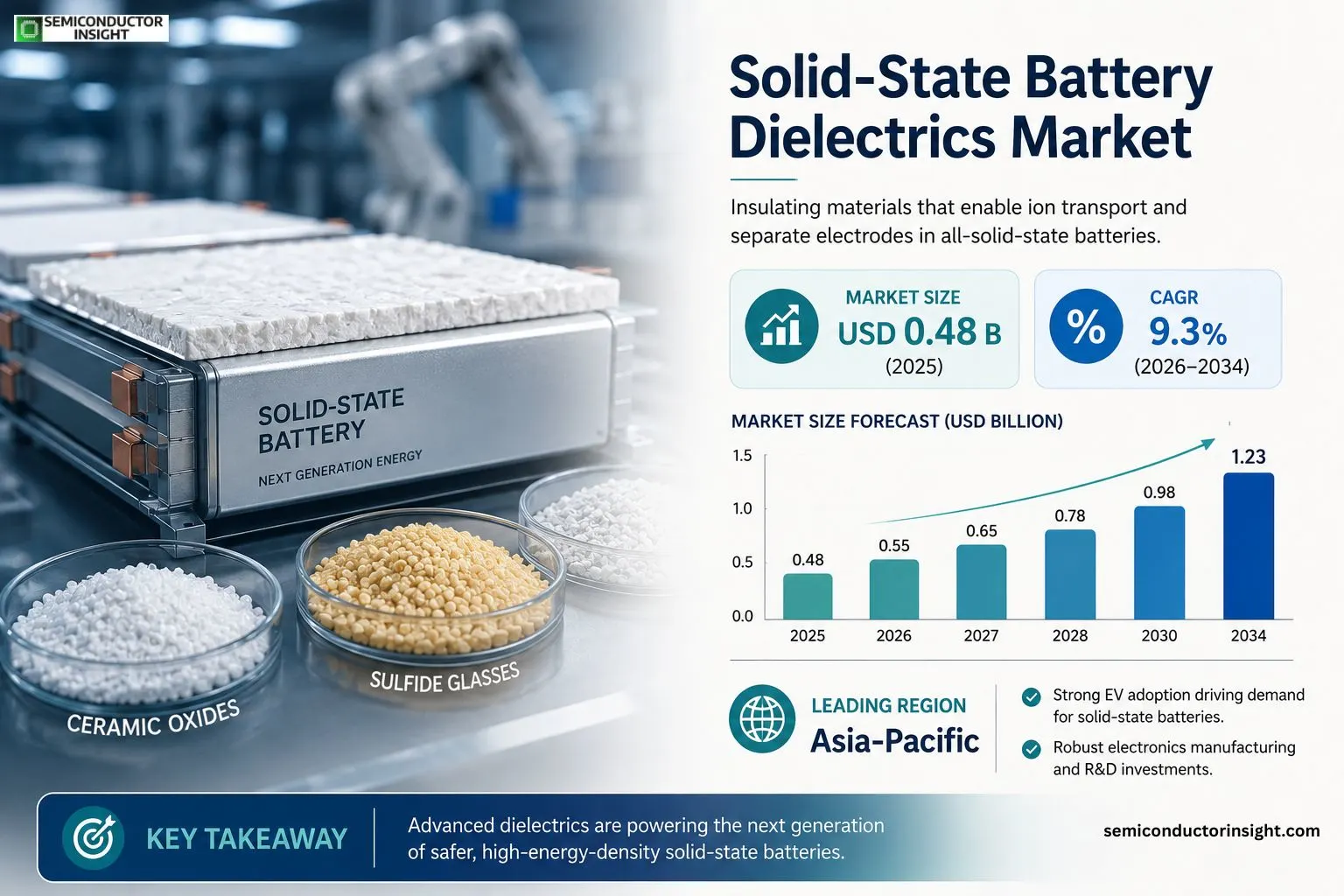
solid-state battery dielectrics market size was valued at USD 0.48 billion in 2025. The market is projected to grow from USD 0.55 billion in 2026 to USD 1.23 billion by 2034, exhibiting a CAGR of 9.3% during the forecast period.
Solid-state battery dielectrics are insulating materials that separate electrodes while enabling ion transport in all‑solid‑state batteries. These materials include ceramic oxides such as Li₇La₃Zr₂O₁₂, sulfide glasses, polymer‑based electrolytes, and hybrid composites designed for high ionic conductivity, thermal stability, and mechanical robustness.The market is experiencing rapid growth because automotive manufacturers are accelerating electrification targets, while consumer electronics demand longer runtimes. Furthermore, government incentives for low‑carbon transportation and increased R&D funding are driving adoption of high‑energy‑density solid‑state batteries. However, challenges such as scalability of ceramic processing and interface resistance persist, prompting collaborations among material suppliers like Toyota, QuantumScape, and Samsung SDI to advance dielectric formulations.
MARKET DRIVERS
Growing Demand for High‑Energy‑Density Storage
The accelerating shift toward electric vehicles (EVs) and portable electronics has heightened the need for batteries that can store more energy per unit weight. Solid-State Battery Dielectrics Market participants are benefitting from this trend as advanced dielectric materials enable safer, higher‑voltage cells, directly supporting longer driving ranges and faster charging cycles.
Regulatory Support and Safety Standards
Governments worldwide are implementing stricter emissions targets and safety regulations for battery systems. These policies incentivize the adoption of solid‑state technologies, where robust dielectric layers reduce the risk of thermal runaway, aligning with emerging safety standards and unlocking subsidies for manufacturers.
➤ Industry analysts project a compound annual growth rate (CAGR) of roughly 12 % for Solid State Battery Dielectrics Market through 2032, driven primarily by EV adoption and regulatory pressure.
In addition, strategic partnerships between material suppliers and automotive OEMs are accelerating R&D pipelines, shortening time‑to‑market for next‑generation dielectric solutions.
MARKET CHALLENGES
High Production Costs and Scale‑Up Barriers
Manufacturing solid‑state cells requires ultra‑pure ceramic or polymer dielectrics, which are currently more expensive than traditional liquid electrolyte components. The cost differential hampers large‑scale adoption, especially in price‑sensitive consumer segments.
Other Challenges
Manufacturing Complexity
Achieving defect‑free thin‑film dielectric layers at high throughput demands specialized equipment and stringent process controls, raising capital expenditures for new production lines.
MARKET RESTRAINTS
Material Compatibility and Longevity Issues
Integration of solid‑state dielectrics with existing electrode chemistries can lead to interfacial impedance growth over repeated cycles. Limited long‑term reliability data creates caution among OEMs, restraining broader market penetration.
MARKET OPPORTUNITIES
Emerging Applications in Aerospace and Grid Storage
Beyond automotive, aerospace platforms and stationary grid‑storage systems are exploring solid‑state batteries for their high safety margin and long cycle life. These sectors present untapped revenue streams for dielectric manufacturers, especially those offering lightweight, high‑temperature‑stable materials.
Solid-State Battery Dielectrics Market Trends
Automotive Electrification Driving Demand
Solid-State Battery Dielectrics Market is being reshaped by accelerating automotive electrification programs and rising consumer expectations for longer device runtimes. Automakers pursuing zero‑emission goals are prioritizing solid‑state battery architectures that rely on high‑performance dielectric layers to improve energy density while ensuring safety. Parallelly, consumer electronics manufacturers are seeking dielectrics that support thinner form factors and faster charging cycles, prompting a shift toward materials that combine high ionic conductivity with robust thermal stability. Government incentives for low‑carbon transportation and increased funding for advanced battery research further amplify demand, encouraging manufacturers to adopt next‑generation dielectric solutions that can meet stringent performance benchmarks. These drivers collectively contribute to a robust pipeline of projects targeting the next generation of energy storage solutions.
Other Trends
Material Innovation in Ceramics
Recent advances in ceramic oxides such as Li₇La₃Zr₂O₁₂ have markedly improved ionic conductivity, positioning them as leading candidates for solid‑state battery dielectrics. Researchers are optimizing synthesis routes to lower sintering temperatures, thereby enhancing scalability and reducing production costs. Hybrid composites that blend ceramic particles with polymer matrices are also gaining traction, offering a balance between mechanical flexibility and high dielectric strength. Meanwhile, sulfide‑based glasses continue to be explored for their low interfacial resistance, though moisture sensitivity remains a processing challenge. The industry is investing heavily in pilot lines that integrate these materials into full‑cell prototypes, aiming to validate long‑term stability under automotive thermal cycles. Furthermore, computational modeling is being employed to predict ionic pathways, shortening experimental cycles and informing compositional tweaks. These material innovations are expected to narrow the performance gap between solid‑state and conventional lithium‑ion technologies over the next decade.
Collaborative Development and Supply Chain Integration
Strategic partnerships among material suppliers, battery manufacturers, and automotive OEMs are accelerating the commercialization of solid‑state dielectric technologies. Alliances such as those between Toyota, QuantumScape, and Samsung SDI facilitate shared R&D resources, enabling rapid iteration on electrolyte formulations and interface engineering. Supply‑chain integration efforts focus on securing raw‑material sources for high‑purity ceramic precursors while establishing standardized testing protocols to ensure reproducibility across partners. As these collaborative frameworks mature, the market is poised to achieve more consistent product performance, reduce time‑to‑market, and address lingering scalability concerns. Continued policy support and investment in manufacturing infrastructure will further underpin market confidence. Consequently, Solid-State Battery Dielectrics Market is expected to sustain a steady upward trajectory, driven by coordinated innovation and expanding adoption across transportation and portable‑electronics sectors.
COMPETITIVE LANDSCAPEKey Industry Players
Solid-State Battery Dielectrics Market – Competitive Overview
Solid State Battery Dielectrics Market is presently led by a handful of large automotive and materials conglomerates that command the majority of R&D spend and production capacity. Toyota, leveraging its in‑house ceramic expertise, remains the dominant force in scaling Li₇La₃Zr₂O₁₂‑based electrolytes for next‑generation EVs, while QuantumScape partners closely with Volkswagen to commercialize sulfide‑glass dielectrics that promise superior ionic conductivity. Samsung SDI and LG Chem have expanded their polymer‑based dielectric portfolios to address consumer‑electronics demand, and Solid Power, backed by Ford and BMW, focuses on hybrid composite dielectrics that balance mechanical robustness with thermal stability. This concentration of resources creates a tiered market structure where a few vertically integrated players drive standards, while specialist material suppliers such as 3M, Bayoxide, Hitachi Chemical, and BASF provide niche additives and coating technologies that complement the core dielectric formulations.Beyond the headline players, a vibrant ecosystem of niche innovators contributes critical breakthroughs that shape the market’s trajectory. Ilika’s ion‑conducting glass‑ceramics, Ionic Materials’ polymer‑based solid electrolytes, and ProLogium’s thin‑film ceramic dielectrics are gaining traction through strategic collaborations with OEMs and battery manufacturers. Smaller firms such as A123 Systems, Envision AESC, Panasonic, and Ionic Materials focus on specialty applications ranging from high‑power drivetrain modules to ultra‑compact portable devices. Their agility enables rapid prototyping of low‑resistance interfaces and scalable processing routes, positioning them as essential partners in the broader industry’s effort to overcome scalability and interface‑resistance challenges.
List of Key Solid-State Battery Dielectrics Companies Profiled
- Toyota Motor Corporation
- QuantumScape
- Samsung SDI
- LG Chem
- Solid Power
- 3M
- Bayoxide Advanced Materials
- Hitachi Chemical
- BASF
- Ilika
- Ionic Materials
- ProLogium
- A123 Systems
- Envision AESC
- Panasonic
Segment Analysis:
| Segment Category | Sub-Segments | Key Insights |
| By Type |
|
Ceramic Oxides dominate due to exceptional thermal stability and mechanical strength—enable long‑life solid‑state cells—provide a robust platform for high energy density designs—however, processing complexity requires advanced manufacturing collaborations. |
| By Application |
|
Automotive Batteries drive innovation with demand for higher energy density—require dielectrics that tolerate rapid charge‑discharge cycles—push suppliers toward materials that combine ionic conductivity with structural resilience. |
| By End User |
|
Automotive Manufacturers prioritize safety and performance—seek dielectrics that reduce risk of thermal runaway—favor partners that can deliver scalable, high‑purity ceramic formulations. |
| By Material |
|
Inorganic Ceramics are valued for their high ionic pathways and thermal endurance—support long‑term cell stability—yet require precise sintering to minimize grain boundary resistance, prompting joint research initiatives. |
| By Performance Attribute |
|
High Ionic Conductivity is the primary driver—enables faster charging while maintaining safety—materials that balance conductivity with low interfacial resistance are favored in next‑generation battery architectures. |
Regional Analysis: North America
North America
Ongoing research and development efforts in solid-state battery dielectrics are yielding promising results, with innovations in materials science and manufacturing processes paving the way for higher performance and cost-effectiveness.
Government support through funding, tax incentives, and supportive policies is accelerating the adoption of solid-state battery technologies and fostering a favorable business environment.
Significant capital investment is being directed towards solid-state battery dielectrics research, development, and manufacturing, indicating strong confidence in the market’s future potential.
The development of robust and scalable supply chains for solid-state battery dielectrics is crucial for meeting the growing demand and ensuring market stability.
Europe
Europe is strategically positioned to be a significant player in Solid-State Battery Dielectrics Market. With stringent environmental regulations promoting the adoption of EVs and a strong emphasis on technological innovation, the region presents a compelling landscape for growth. Key players are focusing on developing advanced battery solutions for the automotive, industrial, and consumer electronics sectors, leveraging their established manufacturing capabilities and research infrastructure. The EU’s battery regulations further incentivize the development and use of safer and higher-performing solid-state batteries.
Asia-Pacific
Asia-Pacific, particularly countries like China, Japan, and South Korea, represents a massive and dynamic market for Solid-State Battery Dielectrics. These nations boast strong automotive industries, robust battery manufacturing ecosystems, and significant investments in R&D. The demand for solid-state batteries is being driven by the rapid growth of the EV market and the increasing adoption of advanced energy storage systems. Innovation in materials and manufacturing is also a key focus in this region, with numerous startups and established companies vying for market share.
South America
South America is an emerging market for Solid-State Battery Dielectrics, primarily driven by the growing automotive sector and increasing interest in renewable energy. While the market is currently smaller compared to North America and Asia-Pacific, it holds considerable potential for future growth. The region’s focus on electrification and energy storage solutions is creating opportunities for the adoption of advanced battery technologies.
Middle East & Africa
The Middle East & Africa region presents a nascent but promising market for Solid-State Battery Dielectrics. The increasing focus on sustainable transportation and energy storage, coupled with government initiatives to diversify economies, is driving interest in advanced battery technologies. While the market is relatively small, it offers significant long-term growth potential, particularly in sectors like logistics and renewable energy.
Report Scope
This market research report provides a comprehensive analysis of the Solid-State Battery Dielectrics Market , covering the forecast period 2026–2034. It offers detailed insights into market dynamics, technological advancements, competitive landscape, and key trends shaping the industry.
Key focus areas of the report include:
- Market Overview: The report begins with an overview outlining its current market scenario, key growth indicators, and industry transformation drivers. It discusses macroeconomic factors, demand–supply balance, regulatory landscape, and the strategic role of semiconductors in powering advancements across industries such as automotive, telecommunications, consumer electronics, and industrial automation.
- Market Size & Forecast: Historical data and future projections for revenue, unit shipments, and market value across major regions and segments.
- Segmentation Analysis: Detailed breakdown by product type, technology, application, and end-user industry to identify high-growth segments and investment opportunities.
- Regional Insights: Insights into market performance across North America, Europe, Asia-Pacific, Latin America, and the Middle East & Africa, including country-level analysis where relevant.
- Competitive Landscape: Profiles of leading market participants, including their product offerings, R&D focus, manufacturing capacity, pricing strategies, and recent developments such as mergers, acquisitions, and partnerships.
- Technology Trends & Innovation: Assessment of emerging technologies, integration of AI/IoT, semiconductor design trends, fabrication techniques, and evolving industry standards.
- Market Drivers & Restraints: Evaluation of factors driving market growth along with challenges, supply chain constraints, regulatory issues, and market-entry barriers.
- Stakeholder Insights: Insights for component suppliers, OEMs, system integrators, investors, and policymakers regarding the evolving ecosystem and strategic opportunities.
Primary and secondary research methods are employed, including interviews with industry experts, data from verified sources, and real-time market intelligence to ensure the accuracy and reliability of the insights presented.
FREQUENTLY ASKED QUESTIONS:
What is the current market size of Solid-State Battery Dielectrics Market?
-> Solid-State Battery Dielectrics Market was valued at USD 0.48 billion in 2025 and is expected to reach USD 1.23 billion by 2034.
Which key companies operate in Solid-State Battery Dielectrics Market?
-> Key players include Toyota, QuantumScape, Samsung SDI, among others.
What are the key growth drivers?
-> Key growth drivers include automotive electrification targets, rising consumer‑electronics demand for longer runtimes, government incentives for low‑carbon transportation, and increased R&D funding for solid‑state battery technologies.
Which region dominates the market?
-> Asia-Pacific is the fastest‑growing region, while Europe remains a significant market due to established automotive and electronics sectors.
What are the emerging trends?
-> Emerging trends include development of high‑ionic‑conductivity ceramic oxides (e.g., Li₇La₃Zr₂O₁₂), polymer‑based hybrid composites, and scalable manufacturing processes to reduce interface resistance.
Get Sample Report PDF for Exclusive Insights
Report Sample Includes
- Table of Contents
- List of Tables & Figures
- Charts, Research Methodology, and more...
 Download Sample Report PDF