Software-defined vehicle zonal gateway chip with PCIe switch Market Insights
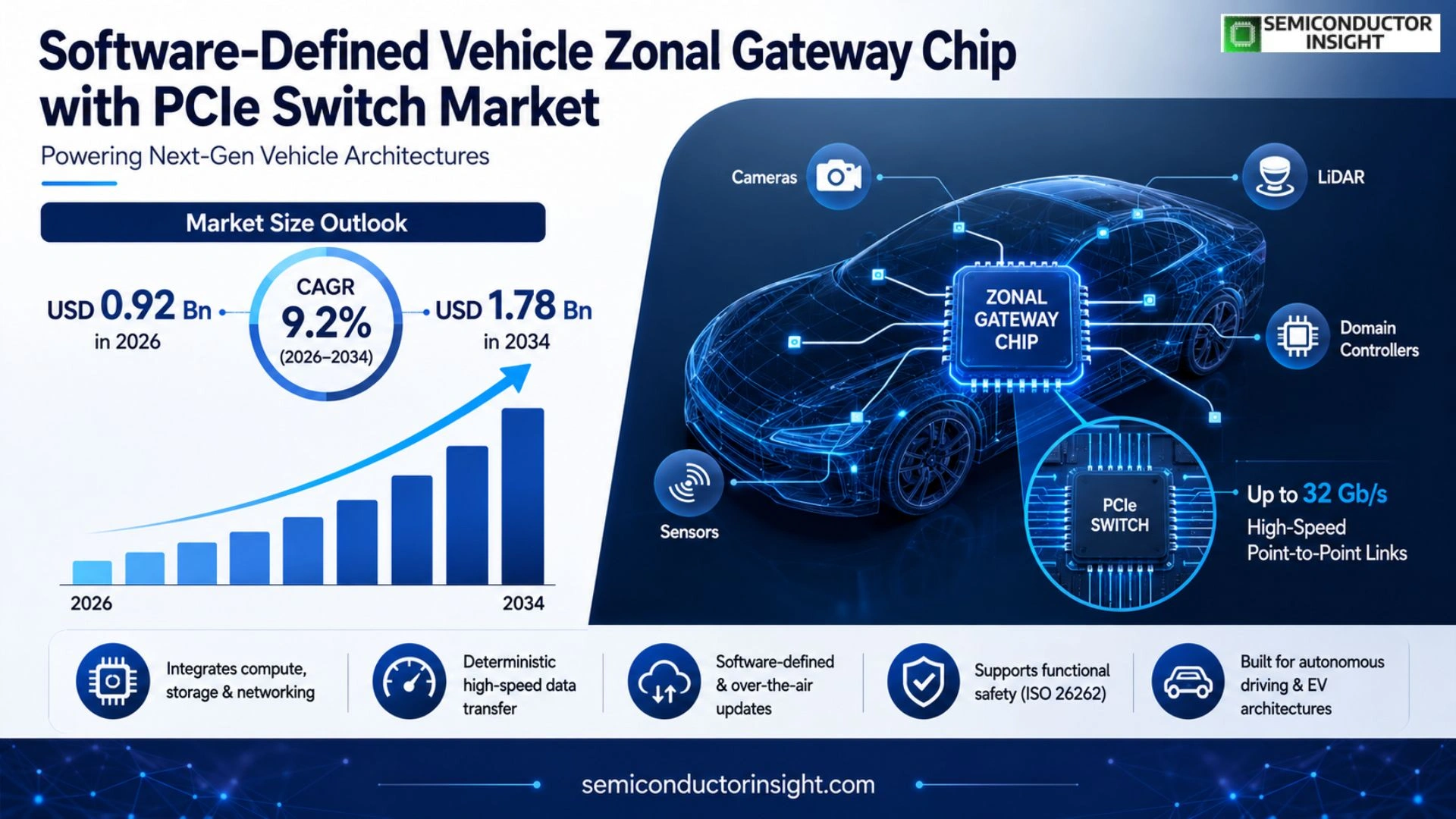
Global Software-defined vehicle zonal gateway chip with PCIe switch market size was valued at USD 0.85 billion in 2025. The market is projected to grow from USD 0.92 billion in 2026 to USD 1.78 billion by 2034, exhibiting a CAGR of 9.2% during the forecast period.
Software-defined vehicle zonal gateway chips integrate compute, storage and networking functions into a single silicon platform that can be reprogrammed via software updates. The embedded PCIe switch provides high‑speed point‑to‑point links between sensors, cameras, LiDAR units and domain controllers, enabling deterministic data transfer rates up to 32 Gb/s within each vehicle zone.
The market is accelerating because automotive manufacturers are adopting modular architectures for autonomous driving and electric vehicles, which demand scalable bandwidth and over‑the‑air update capabilities. Furthermore, stricter functional safety standards such as ISO 26262 encourage the consolidation of safety‑critical domains onto programmable gateways. Recent collaborations,such as NXP’s partnership with Intel on next‑gen vehicular compute fabrics,and increased R&D spending by Tier‑1 suppliers are further fueling growth.
MARKET DRIVERS
Increasing Adoption of Software‑Defined Architectures
Software-defined vehicle zonal gateway chip with PCIe switch Market is being propelled by automotive manufacturers embracing software‑defined vehicle platforms. These platforms enable rapid feature updates, over‑the‑air upgrades, and modular integration of new functions, which in turn demand high‑performance zonal gateway chips that can consolidate multiple domain controllers.
Demand for High‑Speed PCIe Switching
Modern vehicles now host dozens of high‑resolution cameras, LiDAR, and radar sensors that generate terabits of data per hour. The need for PCIe‑based switching fabric within the zonal gateway chip is critical to meeting latency requirements of safety‑critical ADAS and autonomous driving functions.
➤ Integrated zonal gateway and PCIe switch can reduce wiring harness weight by up to 30% while supporting 50 Gbps per lane bandwidth.
Overall, the convergence of software‑centric vehicle design and the requirement for robust, high‑throughput data routing is creating a solid growth foundation for the market.
MARKET CHALLENGES
Complex Integration and Validation
Designing a single chip that combines zonal gateway functions with a multi‑lane PCIe switch introduces architectural complexity. OEMs must validate functional safety, cybersecurity, and thermal performance across heterogeneous domains, extending development cycles.
Other Challenges
Supply Chain Constraints
Global semiconductor shortages and reliance on a limited number of foundries can delay volume production, raising unit costs for early adopters.
MARKET RESTRAINTS
High Development and Qualification Costs
Achieving automotive ISO 26262 compliance and functional safety levels for a combined zonal gateway and PCIe switch chip requires extensive testing and certification, inflating R&D expenditure and making entry barriers steep for smaller suppliers.
MARKET OPPORTUNITIES
Emerging ADAS and Autonomous Driving Applications
As Level‑3 and Level‑4 autonomous systems become commercialized, Software-defined vehicle zonal gateway chip with PCIe switch Market is positioned to capture demand for consolidated compute nodes that can handle massive sensor streams, real‑time AI inference, and deterministic communication within a single silicon solution.
Software-defined vehicle zonal gateway chip with PCIe switch Market Trends
Adoption of Modular Zonal Architectures
The automotive industry is rapidly moving toward modular zonal designs, where compute, storage and networking functions are consolidated into programmable gateways. This shift enables vehicle platforms to scale bandwidth on demand, reduces wiring complexity, and supports over‑the‑air software updates. Market data show the sector valued at USD 0.85 billion in 2025 and projected to reach USD 1.78 billion by 2034, reflecting strong momentum behind these architectures. Tier‑1 suppliers are prioritizing silicon solutions that can be reprogrammed throughout a vehicle’s lifecycle, which drives incremental investment and accelerates deployment across electric and autonomous models.
Other Trends
High‑Speed PCIe Switching Integration
Embedded PCIe switches provide deterministic point‑to‑point links that sustain up to 32 Gb/s per zone, linking cameras, LiDAR units, radar sensors and domain controllers with minimal latency. Such bandwidth is essential for sensor‑fusion workloads required by advanced driver‑assistance systems. The integration of the switch on the same silicon die as the gateway chip eliminates inter‑module bottlenecks, improves power efficiency, and simplifies board‑level design. Recent product releases demonstrate multi‑lane PCIe gen 4 support, positioning the technology as a critical enabler for the next generation of high‑performance vehicular networks.
Safety‑Critical Consolidation and OTA Updates
Stricter functional‑safety standards, notably ISO 26262, encourage consolidation of safety‑critical domains onto software‑defined gateways. Programmable gateways allow manufacturers to apply safety‑related patches via OTA mechanisms, extending the usable life of vehicle platforms while maintaining compliance. Collaborative initiatives such as NXP’s partnership with Intel on next‑generation compute fabrics illustrate the industry’s commitment to unified, secure, and updatable architectures. Tier‑1 R&D spending continues to rise, focusing on fault‑tolerant designs and secure boot processes, which further solidifies the market’s growth trajectory and reinforces confidence among OEMs seeking resilient, future‑proof solutions.
COMPETITIVE LANDSCAPE
Key Industry Players
Software-defined vehicle zonal gateway chip with PCIe switch market competitive overview
The market is currently led by NXP Semiconductors, whose Zonal Gateway portfolio integrates programmable ASICs with high‑speed PCIe switches and has secured multiple OEM contracts for next‑generation ADAS and autonomous driving platforms. NXP’s strategic partnership with Intel expands its compute‑fabric capabilities, effectively establishing it as the reference architecture for modular vehicle zones. Alongside NXP, Intel’s automotive‑grade Xeon‑based solutions and Qualcomm’s Snapdragon Ride processors form the primary tier‑1 offerings, creating a concentration where a few large semiconductor firms dominate volume shipments while specialized Tier‑1 suppliers focus on custom integration, functional safety certification (ISO 26262) and OTA update frameworks. This hierarchy drives a market structure that favors scalable, software‑reprogrammable silicon capable of supporting 32 Gb/s deterministic links across sensor‑rich zones.
Beyond the dominant trio, a diverse set of niche players contributes critical innovations that broaden the competitive landscape. Infineon Technologies and Renesas Electronics offer safety‑centric microcontrollers with embedded PCIe switching optimized for power‑train zones. STMicroelectronics and Texas Instruments supply mixed‑signal ASICs that address cost‑sensitive segments, while Samsung Electronics and MediaTek bring advanced memory‑centric designs to high‑throughput infotainment clusters. NVIDIA’s automotive GPUs, though primarily focused on AI acceleration, are increasingly paired with zonal gateway chips to enable edge compute. ON Semiconductor and Bosch (through its automotive electronics division) provide ruggedized solutions for harsh environments, and Continental contributes domain‑controller integration expertise that leverages third‑party gateway silicon. These companies collectively ensure a vibrant ecosystem where specialization and partnership drive differentiation.
List of Key Software-defined Vehicle Zonal Gateway Chip with PCIe Switch Companies Profiled
- NXP Semiconductors
- Intel Corporation
- Qualcomm Inc.
- Infineon Technologies
- Renesas Electronics
- STMicroelectronics
- Texas Instruments
- Samsung Electronics
- MediaTek Inc.
- NVIDIA Corporation
- ON Semiconductor
- Bosch Automotive Electronics
- Continental Automotive
Segment Analysis:
| Segment Category | Sub-Segments | Key Insights |
| By Type |
|
Compute‑centric
|
| By Application |
|
ADAS
|
| By End User |
|
OEMs
|
| By Architecture |
|
Zonal Architecture
|
| By Integration Level |
|
Integrated Compute‑PCIe Module
|
Regional Analysis: North America
The continuous innovation in semiconductor technology is a key factor driving the growth of software-defined vehicle zonal gateway chips. The integration of PCIe switches enhances data throughput and enables seamless communication between various electronic control units (ECUs) within the vehicle. This technological progress allows for more complex functionalities and improved system performance.
Stringent safety and emission regulations in North America are pushing automakers to incorporate more sophisticated electronic systems. These regulations necessitate the use of advanced zonal gateways that can manage the increasing volume of data generated by these systems. Compliance with these regulations is a significant driver for the adoption of software-defined vehicle zonal gateway chips with PCIe switch.
Modern vehicles are becoming increasingly complex, with a growing number of electronic systems and features. This complexity necessitates the use of powerful zonal gateways to manage the intricate network of vehicle electronics. The demand for these chips is directly proportional to the increasing sophistication of vehicle functionalities.
Significant investments in automotive manufacturing and research & development in North America are fostering innovation and driving demand for advanced automotive components like software-defined vehicle zonal gateway chips. This investment creates a supportive ecosystem for the growth of the market.
Europe
Europe represents another significant market for the software-defined vehicle zonal gateway chip with PCIe switch. The region’s strong focus on electric vehicles and connected car technologies is driving demand for these advanced components. European OEMs are actively pursuing electrification strategies and integrating advanced driver-assistance systems, leading to an increased need for high-performance zonal gateways. The stringent European Union regulations on vehicle safety and emissions further contribute to the adoption of these technologies. The emphasis on sustainable mobility and the development of smart transportation systems are also key drivers for market growth in Europe. The integration of software-defined capabilities within vehicle architectures is a major trend shaping the European automotive landscape.
Asia-Pacific
Asia-Pacific is anticipated to be the fastest-growing market for software-defined vehicle zonal gateway chips with PCIe switch. This growth is primarily driven by the exponential increase in automotive production in countries like China and India. The region’s burgeoning automotive industry is embracing advanced technologies to enhance vehicle safety, connectivity, and autonomous driving capabilities. The increasing adoption of electric vehicles and the government’s supportive policies for the automotive sector are further fueling market expansion. The demand for these chips is significant due to the rapid pace of innovation and the growing complexity of vehicle electronics in the Asia-Pacific region.
South America
South America presents a moderate growth opportunity for Software-defined vehicle zonal gateway chip with PCIe switch Market. The automotive industry in the region is gradually adopting advanced technologies, driven by increasing consumer demand for safety and connectivity features. Government initiatives promoting automotive manufacturing and infrastructure development are also contributing to market growth. While the adoption rate may be slower compared to other regions, the long-term outlook for this market remains positive, particularly with the increasing focus on electric vehicles and the development of connected car services.
Middle East & Africa
The Middle East & Africa region is expected to witness a nascent but growing demand for software-defined vehicle zonal gateway chips with PCIe switch. The automotive market in this region is experiencing steady growth, driven by increasing disposable incomes and a rising preference for modern vehicles. The development of smart city initiatives and the introduction of connected car services are also contributing to market expansion. While the adoption rate may be initially lower, the long-term potential for this market is significant, particularly with the continued growth of the automotive sector and the increasing focus on technological advancements.
Report Scope
This market research report provides a comprehensive analysis of the Software-defined vehicle zonal gateway chip with PCIe switch Market , covering the forecast period 2026–2034. It offers detailed insights into market dynamics, technological advancements, competitive landscape, and key trends shaping the industry.
Key focus areas of the report include:
- Market Overview: The report begins with an overview outlining its current market scenario, key growth indicators, and industry transformation drivers. It discusses macroeconomic factors, demand–supply balance, regulatory landscape, and the strategic role of semiconductors in powering advancements across industries such as automotive, telecommunications, consumer electronics, and industrial automation.
- Market Size & Forecast: Historical data and future projections for revenue, unit shipments, and market value across major regions and segments.
- Segmentation Analysis: Detailed breakdown by product type, technology, application, and end-user industry to identify high-growth segments and investment opportunities.
- Regional Insights: Insights into market performance across North America, Europe, Asia-Pacific, Latin America, and the Middle East & Africa, including country-level analysis where relevant.
- Competitive Landscape: Profiles of leading market participants, including their product offerings, R&D focus, manufacturing capacity, pricing strategies, and recent developments such as mergers, acquisitions, and partnerships.
- Technology Trends & Innovation: Assessment of emerging technologies, integration of AI/IoT, semiconductor design trends, fabrication techniques, and evolving industry standards.
- Market Drivers & Restraints: Evaluation of factors driving market growth along with challenges, supply chain constraints, regulatory issues, and market-entry barriers.
- Stakeholder Insights: Insights for component suppliers, OEMs, system integrators, investors, and policymakers regarding the evolving ecosystem and strategic opportunities.
Primary and secondary research methods are employed, including interviews with industry experts, data from verified sources, and real-time market intelligence to ensure the accuracy and reliability of the insights presented.
FREQUENTLY ASKED QUESTIONS:
What is the current market size of Software-defined vehicle zonal gateway chip with PCIe switch Market?
-> Software-defined vehicle zonal gateway chip with PCIe switch market size is projected to grow from USD 0.92 billion in 2026 to USD 1.78 billion by 2034.
Which key companies operate in Software-defined vehicle zonal gateway chip with PCIe switch Market?
-> Key players include NXP Semiconductors, Intel, and major Tier‑1 automotive suppliers.
What are the key growth drivers?
-> Key growth drivers include adoption of modular vehicle architectures for autonomous driving and electric vehicles, demand for high‑bandwidth over‑the‑air update capabilities, and stricter functional safety standards such as ISO 26262.
Which region dominates the market?
-> The reference does not specify a dominant region.
What are the emerging trends?
-> Emerging trends include strategic collaborations (e.g., NXP with Intel) and increased R&D investment by Tier‑1 suppliers to enhance programmable gateway capabilities.

Get Sample Report PDF for Exclusive Insights
Report Sample Includes
- Table of Contents
- List of Tables & Figures
- Charts, Research Methodology, and more...