SMD Reed Switch Market Insights
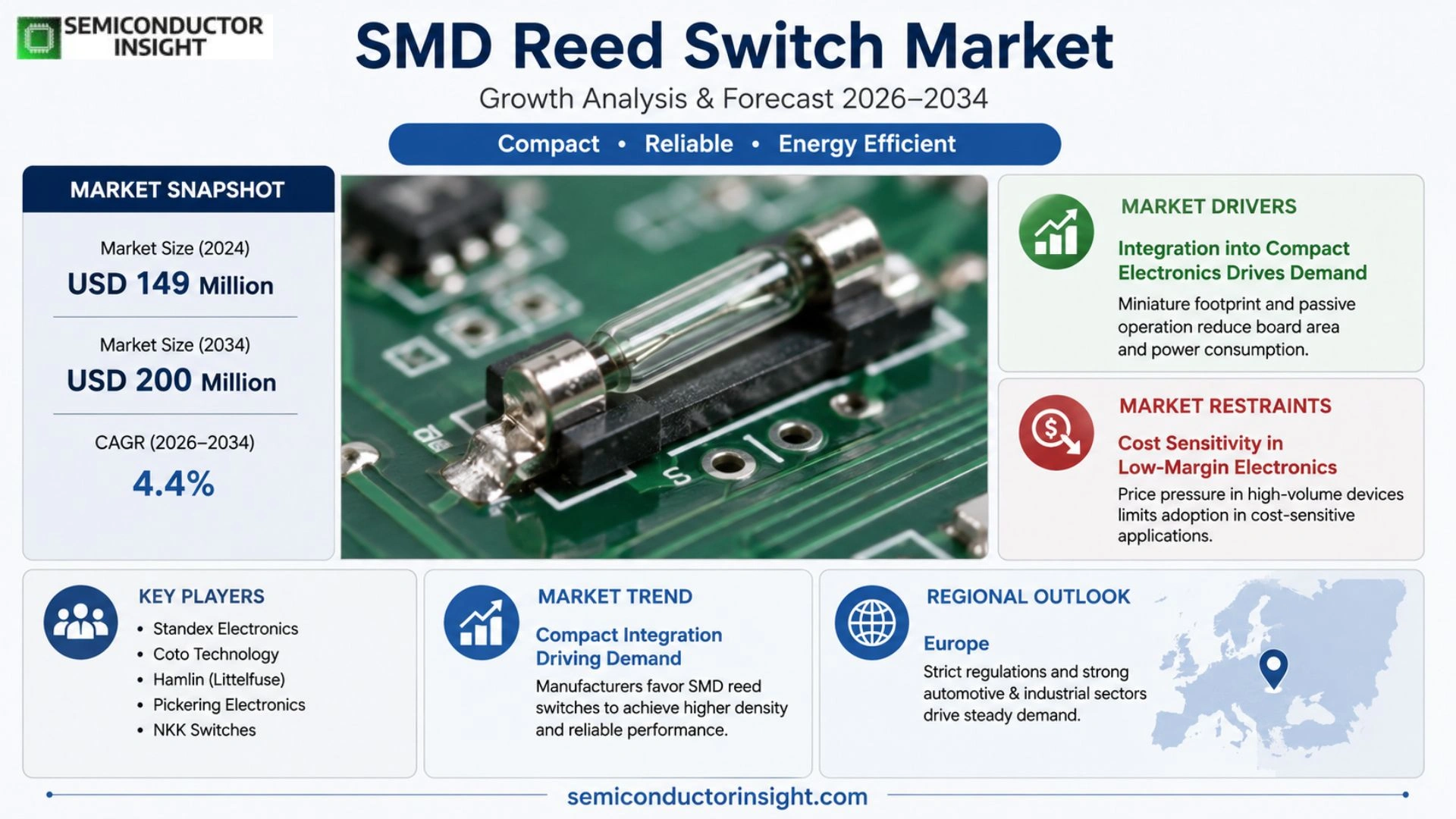
Global SMD Reed Switch Market size was valued at USD 149 million in 2024 and will increase to USD 200 million by 2034, reflecting an annual growth rate of approximately 4.4% over this period.
An SMD Reed Switch is a compact reed switch fabricated using surface‑mount technology, enabling soldering directly onto printed circuit boards alongside other surface‑mount components. Its small footprint suits tight electronic assemblies such as mobile phones, tablets, smartwatches, automotive electronics, medical devices and consumer appliances.
The demand for cost‑effective automated PCB assembly drives adoption across these sectors because manufacturers seek higher density layouts while maintaining reliability. At the same time advances in miniaturisation and improved overmoulding techniques reduce production costs further, creating incremental value for end users.
MARKET DRIVERS
Integration into Compact Electronics Drives Demand
The relentless push for smaller, higher‑density electronic assemblies has placed SMD reed switches at the core of modern circuit designs. Their miniature footprint and passive operation eliminate the need for additional drivers, reducing board area and power consumption. This is particularly attractive in the burgeoning Internet‑of‑Things segment, where billions of ultra‑compact devices require reliable magnetic contact solutions that can be integrated directly into PCB layers. Manufacturers are therefore offering a growing range of high‑frequency, low‑leakage variants that meet the stringent noise‑immunity requirements of consumer wearables and automotive infotainment modules.
Enhanced Reliability and Longevity
Recent advances in hermetic sealing and improved magnetic alloys have extended the service life of the most demanding SMD reed switch applications. With a typical life expectancy exceeding five million cycles, these devices outlast many active solid‑state sensors in vibration‑heavy environments, such as motor control units and aerospace actuators. The result is a lower total cost of ownership for end users, as replacement intervals shrink and field‑service events diminish. Additionally, the non‑contact nature of the reed mechanism reduces wear‑related failure modes, creating a predictable performance envelope that is easy to model in reliability budgets.
➤ The convergence of miniaturization and robust performance positions SMD reed switches as a strategic component in high‑density, low‑power circuit design.
Supply‑chain responses to these demands have been swift. Foundries now stock dedicated SMD reed switch families that align with industry B2B buying patterns, while OEMs have begun to standardise design for manufacturability, ensuring consistent yield rates across multiple production lines. SMD Reed Switch Market remains a focal point for component suppliers aiming to secure long‑term contracts with increasing PWM and smart‑device manufacturers.
MARKET CHALLENGES
Regulatory and Environmental Compliance Hurdles
RoHS, REACH, and emerging hazardous‑material directives impose strict limits on the use of lead, cadmium and certain glass‑ceramic substrates that are traditionally employed in SMD reed switch housings. Adapting to these constraints requires costly redesigns and rigorous testing, which can delay time‑to‑market for new generations of switches. While most manufacturers have managed to achieve compliance, smaller suppliers face a disproportionate burden, potentially tightening competitive pressure and raising industry entry barriers.
Other Challenges
Price Volatility in Rare Materials
The magnetic core of a reed switch consumes significant amounts of neodymium‑iron‑boron, a material whose cost can swing by 15–20 % within a year due to geopolitical trade fluctuations. Companies that rely on long‑term inventory strategies must balance the risk of price spikes against the necessity of maintaining a consistent supply chain.
Supply Chain Disruptions and Lead Times
The COVID‑19 pandemic underscored the fragility of global component sourcing, with many suppliers experiencing lead‑time extensions of up to 8 weeks. The SMD reed switch segment, though typically less complex than active device manufacturing, is still vulnerable to bottlenecks in raw‑material procurement and specialised fabrication equipment.
MARKET RESTRAINTS
Cost Sensitivity in Low‑Margin Electronics
High‑density mobile terminals and entry‑level appliances operate under razor‑thin gross margins, forcing component suppliers to propose competitively priced solutions. Even a modest increase in the cost of an SMD reed switch can cascade into a sizable percentage impact on bill‑of‑materials, compelling OEMs to reassess the balance between reliability and cost. As a result, there is a continual search for cost‑effective alternatives, including ball‑grid‑array (BGA)‑mountable magnetic contacts and optical proximity sensors that perform similar functions at lower price points.
In markets where price drop is a survival strategy, such as in consumer electronics in Asia, tender processes often favour the lowest bid. The temptation to focus solely on price can erode the perceived value of higher‑quality reed switches, undercutting the innovation cycle and slowing the deployment of advanced magnetic interfaces that offer future resistance to electromagnetic interference.
Moreover, the manufacturing footprint for ultra‑miniaturised reed devices requires precision molding and clean‑room containment, disciplines that demand significant capital expenditure. For many small‑to‑mid‑size enterprises, the high setup cost creates a barrier to entry, concentrating market control among a handful of leading conglomerates.
MARKET OPPORTUNITIES
Emerging Markets and Industrial Automation
Smart factory rollouts driven by Industry 4.0 initiatives are expanding the footprint of SMD reed switches beyond traditional consumer electronics. Their compact size and low power envelope make them ideal for embedded sensor networks in machine‑tool diagnostics, predictive maintenance circuits, and real‑time safety interlocks. Early adopters in automotive and aerospace sectors are already integrating miniature reed switches into their structural health monitoring systems, creating a wagon‑line effect that drives volume uptake.
Simultaneously, the growth of HVAC automation and building‑management solutions has spurred demand for low‑profile magnetic sensors that can replace bulky reed pair assemblies traditionally used in commercial air‑conditioning control boxes. The rising prevalence of smart grids and renewable‑energy storage devices further extends the application range, offering seamless integration of sense‑and‑actuate capabilities in tightly packaged modules.
Digital‑twin platforms are beginning to model mechanical state changes directly through embedded SMD reed sensors. Partners between sensor manufacturers and simulation firms are creating pre‑validated design libraries that reduce development time for complex assemblies. This synergy between hardware and software is a promising avenue for up‑skilling the market, opening a new revenue stream that capitalises on the reliability attributes of magnetic switches.
SMD Reed Switch Market Trends
Compact Integration Driving Demand
SMD Reed Switch Market has surged as electronic manufacturers pivot toward surface‑mount solutions that trim board real estate without compromising reliability. In 2024 the market hit roughly US$149 million, escalating to about US$200 million in 2031. This uptick reflects a steady stream of consumer‑grade devices,smartphones, wearables, and automotive infotainment systems,that demand smaller, lighter, and more cost‑effective control components. The move toward tape‑and‑reel packaging further accelerates mass production, allowing OEMs to maintain tight supply chains and reduce lead times.
Other Trends
Rise of Overmolded Packages
Overmolded SMD Reed Switches have gained traction due to enhanced environmental sealing and streamlined assembly. Their integrated gasket improves humidity tolerance, a critical feature for automotive and medical applications. Manufacturers who specialize in overmolding report higher margins, as the added protection commands a premium price while reducing downstream damage rates. Suppliers with robust overmolding capabilities are capturing larger shares in high‑volume automotive and consumer electronics segments, reinforcing supply chain resilience.
Trend toward Automotive Integration
The automotive sector is the fastest expanding application driver for SMD Reed Switch Market. Stringent safety and lifecycle requirements compel automakers to adopt electronics that offer consistent performance under vibration and temperature swings. As vehicle electronics evolve toward autonomous systems, the demand for compact, high‑precision switches ascends. Companies that supply automotive‑grade switches,meeting ISO 26262 and other safety standards,are positioned to capture premium pricing. The shift toward overmolded, ruggedized units also mediates risk, contributing to sustained demand across emerging vehicle platforms.
COMPETITIVE LANDSCAPE
Key Industry Players
SMD Reed Switch Market Landscape Analysis, 2024‑2031
Standex Electronics sustains its leadership through a diversified product line that caters to both mobile and automotive sectors, allowing it to capture a sizable share of the $149 million market in 2024. The company’s emphasis on tape‑and‑reel packaging, coupled with tight integration with OEMs, has yielded a resilient supply chain that supports incremental upgrades in electronic design. Its portfolio, which spans bare glass surface mount to overmolded packages, aligns seamlessly with the rising demand for compact, high‑performance switches in emerging IoT devices. The strategic acquisition of a niche supplier in the medical instrumentation segment has further broadened Standex’s footprint, positioning it to benefit from the projected growth in healthcare electronics that will contribute to the overall market’s climb toward $200 million by 2031.
Other key players,Littelfuse, HSI Sensing, and Nippon Aleph Corporation,play complementary roles within a fragmented competitive environment. Littelfuse, whose focus on automotive and industrial control applications has cemented a reputation for rugged performance, is actively pursuing cost‑optimization through advanced soldering processes. HSI Sensing has leveraged its expertise in overmolded packages to secure long‑term contracts in the tablet and wearable markets, where precision and reliability are paramount. Nippon Aleph Corporation, with its strong foothold in Asian distribution networks, supplies a broad mix of types that supports the rapid deployment of smart home appliances across Europe and North America. Meanwhile, players such as Comus International, PIC Group, and PIT‑RADWAR add depth to the niche market, delivering specialized solutions for sectors like aerospace and energy monitoring where stringent certification requirements dominate.
List of Key SMD Reed Switch Companies Profiled
- Standex Electronics
- Littelfuse
- Nippon Aleph Corporation
- HSI Sensing
- Comus International
- Ryazan Metal Ceramics Instrumentation Plant
- PIC Group
- PIT‑RADWAR
- ASE Technologies
- Sony Kokusai
- Caden Technologies
- Mille Technologies
- Henry Equipment Co.
- D’Adderio Electronics
- Ingrid Technology Solutions
Segment Analysis:
| Segment Category | Sub-Segments | Key Insights |
| By Type |
|
Overmolded Package is decisive for compact designs, offering moisture resistance, improved solderability, and lower overall assembly cost. The overmolded type supports high‑density PCB layouts, aligns with automated tape‑and‑reel handling, and provides greater component reliability in demanding environments. |
| By Application |
|
Consumer Electronics drives demand for compact, cost‑effective switches, crucial for mobile phones and wearables. The trend emphasizes integration density, rapid assembly, and low thermal dissipation. Reliability under vibration and temperature extremes positions the consumer electronics segment as a primary growth driver. |
| By End User |
|
OEM Manufacturers prioritize high‑volume, repeatable manufacturing of SMD reed switches. The OEM focus on supply chain consistency, adherence to industry standards, and cost management shapes purchasing decisions. Their emphasis on reliability and minimal footprint aligns with industry move toward smaller, high‑density PCBs. |
| By Device Type |
|
Signal Switching dominates due to its ability to provide precise circuit activation in low‑voltage scenarios. Applications in mobile and automotive electronics rely on low‑profile, high‑speed switches. Continued development in magnetic core materials extends performance across temperature ranges, sustaining demand. |
| By Consumer Segment |
|
Consumer Electronics remains the most dynamic segment, driven by the proliferation of smart wearables, smartphones, and IoT gateways. Emphasis on miniaturization, low power, and cost, combined with rapid design cycles, supports high adoption of SMD reed switches in this sector. |
Regional Analysis: SMD Reed Switch Market
Reliability in high‑volume automation environments, coupled with the compact footprint of industrial sensors, pushes installations of SMD reed switches in factory floors across North America. Lean production lines that favor minimal maintenance cycles elevate the sensor’s appeal. Manufacturers seeking to satisfy stringent lifecycle certifications opt for these components because they comply readily with established safety protocols.
While automotive control units dominate, the growth in robotics and medical device applications reshapes deployment niches. Low‑voltage, low‑current loads in robotic manipulators demand switching devices that maintain performance under varying temperature envelopes, a need that the compact SMD reeds satisfy out of the box.
Market entrants face a two‑tier battle: established manufacturers back by proven supply chains, and niche players excelling in ultra‑low‑power specialty applications. The former rely on scale and incremental improvements; the latter push toward miniaturized actuation mechanisms that open new niches, especially in wearable technology.
Advancements in multi‑modal sensing,integrating magnetic, thermal, and pressure inputs,are driving feature creep. Coupled with embedded diagnostics, these enhanced modules promise predictive maintenance, tracing line‑age, and failure causation, aligning product roadmap with above‑average uptime goals for critical systems.
Europe
Europe’s emphasis on stringent environmental and safety regulations fuels the demand for SMD Reed Switch components in automotive and industrial control units. The region’s push toward circular manufacturing also steers buyers toward recyclable, low‑profile sensors, positioning the SMD reed switch as a viable solution for secure, compliant control systems that meet upcoming EU directives.
Asia-Pacific
The Asia-Pacific corridor’s rapid urbanization and expanding automation infrastructure spur a gradual shift toward miniature, high‑performance switches. Growing automotive production clusters, coupled with rising demand for smart manufacturing, create a steady pipeline for SMD reed switches that offer compactness and reliability required by Asia’s burgeoning factory automation networks.
South America
South America’s increasing investment in renewable infrastructure,particularly solar farms and advanced HVAC systems,introduces a new niche for low‑maintenance sensors. As local industries adopt electrification trends, SMD reed switches become attractive due to their ruggedness and minimal upkeep, fostering incremental uptake across emerging markets.
Middle East & Africa
In Middle East & Africa, climate conditions and extreme temperature ranges underline the need for durable, maintenance‑free switchgear. Relying on compact magnetic solutions, regional utilities address corrosion challenges by deploying SMD reed switches, capitalizing on their longevity and low lifecycle costs amid expanding energy grids and smart infrastructure projects.
Report Scope
This market research report provides a comprehensive analysis of the SMD Reed Switch Market , covering the forecast period 2026–2034. It offers detailed insights into market dynamics, technological advancements, competitive landscape, and key trends shaping the industry.
Key focus areas of the report include:
- Market Overview: The report begins with an overview outlining its current market scenario, key growth indicators, and industry transformation drivers. It discusses macroeconomic factors, demand–supply balance, regulatory landscape, and the strategic role of semiconductors in powering advancements across industries such as automotive, telecommunications, consumer electronics, and industrial automation.
- Market Size & Forecast: Historical data and future projections for revenue, unit shipments, and market value across major regions and segments.
- Segmentation Analysis: Detailed breakdown by product type, technology, application, and end-user industry to identify high-growth segments and investment opportunities.
- Regional Insights: Insights into market performance across North America, Europe, Asia-Pacific, Latin America, and the Middle East & Africa, including country-level analysis where relevant.
- Competitive Landscape: Profiles of leading market participants, including their product offerings, R&D focus, manufacturing capacity, pricing strategies, and recent developments such as mergers, acquisitions, and partnerships.
- Technology Trends & Innovation: Assessment of emerging technologies, integration of AI/IoT, semiconductor design trends, fabrication techniques, and evolving industry standards.
- Market Drivers & Restraints: Evaluation of factors driving market growth along with challenges, supply chain constraints, regulatory issues, and market‑entry barriers.
- Stakeholder Insights: Insights for component suppliers, OEMs, system integrators, investors, and policymakers regarding the evolving ecosystem and strategic opportunities.
Primary and secondary research methods are employed, including interviews with industry experts, data from verified sources, and real-time market intelligence to ensure the accuracy and reliability of the insights presented.
FREQUENTLY ASKED QUESTIONS:
What is the current market size of SMD Reed Switch Market?
-> SMD Reed Switch Market size will increase to USD 200 million by 2034, reflecting an annual growth rate of approximately 4.4% over this period.
Which key companies operate in SMD Reed Switch Market?
-> Key players include Standex Electronics, Nippon Aleph Corporation, Littelfuse, HSI Sensing, Comus International, Ryazan Metal Ceramics Instrumentation Plant, PIC Group, and PIT-RADWAR.
What are the key growth drivers?
-> Key growth drivers include increasing demand for automated PCB assembly, the cost‑effective nature of SMD reed switches, and expanding usage in mobile phones, tablets, automotive electronics, medical equipment, and consumer electronics.
Which region dominates the market?
-> The provided content does not specify a dominant region for SMD Reed Switch Market.
What are the emerging trends?
-> Emerging trends are not detailed in the provided content.

Get Sample Report PDF for Exclusive Insights
Report Sample Includes
- Table of Contents
- List of Tables & Figures
- Charts, Research Methodology, and more...
 Download Sample Report PDF