
Market Insights
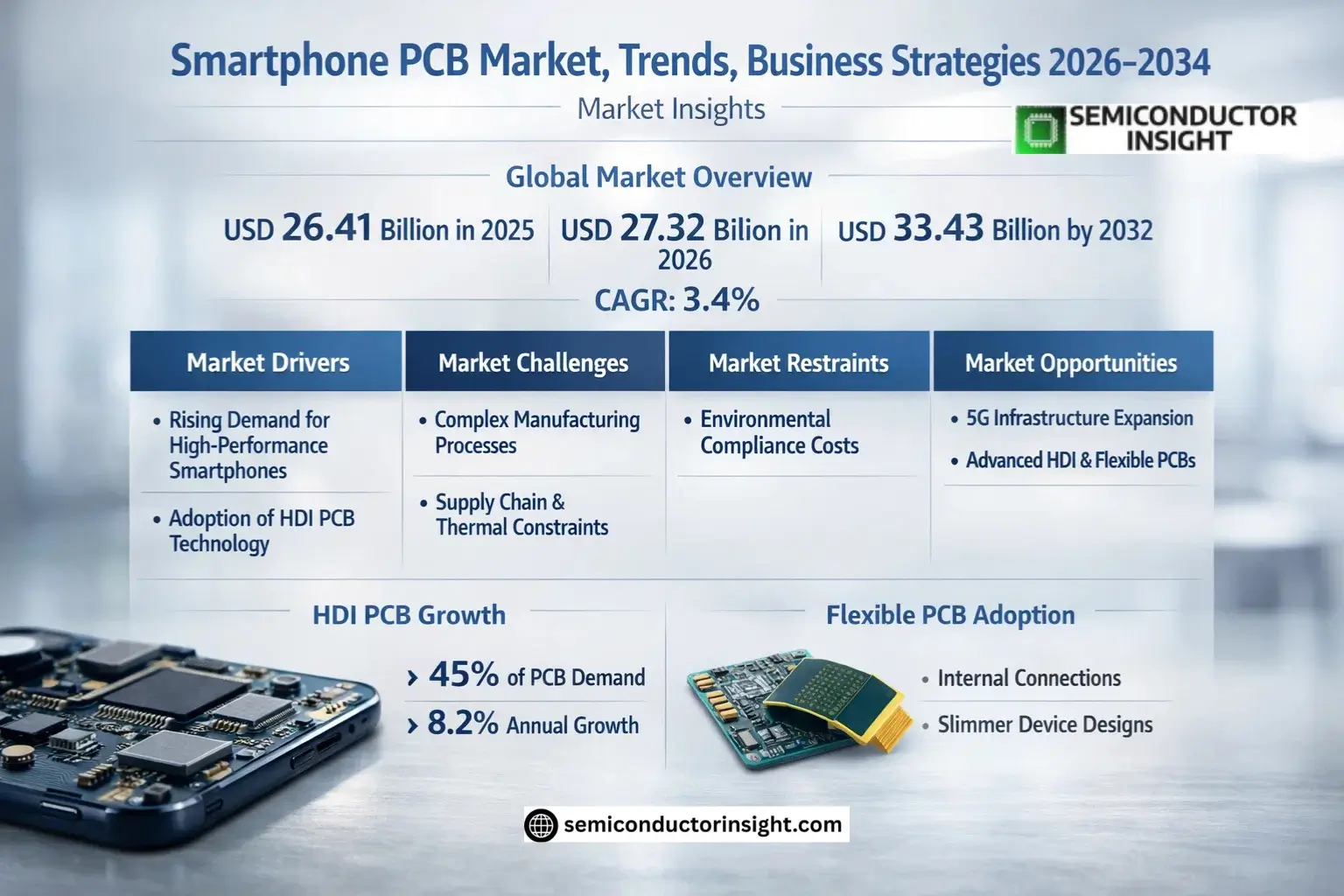
Global Smartphone PCB Market size was valued at USD 26.41 billion in 2025. The market is projected to grow from USD 27.32 billion in 2026 to USD 33.43 billion by 2032, exhibiting a CAGR of 3.4% during the forecast period.
Smartphone PCBs are core components enabling electrical interconnection, signal transmission, and system integration within smartphones. These boards have evolved significantly, with high-density interconnect (HDI) PCBs now dominating due to their ability to support compact designs and high-speed performance. Meanwhile, flexible PCBs (FPCs) are increasingly adopted for internal connections in displays and cameras, while rigid-flex PCBs cater to space-constrained applications requiring enhanced reliability.
The market growth is driven by rising smartphone demand, particularly for premium models featuring advanced PCB technologies. However, supply chain constraints and material cost fluctuations pose challenges. Key players like Zhen Ding Technology and Samsung Electro-Mechanics continue innovating with multilayer HDI solutions to meet evolving industry requirements.
MARKET DRIVERS
Growing Demand for High-Performance Smartphones
Global Smartphone PCB Market is experiencing robust growth due to increasing consumer demand for high-performance devices with advanced functionalities like 5G connectivity, AI processing, and enhanced camera systems. With smartphone shipments projected to reach 1.5 billion units annually, PCB manufacturers are scaling production to meet OEM requirements.
Adoption of HDI PCB Technology
High-Density Interconnect (HDI) PCBs are gaining prominence in smartphone manufacturing, accounting for over 45% of total PCB demand. These compact, multi-layer boards enable slimmer device designs while supporting complex circuitry needed for modern features. The technology shows an annual growth rate of 8.2% in the mobile sector.
Material innovations in PCB substrates, particularly low-loss dielectrics for high-frequency applications, are further propelling market expansion as manufacturers prioritize signal integrity in 5G devices.
MARKET CHALLENGES
Complex Manufacturing Requirements
Smartphone PCB Market faces significant challenges in maintaining production quality while meeting shrinking form factor demands. PCB trace widths now routinely measure below 50 microns, requiring precision equipment that represents major capital expenditure for manufacturers.
Other Challenges
Supply Chain Vulnerability
Disruptions in raw material availability, particularly copper-clad laminates and specialty resins, create pricing volatility. The market saw a 12-15% price increase for key materials during recent supply chain crises.
Thermal Management Constraints
Increasing power density in smartphone processors demands advanced thermal solutions within PCB designs, with heat dissipation becoming a critical design limitation for compact mobile devices.
MARKET RESTRAINTS
Rising Environmental Compliance Costs
Stringent regulations like RoHS and REACH impose additional costs on Smartphone PCB manufacturers, with compliance expenses increasing by an average of 7-9% annually. The transition to lead-free solder and halogen-free materials requires significant process adjustments across the industry.
MARKET OPPORTUNITIES
Emerging 5G Infrastructure Growth
Global rollout of 5G networks presents substantial growth potential for the Smartphone PCB Market, with approximately 38% of new smartphones now featuring 5G capabilities. This transition drives demand for high-frequency PCBs capable of handling millimeter-wave spectrum bands.
Smartphone PCB Market Trends
Transition to Advanced HDI and Flexible PCB Architectures
Smartphone PCB Market has witnessed a significant shift from conventional rigid PCBs to high-density interconnect (HDI) and flexible PCB solutions. HDI technology now dominates smartphone logic boards, offering superior routing density for modern compact designs while maintaining signal integrity. Flexible PCBs have become essential for internal interconnections, enabling slimmer device profiles and modular layouts in displays, cameras, and antenna systems.
Other Trends
Material System Evolution
Polyimide-based PCBs are gaining traction due to their thermal stability and flexibility benefits, particularly in high-performance smartphones. FR4 materials maintain their position in cost-sensitive segments, though premium devices increasingly adopt advanced material systems for enhanced performance characteristics.
Regional Manufacturing Shifts
Asia continues to dominate Smartphone PCB production, with China housing several key manufacturers including Zhen Ding Technology and Unimicron Technology. However, geopolitical factors are prompting some brands to diversify supply chains, creating opportunities in Southeast Asia and India. The market remains concentrated, with the top five players accounting for a significant revenue share globally.
Application-Specific Innovations
Flagship smartphones are driving demand for multilayer rigid-flex PCBs that combine the benefits of both technologies. These advanced solutions provide reliability in space-constrained areas while supporting complex circuitry requirements of premium devices. Mid-range models increasingly adopt refined HDI solutions to balance performance and cost.
Technology Convergence Challenges
PCB manufacturers face increasing pressure to integrate 5G and AI capabilities while maintaining signal integrity in shrinking form factors. The industry is responding with improved thermal management techniques and advanced substrate materials that can handle higher frequencies and power requirements without compromising reliability.
COMPETITIVE LANDSCAPE
Key Industry Players
Global Smartphone PCB Market Dominated by Asian Manufacturers with Technological Edge
Global Smartphone PCB Market is consolidated with top players like Zhen Ding Technology, Unimicron Technology, and Nippon Mektron commanding significant shares through advanced HDI and flexible PCB capabilities. Taiwanese manufacturers lead with approximately 40% collective market share, leveraging their expertise in high-density interconnect technology crucial for flagship smartphones. Samsung Electro-Mechanics maintains a strong position as the primary PCB supplier for Samsung Galaxy series, while AT&S and Ibiden cater to premium segments with high-layer count rigid-flex solutions.
Chinese manufacturers such as DSBJ and Shennan Circuits are gaining traction through aggressive capacity expansions and cost competitiveness in mid-range smartphone segments. Specialized players like TTM Technologies and Tripod Technology focus on niche high-frequency PCB solutions for 5G smartphones. The market sees increasing vertical integration with display PCB suppliers like Interflex and camera module PCB specialists like Compeq developing application-specific solutions for OEMs.
List of Key Smartphone PCB Companies Profiled
- Zhen Ding Technology
- Unimicron Technology
- Compeq
- Nippon Mektron
- Ibiden
- AT&S
- Samsung Electro-Mechanics
- TTM Technologies
- Tripod Technology
- DSBJ
- Shennan Circuits Company
- Kinwong
- Zhuhai Founder
- Interflex
- Victory Giant Technology
Segment Analysis:
| Segment Category | Sub-Segments | Key Insights |
| By Type |
|
HDI PCB dominates smartphone PCB types due to:
|
| By Application |
|
Flagship smartphones drive PCB innovation through:
|
| By End User |
|
OEMs represent the primary demand driver because:
|
| By Material System |
|
Polyimide materials are gaining prominence due to:
|
| By Layer Count |
|
Multilayer PCBs are experiencing growing demand because:
|
Regional Analysis: Asia-Pacific Smartphone PCB Market
The Pearl River Delta hosts over 60% of China’s PCB manufacturers, creating unmatched economies of scale for smartphone PCB production. This clustering enables just-in-time delivery to assembly plants while maintaining competitive pricing structures.
Chinese firms pioneered mass production of Anylayer HDI PCBs required for flagship smartphones, with leading players achieving 20-layer boards at 40μm line spacing. Innovation focuses on thermal management solutions for 5G modems and power-efficient designs.
Homegrown smartphone brands like Xiaomi and Vivo collaborate closely with local PCB suppliers to customize designs, accelerating time-to-market. This symbiotic relationship drives continuous improvement in board reliability and miniaturization.
Chinese PCB manufacturers maintain cost advantages through automated production and high material localization rates. Trade policies favor exports of complete smartphone PCBA modules rather than standalone boards, enhancing value capture.
South Korea
South Korea’s Smartphone PCB Market thrives on technological sophistication, with Samsung Electro-Mechanics leading in advanced substrate solutions. The country specializes in high-end PCB technologies like substrate-like PCBs (SLP) for premium smartphones, with R&D concentrated in Suwon and Pyeongtaek. Local manufacturers focus on ultra-thin designs supporting foldable displays and advanced RF components. Strong semiconductor ecosystem integration allows optimized PCB-chipset co-design, particularly for 5G mmWave applications. The market sees growing demand for low-loss materials to support high-frequency signal integrity.
Japan
Japanese manufacturers dominate the high-reliability segment of smartphone PCBs, with specialized offerings for automotive-grade mobile devices. The Kyoto-Osaka corridor houses PCB material innovators developing low-Dk/Df laminates for 5G smartphones. Niche players lead in ceramic-filled thermal management substrates for gaming smartphones. Japan maintains leadership in ultra-fine line etching technology and automated optical inspection systems used in global PCB production.
India
India’s Smartphone PCB Market shows rapid growth driven by local assembly policies and expanding domestic brands. The PLI scheme incentivizes PCB assembly localization, with clusters developing in Noida and Hyderabad. Challenges remain in upstream PCB fabrication capabilities, with most boards imported from China. Emerging focus on recycling technologies for smartphone PCBs addresses growing e-waste concerns.
Southeast Asia
The ASEAN region emerges as an alternative manufacturing base for smartphone PCBs, with Thailand and Vietnam attracting investment from Chinese manufacturers. The market benefits from lower labor costs and preferential trade agreements. Local capabilities focus on mid-range smartphone PCB assembly, with growing expertise in rigid-flex boards for budget devices. Infrastructure development in Batam and Penang supports regional supply chain integration.
Report Scope
This market research report provides a comprehensive analysis of the Smartphone PCB Market , covering the forecast period 2025–2032. It offers detailed insights into market dynamics, technological advancements, competitive landscape, and key trends shaping the industry.
Key focus areas of the report include:
- Market Overview: The report begins with an overview outlining its current market scenario, key growth indicators, and industry transformation drivers. It discusses macroeconomic factors, demand–supply balance, regulatory landscape, and the strategic role of semiconductors in powering advancements across industries such as automotive, telecommunications, consumer electronics, and industrial automation.
- Market Size & Forecast: Historical data and future projections for revenue, unit shipments, and market value across major regions and segments.
- Segmentation Analysis: Detailed breakdown by product type, technology, application, and end-user industry to identify high-growth segments and investment opportunities.
- Regional Insights: Insights into market performance across North America, Europe, Asia-Pacific, Latin America, and the Middle East & Africa, including country-level analysis where relevant.
- Competitive Landscape: Profiles of leading market participants, including their product offerings, R&D focus, manufacturing capacity, pricing strategies, and recent developments such as mergers, acquisitions, and partnerships.
- Technology Trends & Innovation: Assessment of emerging technologies, integration of AI/IoT, semiconductor design trends, fabrication techniques, and evolving industry standards.
- Market Drivers & Restraints: Evaluation of factors driving market growth along with challenges, supply chain constraints, regulatory issues, and market-entry barriers.
- Stakeholder Insights: Insights for component suppliers, OEMs, system integrators, investors, and policymakers regarding the evolving ecosystem and strategic opportunities.
Primary and secondary research methods are employed, including interviews with industry experts, data from verified sources, and real-time market intelligence to ensure the accuracy and reliability of the insights presented.
FREQUENTLY ASKED QUESTIONS:
What is the current market size of Smartphone PCB Market?
-> Smartphone PCB Market size was valued at USD 26.41 billion in 2025. The market is projected to grow from USD 27.32 billion in 2026 to USD 33.43 billion by 2032, exhibiting a CAGR of 3.4% during the forecast period.
Which key companies operate in Smartphone PCB Market?
-> Key players include Zhen Ding Technology, Unimicron Technology, Compeq, Nippon Mektron, Ibiden, AT&S, Samsung Electro-Mechanics, TTM Technologies, Tripod Technology, and DSBJ, among others.
What are the key growth drivers?
-> Key growth drivers include increasing demand for HDI PCBs, adoption of flexible PCBs for interconnections, and the rise of compact smartphone designs.
Which region dominates the market?
-> Asia is the dominant market, with significant contributions from China, Japan, and South Korea.
What are the emerging trends?
-> Emerging trends include higher adoption of rigid-flex PCBs, increased demand for high-density interconnects, and advanced fabrication techniques.
Get Sample Report PDF for Exclusive Insights
Report Sample Includes
- Table of Contents
- List of Tables & Figures
- Charts, Research Methodology, and more...
 Download Sample Report PDF



