Smartphone Display Driver IC Market Insights
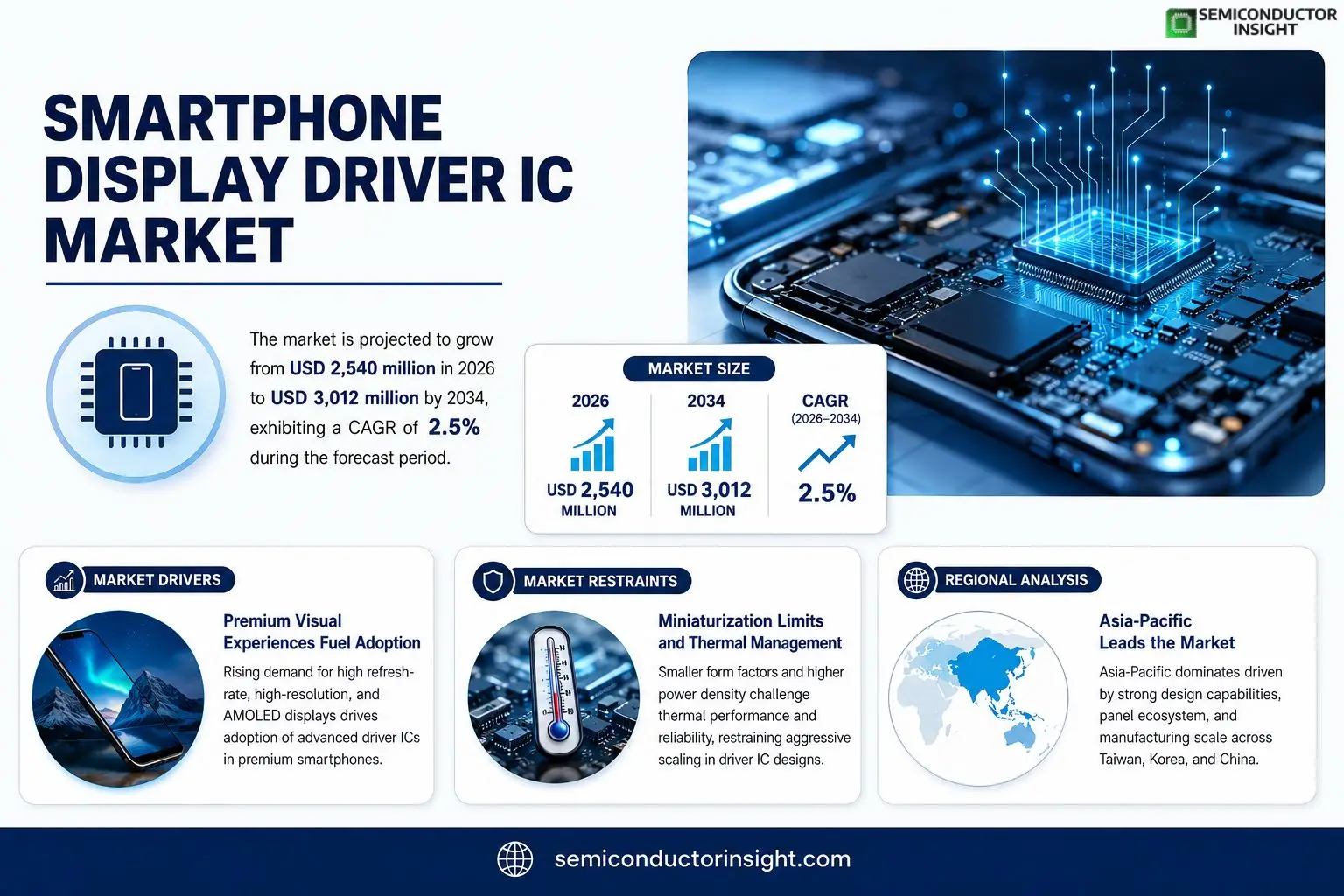
Smartphone Display Driver IC market size was valued at USD 2540 million in 2025. The market will increase from USD 2540 million in 2025 to USD 3012 million by 2034, reflecting a CAGR of 2.5% over the forecast horizon.
Smartphone Display Driver ICs are analog‑mixed‑signal components that link the application processor with the display panel. Their core task is converting image data into pixel‑level driving signals while supporting high resolution, high refresh rates, low power consumption and narrow‑bezel designs. Solutions have progressed from LCD drivers toward AMOLED and integrated TDDI/IDC architectures, offering source and gate driving, timing control, voltage conversion and MIPI interface support.The expansion of this segment stems from several forces: the shift toward premium smartphones demanding refresh rates above 144 Hz, adoption of foldable and flexible panels, and tighter power budgets that push manufacturers toward highly integrated chips. Panel makers and OEMs now view these ICs as strategic enablers of battery life, visual quality and form‑factor innovation rather than simple controllers.
MARKET DRIVERS
Premium Visual Experiences Fuel Adoption
Manufacturers are racing to embed high‑refresh‑rate panels, HDR capabilities, and ultra‑high‑definition resolutions into flag‑ship handsets. These features compel Smartphone Display Driver IC Market to evolve rapidly, because the driver circuitry must synchronize pixel timing with ever‑faster refresh cycles while preserving power budgets. The result is a cascade of investment in mixed‑signal design and silicon‑on‑glass integration.
Foldable and Rollable Form Factors Accelerate Innovation
The emergence of foldable and rollable displays introduces new mechanical stress points and variable aspect ratios. Driver ICs now need adaptive voltage regulation and dynamic lane configuration to maintain image integrity across bends. OEMs view this as a differentiator that justifies premium pricing, prompting suppliers to prioritize flexible‑display compatible architectures.
➤ “The convergence of high‑refresh‑rate and flexible‑display requirements is reshaping the design envelope for driver ICs, creating a niche that rewards rapid engineering cycles.”
Regulatory pushes for lower energy consumption in mobile devices also act as a catalyst. Power‑efficient driver designsleveraging current‑mode signaling and on‑chip power‑managementhelp manufacturers meet stricter standards without sacrificing performance, reinforcing demand across the value chain.
MARKET CHALLENGES
Complexity of Advanced Driver Architectures
Integrating multi‑gate driver architectures, variable‑frequency PLLs, and on‑die diagnostic blocks escalates silicon validation cycles. Small errors can translate into screen artifacts that tarnish brand reputation, making time‑to‑market a delicate balance between thorough testing and competitive pressure.
Other Challenges
Supply‑Chain Volatility
The reliance on specialty substrates and high‑purity silicon wafers exposes the ecosystem to geopolitical fluctuations and pandemic‑related disruptions. Lead‑time extensions force OEMs to reassess inventory strategies, often leading to cost‑plus pricing models that squeeze margins.
MARKET RESTRAINTS
Miniaturization Limits and Thermal Management
As smartphones compress more functionality into thinner profiles, driver ICs must occupy ever‑smaller footprints while dissipating heat effectively. Current thermal‑interface materials reach physical limits, and any overheating threatens display reliability, curbing aggressive scaling in certain price segments.Stringent electromagnetic‑compatibility (EMC) regulations in major markets require additional shielding and filtering, adding bill‑of‑materials cost. For lower‑tier devices, these compliance expenses can outweigh the perceived benefit of higher‑end driver features, restraining market penetration.
MARKET OPPORTUNITIES
AI‑Enabled Adaptive Brightness and Color Calibration
Embedding lightweight neural‑network inference engines within driver ICs enables real‑time scene analysis, allowing dynamic adjustment of backlight intensity and color gamut. This not only elevates user experience but also drives power savings, offering manufacturers a tangible value proposition for next‑generation handsets.Emerging display technologies such as micro‑LED and mini‑LED present a fresh substrate for driver innovation. Their discrete emitters require precise current control per pixel, opening a niche for highly granular driver solutions that can command premium margins.Cross‑industry convergence, notably the integration of smartphones into automotive infotainment and augmented‑reality headsets, expands the addressable base for specialized driver IP. Companies that can certify their designs for automotive safety standards stand to capture a new revenue stream beyond traditional mobile OEMs.
Smartphone Display Driver IC Market Trends
Integration and Feature‑Rich Drivers
Smartphone Display Driver IC Market is moving away from a purely signal‑routing function toward a platform that shapes the entire visual experience. Modern DDICs now embed source‑ and gate‑driving, frame buffering, and voltage conversion while also supporting variable refresh rates, low‑frequency always‑on display, and seamless touch‑display integration. This broadened capability set reflects manufacturers’ response to high‑resolution AMOLED panels, narrow‑bezel designs, and the relentless push for lower power draw. Suppliers that can embed these functions in a single silicon die gain a decisive advantage in design‑in negotiations because they simplify board layout, reduce BOM weight, and align more tightly with panel process requirements.
Other Trends
Regional Supply‑Chain Concentration
Production of these chips remains anchored in East Asia, where Taiwan, South Korea, and mainland China host the majority of design houses and fabs. The concentration is not accidental; it mirrors a dense ecosystem of panel manufacturers, advanced packaging facilities, and test services that co‑evolve with driver‑IC development cycles. Taiwanese firms leverage decades of analog expertise, Korean players benefit from close ties to domestic OLED producers, and Chinese companies are rapidly scaling capacity for high‑refresh mobile drivers. This geography‑driven network reinforces regional competitive edges and makes localized co‑development a norm rather than an exception.
Demand Shift to Premium Form Factors
On the demand side, the market narrative has shifted from pure shipment volume to structural upgrades. Foldable smartphones, flexible displays, and an expanding wearables segment now require drivers that can handle variable panel geometry, tighter power budgets, and integrated touch functionality. High‑end devices seeking refresh rates above 144 Hz or LTPO‑based low‑power strategies compel suppliers to deliver chips that are both power‑efficient and capable of dynamic timing adjustment. Consequently, the value per chip is rising, and OEMs are looking for partners that can offer customized co‑development rather than off‑the‑shelf parts. The combined effect is a market that rewards technical depth, packaging versatility, and close alignment with panel roadmaps.
COMPETITIVE LANDSCAPE
Key Industry Players
Competitive Dynamics in Smartphone Display Driver IC Market
Samsung Electronics leads the premium segment with its integrated TDDI solutions that fuse touch and display control onto a single die. The company leverages deep ties to domestic OLED panel manufacturers, enabling rapid alignment of driver specifications with evolving panel processes. Its ability to deliver sub‑10 mW power envelopes while supporting 144 Hz‑plus refresh rates has secured design‑in wins across flagship Android and iPhone devices, consolidating a decisive market position that shapes supplier bargaining power throughout the supply chain.Beyond the flagship tier, a cluster of Taiwanese and Chinese firms occupies the high‑volume space. Novatek and Himax dominate the mid‑range market by offering flexible packaging options such as COF and COP, which accommodate the thin‑bezel designs demanded by Chinese OEMs. Companies like ILI Technology, FocalTech, Raydium, Chipone, LX Semicon, Fitipower, Omnivision, Viewtrix, and Anapass provide niche differentiation through specialized featuresvariable refresh‑rate control, low‑frequency AOD, or integrated stylus supportthat appeal to emerging form‑factors like foldables and wearables. Their business models rely on close co‑development with panel makers, allowing them to capture design‑in opportunities that larger rivals may overlook.
List of Key Smartphone Display Driver IC Companies Profiled
- Novatek Microelectronics Corp.
- Himax Technologies, Inc.
- Samsung Electronics Co., Ltd.
- LX Semicon Co., Ltd.
- ILI Technology Corp.
- FocalTech Systems Co., Ltd.
- Omnivision Technologies, Inc.
- Fitipower Integrated Technology Inc.
- Raydium Semiconductor Corporation
- Chipone Technology (Beijing) Co., Ltd.
- Viewtrix Technology Co., Ltd.
- Anapass Co., Ltd.
- Powerchip Semiconductor Manufacturing Corp.
- Unimicron Technology Corp.
- MediaTek Inc. (Display Driver Division)
Segment Analysis:
| Segment Category | Sub-Segments | Key Insights |
| By Type |
|
Integrated TDDI/IDC
|
| By Application |
|
Foldable smartphones
|
| By End User |
|
Smartphone OEMs
|
| By Integration Level |
|
Touch‑Display Integrated (TDDI/IDC)
|
| By Packaging Form |
|
COF
|
Regional Analysis: Smartphone Display Driver IC Market
Asia-Pacific
High‑end OLED panels are driving a surge in driver IC complexity, prompting regional design houses to prioritize power‑efficiency algorithms that extend battery life without compromising luminance. Early adopters are seeing a measurable uplift in user satisfaction, reinforcing the market’s shift toward premium visual technology.
Recent geopolitical tensions have spurred diversification of component sourcing within Asia‑Pacific, with firms establishing secondary fabs in Vietnam and Malaysia. This redundancy cushions the market against single‑point disruptions and sustains production cadence for high‑volume smartphone launches.
The nascent foldable device segment imposes unique stress on driver ICs, requiring flexible interconnects and adaptive voltage scaling. Regional startups are experimenting with thin‑film technologies, positioning themselves as niche suppliers for next‑generation form factors.
Universities in Japan and Singapore are increasingly partnering with semiconductor firms, generating joint patents that target low‑latency driver architectures. These collaborations accelerate the diffusion of cutting‑edge solutions across the broader market.
North America
North America remains a critical hub for advanced driver IC design, largely because of its strong intellectual property ecosystem and deep ties to major smartphone OEMs. While the region does not match Asia‑Pacific in sheer volume, its emphasis on high‑performance, low‑power solutions feeds premium device segments that command substantial margins. Strategic alliances between Silicon Valley firms and hardware manufacturers are fostering bespoke driver suites that integrate AI‑enabled brightness optimization, offering a competitive edge for flagship models released in the United States and Canada.
Europe
European activity centers on regulatory compliance and sustainability, influencing driver IC specifications toward reduced electromagnetic emissions and greener manufacturing processes. The region’s fragmented market, spanning Germany, France, and the United Kingdom, encourages modular design approaches that can be customized for diverse carrier requirements. This adaptability creates opportunities for component suppliers that can deliver flexible, standards‑compliant drivers while adhering to stringent environmental directives.
South America
In South America, market growth is modest but driven by expanding smartphone penetration and a rising middle class. Local manufacturers often source driver ICs from regional distributors that balance cost with reliable performance. The primary challenge lies in navigating tariff structures and logistical constraints, prompting companies to adopt inventory‑buffer strategies that mitigate supply volatility for new device rollouts.
Middle East & Africa
The Middle East & Africa region exhibits a heterogeneous landscape, with affluent Gulf markets demanding high‑end devices, while sub‑Saharan nations focus on cost‑effective smartphones. This duality forces driver IC providers to tailor product portfolios, offering both premium, feature‑rich chips and stripped‑down versions that prioritize affordability. Partnerships with regional telecom operators facilitate localized testing, ensuring that driver performance aligns with varied network conditions across the continent.
Report Scope
This market research report provides a comprehensive analysis of the Smartphone Display Driver IC Market , covering the forecast period 2026–2034. It offers detailed insights into market dynamics, technological advancements, competitive landscape, and key trends shaping the industry.
Key focus areas of the report include:
- Market Overview: The report begins with an overview outlining its current market scenario, key growth indicators, and industry transformation drivers. It discusses macroeconomic factors, demand–supply balance, regulatory landscape, and the strategic role of semiconductors in powering advancements across industries such as automotive, telecommunications, consumer electronics, and industrial automation.
- Market Size & Forecast: Historical data and future projections for revenue, unit shipments, and market value across major regions and segments.
- Segmentation Analysis: Detailed breakdown by product type, technology, application, and end-user industry to identify high-growth segments and investment opportunities.
- Regional Insights: Insights into market performance across North America, Europe, Asia-Pacific, Latin America, and the Middle East & Africa, including country-level analysis where relevant.
- Competitive Landscape: Profiles of leading market participants, including their product offerings, R&D focus, manufacturing capacity, pricing strategies, and recent developments such as mergers, acquisitions, and partnerships.
- Technology Trends & Innovation: Assessment of emerging technologies, integration of AI/IoT, semiconductor design trends, fabrication techniques, and evolving industry standards.
- Market Drivers & Restraints: Evaluation of factors driving market growth along with challenges, supply chain constraints, regulatory issues, and market-entry barriers.
- Stakeholder Insights: Insights for component suppliers, OEMs, system integrators, investors, and policymakers regarding the evolving ecosystem and strategic opportunities.
Primary and secondary research methods are employed, including interviews with industry experts, data from verified sources, and real-time market intelligence to ensure the accuracy and reliability of the insights presented.
FREQUENTLY ASKED QUESTIONS:
What is the current market size of Smartphone Display Driver IC Market?
-> Smartphone Display Driver IC Market was valued at USD 2540 million in 2025 and is expected to reach USD 3012 million by 2034 at a CAGR of 2.5%.
Which key companies operate in Smartphone Display Driver IC Market?
-> Key players include Novatek Microelectronics Corp., Himax Technologies, Inc., Samsung Electronics Co., Ltd., LX Semicon Co., Ltd., ILI Technology Corp., FocalTech Systems Co., Ltd., OMNIVISION Technologies, Inc., Fitipower Integrated Technology Inc., Raydium Semiconductor Corporation, Chipone Technology (Beijing) Co., Ltd., Viewtrix Technology Co., Ltd., and Anapass Co., Ltd.
What are the key growth drivers?
-> Key growth drivers include rising demand for high refresh‑rate and high‑resolution displays, increasing adoption of AMOLED and flexible/foldable panels, stringent power‑efficiency requirements, integration of touch and display (TDDI/IDC) functions, and premium‑smartphone differentiation strategies.
Which region dominates the market?
-> Asia‑Pacific (particularly East Asia – Taiwan, South Korea, and Mainland China) dominates the market, benefiting from concentrated design, manufacturing capabilities, and close collaboration with panel makers.
What are the emerging trends?
-> Emerging trends include integrated touch‑display solutions (TDDI/IDC), foldable and flexible display support, LTPO low‑power technologies, advanced packaging formats (COG, COF, COP), and AI‑enabled display optimization for variable refresh‑rate and low‑frequency AOD.
Get Sample Report PDF for Exclusive Insights
Report Sample Includes
- Table of Contents
- List of Tables & Figures
- Charts, Research Methodology, and more...