
Market Insights
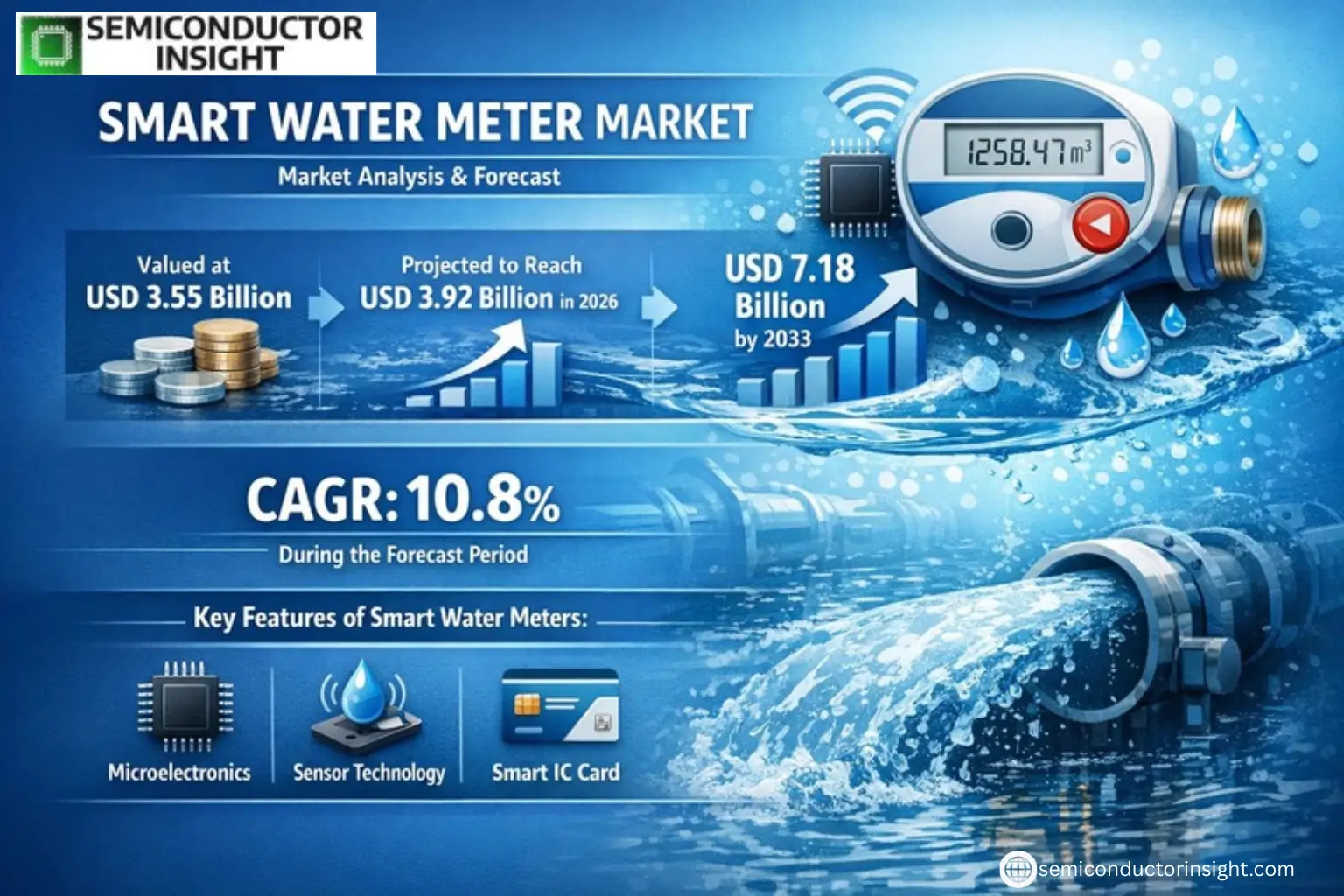
Global Smart Water Meter Market was valued at USD 3.55 billion in 2025 and is projected to grow from USD 3.92 billion in 2026 to USD 7.18 billion by 2033, exhibiting a CAGR of 10.8% during the forecast period.
Smart water meters are advanced metering devices that leverage microelectronics, sensor technology, and smart IC card capabilities to measure water consumption accurately. These devices not only track usage but also enable real-time data transmission and automated billing, enhancing operational efficiency for utilities and end-users alike.
The market is witnessing robust growth due to increasing urbanization, stringent government regulations on water conservation, and the rising adoption of IoT-based solutions in utility management. Furthermore, technological advancements such as two-way communication systems (AMI/AMR) and cloud-based analytics are accelerating market expansion. Key players like Arad Group, Kamstrup, and Xylem Inc. dominate the landscape, collectively holding over 40% market share. Asia Pacific leads demand with a 35% share, driven by rapid infrastructure development in countries like China and India.
MARKET DRIVERS
Growing Urbanization and Water Scarcity Concerns
The rapid urbanization in developing nations has significantly increased the demand for efficient water management systems. Smart water meters help utilities monitor consumption patterns, reduce non-revenue water losses, and optimize distribution. By 2026, over 40% of urban water networks are projected to integrate smart metering solutions to address water scarcity challenges.
Government Regulations and Smart City Initiatives
Governments worldwide are implementing stringent regulations to promote water conservation. Smart city projects in regions like North America and Europe are mandating the adoption of smart water meters. Utilities investing in advanced metering infrastructure (AMI) have reported 15-25% reduction in water losses within the first year of deployment.
Increasing consumer awareness about water conservation and real-time monitoring benefits is further accelerating market adoption, particularly in residential sectors.
MARKET CHALLENGES
High Initial Investment Costs
The deployment of smart water metering systems requires substantial capital expenditure for infrastructure upgrades and installation. Many municipalities in developing economies face budget constraints, slowing down the adoption rate despite long-term benefits.
Other Challenges
Data Security and Privacy Concerns
The collection and transmission of consumption data raise cybersecurity risks. Utilities must invest in robust encryption protocols to protect sensitive customer information from potential breaches.
MARKET RESTRAINTS
Limited Technical Expertise in Emerging Markets
Developing regions often lack skilled personnel for installation and maintenance of smart water metering systems. This knowledge gap creates operational hurdles and increases dependency on foreign vendors, impacting total cost of ownership.
MARKET OPPORTUNITIES
Integration with AI and Predictive Analytics
The combination of smart water meters with artificial intelligence allows utilities to predict consumption patterns and detect leaks proactively. Early adopters have achieved 30% improvement in operational efficiency through these integrated solutions, creating new revenue streams for technology providers.
Smart Water Meter Market () Trends
Rapid Growth Projected in Smart Water Meter Market
Global Smart Water Meter Market, valued at USD 3554 million in 2025, is projected to reach USD 7179 million by 2033, growing at a CAGR of 10.8%. This growth is driven by increasing adoption of advanced water management solutions, regulatory pressures for efficient resource utilization, and rising demand for real-time water consumption data. Asia Pacific currently dominates with over 35% market share, with key contributions from China and India.
Other Trends
Dominance of Electronics Type Meters
Electronics Type smart meters hold over 40% market share, favored for their precision and two-way communication capabilities. These devices integrate modern micro-electro technology and smart IC card systems to enable accurate measurement and automated billing. Residential applications lead adoption due to government mandates in water-scarce regions.
Regional Market Developments
Europe and North America collectively account for approximately 60% of the Smart Water Meter Market. Stringent water conservation regulations in these regions are accelerating deployments. Major players including Kamstrup, Xylem, and Badger Meter are focusing on R&D to develop advanced AMI solutions with enhanced data analytics capabilities.
Commercial Sector Growth
Following residential applications, commercial usage represents the second-largest application segment. Smart water meters are increasingly deployed in hotels, office complexes, and retail spaces for leak detection and cost optimization. Utilities are partnering with technology providers to develop integrated water management platforms.
Competitive Landscape
The top five Smart Water Meter manufacturers hold over 40% market share, with Arad Group, Kamstrup, and Xylem leading innovation. Recent industry developments include mergers to expand geographical presence and investments in IoT-enabled solutions. Pricing pressures remain a key challenge as developing economies seek cost-effective solutions.
COMPETITIVE LANDSCAPE
Key Industry Players
Smart Water Meter Market Dominated by Top 5 Players Holding 40% Share
Global Smart Water Meter Market is moderately consolidated, with the top five manufacturers – Arad Group, Kamstrup, Xylem (Sensus), Badger Meter, and Takahata Precision – collectively controlling over 40% market share. Arad Group and Kamstrup are clear market leaders with extensive global distribution networks and advanced metering infrastructure solutions. Xylem strengthened its position through the strategic acquisition of Sensus, while Badger Meter dominates the North American market with its innovative ultrasonic meter technology.
Several regional players are gaining traction through specialized offerings. Asian manufacturers like Sanchuan, Suntront, and Wasion Group are expanding aggressively with cost-effective solutions. European brands such as Itron and Elster maintain strong positions in smart city projects, while Neptune Technology Group leads in advanced leak detection systems. Emerging players like Aquiba and Datamatic are focusing on IoT-enabled water metering solutions to capture niche segments.
List of Key Smart Water Meter Companies Profiled
- Arad Group
- Kamstrup
- Xylem Inc (Sensus)
- Badger Meter
- Takahata Precision
- Neptune Technology Group
- SenTec
- Itron
- Elster (Honeywell)
- Aquiba
- Johnson Valves
- Datamatic
- Sanchuan Smart Technology
- Suntront Technology
- Wasion Group
Segment Analysis:
| Segment Category | Sub-Segments | Key Insights |
| By Type |
|
Electronics Meter dominates the market due to its advanced features and accuracy.
|
| By Application |
|
Residential sector shows strongest adoption of smart water meters globally.
|
| By End User |
|
Municipal Water Utilities lead in smart water meter implementation.
|
| By Technology |
|
Advanced Metering Infrastructure is gaining significant traction.
|
| By Communication Type |
|
RF Communication remains widely used despite growing alternatives.
|
Regional Analysis: Smart Water Meter Market
EPA mandates and state-level water conservation policies drive smart meter deployments. California’s Sustainable Groundwater Management Act exemplifies regulatory push for precision water measurement, creating consistent demand from utilities.
AMI systems account for over 60% of new installations, with LoRaWAN and cellular networks becoming preferred communication protocols. Utilities prioritize meters with cloud-based analytics for predictive maintenance capabilities.
Major water providers like American Water and SUEZ conduct large-scale replacement programs, transitioning from mechanical to ultrasonic smart meters. Pilot projects for AI-powered consumption pattern analysis show promising results.
Established players (Badger Meter, Itron) compete with tech entrants offering integrated software platforms. Partnerships between meter manufacturers and IoT providers accelerate product innovation in flow measurement accuracy.
Europe
Europe represents the second-largest Smart Water Meter Market, propelled by EU’s Water Framework Directive mandates. Countries like the UK, France, and Germany lead adoption through nationwide smart meter rollout programs. Urban water utilities focus on reducing non-revenue water via advanced metering infrastructure. The region sees growing integration of smart meters with building management systems for commercial properties. Eastern European markets show accelerated growth potential as EU funding supports water infrastructure modernization projects.
Asia-Pacific
APAC emerges as the fastest-growing market, with China and India driving expansion through smart city initiatives. Chinese manufacturers lead low-cost ultrasonic smart meter production, while Japan focuses on earthquake-resistant designs. Southeast Asian countries invest in smart water networks to address urban water scarcity. Australia’s water utilities pioneer solar-powered smart meter deployments, setting benchmarks for sustainable operation models across the region.
Middle East & Africa
GCC countries prioritize smart water meters for leak detection in arid regions, with Dubai’s DEWA implementing comprehensive AMI networks. South Africa leads sub-Saharan adoption through prepaid smart meter programs in water-stressed municipalities. Desalination plants integrate smart metering for consumption tracking, while IoT-based solutions gain traction for remote area deployments with limited infrastructure.
South America
Brazil and Chile spearhead smart water meter adoption, supported by World Bank-funded water conservation projects. Utilities in major cities replace outdated meters to reduce commercial losses from illegal connections. Smart irrigation systems incorporating flow meters gain popularity in agricultural regions, while mountain cities implement freeze-resistant smart meter designs for high-altitude operations.
Report Scope
This market research report provides a comprehensive analysis of the Smart Water Meter Market , covering the forecast period 2025–2033. It offers detailed insights into market dynamics, technological advancements, competitive landscape, and key trends shaping the industry.
Key focus areas of the report include:
- Market Overview: The report begins with an overview outlining its current market scenario, key growth indicators, and industry transformation drivers. It discusses macroeconomic factors, demand–supply balance, regulatory landscape, and the strategic role of smart water meters in optimizing water management across industries such as residential, commercial, and industrial sectors.
- Market Size & Forecast: Historical data and future projections for revenue, unit shipments, and market value across major regions and segments.
- Segmentation Analysis: Detailed breakdown by product type, technology, application, and end-user industry to identify high-growth segments and investment opportunities.
- Regional Insights: Insights into market performance across North America, Europe, Asia-Pacific, Latin America, and the Middle East & Africa, including country-level analysis where relevant.
- Competitive Landscape: Profiles of leading market participants, including their product offerings, R&D focus, manufacturing capacity, pricing strategies, and recent developments such as mergers, acquisitions, and partnerships.
- Technology Trends & Innovation: Assessment of emerging technologies, integration of AI/IoT, smart meter design trends, and evolving industry standards.
- Market Drivers & Restraints: Evaluation of factors driving market growth along with challenges, supply chain constraints, regulatory issues, and market-entry barriers.
- Stakeholder Insights: Insights for component suppliers, OEMs, system integrators, investors, and policymakers regarding the evolving ecosystem and strategic opportunities.
Primary and secondary research methods are employed, including interviews with industry experts, data from verified sources, and real-time market intelligence to ensure the accuracy and reliability of the insights presented.
FREQUENTLY ASKED QUESTIONS:
What is the current market size of Smart Water Meter Market?
-> Smart Water Meter Market was valued at USD 3.55 billion in 2025 and is projected to grow from USD 3.92 billion in 2026 to USD 7.18 billion by 2033, exhibiting a CAGR of 10.8% during the forecast period.
Which key companies operate in Smart Water Meter Market?
-> Key players include Arad Group, Kamstrup, Xylem (Sensus), Badger Meter, and Takahata Precison, among others. Global top five manufacturers hold a share over 40%.
What are the key growth drivers?
-> Key growth drivers include rising demand for efficient water management, urbanization, and government initiatives for smart water infrastructure.
Which region dominates the market?
-> Asia Pacific is the largest market with a share over 35%, followed by Europe and North America with a combined share about 60%.
What are the emerging trends?
-> Emerging trends include integration of IoT in water metering, advanced sensor technologies, and cloud-based water management solutions.

Get Sample Report PDF for Exclusive Insights
Report Sample Includes
- Table of Contents
- List of Tables & Figures
- Charts, Research Methodology, and more...
 Download Sample Report PDF


