Smart TV Chip Market Insights
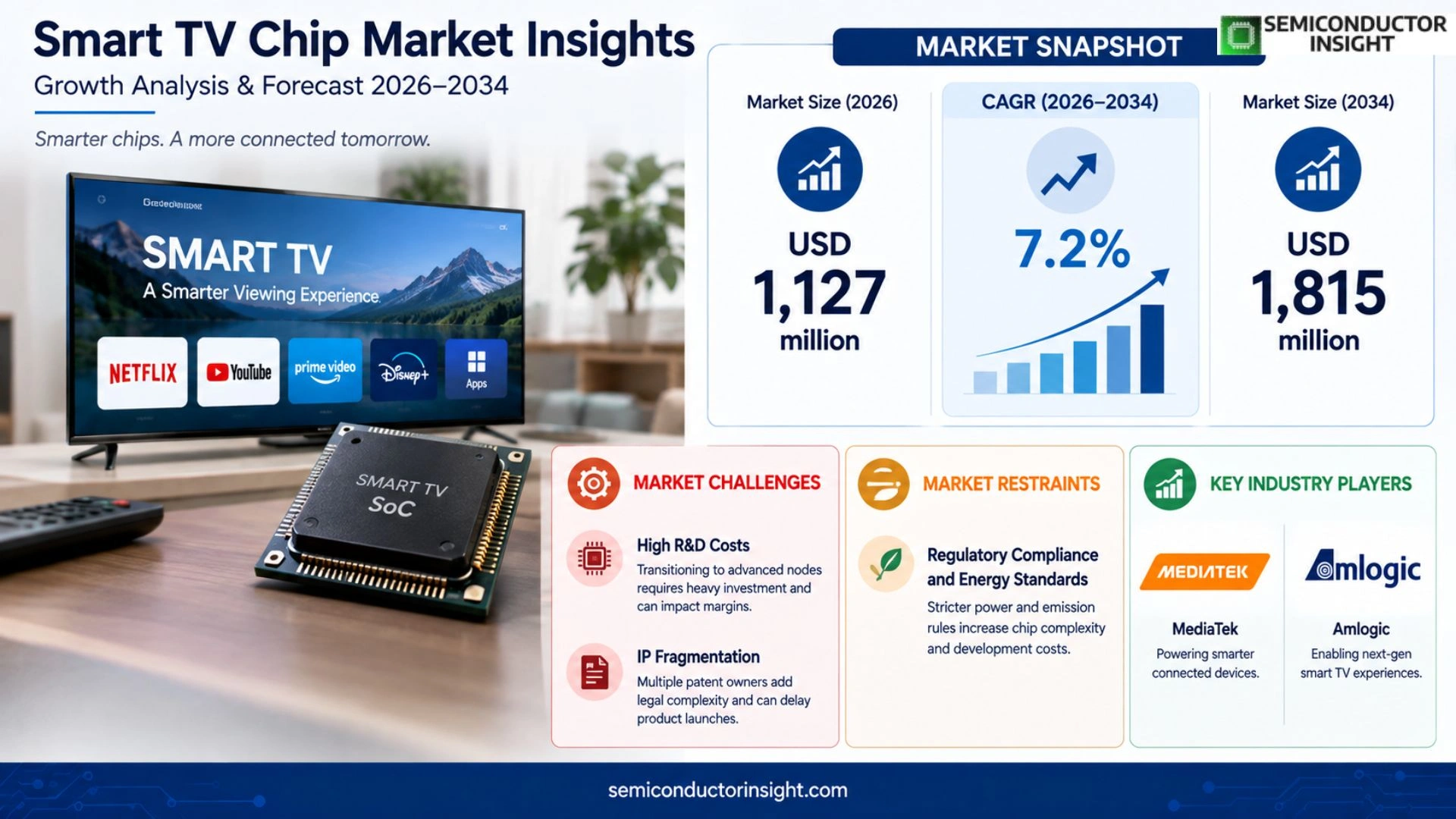
Smart TV Chip market is projected to grow from USD 1 127 million in 2026 to USD 1 815 million by 2034, exhibiting a CAGR of 7.2% during the forecast period.
Smart TV Chip serves as the central processing unit for contemporary televisions. Implemented as a System‑on‑Chip (SoC), it combines a CPU, GPU, audio‑processing blocks and networking modules to run the operating system, decode ultra‑high‑definition video (4K/8K), render graphics and handle voice or AI‑driven interactions. By supporting OTT services such as Netflix or YouTube and enabling AI‑enhanced picture tuning or smart‑home integration, these chips power both consumer smart TVs and commercial displays. Prominent families include HiSilicon, MediaTek, Realtek and Goke.
MARKET DRIVERS
Growing Demand for Integrated Processing
Manufacturers are consolidating video decoding, AI inference, and network stacks into a single silicon package. This convergence trims board‑level component counts, lowers bill‑of‑materials, and shortens time‑to‑market. Cost efficiencies derived from fewer discrete parts give OEMs pricing leeway that directly reflects on retail pricing, encouraging broader adoption of premium‑grade televisions.
Emergence of AI‑Enabled Viewing Experiences
On‑device neural engines now handle real‑time scene analysis, upscaling, and voice recognition without reliance on cloud latency. Consumers notice smoother motion handling and personalized picture tuning, which fuels repeat purchases in mid‑tier segments. Differentiation through AI becomes a decisive factor when households evaluate competing brands.
➤ “The integration of AI accelerators within the main SoC reduces latency by up to 40 % while cutting power draw, a combination that resonated strongly with both manufacturers and end‑users.”
Supply‑chain synergies are another catalyst. Foundries that specialize in advanced‑node production are allocating capacity to chipset lines that support 8K resolution and HDR10+ standards. This alignment ensures that Smart TV Chip market can meet the escalating pixel‑density demands projected for the next two product cycles.
MARKET CHALLENGES
Escalating R&D Expenditure for Advanced Nodes
Transitioning from 7 nm to 5 nm silicon requires multi‑year design cycles and substantial capital outlay. Smaller geometries promise lower power consumption but also introduce yield volatility, pressuring margins for chip makers that are already operating in a price‑sensitive segment.
Other Challenges
Intellectual Property Fragmentation
Multiple vendors own overlapping patents on video codecs, AI kernels, and connectivity stacks. Negotiating cross‑licensing agreements adds legal overhead and can delay product launches, especially for smaller participants trying to enter the arena.
MARKET RESTRAINTS
Regulatory Compliance and Energy Standards
Stringent regional regulations on power consumption and electromagnetic emissions compel designers to embed additional power‑management circuitry. While such features improve sustainability, they also inflate chip complexity, extending validation cycles and raising the overall cost of development.
Consumer privacy mandates, particularly in Europe, require on‑device processing of biometric voice commands. Implementing secure enclaves and encrypted data pathways consumes silicon area, limiting the amount of space available for performance‑critical blocks.
Finally, macro‑economic pressure on discretionary spending forces retailers to favor cost‑effective models. This price‑sensitivity can constrain the willingness of brands to adopt next‑generation chips that carry a premium price tag.
MARKET OPPORTUNITIES
Edge Computing Integration
Embedding edge‑compute capabilities within the television chipset opens pathways for localized content rendering, gaming, and augmented reality apps. Companies that can package a robust GPU, AI accelerator, and secure enclave on a single die stand to capture a sizeable share of emerging use cases that extend beyond traditional broadcast viewing.
Another avenue lies in the burgeoning home‑automation ecosystem. By positioning the TV as a hub that supports Zigbee, Thread, and Matter protocols, chip manufacturers can monetize software licensing and ongoing service fees, turning a traditionally one‑off hardware sale into a recurring revenue stream.
Geographically, emerging markets are upgrading from legacy LCD panels to smart displays at an accelerated pace. Tailoring cost‑optimized SoCs that balance modest AI functionality with sufficient decoding power could unlock volume growth in regions where price elasticity remains high.
Smart TV Chip Market Trends
AI‑Enhanced SoC Architectures Gain Traction
Smart TV Chip market is seeing a clear shift toward system‑on‑chip designs that embed dedicated neural processing units. Manufacturers such as HiSilicon and MediaTek have introduced SoCs that offload voice‑assistant inference and recommendation‑engine calculations from the host CPU, cutting latency and power draw. This architectural evolution responds to consumer demand for on‑device AI features,voice search, gesture control, and personalized content suggestions,while reducing reliance on cloud services. For OEMs, the integration lowers bill‑of‑materials and simplifies board layout, translating into modest margin improvement despite tighter price competition. The move also creates a barrier to entry for smaller players lacking AI IP, reshaping competitive dynamics within the market.
Other Trends
Pricing Pressure Across Segments
Entry‑level FHD chips continue to trade between USD 3 and 8, whereas mainstream 4K solutions hover in the USD 8‑20 range. High‑end 8K SoCs, once priced above USD 100, are now offered near the USD 80 mark as manufacturers leverage advanced process nodes to achieve better performance‑per‑watt ratios. The narrowing spread compresses gross margins, which now fluctuate between 30 % and 50 % depending on integration depth. Companies that can combine multiple functions,audio processing, networking, and AI,into a single die tend to protect margin better than those that sell fragmented solutions.
Supply‑Chain Realignment and Regional Disparities
Recent semiconductor policy shifts have spurred greater R&D spending in East Asia, prompting a wave of co‑development projects between chip designers and TV brands. This collaboration shortens time‑to‑market for customized SoCs that meet local broadcast standards and energy‑efficiency mandates. Meanwhile, foundry capacity constraints in the United States and Europe limit the ability of smaller players to access leading‑edge nodes, reinforcing the dominance of established Asian suppliers. The resulting regional split means that high‑end 8K solutions remain concentrated in premium models sold in North America and Western Europe, while emerging markets mostly adopt cost‑optimized 4K and FHD chips. For investors, the pattern suggests that growth opportunities will be found in niche high‑performance segments as well as in volume‑driven mid‑range products tailored to price‑sensitive regions.
COMPETITIVE LANDSCAPE
Key Industry Players
Smart TV Chip Market: Competitive Overview
The segment is anchored by a handful of firms that command the high‑performance SoC space for 4K and 8K televisions. MediaTek, Amlogic and HiSilicon consistently deliver integrated solutions that blend CPU, GPU, AI‑accelerators and networking in a single die, enabling OEMs to differentiate premium models without incurring excessive bill of materials. Samsung Electronics leverages its advanced 5‑nm process to embed sophisticated image‑signal processors, while LG’s proprietary chip family focuses on energy‑efficient OLED driving. The dominance of these players is reinforced by long‑term co‑development agreements with leading TV brands, which translate into predictable revenue streams and a barrier to entry for newcomers seeking to replicate the same level of integration.
Beyond the core tier, a vibrant set of niche manufacturers fills the mid‑range and entry‑level niches. Realtek and Goke Microelectronics specialize in cost‑effective FHD solutions that satisfy price‑sensitive markets in Southeast Asia and Latin America. Novatek, Unisoc and Rockchip concentrate on AI‑enhanced voice and gesture interfaces for smart‑home convergence. Qualcomm’s Snapdragon TV line brings mobile‑grade connectivity and graphics to upscale panels, while Allwinner and MStar (now part of MediaTek) cater to low‑cost smart projectors and commercial displays. These firms compete aggressively on price and feature‑set modularity, prompting larger players to broaden portfolio options and keep margins healthy across the spectrum.
List of Key Smart TV Chip Companies Profiled
- MediaTek
- Amlogic
- HiSilicon Technologies
- Samsung Electronics
- LG Electronics
- Realtek Semiconductor
- Goke Microelectronics
- Novatek
- Unisoc (Spreadtrum)
- Rockchip
- Allwinner Technology
- Qualcomm
- Texas Instruments
- STMicroelectronics
Segment Analysis:
| Segment Category | Sub-Segments | Key Insights |
| By Type |
|
UHD SoC
|
| By Application |
|
Home Entertainment TVs
|
| By End User |
|
Residential Consumers
|
| By Technology Integration |
|
AI/ML Acceleration
|
| By Ecosystem Role |
|
Core Hub Chipsets
|
Regional Analysis: Smart TV Chip Market
Asia‑Pacific
Chip manufacturers are embedding dedicated vision processors to handle gesture control and real‑time object recognition. This shift reduces latency, creating a smoother user experience that OEMs market as a competitive advantage.
The convergence of Wi‑Fi 6E, Bluetooth 5.2, and emerging Thread protocols within a single silicon block simplifies board design and shortens time‑to‑market for next‑gen set‑top solutions.
Low‑power domains are becoming a design priority as manufacturers aim to extend standby life and meet increasingly stringent energy‑label standards across the region.
Foundries are offering modular IP stacks that allow OEMs to tailor chip functionality,adding or stripping modules such as HDR processing,to align with regional pricing strategies.
North America
In the United States and Canada, content‑driven ecosystems dominate, prompting chip firms to prioritize seamless integration with over‑the‑top services. While manufacturing scale is modest compared with Asia‑Pacific, the region’s emphasis on security and privacy drives adoption of encrypted video pipelines, forcing silicon vendors to embed robust DRM modules. The strategic takeaway for suppliers is to align product roadmaps with the aggressive rollout of subscription‑based platforms, ensuring that chips can support frequent firmware updates without hardware redesign.
Europe
European markets exhibit a cautious approach, balancing consumer appetite for premium visual quality with stringent regulatory requirements on energy consumption and data handling. Chip designers are responding by embedding localized language processing units to satisfy multilingual voice assistants while adhering to GDPR‑compliant data pathways. The competitive implication is that vendors who can certify compliance across diverse national standards will secure contracts with major broadcasters seeking to future‑proof their hardware.
South America
Growth in Brazil, Argentina, and Chile is propelled by a rising middle class eager for affordable smart entertainment. Manufacturers therefore favour highly integrated, cost‑effective system‑on‑chip solutions that bundle decoding, graphics, and connectivity. The market’s price sensitivity encourages partnerships with regional assemblers who can blend imported silicon with locally sourced components to keep end‑product pricing attractive.
Middle East & Africa
The Middle East’s luxury‑focused segment values ultra‑high‑definition displays and advanced AI features, while African markets prioritize durability and low power draw due to intermittent electricity supply. Chip developers are thus bifurcating their portfolios: premium variants target Gulf consumers with sophisticated up‑scaling engines, whereas ruggedized, low‑energy chips aim at sub‑Saharan deployments where longevity outweighs raw performance.
Report Scope
This market research report provides a comprehensive analysis of the Smart TV Chip Market , covering the forecast period 2026–2034. It offers detailed insights into market dynamics, technological advancements, competitive landscape, and key trends shaping the industry.
Key focus areas of the report include:
- Market Overview: The report begins with an overview outlining its current market scenario, key growth indicators, and industry transformation drivers. It discusses macroeconomic factors, demand–supply balance, regulatory landscape, and the strategic role of semiconductors in powering advancements across industries such as automotive, telecommunications, consumer electronics, and industrial automation.
- Market Size & Forecast: Historical data and future projections for revenue, unit shipments, and market value across major regions and segments.
- Segmentation Analysis: Detailed breakdown by product type, technology, application, and end-user industry to identify high-growth segments and investment opportunities.
- Regional Insights: Insights into market performance across North America, Europe, Asia-Pacific, Latin America, and the Middle East & Africa, including country-level analysis where relevant.
- Competitive Landscape: Profiles of leading market participants, including their product offerings, R&D focus, manufacturing capacity, pricing strategies, and recent developments such as mergers, acquisitions, and partnerships.
- Technology Trends & Innovation: Assessment of emerging technologies, integration of AI/IoT, semiconductor design trends, fabrication techniques, and evolving industry standards.
- Market Drivers & Restraints: Evaluation of factors driving market growth along with challenges, supply chain constraints, regulatory issues, and market-entry barriers.
- Stakeholder Insights: Insights for component suppliers, OEMs, system integrators, investors, and policymakers regarding the evolving ecosystem and strategic opportunities.
Primary and secondary research methods are employed, including interviews with industry experts, data from verified sources, and real-time market intelligence to ensure the accuracy and reliability of the insights presented.
FREQUENTLY ASKED QUESTIONS:
What is the current market size of Smart TV Chip Market?
-> Smart TV Chip market is projected to grow from USD 1 127 million in 2026 to USD 1 815 million by 2034, exhibiting a CAGR of 7.2% during the forecast period.
Which key companies operate Smart TV Chip Market?
-> Key players include HiSilicon, MediaTek, Realtek, Goke, Amlogic, Novatek, and Hisense, among others.
What are the key growth drivers?
-> Key growth drivers include rising global penetration of smart TVs, consumer demand for higher resolution (4K/8K) and AI‑enabled features, and advancements in semiconductor manufacturing processes.
Which region dominates the market?
-> Asia‑Pacific is the largest market, driven by strong demand in China, Japan, and South Korea, while Europe and North America remain significant contributors.
What are the emerging trends?
-> Emerging trends include integration of dedicated neural processing units for AI, IoT‑enabled smart home connectivity, cloud gaming support, and development of low‑power high‑performance SoCs.
Get Sample Report PDF for Exclusive Insights
Report Sample Includes
- Table of Contents
- List of Tables & Figures
- Charts, Research Methodology, and more...
 Download Sample Report PDF