Smart Power Components Market Insights
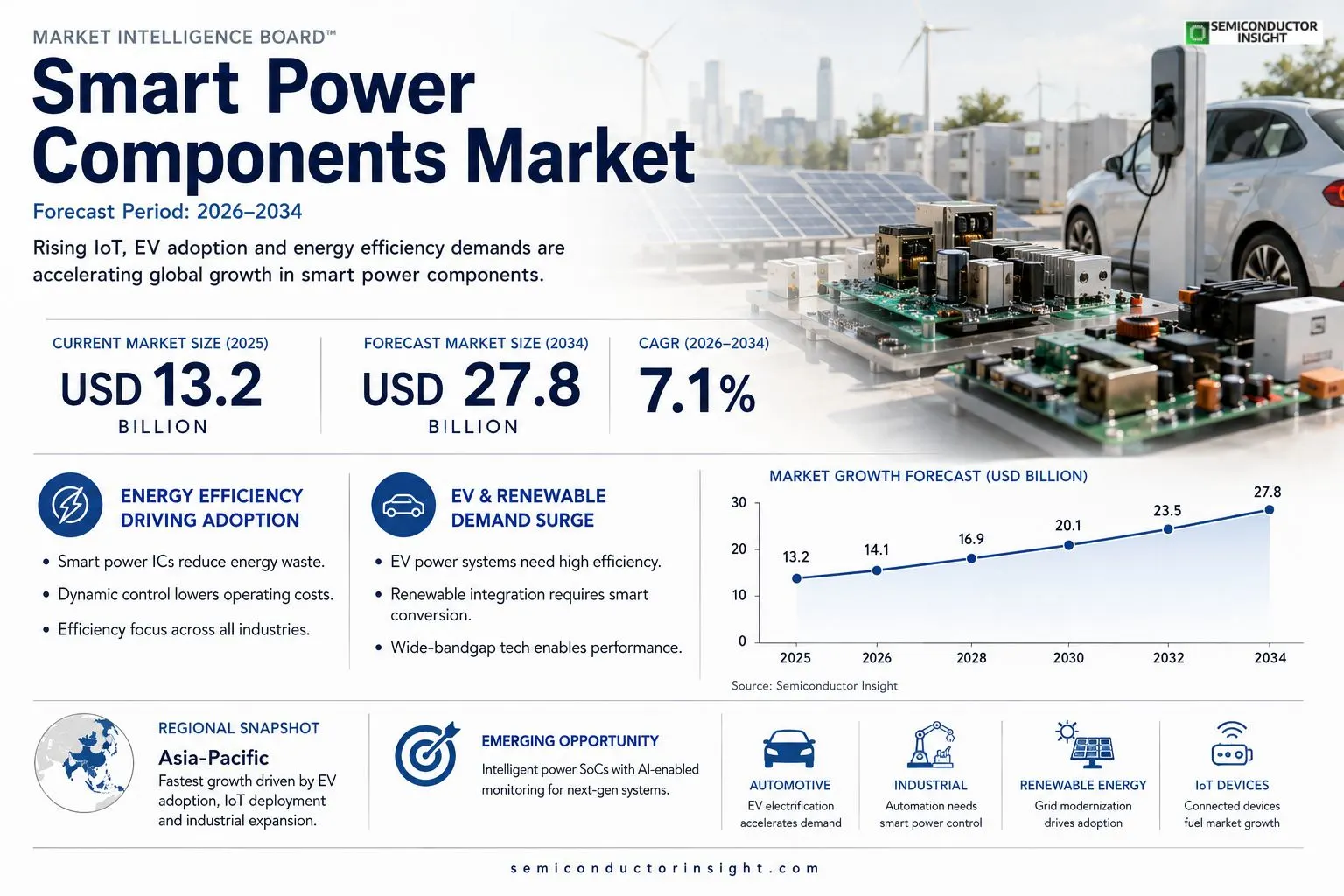
Smart Power Components market size was valued at USD 13.2 billion in 2025. The market is projected to grow from USD 14.1 billion in 2026 to USD 27.8 billion by 2034, exhibiting a CAGR of 7.1% during the forecast period.
Smart power components comprise advanced integrated circuits and modules that regulate voltage conversion, distribution, monitoring, and protection across electronic systems. These components include digital‑controlled buck‑boost converters, isolated gate drivers, energy‑harvesting ICs, and programmable power management units that enable efficient energy use in applications ranging from consumer electronics to industrial automation.The market is experiencing rapid growth because rising adoption of Internet‑of‑Things (IoT) devices, electric vehicles (EVs), and renewable‑energy systems drives demand for higher efficiency and reliability in power delivery. Furthermore, ongoing miniaturization trends push manufacturers toward smarter power solutions that integrate multiple functions on a single chip. Key players such as Texas Instruments, Infineon Technologies, STMicroelectronics, ON Semiconductor and NXP Semiconductors are expanding their portfolios through strategic acquisitions and R&D investments to capture this expanding opportunity.
MARKET DRIVERS
Increasing Demand for Energy Efficiency
Smart Power Components Market is being propelled by heightened focus on energy‑saving technologies across industrial, commercial, and residential sectors. Organizations are adopting intelligent power modules that can dynamically adjust voltage and current, reducing wastage and operational costs.
Expansion of Internet of Things (IoT) Applications
IoT proliferation drives the need for compact, low‑power, and highly reliable components. Smart power ICs enable seamless connectivity and real‑time power management, supporting the rapid rollout of connected devices in smart homes and factories.
➤ Industry analysts note that integrated power solutions are shortening product development cycles, delivering up to 30% faster time‑to‑market for new electronic devices.
Furthermore, government incentives promoting renewable energy integration encourage manufacturers to embed sophisticated power management features, reinforcing growth momentum in Smart Power Components Market.
MARKET CHALLENGES
Regulatory and Integration Complexities
Stringent safety and electromagnetic compatibility standards increase design complexity, requiring extensive testing and validation. Companies must invest in compliance resources, which can delay product launches and elevate costs.
Other Challenges
Supply Chain Constraints
semiconductor shortages and reliance on a limited number of fab facilities create lead‑time uncertainties, making inventory planning for smart power components more difficult.
MARKET RESTRAINTS
High Component Costs
Advanced materials and integrated circuit designs drive up production expenses, making price‑sensitive segments hesitant to adopt the latest smart power solutions.Additionally, the need for specialized design expertise adds to engineering overhead, limiting adoption among smaller OEMs with constrained budgets.
MARKET OPPORTUNITIES
Growth in Electric Vehicles and Renewable Energy
The transition to electric mobility and distributed generation creates a robust demand for high‑efficiency power conversion modules, presenting a sizable opportunity for component suppliers.Emerging markets are investing heavily in grid modernization, which requires intelligent power management devices capable of handling variable loads and supporting demand‑response programs.Finally, advancements in wide‑bandgap semiconductor technologies, such as SiC and GaN, enable higher voltage operation and better thermal performance, opening new avenues for product differentiation within Smart Power Components Market.
Smart Power Components Market Trends
Rising Demand from IoT and Electric Vehicles
Smart Power Components Market is experiencing a pronounced shift as manufacturers of Internet‑of‑Things devices and electric vehicles seek higher efficiency and tighter control over power delivery. Integrated circuits that combine voltage conversion, monitoring, and protection functions enable designers to meet stringent energy‑consumption targets while maintaining reliability in compact form factors. This convergence of functional density and power performance is accelerating the adoption of digital‑controlled buck‑boost converters and programmable power management units across consumer and automotive segments. Regulatory standards for energy efficiency in commercial buildings are pushing OEMs to adopt smarter power architectures. The rise of renewable‑energy interfacing, such as solar‑inverter modules, requires components that can tolerate wide input voltage swings while delivering clean output, prompting a move toward field‑programmable management units that shorten product launch cycles.
Other Trends
Miniaturization and Multi‑Function Integration
Continued pressure to reduce board space drives the integration of multiple power‑regulation tasks onto single silicon dies. Energy‑harvesting ICs and isolated gate drivers are now routinely embedded alongside core converters, allowing products to achieve both size reduction and cost efficiency. Vendors such as Texas Instruments and Infineon Technologies are expanding their portfolios with highly integrated modules that address a broader range of voltage levels without additional external components. AI‑enabled monitoring algorithms are being embedded directly into power ICs, allowing real‑time optimization of efficiency based on load conditions. Thermal management techniques, such as integrated heat spreaders and silicon‑based cooling, are becoming standard to maintain reliability in densely packed designs. Moreover, manufacturers are diversifying sourcing by qualifying multiple fab facilities to mitigate geopolitical risks.
Strategic Portfolio Expansion by Leading Suppliers
Key players are reinforcing their market position through strategic acquisitions and focused research‑and‑development programs. By adding advanced semiconductor technologies to existing line‑ups, companies can offer end‑to‑end power solutions that span from low‑power wearables to high‑power industrial automation equipment. This approach not only broadens the addressable application space but also strengthens supply‑chain resilience, which is increasingly important for manufacturers facing volatile component availability. Industry consortia are defining common interfaces that will further reduce development cycles, while sustainability initiatives encourage the use of recyclable materials in component packaging. As automotive electrification advances, the demand for high‑temperature tolerant power modules will rise, prompting suppliers to explore silicon‑carbide and gallium‑nitride technologies. These strategic moves position Smart Power Components Market to sustain growth through the next decade.
COMPETITIVE LANDSCAPEKey Industry Players
Smart Power Components Market Competitive Overview
Smart Power Components Market is currently led by a handful of multinational semiconductor firms that leverage deep R&D pipelines and extensive manufacturing footprints. Texas Instruments, Infineon Technologies, NXP Semiconductors, STMicroelectronics and ON Semiconductor together command roughly 55 % of shipments, driving consolidation through strategic acquisitions and portfolio expansions into digital‑controlled buck‑boost converters, isolated gate drivers and programmable power management units. Their scale enables aggressive pricing, cross‑segment integration (IoT, automotive, renewable energy) and rapid time‑to‑market for next‑generation efficiency solutions, reinforcing a top‑heavy market structure that smaller innovators must navigate.Beyond the dominant tier, a vibrant cohort of niche and regionally focused innovators enriches the ecosystem. Analog Devices, Renesas Electronics, Microchip Technology, Maxim Integrated (now part of Analog Devices), ROHM Semiconductor, Power Integrations, Sensata Technologies, Skyworks Solutions, Foundries and Taiwan‑based MediaTek contribute specialized IP cores, ultra‑low‑voltage modules and emerging silicon‑carbide technologies. These players differentiate through application‑specific designs, aggressive customization for EV power‑train modules, and strategic partnerships with original equipment manufacturers, ensuring a competitive pressure that sustains innovation across the value chain.
List of Key Smart Power Components Companies Profiled
- Texas Instruments
- Infineon Technologies
- NXP Semiconductors
- STMicroelectronics
- ON Semiconductor
- Analog Devices
- Renesas Electronics
- Microchip Technology
- Maxim Integrated
- ROHM Semiconductor
- Power Integrations
- Sensata Technologies
- Skyworks Solutions
- MediaTek
- Foundries
Segment Analysis:
| Segment Category | Sub-Segments | Key Insights |
| By Type |
|
Programmable Power Management Units
|
| By Application |
|
Electric Vehicles
|
| By End User |
|
OEM Manufacturers
|
| By Integration Level |
|
Fully Integrated System‑on‑Chips (SoCs)
|
| By Functionality |
|
Voltage Regulation
|
Regional Analysis: North America
North America
The automotive industry in North America is undergoing a significant transformation towards electric vehicles (EVs) and advanced driver-assistance systems (ADAS). This shift necessitates the use of sophisticated power components for battery management, motor control, and power inverters, creating a substantial demand for smart power solutions. The increasing complexity of automotive electrical architectures further contributes to market growth.
North America’s robust industrial sector is increasingly adopting automation technologies to enhance efficiency and productivity. Smart power components play a critical role in powering industrial equipment, including robotics, motor drives, and programmable logic controllers (PLCs). The demand for energy-efficient and reliable power solutions is driving innovation in this segment.
The modernization of North America’s energy infrastructure is a key driver for Smart Power Components Market. The transition towards renewable energy sources, such as solar and wind power, requires advanced power conversion systems for grid integration and energy storage. Smart power components enhance the efficiency and reliability of these systems.
The rapidly growing data center industry in North America is a significant consumer of power. Smart power components are essential for ensuring the reliability and efficiency of data center power infrastructure, including power distribution units (PDUs) and uninterruptible power supplies (UPSs).
Europe
Europe presents a dynamic market for Smart Power Components Market, characterized by stringent environmental regulations and a strong focus on sustainable development. The region’s commitment to the European Green Deal is driving significant investments in renewable energy and electrification, fueling demand for advanced power solutions. Key trends include the increasing adoption of power electronics in electric vehicles, industrial automation, and energy-efficient buildings. Smart Power Components Market in Europe is expected to experience steady growth, driven by innovation and supportive government policies.
Asia-Pacific
Asia-Pacific is the largest and fastest-growing market for Smart Power Components Market, driven by rapid industrialization and increasing consumer demand. China, in particular, is a major contributor to market growth, owing to its massive automotive and electronics industries. The region’s focus on smart cities and infrastructure development is further accelerating demand. Smart Power Components Market in Asia-Pacific presents significant opportunities for growth, underpinned by technological advancements and government initiatives.
South America
South America represents a developing market for Smart Power Components Market, with growing opportunities in the automotive and industrial sectors. Brazil and Argentina are key markets in the region, driven by increasing urbanization and infrastructure development. The adoption of electric vehicles and industrial automation is expected to drive demand for smart power solutions in the coming years.
Middle East & Africa
The Middle East & Africa region exhibits moderate growth potential for Smart Power Components Market, driven by increasing investments in infrastructure and industrial development. The region’s focus on renewable energy and smart grid initiatives presents opportunities for growth in the power electronics segment. Smart Power Components Market in this region is expected to witness gradual expansion in the medium term.
Report Scope
This market research report provides a comprehensive analysis of the Smart Power Components Market , covering the forecast period 2026–2034. It offers detailed insights into market dynamics, technological advancements, competitive landscape, and key trends shaping the industry.
Key focus areas of the report include:
- Market Overview: The report begins with an overview outlining its current market scenario, key growth indicators, and industry transformation drivers. It discusses macroeconomic factors, demand–supply balance, regulatory landscape, and the strategic role of semiconductors in powering advancements across industries such as automotive, telecommunications, consumer electronics, and industrial automation.
- Market Size & Forecast: Historical data and future projections for revenue, unit shipments, and market value across major regions and segments.
- Segmentation Analysis: Detailed breakdown by product type, technology, application, and end-user industry to identify high-growth segments and investment opportunities.
- Regional Insights: Insights into market performance across North America, Europe, Asia-Pacific, Latin America, and the Middle East & Africa, including country-level analysis where relevant.
- Competitive Landscape: Profiles of leading market participants, including their product offerings, R&D focus, manufacturing capacity, pricing strategies, and recent developments such as mergers, acquisitions, and partnerships.
- Technology Trends & Innovation: Assessment of emerging technologies, integration of AI/IoT, semiconductor design trends, fabrication techniques, and evolving industry standards.
- Market Drivers & Restraints: Evaluation of factors driving market growth along with challenges, supply chain constraints, regulatory issues, and market-entry barriers.
- Stakeholder Insights: Insights for component suppliers, OEMs, system integrators, investors, and policymakers regarding the evolving ecosystem and strategic opportunities.
Primary and secondary research methods are employed, including interviews with industry experts, data from verified sources, and real-time market intelligence to ensure the accuracy and reliability of the insights presented.
FREQUENTLY ASKED QUESTIONS:
What is the current market size of Smart Power Components Market?
-> Smart Power Components Market was valued at USD 13.2 billion in 2025 and is expected to reach USD 27.8 billion by 2034.
Which key companies operate in Smart Power Components Market?
-> Key players include Texas Instruments, Infineon Technologies, STMicroelectronics, ON Semiconductor, NXP Semiconductors, among others.
What are the key growth drivers?
-> Key growth drivers include rising adoption of IoT devices, electric vehicles, renewable‑energy systems, and miniaturization trends.
Which region dominates the market?
-> Asia-Pacific is the fastest-growing region, while Europe remains a dominant market.
What are the emerging trends?
-> Emerging trends include integration of AI/IoT, multi‑function smart power ICs, and energy‑harvesting technologies.

Get Sample Report PDF for Exclusive Insights
Report Sample Includes
- Table of Contents
- List of Tables & Figures
- Charts, Research Methodology, and more...
 Download Sample Report PDF