MARKET INSIGHTS
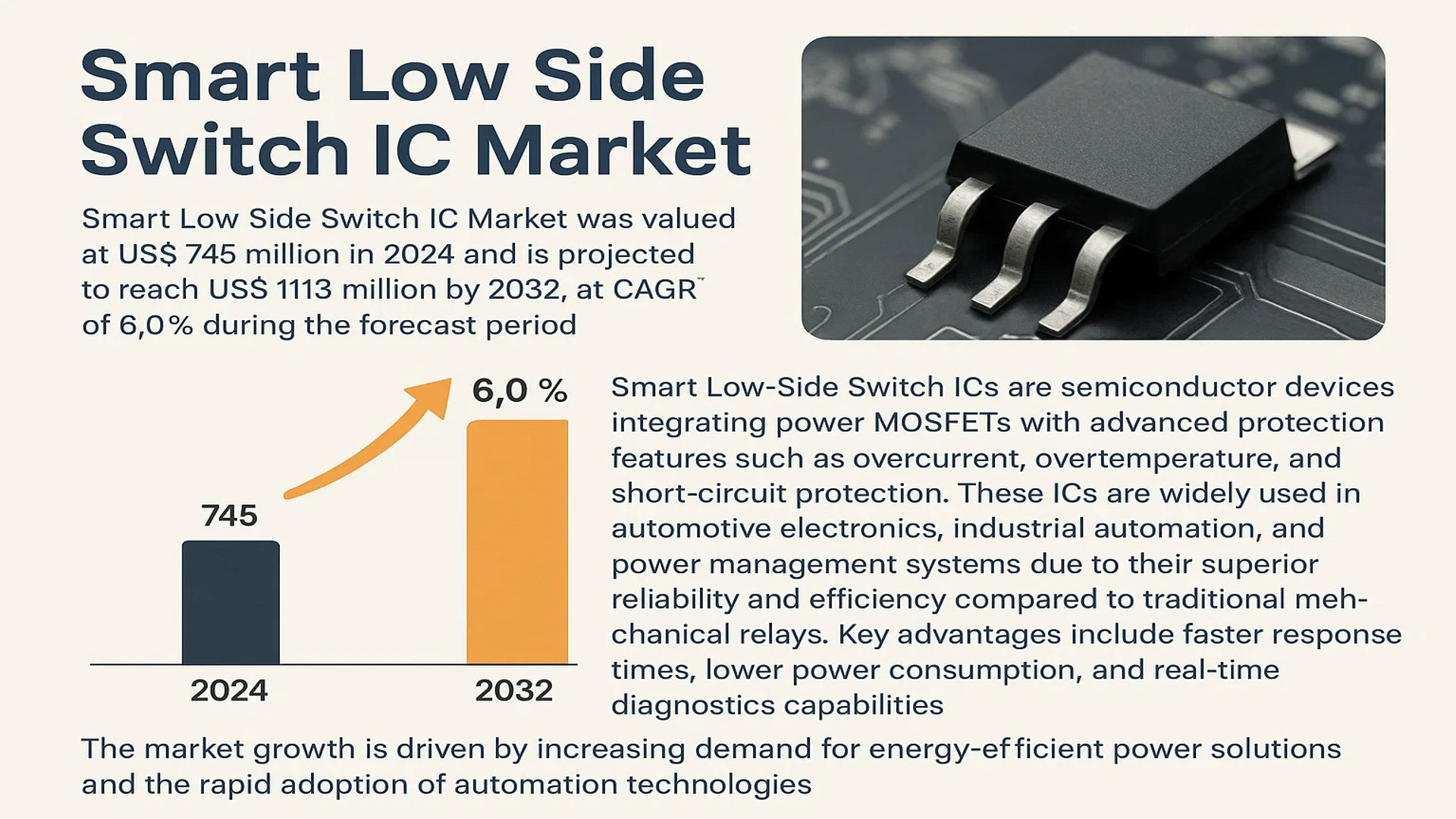
The global Smart Low Side Switch IC Market was valued at 745 million in 2024 and is projected to reach US$ 1113 million by 2032, at a CAGR of 6.0% during the forecast period.
Smart Low-Side Switch ICs are semiconductor devices integrating power MOSFETs with advanced protection features such as overcurrent, overtemperature, and short-circuit protection. These ICs are widely used in automotive electronics, industrial automation, and power management systems due to their superior reliability and efficiency compared to traditional mechanical relays. Key advantages include faster response times, lower power consumption, and real-time diagnostics capabilities.
The market growth is driven by increasing demand for energy-efficient power solutions and the rapid adoption of automation technologies. Furthermore, stringent safety regulations in automotive applications are accelerating the replacement of electromechanical components with smart ICs. Leading manufacturers such as STMicroelectronics, Infineon, and Texas Instruments are expanding their product portfolios with innovative solutions, further fueling market expansion. For instance, in 2023, Infineon launched a new generation of PROFET™ Smart Low-Side Switches with enhanced diagnostic features for automotive applications.
MARKET DYNAMICS
MARKET DRIVERS
Automotive Electrification Boom Accelerates Demand for Smart Low-Side Switch ICs
The global shift toward vehicle electrification is driving unprecedented demand for smart low-side switch ICs. With electric vehicle production projected to grow at over 20% CAGR through 2030, semiconductor content per vehicle is increasing substantially. These ICs play a critical role in managing power distribution for auxiliary systems like lighting, HVAC controls, and infotainment – areas seeing expanded functionality in modern EVs. Their ability to provide robust circuit protection while minimizing space and power loss makes them ideal for next-generation automotive architectures. Major OEMs are now designing these components into 48V mild hybrid systems and battery management circuits, creating a sustained growth pipeline for manufacturers.
Industrial Automation Trends Fueling Adoption Across Manufacturing Sectors
Industrial automation investments reached record levels in 2023, with the sector expected to maintain 8-10% annual growth through the decade. Smart low-side switches are becoming essential components in factory automation equipment, particularly for controlling solenoid valves, small motors, and sensor arrays. Their diagnostic capabilities enable predictive maintenance systems to monitor load health – a key requirement for Industry 4.0 implementations. The food processing and packaging vertical has shown particularly strong adoption, where these ICs help meet stringent safety standards while reducing electromechanical component counts by up to 40% in control panels.
Energy Efficiency Regulations Drive Replacement of Legacy Switching Solutions
Stringent global efficiency standards like the EU’s EcoDesign Directive are phasing out electromagnetic relays in favor of semiconductor solutions. Smart low-side switch ICs typically reduce power consumption by 30-50% compared to traditional mechanical switching while offering superior reliability. This has driven widespread adoption in home appliance controllers, particularly for refrigerators and washing machines where energy ratings directly impact product competitiveness. Regulatory tailwinds combined with consumer demand for quieter, longer-lasting appliances create a robust replacement cycle that will sustain market growth beyond initial adoption phases.
MARKET RESTRAINTS
Supply Chain Volatility Impacts Pricing and Availability
The semiconductor industry continues facing capacity constraints for specialized analog/mixed-signal processes used in smart switch ICs. While the overall chip shortage has eased, lead times for automotive-grade components remain extended at 30-40 weeks, forcing manufacturers to implement allocation strategies. This supply-demand imbalance has led to price increases of 15-20% for certain product families since 2022, discouraging some cost-sensitive applications from transitioning from electromechanical alternatives. The situation is particularly challenging for smaller OEMs without established long-term supply agreements.
Thermal Management Challenges in High-Density Designs
As electronic systems become more compact, heat dissipation poses growing constraints. While smart switches integrate protection features, sustained operation near current limits can trigger thermal shutdowns in space-constrained designs. This has slowed adoption in some industrial PLC applications where ambient temperatures routinely exceed 70°C. Manufacturers are responding with new package technologies and advanced thermal modeling tools, but design complexity remains a barrier for many engineering teams transitioning from simpler switching solutions.
MARKET CHALLENGES
Design Complexity Increases Time-to-Market Pressures
While offering superior functionality, smart switches require more sophisticated PCB layout and software integration than traditional solutions. The need to properly implement diagnostic reporting and protection features adds 20-30% to development cycles in many cases. This creates adoption challenges in markets like consumer appliances where compressed product timelines are the norm. Several major manufacturers have reported field issues stemming from improper implementation of current sensing circuits, leading to unnecessary warranty claims.
Other Challenges
Electromagnetic Compatibility Requirements
Meeting stringent EMC standards for automotive and industrial applications requires careful design consideration. Radiated emissions from fast switching transitions can exceed limits without proper filtering, adding component cost and board space that erode some of the IC’s integration benefits.
Alternative Technologies
New solid-state relay modules combining optocouplers with power MOSFETs are emerging as alternatives for certain applications. While lacking advanced diagnostics, these solutions appeal to designers familiar with traditional relay interfaces.
MARKET OPPORTUNITIES
Expansion into Renewable Energy Systems Opens New Vertical Markets
The rapid growth of distributed solar and energy storage systems creates significant opportunities for smart switch ICs. These components are increasingly specified for DC load switching in residential solar inverters, where their fault detection capabilities enhance system safety. Manufacturers are developing new product variants with higher voltage ratings (up to 100V) to better serve this market. Early adopters report 25% reductions in field failures compared to conventional contactor-based designs.
Integration with IIoT Platforms Creates Value-Added Services Potential
By combining smart switch diagnostic data with industrial IoT analytics, manufacturers can create predictive maintenance services with recurring revenue streams. Several leading suppliers now offer cloud-connected evaluation kits that demonstrate how load current signatures can predict motor bearing wear or valve stiction issues. This value-added approach helps justify premium pricing while distancing products from low-cost commodity alternatives.
SMART LOW SIDE SWITCH IC MARKET TRENDS
Rising Demand for Energy-Efficient Power Management Solutions Drives Market Growth
The global Smart Low Side Switch IC market, valued at $745 million in 2024, is projected to grow at a CAGR of 6.0%, reaching $1,113 million by 2032, driven by the increasing need for energy-efficient power management solutions. Unlike traditional mechanical relays, these ICs enhance system reliability with features like overcurrent protection and rapid switching capabilities, reducing power losses in automotive, industrial, and consumer electronics. In automotive applications, their adoption in electric vehicles (EVs) and advanced driver-assistance systems (ADAS) is accelerating due to stringent energy efficiency regulations in regions like Europe and North America, where automotive electrification investments exceeded $500 billion in 2023.
Other Trends
Miniaturization and Integration Advancements
The trend toward smaller and more integrated power electronics is reshaping the market. Semiconductor manufacturers are developing multi-channel Smart Low Side Switch ICs with embedded diagnostic functions to replace discrete components, reducing PCB space by up to 30%. For instance, dual-channel ICs now dominate 45% of the industrial automation segment, as they simplify circuit design in robotics and motor control systems. Furthermore, the shift to higher voltage ratings (up to 60V) addresses demands from renewable energy systems, where compact power switches are critical for solar inverters and battery management.
Automotive Electrification as a Key Growth Catalyst
Automotive applications account for over 35% of the market revenue, with EVs requiring up to 50% more Smart Low Side Switch ICs per vehicle compared to traditional internal combustion engines. These ICs manage loads in infotainment, lighting, and powertrain systems while adhering to ISO 26262 functional safety standards. China’s aggressive EV adoption, targeting 40% EV sales penetration by 2030, is pushing local suppliers like ROHM and Toshiba to expand production capacities. Meanwhile, collaborations between automakers and semiconductor firms—such as Infineon’s partnerships with BMW—are accelerating innovations in fault-tolerant designs.
COMPETITIVE LANDSCAPE
Key Industry Players
Strategizing Through Innovation and Expansion in the Smart Low Side Switch IC Market
The global Smart Low Side Switch IC market demonstrates a moderately consolidated structure, with key semiconductor leaders competing alongside emerging players. STMicroelectronics and Infineon dominate the market due to their extensive product portfolios and technological expertise in automotive and industrial applications. In 2024, these companies collectively held a significant revenue share, driven by their strong foothold in Europe and North America.
ROHM Semiconductor and Texas Instruments follow closely, leveraging their R&D capabilities to develop power-efficient solutions with advanced protection features. Recent advancements include integrated diagnostics and ultra-low power consumption designs, which are increasingly demanded by automotive OEMs and IoT device manufacturers.
Market expansion strategies such as strategic acquisitions and collaborations are shaping the competitive environment. For instance, Renesas’ acquisition of Dialog Semiconductor strengthened its position in power management ICs, while Infineon’s partnerships with Chinese EV manufacturers highlight the growing Asia-Pacific influence.
Meanwhile, onsemi and Diodes Incorporated are scaling production capacities to meet rising demand, particularly in the dual-channel switch segment. Their cost-optimized solutions cater to mid-tier industrial automation and consumer electronics markets.
List of Key Smart Low Side Switch IC Manufacturers
- STMicroelectronics (Switzerland)
- Infineon Technologies (Germany)
- Texas Instruments (U.S.)
- ROHM Semiconductor (Japan)
- Diodes Incorporated (U.S.)
- Renesas Electronics (Japan)
- Microchip Technology (U.S.)
- onsemi (U.S.)
- Fuji Electric (Japan)
- Toshiba Electronic Devices & Storage Corporation (Japan)
Segment Analysis:
By Type
Single Channel Segment Leads the Market Due to High Adoption in Compact Power Management Systems
The market is segmented based on type into:
- Single Channel
- Dual Channel
By Application
Automotive Segment Dominates Owing to Increasing Demand for Advanced Vehicle Electronics
The market is segmented based on application into:
- Industrial
- Home Appliances
- Automotive
- Other
Regional Analysis: Smart Low Side Switch IC Market
Asia-Pacific
The Asia-Pacific region dominates the global Smart Low Side Switch IC market, driven by rapid industrialization and expanding automotive production. China accounts for the largest share, fueled by massive electronics manufacturing and government initiatives like “Made in China 2025.” With semiconductor production increasing by 12% annually, local players are scaling up smart switch IC development to meet demand from automotive electrification and industrial automation sectors. Japan and South Korea maintain strong positions through technological leadership in power electronics, while India emerges as a key growth market due to rising domestic electronics consumption and EV adoption.
North America
North America represents the second-largest market for Smart Low Side Switch ICs, with the U.S. contributing over 80% of regional demand. The market thrives on advanced automotive applications and Industry 4.0 adoption, where smart switches ensure precise load control in automated systems. Stringent vehicle safety standards and investments in smart grid technologies drive innovation, with Texas Instruments and Microchip Technology leading product development. The region also benefits from strong R&D ecosystems in power management ICs and strategic partnerships between automotive OEMs and semiconductor suppliers.
Europe
Europe’s Smart Low Side Switch IC market grows steadily, supported by automotive electrification trends and industrial automation mandates under Industry 5.0 initiatives. Germany remains the technology hub, with Infineon and STMicroelectronics developing advanced protection features for automotive and industrial applications. The EU’s focus on energy-efficient electronics accelerates demand for smart switches in home appliances and building automation. However, the region faces challenges from component shortages and dependence on Asian foundries, prompting local manufacturers to expand production capacities.
South America
South America shows emerging potential in the Smart Low Side Switch IC market, particularly in Brazil and Argentina where industrial modernization gains momentum. Growth remains constrained by economic volatility and limited local semiconductor production, forcing reliance on imports. The automotive aftermarket presents opportunities as vehicle electronics become more sophisticated, though high costs slow mainstream adoption. Regional manufacturers increasingly source smart switch ICs for agricultural equipment and renewable energy systems, creating niche demand.
Middle East & Africa
The MEA region demonstrates gradual adoption of Smart Low Side Switch ICs, with growth concentrated in GCC countries and South Africa. Infrastructure development projects and increasing vehicle electrification drive demand, though the market remains price-sensitive. Limited local manufacturing capabilities result in heavy import dependence, while the lack of technical expertise in power electronics delays advanced applications. Strategic investments in smart cities and industrial automation hint at long-term growth potential for efficient power management solutions.
Report Scope
This market research report provides a comprehensive analysis of the Global Smart Low Side Switch IC market, covering the forecast period 2024–2032. It offers detailed insights into market dynamics, technological advancements, competitive landscape, and key trends shaping the industry.
Key focus areas of the report include:
- Market Size & Forecast: Historical data and future projections for revenue, unit shipments, and market value across major regions and segments.
- Segmentation Analysis: Detailed breakdown by product type, technology, application, and end-user industry to identify high-growth segments and investment opportunities.
- Regional Outlook: Insights into market performance across North America, Europe, Asia-Pacific, Latin America, and the Middle East & Africa, including country-level analysis where relevant.
- Competitive Landscape: Profiles of leading market participants, including their product offerings, R&D focus, manufacturing capacity, pricing strategies, and recent developments such as mergers, acquisitions, and partnerships.
- Technology Trends & Innovation: Assessment of emerging technologies, integration of AI/IoT, semiconductor design trends, fabrication techniques, and evolving industry standards.
- Market Drivers & Restraints: Evaluation of factors driving market growth along with challenges, supply chain constraints, regulatory issues, and market-entry barriers.
- Stakeholder Analysis: Insights for component suppliers, OEMs, system integrators, investors, and policymakers regarding the evolving ecosystem and strategic opportunities.
Primary and secondary research methods are employed, including interviews with industry experts, data from verified sources, and real-time market intelligence to ensure the accuracy and reliability of the insights presented.
FREQUENTLY ASKED QUESTIONS:
What is the current market size of Global Smart Low Side Switch IC Market?
-> Smart Low Side Switch IC Market was valued at 745 million in 2024 and is projected to reach US$ 1113 million by 2032, at a CAGR of 6.0% during the forecast period..
Which key companies operate in Global Smart Low Side Switch IC Market?
-> Key players include STMicroelectronics, Infineon, Diodes Incorporated, ROHM, Renesas, Fuji Electric, Texas Instruments, Microchip, onsemi, and Toshiba, among others.
What are the key growth drivers?
-> Key growth drivers include rising demand for automotive electronics, industrial automation, energy-efficient power management systems, and integration of advanced protection features in semiconductor devices.
Which region dominates the market?
-> Asia-Pacific is the fastest-growing region, driven by semiconductor manufacturing hubs in China, Japan, and South Korea, while North America remains a key market due to technological advancements.
What are the emerging trends?
-> Emerging trends include integration of AI-driven diagnostics, miniaturization of components, adoption of wide-bandgap semiconductors, and smart manufacturing applications.

Get Sample Report PDF for Exclusive Insights
Report Sample Includes
- Table of Contents
- List of Tables & Figures
- Charts, Research Methodology, and more...
 Download Sample Report PDF