Smart IoT Gateway Market Insights
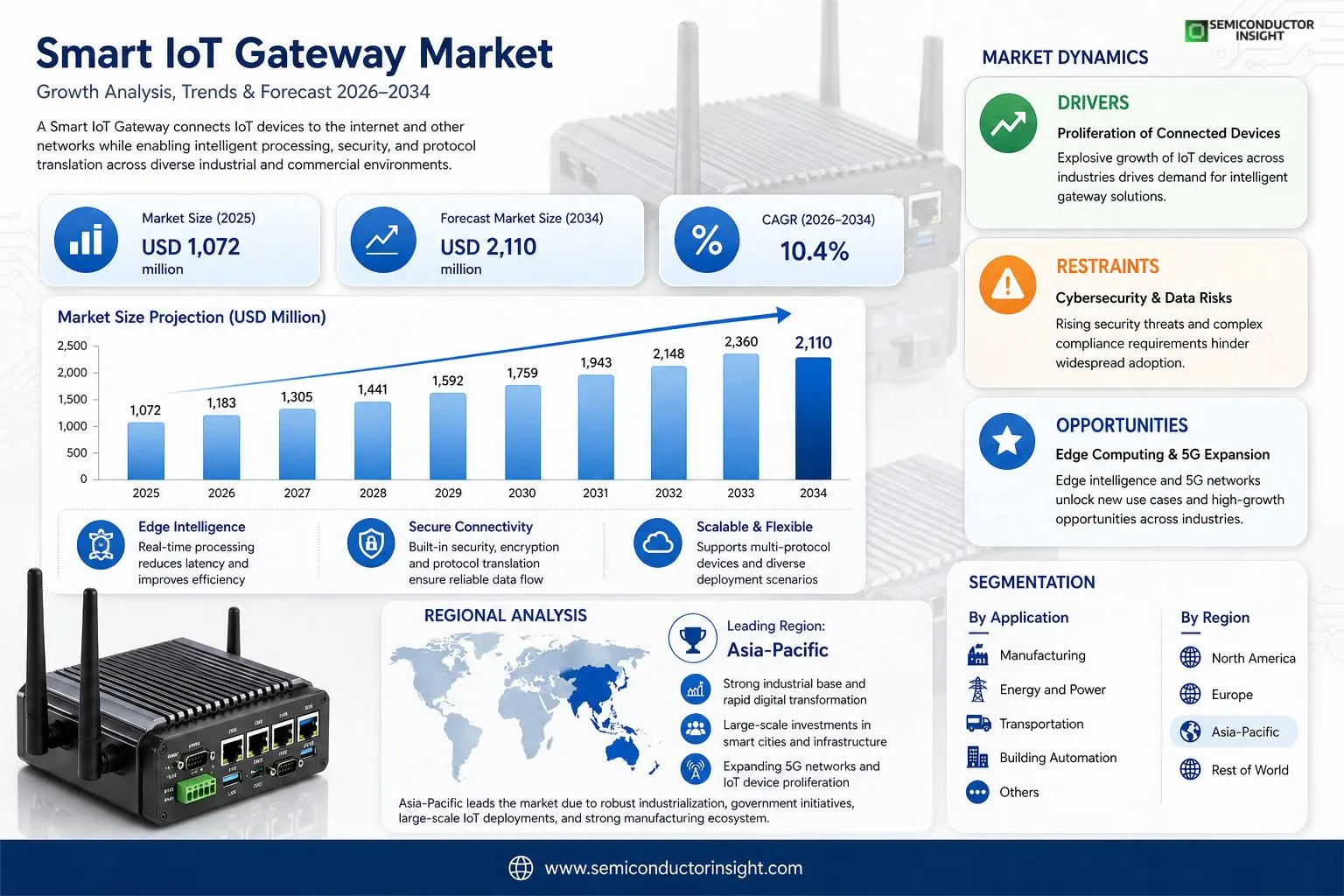
Global Smart IoT Gateway market size was valued at USD 1,072 million in 2025. The market is projected to grow from USD 1,183 million in 2026 to USD 2,110 million by 2034, exhibiting a CAGR of 10.4% during the forecast period.
A Smart IoT Gateway is a specialized device that connects and bridges various Internet of Things (IoT) devices to the internet or other networks while adding intelligent processing capabilities. It acts as a communication hub and often provides additional functionalities such as data processing, security, and protocol translation. These gateways support a wide range of connectivity protocols including Wi-Fi, Bluetooth, Zigbee, Z-Wave, and cellular networks, enabling seamless interoperability across heterogeneous IoT ecosystems. Form factors in the market span across Wall-Mounted, Guide-Rail, and other configurations, each designed to serve distinct industrial and commercial deployment environments.
The market is witnessing robust expansion driven by the accelerating adoption of industrial automation, the rapid proliferation of connected devices across manufacturing, energy and power, and transportation sectors, and the growing emphasis on edge computing capabilities. Furthermore, the increasing demand for real-time data analytics at the network edge , rather than solely in centralized cloud infrastructure , is positioning smart gateways as critical components of modern IoT architectures. Key global manufacturers operating in this space include Cisco, Dell, Ubiquiti, Sierra Wireless (Semtech), Huawei, Advantech, Siemens, Schneider Electric, Fujitsu, and ZTE, among others, collectively reinforcing a competitive and innovation-driven market landscape.
MARKET DRIVERS
Rapid Proliferation of Connected Devices Accelerating Smart IoT Gateway Adoption
Global expansion of connected devices across industrial, commercial, and residential environments is a primary catalyst for Smart IoT Gateway Market. As organizations deploy thousands of sensors, actuators, and edge devices, the need for intelligent gateways that can aggregate, filter, and transmit data securely has intensified. Smart IoT gateways serve as the critical interface between field-level devices and cloud or enterprise platforms, making them indispensable in modern IoT architectures. Industries such as manufacturing, energy, healthcare, and transportation are scaling their IoT deployments at a pace that demands robust and interoperable gateway solutions.
Edge Computing Integration Driving Demand for Intelligent Gateway Solutions
The convergence of edge computing with IoT infrastructure has significantly elevated the role of smart IoT gateways. By enabling local data processing, real-time analytics, and low-latency decision-making at the network edge, smart gateways reduce dependence on centralized cloud infrastructure. This capability is particularly valuable in time-sensitive applications such as predictive maintenance, autonomous systems, and remote asset monitoring. Enterprises are increasingly prioritizing edge-capable gateway platforms that support machine learning inference, protocol translation, and secure communication , all core functionalities that define the next generation of smart IoT gateway solutions.
➤ The industrial sector remains the largest end-user segment for smart IoT gateways, driven by the accelerating adoption of Industry 4.0 frameworks, digital twin deployments, and smart factory initiatives that require reliable, high-throughput edge connectivity.
Government-backed digital infrastructure programs and smart city initiatives across North America, Europe, and Asia-Pacific are further amplifying market momentum. Public sector investments in smart grid modernization, intelligent transportation systems, and connected public utilities are generating substantial demand for smart IoT gateway deployments. These programs require gateways capable of supporting multi-protocol environments, over-the-air firmware updates, and integration with diverse cloud ecosystems , positioning versatile smart IoT gateway platforms at the forefront of public infrastructure modernization.
MARKET CHALLENGES
Cybersecurity Vulnerabilities Posing Significant Barriers in Smart IoT Gateway Deployments
Security remains one of the most pressing challenges confronting Smart IoT Gateway Market. Gateways act as central nodes connecting operational technology (OT) networks with IT infrastructure and cloud platforms, making them high-value targets for cyberattacks. Many legacy gateway deployments lack robust encryption, secure boot mechanisms, and identity management frameworks, exposing enterprise networks to potential breaches. As the attack surface expands with growing device counts, vendors in the smart IoT gateway space are under increasing pressure to embed zero-trust architectures, hardware-based security modules, and continuous threat monitoring into their offerings.
Other Challenges
Interoperability and Protocol Fragmentation
Smart IoT Gateway Market is characterized by a highly fragmented protocol landscape, with devices operating across Zigbee, Z-Wave, MQTT, OPC-UA, Modbus, and numerous proprietary communication standards. Achieving seamless interoperability across heterogeneous device ecosystems remains a persistent technical challenge for both vendors and end-users. Gateway solutions must support extensive protocol translation capabilities while maintaining performance and reliability, adding complexity to product development and integration processes.
High Total Cost of Ownership in Resource-Constrained Environments
For small and medium-sized enterprises (SMEs) and deployments in developing economies, the total cost of ownership associated with smart IoT gateway infrastructure , encompassing hardware procurement, software licensing, integration services, and ongoing maintenance , can be prohibitive. This cost barrier limits market penetration in price-sensitive segments, particularly in sectors such as agriculture, small-scale manufacturing, and community utilities where IoT adoption remains nascent but holds significant potential.
MARKET RESTRAINTS
Regulatory Complexity and Data Sovereignty Requirements Limiting Market Scalability
Evolving data privacy regulations and cross-border data governance frameworks present meaningful restraints for Smart IoT Gateway Market. Compliance requirements such as the General Data Protection Regulation (GDPR) in Europe, and various national data localization laws in Asia and the Middle East, impose constraints on how data collected and processed by IoT gateways can be transmitted, stored, and accessed. Organizations deploying smart IoT gateway solutions across multiple jurisdictions must navigate a complex and often inconsistent regulatory environment, increasing compliance costs and slowing deployment timelines, particularly for multinational enterprises and cloud-integrated gateway platforms.
Supply Chain Disruptions and Semiconductor Availability Constraining Hardware Production
Smart IoT Gateway Market has been materially affected by global semiconductor supply chain disruptions, which have led to extended lead times, elevated component costs, and constrained hardware production capacity. Smart IoT gateways rely on specialized chipsets for wireless communication, edge processing, and hardware security, making them vulnerable to shortages in the broader semiconductor ecosystem. While supply chain conditions have gradually improved, residual volatility in component availability and pricing continues to restrain market growth, particularly for vendors dependent on a narrow base of chipset suppliers. This dynamic is also compelling gateway manufacturers to accelerate efforts toward supply chain diversification and custom silicon development.
MARKET OPPORTUNITIES
Expansion of 5G Networks Creating New Growth Frontiers for Smart IoT Gateway Vendors
Global rollout of 5G network infrastructure presents a transformative opportunity for Smart IoT Gateway Market. The high bandwidth, ultra-low latency, and massive device connectivity capabilities of 5G networks are expected to unlock new use cases for IoT deployments in sectors including autonomous vehicles, remote healthcare, advanced robotics, and smart logistics. Smart IoT gateways equipped with 5G modules are positioned to serve as the foundational connectivity layer for these next-generation applications, enabling real-time data exchange between edge devices and centralized systems at previously unattainable speeds and scale.
Industrial IoT and Smart Manufacturing Initiatives Unlocking High-Value Deployment Opportunities
The accelerating adoption of Industrial IoT (IIoT) frameworks within manufacturing, oil and gas, utilities, and logistics sectors represents one of the most substantial growth opportunities in Smart IoT Gateway Market. As industrial enterprises modernize legacy operational technology (OT) infrastructure and integrate it with IT systems, demand for smart gateways capable of supporting real-time monitoring, remote diagnostics, and predictive analytics is rising sharply. Vendors offering ruggedized, industrial-grade smart IoT gateway platforms with extended temperature ranges, wide-input power support, and certified hazardous location ratings are well-positioned to capture expanding deployments across asset-intensive industries globally.
Cloud-Native and AI-Embedded Gateway Architectures Opening Next-Generation Market Segments
The integration of artificial intelligence and cloud-native software architectures into smart IoT gateway platforms is creating differentiated growth opportunities for innovative vendors. AI-embedded gateways capable of performing on-device anomaly detection, adaptive data filtering, and autonomous decision-making are gaining traction in applications where continuous cloud connectivity is unreliable or cost-prohibitive. Additionally, the shift toward containerized, microservices-based gateway software is enabling flexible deployment models and simplified lifecycle management. These technological advancements are expanding the addressable market for smart IoT gateways beyond traditional connectivity use cases into intelligent edge computing and autonomous operations segments.
Trends
Rising Demand for Intelligent Edge Processing Driving Smart IoT Gateway Market
Smart IoT Gateway Market is experiencing significant momentum as industries increasingly prioritize intelligent edge computing to manage the growing volume of connected device data. A Smart IoT Gateway serves as a critical communication hub, bridging IoT devices to broader networks while enabling real-time data processing, protocol translation, and enhanced security at the network edge. As enterprises across manufacturing, energy, transportation, and other sectors accelerate their digital transformation initiatives, the demand for robust and scalable Smart IoT Gateway solutions continues to rise. Leading players such as Cisco, Huawei, Siemens, Schneider Electric, and Advantech are actively investing in next-generation gateway technologies to address evolving connectivity requirements across diverse industrial environments.
Other Trends
Expansion Across Industrial Applications
Smart IoT Gateway Market is witnessing expanding adoption across key verticals including manufacturing, energy and power, and transportation. In manufacturing, smart gateways enable seamless machine-to-machine communication, predictive maintenance, and real-time process monitoring, helping facilities reduce downtime and improve operational efficiency. The energy and power sector leverages these gateways for remote monitoring of grid infrastructure, smart metering, and integration of renewable energy sources into existing networks. In transportation, Smart IoT Gateways support fleet management, traffic monitoring systems, and connected vehicle infrastructure, reflecting the broadening scope of IoT deployment across critical industries.
Protocol Interoperability and Security as Key Differentiators
As Smart IoT Gateway Market matures, protocol interoperability and cybersecurity capabilities have emerged as primary differentiators among competing solutions. Industrial environments often deploy devices operating on heterogeneous communication protocols, making seamless protocol translation a fundamental requirement for effective IoT integration. Simultaneously, the increased connectivity of operational technology networks has elevated the importance of built-in security features such as data encryption, secure boot, and intrusion detection. Manufacturers including Moxa, ADLINK Technology, Robustel, and Secomea are prioritizing these capabilities in their product development roadmaps to meet stringent industrial security standards.
Regional Growth Patterns and Competitive Landscape Shaping Market Direction
North America and Asia remain at the forefront of Smart IoT Gateway Market development, with strong contributions from the United States, China, Japan, and South Korea. These regions benefit from well-established industrial infrastructure, supportive government digitalization policies, and a high concentration of technology manufacturers and end-users. Europe is also demonstrating steady growth, particularly in Germany and the U.K., driven by Industry 4.0 adoption and smart grid investments. The competitive landscape features a diverse mix of global technology giants and specialized vendors, including InHand Networks, Four-Faith, Neousys, and Sierra Wireless (Semtech), all competing to deliver differentiated value through enhanced connectivity, edge intelligence, and deployment flexibility tailored to specific industry requirements.
COMPETITIVE LANDSCAPE
Key Industry Players
Smart IoT Gateway Market , Competitive Dynamics and Leading Manufacturer Profiles
Global Smart IoT Gateway market is characterized by intense competition among a mix of large multinational technology conglomerates and specialized industrial networking firms. Cisco Systems stands out as a dominant force, leveraging its deep-rooted expertise in networking infrastructure, cybersecurity, and edge computing to deliver enterprise-grade IoT gateway solutions across manufacturing, energy, and transportation verticals. Huawei and Siemens similarly command significant market presence, each bringing robust R&D capabilities and vertically integrated product portfolios that span hardware, firmware, and cloud-based IoT management platforms. The top five global players collectively held a substantial share of total market revenue in 2025, underscoring the consolidated nature of market leadership. With the market valued at approximately USD 1,072 million in 2025 and projected to reach USD 2,110 million by 2034 at a CAGR of 10.4%, leading vendors are actively investing in protocol translation capabilities, AI-driven edge analytics, and enhanced cybersecurity features to differentiate their offerings and capture a greater share of this rapidly expanding market.
Beyond the market leaders, a vibrant tier of specialized and regional players contributes meaningfully to the competitive ecosystem of Smart IoT Gateway Market. Companies such as Advantech, Moxa, and ADLINK Technology have carved out strong niches in industrial-grade deployments, offering ruggedized gateway hardware optimized for harsh operational environments in sectors like energy, utilities, and smart manufacturing. Sierra Wireless (now part of Semtech) continues to be a recognized name in cellular IoT connectivity gateways, while Schneider Electric and ABB bring domain expertise in energy management and industrial automation to their gateway product lines. Emerging and mid-tier vendors including InHand Networks, Robustel, Secomea, Four-Faith, and Neousys are gaining traction by offering cost-competitive, application-specific gateway solutions tailored to regional markets and vertical use cases such as smart grid infrastructure and intelligent transportation systems. Collectively, this diverse competitive field is driving rapid innovation in areas such as wall-mounted and guide-rail form factors, multi-protocol support, and secure remote device management.
List of Key Smart IoT Gateway Companies Profiled
- Cisco
- Dell
- Ubiquiti
- Sierra Wireless (Semtech)
- Huawei
- Advantech
- Siemens
- Schneider Electric
- Fujitsu
- ZTE
- ABB
- ADLINK Technology
- Moxa
- Obvius (Leviton)
- InHand Networks
- Robustel
- Secomea
- Four-Faith
- Neousys
- Nomadix
- SEL (Schweitzer Engineering Laboratories)
- MB Connect Line
- Alotcer
- Electronic Systems Technology
- Hignton
Segment Analysis:
| Segment Category | Sub-Segments | Key Insights |
| By Type |
|
Wall-Mounted gateways represent the leading segment within Smart IoT Gateway Market by product type, driven by their widespread deployment across industrial facilities, commercial buildings, and smart infrastructure environments.
Guide-Rail variants, while more specialized, are gaining traction in industrial control panel environments where DIN rail mounting is a standard practice, particularly in manufacturing and energy sectors. |
| By Application |
|
Manufacturing stands as the dominant application segment for Smart IoT Gateways, underpinned by the accelerating global shift toward Industry 4.0 and intelligent factory automation.
The Energy and Power segment is also witnessing robust momentum, driven by smart grid modernization initiatives and the proliferation of distributed energy resources that require intelligent edge connectivity. Transportation applications, including connected vehicle infrastructure and intelligent traffic management, are emerging as high-growth areas as governments invest in smart mobility frameworks. |
| By End User |
|
Industrial Enterprises constitute the leading end user segment in Smart IoT Gateway Market, reflecting the deep penetration of connected device ecosystems across sectors such as automotive, chemicals, food and beverage, and heavy machinery.
Commercial building operators and utilities represent significant and growing end user bases, driven respectively by smart building management mandates and grid modernization programs that necessitate scalable, interoperable gateway deployments. |
| By Connectivity Technology |
|
Wireless Connectivity (Wi-Fi and Cellular) gateways are emerging as the leading sub-segment, fueled by the rapid global rollout of 5G networks and the growing demand for flexible, mobile-compatible IoT deployments.
LPWAN technologies such as LoRa and NB-IoT are gaining traction in low-power, wide-area applications including smart cities and agricultural IoT, complementing higher-bandwidth wireless solutions in multi-tier network architectures. |
| By Deployment Mode |
|
Hybrid Deployment is rapidly establishing itself as the preferred mode for Smart IoT Gateway implementations, as organizations seek to balance the performance benefits of local edge processing with the scalability and analytical power of cloud platforms.
Pure cloud-integrated deployments remain relevant for less latency-sensitive applications and smaller organizations with limited on-site IT resources, while on-premise deployments continue to serve highly regulated industries prioritizing air-gapped security environments. |
Regional Analysis: Smart IoT Gateway Market
North America
North America’s manufacturing sector stands as a principal end-user of smart IoT gateway solutions. Factories across the United States are embracing Industry 4.0 principles, deploying intelligent gateways to bridge legacy operational technology with modern cloud platforms. This transition enhances predictive maintenance capabilities, minimizes unplanned downtime, and significantly improves overall equipment effectiveness across diverse industrial verticals.
The North American smart IoT gateway market benefits from a maturing regulatory environment focused on connected device security. Federal frameworks such as NIST guidelines and evolving state-level data protection laws are encouraging enterprises to deploy gateways with robust built-in security protocols, encrypted communication channels, and real-time threat detection capabilities, positioning security as a core market differentiator.
A defining characteristic of the North American smart IoT gateway market is its swift convergence with edge computing architectures. Enterprises are increasingly deploying intelligent gateways capable of local data processing to reduce latency and bandwidth consumption. This edge-first strategy is particularly prominent in healthcare monitoring, autonomous logistics, and smart utility grid management, enabling faster decision-making closer to the data source.
The ongoing nationwide rollout of 5G networks across the United States and Canada is dramatically amplifying the performance potential of smart IoT gateway deployments. High-bandwidth, low-latency 5G connectivity enables gateways to support dense networks of connected endpoints simultaneously. This development is unlocking new use cases in smart transportation, remote asset monitoring, and connected healthcare that were previously constrained by legacy network limitations.
Europe
Europe represents one of the most strategically significant regions within Global smart IoT gateway market, shaped by a combination of progressive regulatory mandates, sustainability-driven industrial policies, and a commitment to digital sovereignty. The European Union’s ambitious digital agenda, including initiatives such as the European Green Deal and the EU Data Act, is compelling enterprises across sectors to modernize their connectivity infrastructure with intelligent gateway solutions. Germany leads the regional charge, leveraging its formidable industrial base to integrate smart IoT gateways across automotive, logistics, and precision manufacturing environments. The United Kingdom, France, and the Nordic countries are also actively deploying gateway technologies within smart energy grids, urban mobility platforms, and healthcare digitization programs. Europe’s emphasis on data residency and privacy compliance, anchored by GDPR, is shaping a distinct regional market dynamic where secure, locally processing smart IoT gateways are highly favored. This regulatory clarity, combined with government-backed innovation funding, is expected to sustain strong regional market development throughout the 2026 to 2034 forecast horizon.
Asia-Pacific
Asia-Pacific is emerging as the fastest-growing region in Smart IoT Gateway Market, propelled by rapid urbanization, expansive smart city programs, and aggressive government-led digitalization strategies across multiple economies. China remains the dominant force, with large-scale deployments of IoT infrastructure spanning transportation, public safety, utilities, and industrial manufacturing. The country’s strong domestic technology manufacturing ecosystem also reduces barriers to IoT gateway adoption at scale. India is gaining significant momentum, driven by national initiatives promoting smart infrastructure development and the expansion of industrial IoT across its growing manufacturing and logistics sectors. Japan and South Korea contribute through advanced robotics integration and telecommunications innovation, while Southeast Asian nations including Singapore, Vietnam, and Indonesia are steadily building IoT-ready environments. The region’s vast pool of connected devices, combined with declining hardware costs and improving broadband penetration, is creating an exceptionally favorable commercial environment for smart IoT gateway vendors seeking high-growth opportunities.
South America
South America occupies a developing but progressively expanding position within Global smart IoT gateway market. Brazil serves as the regional anchor, with enterprises in agribusiness, energy, and urban infrastructure beginning to embrace IoT connectivity solutions to optimize resource utilization and operational visibility. The country’s significant agricultural sector, in particular, is discovering substantial value in deploying smart IoT gateways to enable precision farming, remote equipment monitoring, and supply chain traceability across vast geographic territories. Colombia, Chile, and Argentina are also witnessing early-stage adoption of IoT gateway technologies, particularly within mining, logistics, and smart metering applications. Challenges related to inconsistent broadband infrastructure, economic volatility, and limited access to skilled technical talent continue to temper the pace of adoption across parts of the region. Nevertheless, increasing foreign investment in digital infrastructure and growing awareness of IoT’s operational benefits are expected to gradually accelerate market penetration for smart IoT gateway solutions throughout South America during the forecast period.
Middle East & Africa
The Middle East and Africa region presents a nuanced and increasingly promising landscape for Smart IoT Gateway Market. Gulf Cooperation Council nations, led by the United Arab Emirates and Saudi Arabia, are at the forefront of regional IoT adoption, channeling substantial investment into smart city infrastructure, intelligent transportation systems, and energy sector digitalization as part of ambitious national vision programs. The UAE’s smart governance initiatives and Saudi Arabia’s Vision 2030 framework are actively accelerating the demand for intelligent connectivity solutions, including smart IoT gateways, across both public and private sector deployments. Africa, while at an earlier stage of adoption, is showing growing interest in IoT gateway applications within agriculture, healthcare delivery, and mobile energy access , sectors where connectivity solutions can deliver transformative social and economic impact. Infrastructure gaps and affordability considerations remain key challenges across sub-Saharan markets, yet the increasing involvement of international development organizations and technology partners is steadily improving the conditions necessary for sustainable smart IoT gateway market growth across the broader region.
Report Scope
This market research report provides a comprehensive analysis of Smart IoT Gateway Market, covering the forecast period 2026–2034. It offers detailed insights into market dynamics, technological advancements, competitive landscape, and key trends shaping the industry.
Key focus areas of the report include:
- Market Overview: The report begins with an overview outlining its current market scenario, key growth indicators, and industry transformation drivers. It discusses macroeconomic factors, demand–supply balance, regulatory landscape, and the strategic role of Smart IoT Gateways in powering advancements across industries such as manufacturing, energy and power, transportation, and industrial automation.
- Market Size & Forecast: Historical data and future projections for revenue, unit shipments, and market value across major regions and segments.
- Segmentation Analysis: Detailed breakdown by product type, technology, application, and end-user industry to identify high-growth segments and investment opportunities.
- Regional Insights: Insights into market performance across North America, Europe, Asia-Pacific, Latin America, and the Middle East & Africa, including country-level analysis where relevant.
- Competitive Landscape: Profiles of leading market participants, including their product offerings, R&D focus, manufacturing capacity, pricing strategies, and recent developments such as mergers, acquisitions, and partnerships.
- Technology Trends & Innovation: Assessment of emerging technologies, integration of AI/IoT, smart gateway design trends, protocol translation capabilities, and evolving industry standards.
- Market Drivers & Restraints: Evaluation of factors driving market growth along with challenges, supply chain constraints, regulatory issues, and market-entry barriers.
- Stakeholder Insights: Insights for component suppliers, OEMs, system integrators, investors, and policymakers regarding the evolving ecosystem and strategic opportunities.
Primary and secondary research methods are employed, including interviews with industry experts, data from verified sources, and real-time market intelligence to ensure the accuracy and reliability of the insights presented.
FREQUENTLY ASKED QUESTIONS:
What is the current market size of Smart IoT Gateway Market?
-> Global Smart IoT Gateway Market was valued at USD 1,072 million in 2025 and is expected to reach USD 2,110 million by 2034, growing at a CAGR of 10.4% during the forecast period.
Which key companies operate in Smart IoT Gateway Market?
-> Key players include Cisco, Dell, Ubiquiti, Sierra Wireless (Semtech), Huawei, Advantech, Siemens, Schneider Electric, Fujitsu, ZTE, ABB, ADLINK Technology, Moxa, InHand Networks, Robustel, and Secomea, among others.
What are the key growth drivers?
-> Key growth drivers include rising adoption of IoT devices across manufacturing, energy, and transportation sectors, increasing demand for edge computing and real-time data processing, growing need for secure protocol translation and network bridging, and expanding industrial automation and smart infrastructure investments globally.
Which region dominates Smart IoT Gateway Market?
-> Asia-Pacific is among the fastest-growing regions driven by rapid industrialization in China, Japan, South Korea, and Southeast Asia, while North America remains a significant market with strong adoption across manufacturing and energy sectors in the United States and Canada.
What are the emerging trends in Smart IoT Gateway Market?
-> Emerging trends include AI-integrated edge processing in gateways, adoption of multi-protocol communication standards, increasing deployment of Wall-Mounted and Guide-Rail form factors, growing use of gateways in smart grid and energy management systems, and rising focus on cybersecurity and data integrity within IoT ecosystems.

Get Sample Report PDF for Exclusive Insights
Report Sample Includes
- Table of Contents
- List of Tables & Figures
- Charts, Research Methodology, and more...
 Download Sample Report PDF