Smart Home Hub Market Insights
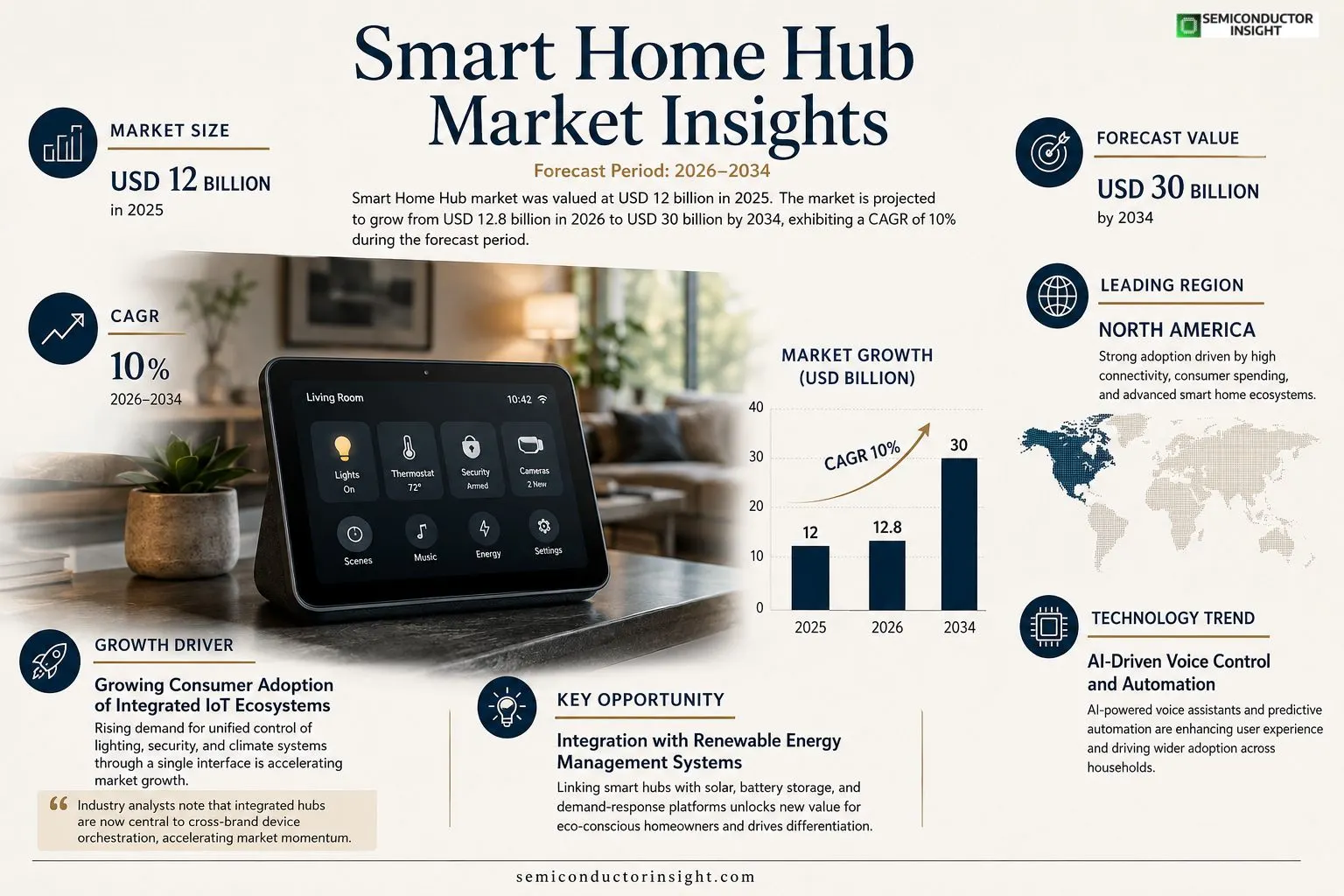
Smart Home Hub market size was valued at USD 12 billion in 2025. The market is projected to grow from USD 12.8 billion in 2026 to USD 30 billion by 2034, exhibiting a CAGR of 10% during the forecast period.
Smart home hubs are centralized controllers that connect and manage diverse Internet‑of‑Things (IoT) devices,such as lighting systems, thermostats, security cameras and voice assistants,through a unified interface typically accessed via mobile applications or voice commands.The market is experiencing rapid growth due to several factors, including widespread broadband penetration, rising consumer demand for seamless home automation, and decreasing costs of connected sensors. Furthermore, advancements in AI‑driven voice recognition and interoperability standards are accelerating adoption. Initiatives by key players are also expected to fuel market expansion; for example, Amazon’s continual updates to Echo devices, Google’s integration of Nest Hub within its ecosystem, and Samsung’s partnership with third‑party manufacturers to broaden SmartThings compatibility.
MARKET DRIVERS
Growing Consumer Adoption of Integrated IoT Ecosystems
Smart Home Hub Market is being propelled by increasing household demand for seamless control of lighting, security, and climate systems through a single interface. Consumers value convenience and energy‑saving capabilities, prompting manufacturers to embed AI‑driven voice assistants that simplify daily routines.
Expansion of High‑Speed Broadband and 5G Connectivity
Broadband penetration and emerging 5G networks enhance real‑time data exchange between devices, reducing latency and improving reliability of hub‑mediated automation. This technical foundation encourages both new installations and upgrades of existing smart home setups.
➤ Industry analysts note that integrated hubs are now central to cross‑brand device orchestration, accelerating market momentum.
Manufacturers are also leveraging modular hardware designs that allow easy addition of new protocols, ensuring longevity of the hub and fostering consumer confidence in long‑term investments.
MARKET CHALLENGES
Fragmented Standards and Compatibility Issues
Despite the overall growth, Smart Home Hub Market contends with a proliferation of competing communication protocols (Zigbee, Z‑Wave, Thread, Matter) that can confuse end‑users and increase integration costs for vendors.
Other Challenges
Security and Data Privacy Concerns
Consumers remain wary of potential vulnerabilities in hub firmware, and high‑profile breaches have heightened expectations for robust encryption and transparent data handling policies.
MARKET RESTRAINTS
High Initial Investment for Premium Solutions
The cost premium associated with advanced hubs that support multiple protocols and AI features can deter price‑sensitive buyers, especially in emerging economies where discretionary spending on home automation remains limited.Additionally, limited consumer awareness of the long‑term energy savings and convenience benefits may slow adoption rates, constraining the overall market expansion.
MARKET OPPORTUNITIES
Integration with Renewable Energy Management Systems
Linking smart hubs with solar inverters, battery storage, and demand‑response platforms creates a compelling value proposition for eco‑conscious homeowners, opening a niche for differentiated product offerings.Furthermore, partnerships with telecom operators to bundle hub services with broadband packages present a scalable channel for reaching untapped residential segments, amplifying market penetration.
Smart Home Hub Market Trends
Rapid AI‑Driven Adoption
Smart Home Hub Market is being reshaped by artificial‑intelligence enhancements that enable more natural voice interaction and predictive automation. As broadband coverage expands ly, households are increasingly comfortable connecting diverse IoT devices,lighting, climate control, security cameras, and appliance managers,to a single interface. AI‑powered voice assistants now recognize context and user preferences, turning routine commands into proactive adjustments, such as pre‑heating rooms before occupants arrive. This functional depth reduces friction for end‑users, encouraging wider adoption across both new‑build and retrofit segments. The convergence of lower sensor costs and robust AI models creates a virtuous cycle where enhanced convenience drives purchase intent, further accelerating market momentum.
Other Trends
Interoperability and Standards
Interoperability remains a pivotal focus as Smart Home Hub Market strives to dissolve brand silos. Industry groups have introduced unified communication protocols that allow hubs to orchestrate devices from multiple manufacturers without proprietary constraints. This shift is evident in the growing lineup of hubs supporting Matter, a neutral standard that guarantees consistent behavior across ecosystems. Consumers now experience seamless scene creation,linking a smart thermostat, security system, and entertainment platform,through a single app or voice command. Manufacturers such as Amazon, Google, and Samsung are contributing firmware updates that embed these standards, reinforcing confidence that today’s investment will remain functional as the ecosystem evolves.
Cost Reduction and Consumer Demand
Declining component prices are making smart hub solutions more affordable for mainstream buyers, a trend that directly fuels demand. Economies of scale in semiconductor production, combined with competitive pricing strategies from major players, have lowered the entry barrier for households seeking integrated automation. As a result, adoption is moving beyond early enthusiasts to broader consumer segments that prioritize convenience and energy efficiency. Promotional bundles that pair hubs with popular voice assistants or subscription services further enhance perceived value. This price sensitivity, paired with heightened awareness of energy‑saving benefits, positions the market for sustained expansion as more households transition to connected living environments.
COMPETITIVE LANDSCAPEKey Industry Players
Smart Home Hub Market Competitive Overview
Smart Home Hub Market, valued at USD 12 billion in 2025, is dominated by a handful of technology giants that shape ecosystem standards and drive consumer adoption. Amazon leads with its Echo line, leveraging deep integration with Alexa and extensive third‑party skill support, while Google’s Nest Hub anchors the Android‑centric ecosystem through seamless interaction with Google Assistant and services. Samsung anchors the Android‑based hardware side via SmartThings, offering a widely compatible hub that bridges OEM devices and third‑party accessories. This oligopolistic structure sustains high barriers to entry, as each leader invests heavily in AI‑driven voice recognition, cloud services, and cross‑brand interoperability, fueling the forecasted growth to USD 30 billion by 2034 at a 10 % CAGR.Beyond the tier‑one firms, a robust cohort of niche and regional players enriches the market with specialized capabilities. Apple expands its HomeKit‑enabled HomePod and Siri integration, focusing on privacy and seamless iOS connectivity. Xiaomi and Huawei provide cost‑effective hubs that tap into their massive smart‑device ecosystems in Asia. Philips Hue, Ecobee, and Ring concentrate on premium lighting, thermostatic control, and security solutions, respectively, often bundling hardware with subscription services. European and niche manufacturers such as Bosch, Logitech, Sonos, TP‑Link, Aqara, and Wink differentiate through localized standards, open‑source platforms, or audio‑centric designs, creating a layered competitive landscape that encourages innovation and consumer choice.
List of Key Smart Home Hub Companies Profiled
- Amazon
- Samsung
- Apple
- Xiaomi
- Huawei
- Philips Hue
- Ecobee
- Ring
- Wink
- Bosch
- Logitech
- Sonos
- TP-Link
- Aqara
Segment Analysis:
| Segment Category | Sub-Segments | Key Insights |
| By Type |
|
Voice‑Controlled Hubs
|
| By Application |
|
Security and Surveillance
|
| By End User |
|
Residential Homeowners
|
| By Connectivity |
|
Wi‑Fi Based Hubs
|
| By Ecosystem Integration |
|
Cross‑Platform Open Ecosystem
|
Regional Analysis: North America
United States
The demand for Smart Home Hubs is closely tied to the proliferation of IoT devices. As more consumers integrate smart lighting, thermostats, security systems, and appliances into their homes, the need for a central control point becomes increasingly important. This trend is further amplified by the increasing adoption of voice assistants like Amazon Alexa and Google Assistant, which are often integrated with Smart Home Hubs, offering hands-free control and enhanced convenience. The market is also seeing a rise in specialized hubs catering to specific needs, such as hubs focused on home entertainment or energy management.
The primary drivers for the North American Smart Home Hub market include increasing disposable incomes, growing awareness of home automation benefits, and the expanding ecosystem of connected devices. The desire for enhanced security and energy efficiency also contributes significantly to market growth.
Rising adoption of voice control technologies further stimulates demand for smart home hubs.
The North American Smart Home Hub market features a competitive landscape with key players investing heavily in product innovation and market expansion. The focus is on establishing strong brand recognition and building robust ecosystems of compatible devices and services. Partnerships and acquisitions are common strategies to gain market share and expand product offerings.
Competition is intensifying with the entry of new players and the emergence of niche hubs targeting specific consumer segments.
Several emerging trends are shaping the future of Smart Home Hub Market in North America. These include the increasing integration of artificial intelligence (AI) and machine learning (ML) for personalized automation, the growing adoption of mesh networking for enhanced reliability, and a greater emphasis on data privacy and security.
The rise of edge computing is also enabling hubs to process data locally, reducing latency and enhancing privacy.
While the North American Smart Home Hub market offers significant growth opportunities, it also faces certain challenges. These include concerns about data security and privacy, the complexity of integrating devices from different manufacturers, and the relatively high cost of some smart home solutions.
Opportunities lie in developing more user-friendly and secure hubs, fostering greater interoperability standards, and offering bundled solutions that address the needs of diverse consumer segments.
Europe
The European Smart Home Hub Market is experiencing steady growth, driven by increasing internet penetration and a growing awareness of smart home technologies. Stringent data privacy regulations, particularly GDPR, are influencing product development and market strategies. The focus is on ensuring user data security and providing transparent data usage policies.
The European market is characterized by a diverse range of consumer preferences and regulatory environments across different countries. This necessitates tailored marketing campaigns and product offerings to cater to specific regional needs. Business strategies emphasize building strong relationships with local retailers and distributors. Integrating with existing home energy management systems is also a key focus area.
Asia-Pacific
Asia-Pacific represents a high-growth potential market for Smart Home Hubs. Rapid urbanization, increasing disposable incomes, and a growing middle class are driving demand for smart home solutions. The region is witnessing a surge in adoption of smartphones and internet connectivity, creating a favorable environment for the smart home market.
China is the largest market in the region, followed by Japan, South Korea, and India. Local players are gaining prominence, competing with brands. The focus is on affordability and ease of use to cater to the price-sensitive consumer base. Integration with local ecosystems and payment platforms is a key strategic priority.
South America
Smart Home Hub Market in South America is still in its nascent stages but exhibits significant growth potential. Increasing internet access and a rising adoption of smart devices are driving demand. However, challenges remain in terms of affordability and infrastructure development.
Brazil and Argentina are the largest markets in the region, with a growing interest in smart home security solutions. Business strategies focus on partnerships with telecom operators and retailers to expand market reach and offer value-added services.
Middle East & Africa
The Middle East & Africa region presents a promising growth opportunity for Smart Home Hub Market. Increasing disposable incomes, urbanization, and government initiatives promoting smart cities are driving demand. The region is witnessing a growing adoption of smart home technologies, particularly in affluent urban areas.
The focus is on providing solutions that cater to the specific needs of the region, such as energy efficiency in hot climates and enhanced security in areas with higher crime rates. Business strategies emphasize partnerships with local developers and distributors.
Report Scope
This market research report provides a comprehensive analysis of the Smart Home Hub Market , covering the forecast period 2026–2034. It offers detailed insights into market dynamics, technological advancements, competitive landscape, and key trends shaping the industry.
Key focus areas of the report include:
- Market Overview: The report begins with an overview outlining its current market scenario, key growth indicators, and industry transformation drivers. It discusses macroeconomic factors, demand–supply balance, regulatory landscape, and the strategic role of semiconductors in powering advancements across industries such as automotive, telecommunications, consumer electronics, and industrial automation.
- Market Size & Forecast: Historical data and future projections for revenue, unit shipments, and market value across major regions and segments.
- Segmentation Analysis: Detailed breakdown by product type, technology, application, and end-user industry to identify high-growth segments and investment opportunities.
- Regional Insights: Insights into market performance across North America, Europe, Asia-Pacific, Latin America, and the Middle East & Africa, including country-level analysis where relevant.
- Competitive Landscape: Profiles of leading market participants, including their product offerings, R&D focus, manufacturing capacity, pricing strategies, and recent developments such as mergers, acquisitions, and partnerships.
- Technology Trends & Innovation: Assessment of emerging technologies, integration of AI/IoT, semiconductor design trends, fabrication techniques, and evolving industry standards.
- Market Drivers & Restraints: Evaluation of factors driving market growth along with challenges, supply chain constraints, regulatory issues, and market-entry barriers.
- Stakeholder Insights: Insights for component suppliers, OEMs, system integrators, investors, and policymakers regarding the evolving ecosystem and strategic opportunities.
Primary and secondary research methods are employed, including interviews with industry experts, data from verified sources, and real-time market intelligence to ensure the accuracy and reliability of the insights presented.
FREQUENTLY ASKED QUESTIONS:
What is the current market size of Smart Home Hub Market?
-> Smart Home Hub Market was valued at USD 12 billion in 2025 and is expected to reach USD 30 billion by 2034.
Which key companies operate in Smart Home Hub Market?
-> Key players include Amazon (Echo), Google (Nest Hub), and Samsung (SmartThings), among others.
What are the key growth drivers?
-> Key growth drivers include broadband penetration, rising consumer demand for seamless home automation, decreasing costs of connected sensors, AI‑driven voice recognition, and emerging interoperability standards.
Which region dominates the market?
-> The reference does not specify a single dominant region; however, adoption is strong across North America, Europe, and Asia‑Pacific, reflecting the nature of the market.
What are the emerging trends?
-> Emerging trends include AI‑enhanced voice control, increased device interoperability, and integration of advanced sensor networks within smart home ecosystems.

Get Sample Report PDF for Exclusive Insights
Report Sample Includes
- Table of Contents
- List of Tables & Figures
- Charts, Research Methodology, and more...
 Download Sample Report PDF