MARKET INSIGHTS
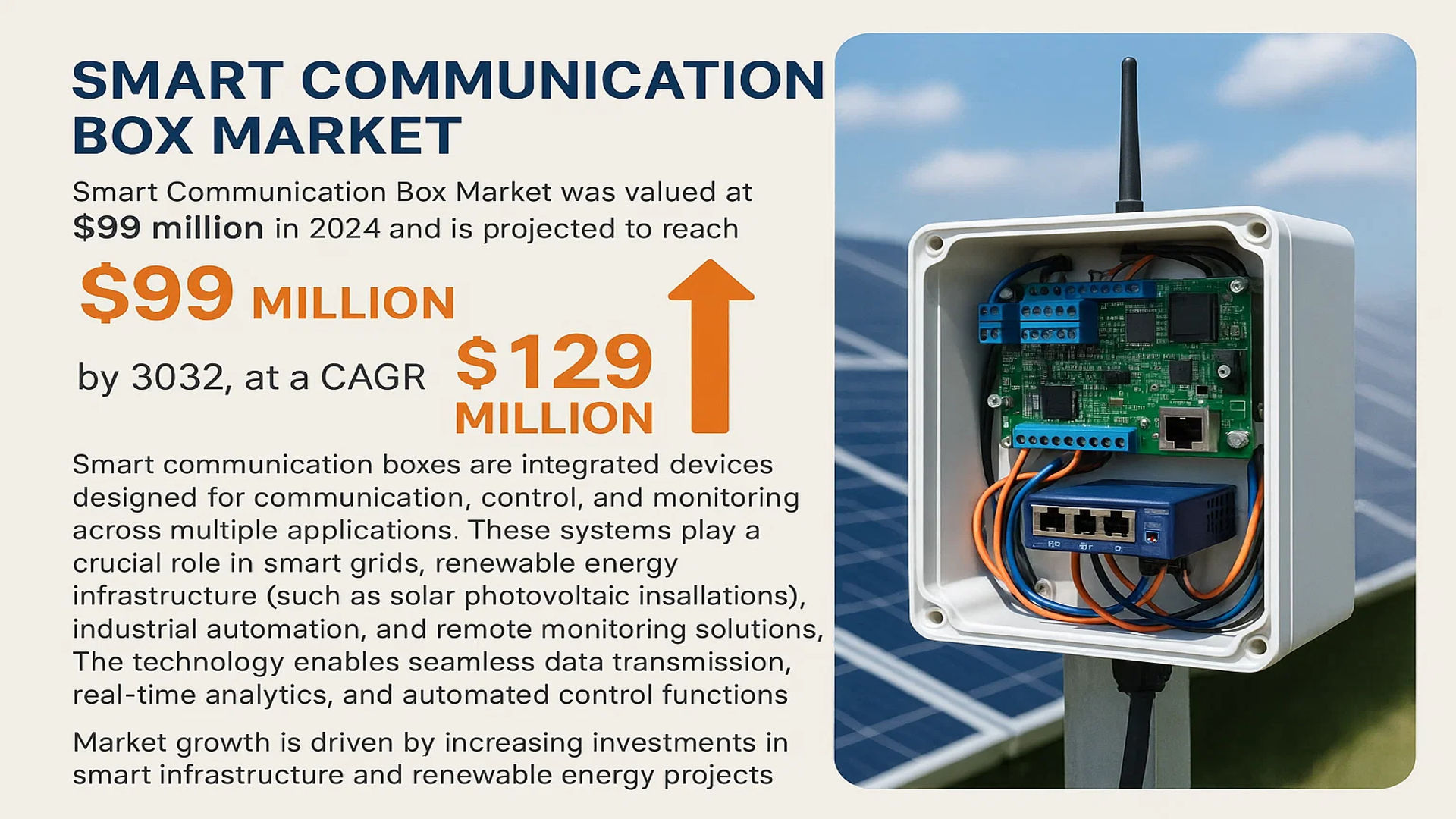
The global Smart Communication Box Market was valued at 99 million in 2024 and is projected to reach US$ 129 million by 2032, at a CAGR of 3.3% during the forecast period.
Smart communication boxes are integrated devices designed for communication, control, and monitoring across multiple applications. These systems play a crucial role in smart grids, renewable energy infrastructure (such as solar photovoltaic installations), industrial automation, and remote monitoring solutions. The technology enables seamless data transmission, real-time analytics, and automated control functions.
Market growth is driven by increasing investments in smart infrastructure and renewable energy projects globally. However, adoption rates vary by region, with China and the U.S. emerging as key markets. The portable segment is expected to show particularly strong growth, though specific CAGR figures remain to be determined through further market analysis. Leading manufacturers including KBC Networks, CORNING, and COMMSCOPE are actively expanding their product portfolios to capitalize on these emerging opportunities in industrial and energy applications.
MARKET DYNAMICS
MARKET DRIVERS
Expansion of Smart Grids and Renewable Energy Infrastructure to Accelerate Market Growth
The global push toward renewable energy adoption is significantly increasing demand for smart communication boxes, which serve as critical components in solar farms and wind power plants. Smart communication boxes enable real-time monitoring, remote control, and data transmission between distributed energy resources and central management systems. In 2024, renewable energy capacity installations grew by over 9% year-over-year, with solar photovoltaic systems accounting for more than 60% of new additions. This expansion is driving substantial investments in supporting infrastructure, including communication technologies that ensure grid stability and efficient energy management.
Industrial Automation Boom to Fuel Adoption Across Manufacturing Sectors
The fourth industrial revolution is transforming manufacturing through automation, creating new opportunities for smart communication solutions. Smart communication boxes play a vital role in factory automation by enabling machine-to-machine (M2M) communication, equipment monitoring, and predictive maintenance. The industrial automation market is projected to maintain 7% annual growth through 2030, with smart factories increasingly adopting Industrial Internet of Things (IIoT) technologies. These boxes provide the necessary communication backbone for sensors, controllers, and cloud platforms to exchange critical operational data.
➤ For instance, major automotive manufacturers have implemented smart communication boxes across production lines to reduce downtime by 15-20% through real-time equipment monitoring.
Furthermore, the rise of smart city initiatives worldwide is creating additional demand for these solutions in urban infrastructure management, from traffic control systems to public utility monitoring.
MARKET RESTRAINTS
High Implementation Costs and Complexity to Hinder Widespread Adoption
While smart communication boxes offer numerous benefits, their deployment often requires substantial upfront investment and system integration expertise. The total cost of ownership includes not just hardware procurement but also installation, configuration, and ongoing maintenance expenses. For many small and medium enterprises, these costs remain prohibitive, particularly when retrofitting existing infrastructure. Industry surveys indicate that 40% of potential buyers cite budget constraints as their primary barrier to adoption, compared to only 25% who mention technological concerns.
Cybersecurity Risks Create Reluctance Among Critical Infrastructure Operators
The increasing connectivity of industrial systems through smart communication boxes introduces new cybersecurity vulnerabilities that restrain market growth. Energy providers and manufacturers handling sensitive operations remain cautious about potential cyber threats that could compromise system integrity. Recent analyses show that industrial control systems experienced a 30% increase in cyberattack attempts in 2024, with communication infrastructure being a prime target. This security concern is particularly acute in sectors like power generation and water treatment where operational technology must meet stringent safety standards.
Additionally, the lack of standardized communication protocols across different manufacturers creates interoperability challenges that further complicate deployment scenarios.
MARKET CHALLENGES
Rapid Technological Evolution Creates Obsolescence Risks
The fast pace of innovation in communication technologies presents ongoing challenges for both manufacturers and adopters of smart communication boxes. New wireless standards, edge computing capabilities, and protocol updates emerge frequently, potentially rendering existing solutions outdated within short timeframes. This creates dilemmas for organizations making long-term infrastructure investments, as they must balance current needs against future-proofing requirements. Field data suggests that nearly 35% of industrial communication hardware requires replacement or significant upgrades within five years of deployment to maintain compatibility with evolving systems.
Other Challenges
Supply Chain Disruptions
Component shortages and logistics bottlenecks continue affecting production lead times and product availability, with some manufacturers reporting 20-30% longer delivery cycles compared to pre-pandemic levels.
Regulatory Compliance
Differing regional certification requirements for industrial communication equipment add complexity to global product rollouts and may delay time-to-market for new solutions.
MARKET OPPORTUNITIES
5G and Edge Computing Integration to Create Next-Generation Applications
The rollout of 5G networks and edge computing infrastructure presents transformative opportunities for smart communication box manufacturers. These technologies enable ultra-low latency communication and distributed processing capabilities that are ideal for time-sensitive industrial applications. Early adopters in manufacturing automation are already demonstrating 50-60% improvements in real-time control loop performance when combining 5G-connected smart boxes with edge analytics. The industrial 5G market is forecast to grow at 45% CAGR through 2030, creating substantial demand for compatible communication solutions.
Emerging Applications in Electric Vehicle Charging Infrastructure
The global expansion of electric vehicle charging networks requires robust communication solutions to manage charging stations, payments, and grid interactions. Smart communication boxes are becoming essential components in charging infrastructure, facilitating secure transactions and dynamic load management. With EV charging station installations projected to triple by 2027, this represents a high-growth vertical for communication box providers offering specialized solutions for the mobility sector.
Moreover, increasing investments in digital substation technologies and smart energy meters are creating complementary opportunities across the power distribution value chain.
SMART COMMUNICATION BOX MARKET TRENDS
Integration of IoT and AI to Accelerate Smart Communication Box Adoption
The smart communication box market is experiencing rapid growth due to the increasing integration of the Internet of Things (IoT) and Artificial Intelligence (AI) into industrial and energy applications. These boxes are evolving into intelligent hubs capable of real-time data processing, remote monitoring, and predictive maintenance. With industries prioritizing automation and digital transformation, smart communication boxes now support advanced features like edge computing and AI-driven analytics, enhancing operational efficiency. The ability to integrate seamlessly with cloud platforms is further expanding their utility in smart grids and renewable energy systems.
Other Trends
Expansion in Renewable Energy Infrastructure
The global push toward renewable energy, particularly solar and wind power, has significantly increased the demand for smart communication boxes in energy management systems. These devices play a critical role in monitoring and controlling distributed energy resources, ensuring grid stability and efficiency. The rise in grid modernization initiatives, particularly in regions like Europe and Asia-Pacific, is fueling installations of smart communication solutions in photovoltaic systems. Moreover, government incentives for renewable energy projects have accelerated the deployment of these devices in utility-scale installations.
Industrial Automation Driving Market Growth
Industrial automation is a key driver for the smart communication box market, as businesses increasingly adopt smart manufacturing technologies. The need for reliable data communication and remote equipment management in industries such as automotive, chemicals, and logistics is propelling demand. The ability of these devices to facilitate machine-to-machine (M2M) communication in harsh industrial environments makes them indispensable for Industry 4.0 applications. Additionally, innovations such as modular and ruggedized designs are enhancing their suitability for varied industrial use cases.
COMPETITIVE LANDSCAPE
Key Industry Players
Global Leaders and Emerging Innovators Compete for Market Dominance
The global Smart Communication Box market presents a dynamic and moderately consolidated competitive landscape, featuring a mix of established multinational corporations and agile regional players. The market is projected to grow from $99 million in 2024 to $129 million by 2032, with a steady CAGR of 3.3%, attracting both existing players and new entrants.
CORNING dominates the market with its globally recognized fiber optic communication solutions, leveraging its strong R&D capabilities and extensive distribution network. The company’s strategic focus on industrial IoT applications has positioned it as a leader in smart communication infrastructure. KBC Networks follows closely, with its robust product portfolio in wireless communication solutions for harsh industrial environments, contributing significantly to its market share.
Meanwhile, Asian players like YOFC (Yangtze Optical Fibre and Cable) and Sungrow are making substantial gains, particularly in renewable energy applications. Their cost-competitive solutions and strong government support in China’s expanding smart grid sector are driving their rapid market penetration. These companies also benefit from the growing demand for photovoltaic system communication modules.
Recent developments show companies like COMMSCOPE and Hengtong Group are actively acquiring smaller tech firms to enhance their smart communication capabilities. Additionally, specialized players like Sofar Solar focus exclusively on solar energy communication solutions, carving out profitable niches in this expanding market.
List of Key Smart Communication Box Manufacturers
- CORNING (U.S.)
- KBC Networks (U.K.)
- COMMSCOPE (U.S.)
- YOFC (China)
- Sofar Solar (China)
- POTEL (China)
- ICPBOX (China)
- HEJIA (China)
- HANHGK (China)
- ONV (China)
- i-SHYY (China)
- Sungrow (China)
- GoodWe (China)
- Hengtong Group (China)
Segment Analysis:
By Type
Portable Segment Gains Traction Due to Enhanced Mobility and Deployment Flexibility
The market is segmented based on type into:
- Portable
- Subtypes: Handheld, Mountable, and others
- Desktop
- Subtypes: Wall-mounted, Rack-mounted, and others
By Application
Energy Industry Holds Significant Share Due to Demand for Smart Grid Solutions
The market is segmented based on application into:
- Electrical Industry
- Subtypes: Power distribution, Grid monitoring, and others
- Energy Industry
- Subtypes: Renewable energy monitoring, Oil & gas facilities, and others
- Environmental Industry
- Subtypes: Weather stations, Pollution monitoring, and others
- Construction Industry
- Subtypes: Site monitoring, Safety systems, and others
- Others
By Functionality
Integrated Monitoring Systems Drive Adoption Across Industries
The market is segmented based on functionality into:
- Communication Modules
- Control Systems
- Monitoring Solutions
- Data Logging
- Others
Regional Analysis: Smart Communication Box Market
Asia-Pacific
The Asia-Pacific region dominates the global Smart Communication Box market, spearheaded by China’s rapid industrialization and smart grid expansion. With China accounting for approximately 35% of global market revenue in 2024, the region benefits from aggressive renewable energy adoption, particularly in solar power installations deploying smart communication solutions. Government initiatives like China’s 14th Five-Year Plan for Renewable Energy prioritize IoT-enabled infrastructure, creating sustained demand. However, price sensitivity in emerging economies such as India and Vietnam leads to a preference for cost-effective portable units over high-end desktop variants. Local manufacturers like YOFC and Sungrow have capitalized on this trend, securing significant market share through scalable, localized solutions.
North America
In North America, stringent cybersecurity standards and grid modernization projects under the U.S. Department of Energy’s Grid Modernization Initiative drive demand for advanced Smart Communication Boxes. The U.S. holds the largest regional market share, with utilities investing heavily in distributed energy resource management systems (DERMS) requiring real-time data communication. Companies like CORNING and COMMSCOPE lead innovation in ruggedized designs for extreme weather resilience. A notable shift toward edge computing-compatible units is emerging, particularly for wildfire-prone areas where offline operational capability is critical. Canada’s focus on remote microgrids further amplifies niche growth opportunities.
Europe
Europe’s market is shaped by EU directives on energy efficiency (EU 2019/944) and the push for carbon-neutral smart cities. Germany and France collectively represent over 45% of regional shipments, with emphasis on interoperable systems compliant with IEC 61850 standards for grid communication. The Nordic countries are early adopters of 5G-integrated communication boxes for offshore wind farms, while Southern Europe sees rising deployments in solar PV monitoring. Regulatory pressures to phase out legacy SCADA systems have accelerated replacement cycles, though high R&D costs pose barriers for smaller utilities.
Middle East & Africa
This emerging market is bifurcated: Gulf Cooperation Council (GCC) nations like Saudi Arabia prioritize mega solar projects (e.g., NEOM) utilizing smart communication infrastructure, whereas Sub-Saharan Africa relies on mobile network-based solutions for off-grid applications. The UAE leads in smart city integrations, with deployment focus on real-time load monitoring for desalination plants. Challenges include intermittent power supply in rural areas, necessitating battery-backed units with low energy consumption. Long-term potential lies in mining sector automation, particularly in South Africa and Zambia.
South America
Brazil and Chile drive regional demand through hydropower and lithium mining operations requiring robust monitoring systems. However, economic instability has delayed large-scale smart grid rollouts, with most investments concentrated in industrial IoT applications. Argentina’s renewable energy auctions have spurred some growth, though currency fluctuations hinder foreign supplier participation. The lack of standardized communication protocols across countries remains a key obstacle for pan-regional solutions.
Report Scope
This market research report provides a comprehensive analysis of the global and regional Smart Communication Box markets, covering the forecast period 2024–2032. It offers detailed insights into market dynamics, technological advancements, competitive landscape, and key trends shaping the industry.
Key focus areas of the report include:
- Market Size & Forecast: Historical data and future projections for revenue, unit shipments, and market value across major regions and segments. The global Smart Communication Box market was valued at USD 99 million in 2024 and is projected to reach USD 129 million by 2032, growing at a CAGR of 3.3%.
- Segmentation Analysis: Detailed breakdown by product type (Portable, Desktop), application (Electrical Industry, Energy Industry, Environmental Industry, Construction Industry, Others), and end-user industry to identify high-growth segments.
- Regional Outlook: Insights into market performance across North America, Europe, Asia-Pacific, Latin America, and the Middle East & Africa. The U.S. market is a key player, while China shows significant growth potential.
- Competitive Landscape: Profiles of leading market participants such as KBC Networks, CORNING, COMMSCOPE, YOFC, and POTEL, including their product portfolios, market share, and strategic initiatives.
- Technology Trends & Innovation: Assessment of emerging technologies in smart grids, renewable energy systems, and industrial automation driving market evolution.
- Market Drivers & Restraints: Evaluation of factors like increasing demand for smart grid solutions and renewable energy integration, alongside challenges such as regulatory complexities.
- Stakeholder Analysis: Insights for manufacturers, suppliers, investors, and policymakers to navigate market opportunities and challenges.
Primary and secondary research methods, including industry expert interviews and validated data sources, ensure the accuracy and reliability of the insights presented.
FREQUENTLY ASKED QUESTIONS:
What is the current market size of Global Smart Communication Box Market?
-> Smart Communication Box Market was valued at 99 million in 2024 and is projected to reach US$ 129 million by 2032, at a CAGR of 3.3% during the forecast period.
Which key companies operate in Global Smart Communication Box Market?
-> Key players include KBC Networks, CORNING, COMMSCOPE, YOFC, POTEL, Sofar Solar, ICPBOX, HEJIA, HANHGK, and ONV, among others.
What are the key growth drivers?
-> Key growth drivers include rising adoption of smart grids, renewable energy projects, and industrial automation.
Which region dominates the market?
-> Asia-Pacific is witnessing rapid growth, driven by infrastructure investments, while North America remains a significant market.
What are the emerging trends?
-> Emerging trends include integration of IoT in communication boxes, energy-efficient designs, and modular solutions.

Get Sample Report PDF for Exclusive Insights
Report Sample Includes
- Table of Contents
- List of Tables & Figures
- Charts, Research Methodology, and more...
 Download Sample Report PDF