
MARKET INSIGHTS
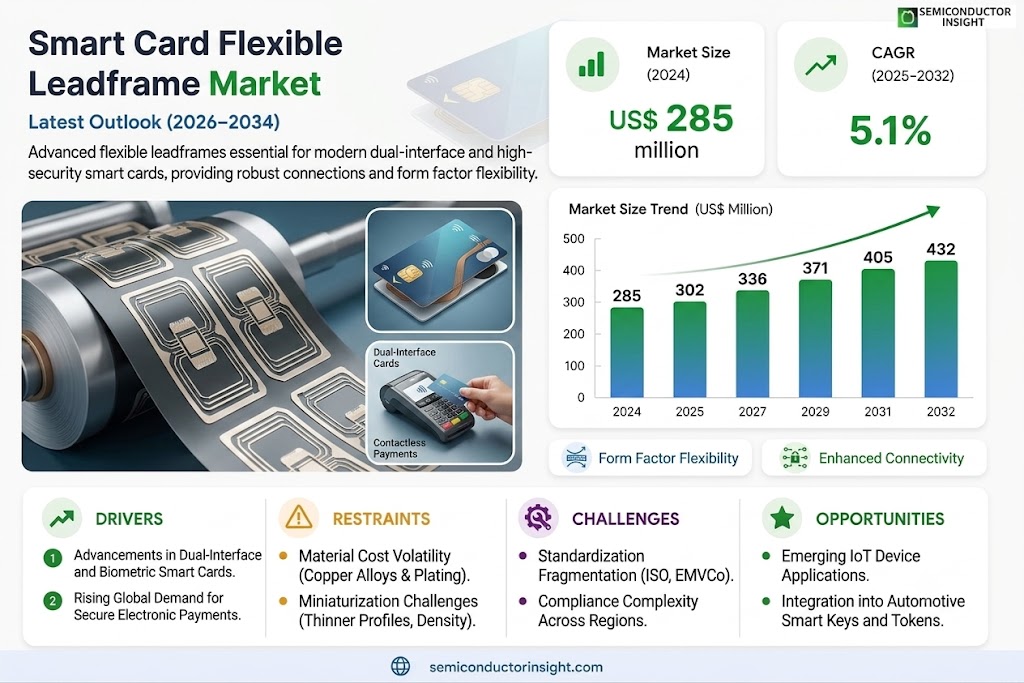
The global Smart Card Flexible Leadframe Market size was valued at US$ 285 million in 2024 and is projected to reach US$ 432 million by 2032, at a CAGR of 5.1% during the forecast period 2025-2032.
Smart Card Flexible Leadframes are precision-engineered conductive components that form the electrical interface between microchips and card bodies in contact-based smart cards. These components enable secure data transmission while providing mechanical support for semiconductor dies. The leadframes are manufactured using specialized alloys and advanced etching/plating processes to ensure durability and conductivity.
The market growth is primarily driven by increasing adoption of contact-based payment cards, government ID programs, and telecom SIM cards worldwide. While traditional banking cards dominate demand, emerging applications in transportation (ETC cards) and digital identity solutions are creating new opportunities. The Single Interface Flexible Leadframe segment currently holds over 65% market share, though Double Interface variants are gaining traction due to hybrid card adoption. Key players like Linxens and LGInnotek continue to innovate with thinner, more durable designs to meet evolving industry standards.
MARKET DYNAMICS
MARKET DRIVERS
Expanding Adoption of Contactless Payment Systems Accelerates Market Demand
The global shift toward contactless payment solutions is driving substantial growth in the smart card flexible leadframe market. With over 60% of point-of-sale terminals worldwide now supporting contactless transactions, the demand for durable and high-performance leadframes has surged. These components are critical for enabling secure data transmission in payment cards while maintaining the mechanical flexibility required for daily use. The recent EMVCo standards update mandating improved antenna designs has further increased the technological requirements for flexible leadframes, creating opportunities for advanced solutions.
Government Digital Identity Initiatives Create Sustained Demand
National ID programs and digital transformation initiatives are generating long-term demand for smart card components. Over 130 countries have implemented or are developing digital ID systems that rely on smart card technology, with many adopting dual-interface solutions that require sophisticated flexible leadframe designs. The integration of biometric authentication in next-generation ID cards is particularly driving innovation in leadframe architecture to accommodate additional sensors while maintaining card durability.
➤ The European Union’s recent Digital Identity Wallet initiative is projected to require over 450 million smart cards by 2030, representing a significant opportunity for leadframe manufacturers.
Telecom Sector Modernization Fuels SIM Card Innovations
The ongoing transition to 5G networks and embedded SIM (eSIM) technology is creating new technical requirements for smart card components. While eSIM adoption grows, traditional SIM cards continue dominating emerging markets – with over 5 billion conventional SIMs still shipped annually. Flexible leadframes must now support higher data transfer rates and improved signal integrity to meet 5G specifications, while also maintaining backward compatibility with existing networks.
MARKET RESTRAINTS
Material Cost Volatility Impacts Manufacturing Economics
The smart card flexible leadframe market faces significant pressure from fluctuating raw material prices, particularly for copper alloys and specialty plating materials. These materials account for approximately 40-50% of total production costs, and recent supply chain disruptions have created unpredictable pricing environments. Manufacturers must balance material performance requirements with cost containment, often forcing difficult trade-offs between product quality and profitability.
Miniaturization Challenges Test Engineering Capabilities
As smart cards incorporate more features in the same form factor, leadframe designs face increasing density challenges. The push for thinner profiles (now routinely below 0.3mm) while maintaining signal integrity and mechanical durability creates complex engineering obstacles. These technical constraints are particularly evident in dual-interface cards where electromagnetic performance must be maintained across both contact and contactless modes despite shrinking geometries.
MARKET CHALLENGES
Standardization Fragmentation Increases Compliance Complexity
The smart card industry operates under multiple competing standards from organizations including ISO, EMVCo, and national regulators. This fragmentation creates compliance challenges for leadframe manufacturers who must adapt designs for different regional requirements. The recent introduction of supplemental security features in various markets has further complicated the landscape, requiring additional process steps that can reduce production yields.
Talent Shortage in Precision Manufacturing
The specialized nature of leadframe production creates significant workforce challenges, with an estimated 25% skills gap in precision etching and micro-forming technologies. As experienced workers retire, manufacturers struggle to find adequately trained replacements, particularly for quality control positions requiring microscopic inspection expertise. This talent shortage threatens to constrain production capacity just as market demand accelerates.
MARKET OPPORTUNITIES
Emerging Applications in IoT and Wearable Devices
Beyond traditional card applications, flexible leadframe technology is finding new opportunities in wearable payment devices and IoT endpoints. The market for payment-enabled wearables is projected to grow at 25% annually, requiring innovative leadframe designs that can withstand bending and stretching while maintaining electrical performance. Early adopters are exploring hybrid solutions combining conventional leadframe manufacturing with flexible printed electronics techniques.
Advanced Materials Enable Next-Generation Designs
Recent developments in conductive polymers and nanocomposite materials are opening new possibilities for leadframe performance. These advanced materials offer improved flexibility, corrosion resistance, and signal characteristics compared to traditional metals. Early-adopting manufacturers are already demonstrating prototypes with 30% better flex cycle performance, potentially extending product lifetimes in high-use applications such as transit cards.
SMART CARD FLEXIBLE LEADFRAME MARKET TRENDS
Adoption of Contactless Payment Solutions Driving Market Growth
The rapid adoption of contactless payment technologies is accelerating demand for smart card flexible leadframes globally. With the increasing preference for NFC-enabled payment cards, governments and financial institutions are transitioning from magnetic stripe cards to EMV chip-based solutions, creating a substantial market opportunity. The global market is projected to grow at a CAGR of 6-8%, fueled by investments in secure transaction infrastructure. Additionally, the pandemic-induced shift toward cashless transactions has reinforced the need for durable and high-performance leadframes in smart card manufacturing, ensuring prolonged card lifespan and reliability.
Other Trends
Technological Innovations in Multi-Interface Leadframes
Manufacturers are increasingly focusing on double interface flexible leadframes, which support both contact and contactless functionalities within a single smart card. This innovation is particularly significant in sectors such as transportation (ETC cards) and banking (hybrid payment cards), reducing production costs while enhancing user convenience. Recent advancements in ultra-thin and flexible materials have further improved mechanical stability and electrical conductivity, addressing key industry challenges such as signal interference and durability in harsh environments.
Regional Expansion and Government Initiatives
Government regulations mandating secure identity solutions are propelling demand for smart cards embedded with flexible leadframes. Regions like Europe and Asia-Pacific are leading the charge, with large-scale projects such as national ID programs and digital driver’s licenses. In China alone, the market is expected to surpass $250 million by 2032, driven by the country’s push for digital transformation. Meanwhile, collaborations between financial institutions and telecom providers in emerging markets are accelerating the deployment of secure SIM cards, further widening the application scope for flexible leadframe technologies.
COMPETITIVE LANDSCAPE
Key Industry Players
Technological Innovation Drives Competition in Smart Card Flexible Leadframe Market
The global smart card flexible leadframe market represents a dynamic competitive environment where Linxens, HENGHUI Technology, and LGInnotek currently dominate with a combined market share of approximately 40% as of 2024. This semi-consolidated landscape features a mix of multinational corporations and specialized manufacturers vying for position through technological differentiation and strategic partnerships.
Linxens maintains its leadership position through its vertically integrated production capabilities and extensive patent portfolio covering advanced microconnector technologies. Their recent acquisition of a major European semiconductor packaging firm has further strengthened their manufacturing capacity for high-density leadframe solutions.
Meanwhile, HENGHUI Technology has carved out significant market share in Asia-Pacific through cost-competitive manufacturing and rapid prototyping services. Their dual-interface leadframe solutions now account for nearly 30% of their total production output, reflecting growing demand for multi-functional smart card components.
The competitive intensity is further heightened by LGInnotek’s aggressive R&D investments, which yielded three new flexible leadframe patents in 2024 alone. Their work in ultra-thin, high-conductivity alloys has positioned them as the preferred supplier for next-generation financial smart cards requiring enhanced data transmission speeds.
List of Key Smart Card Flexible Leadframe Manufacturers
- Linxens (France)
- HENGHUI Technology (China)
- LGInnotek (South Korea)
- Mitsui High-tec (Japan)
- Shinko Electric Industries (Japan)
- ASM Pacific Technology (Singapore)
- Tong Hsing Electronic (Taiwan)
- QPL International (Hong Kong)
- Possehl Electronics (Germany)
Segment Analysis:
By Type
Single Interface Flexible Leadframe Segment Leads Due to Rising Demand for SIM and Payment Cards
The market is segmented based on type into:
- Single Interface Flexible Leadframe
- Double Interface Flexible Leadframe
By Application
Telecom SIM Card Segment Dominates Owing to Global Smartphone Penetration
The market is segmented based on application into:
- Telecom SIM card
- Livelihood Card
- Debit Card
- ETC Card
- Others
By Material
Copper-Based Leadframes Remain Preferred Choice for Electrical Conductivity
The market is segmented based on material into:
- Copper-based
- Alloy-based
- Others
By End-User Industry
Banking & Financial Services Sector Drives Adoption for Secure Transactions
The market is segmented based on end-user industry into:
- Telecommunications
- Banking & Financial Services
- Government
- Retail
- Others
Regional Analysis: Smart Card Flexible Leadframe Market
North America
The North American market for Smart Card Flexible Leadframes is driven by strong demand from financial and telecommunications sectors, particularly in the U.S. and Canada. The region’s emphasis on advanced payment technologies and secure identification systems has spurred adoption, with major financial institutions accelerating the shift to dual-interface smart cards. The U.S. accounts for the largest market share in the region, supported by robust investments in banking infrastructure and government ID programs. However, stringent manufacturing standards and supply chain complexities present challenges for leadframe producers, compelling them to prioritize high-precision fabrication techniques to meet local requirements.
Europe
Europe holds a significant position in the global Smart Card Flexible Leadframe market, with Germany, France, and the U.K. leading in production and consumption. The region benefits from strict data security regulations such as GDPR, which necessitate secure authentication methods, driving demand for advanced smart card components. The widespread adoption of contactless payment systems across EU nations further supports market growth. Manufacturers in Europe are also focusing on sustainability initiatives, with increasing use of recyclable materials in leadframe production. However, rising labor costs and competition from Asian suppliers pose notable challenges in maintaining cost competitiveness.
Asia-Pacific
Asia-Pacific dominates the global Smart Card Flexible Leadframe market, accounting for the highest consumption volume, with China, Japan, and South Korea at the forefront. China’s thriving electronics manufacturing industry and extensive deployment of telecom SIM cards have significantly boosted demand. Meanwhile, India’s push for digital payment solutions, such as RuPay cards and Aadhaar-linked smart cards, creates additional opportunities. The region benefits from cost-effective production capabilities, though manufacturers must navigate fluctuations in raw material costs. Additionally, increasing competition among local suppliers is driving innovation in miniaturized and high-durability leadframes.
South America
South America represents a slowly growing yet niche market for smart card leadframes, with Brazil and Argentina as the primary contributors. Expanding financial inclusion efforts and the gradual transition to chip-based payment cards are stimulating demand. However, economic instability, currency fluctuations, and limited technological infrastructure hinder market expansion. While government initiatives around digital ID programs provide long-term potential, the region currently relies heavily on imported leadframes, limiting local industry growth.
Middle East & Africa
The Middle East & Africa market is in an emerging phase, with growth concentrated in the UAE, Saudi Arabia, and South Africa due to smart city initiatives and digital banking advancements. The increasing adoption of smart ID cards and transit payment systems creates opportunities, though market development is hindered by inconsistent regulatory frameworks and reliance on imports. In Africa, mobile money penetration is high, but smart card adoption remains relatively low, presenting untapped potential for flexible leadframe suppliers as financial digitization accelerates in the region.
Report Scope
This market research report provides a comprehensive analysis of the global and regional Smart Card Flexible Leadframe markets, covering the forecast period 2025–2032. It offers detailed insights into market dynamics, technological advancements, competitive landscape, and key trends shaping the industry.
Key focus areas of the report include:
- Market Size & Forecast: Historical data and future projections for revenue, unit shipments, and market value across major regions and segments. The global Smart Card Flexible Leadframe market was valued at US$ 285 million in 2024 and is projected to reach US$ 432 million by 2032.
- Segmentation Analysis: Detailed breakdown by product type (Single Interface and Double Interface Flexible Leadframe), application (Telecom SIM cards, Debit Cards, ETC Cards, etc.), and end-user industry to identify high-growth segments.
- Regional Outlook: Insights into market performance across North America, Europe, Asia-Pacific, Latin America, and the Middle East & Africa. The U.S. market is estimated at USD million in 2024, while China is projected to reach USD million.
- Competitive Landscape: Profiles of leading market participants including Linxens, HENGHUI Technology, and LGInnotek, covering their product offerings, market share (top five players held approximately % share in 2024), and recent developments.
- Technology Trends & Innovation: Assessment of emerging semiconductor packaging technologies, miniaturization trends, and material advancements in leadframe manufacturing.
- Market Drivers & Restraints: Evaluation of factors such as increasing smart card adoption, contactless payment trends, and challenges in raw material supply chains.
- Stakeholder Analysis: Strategic insights for component manufacturers, smart card producers, investors, and policymakers regarding market opportunities and challenges.
Research methodology includes primary interviews with industry experts and analysis of verified market data to ensure accuracy and reliability of insights.
FREQUENTLY ASKED QUESTIONS:
What is the current market size of Global Smart Card Flexible Leadframe Market?
-> Smart Card Flexible Leadframe Market size was valued at US$ 285 million in 2024 and is projected to reach US$ 432 million by 2032, at a CAGR of 5.1% during the forecast period 2025-2032.
Which key companies operate in Global Smart Card Flexible Leadframe Market?
-> Key players include Linxens, HENGHUI Technology, and LGInnotek, among others.
What are the key growth drivers?
-> Key growth drivers include rising demand for contactless payment solutions, government ID programs, and expansion of telecom networks.
Which region dominates the market?
-> Asia-Pacific is the fastest-growing region, driven by China’s expanding smart card infrastructure.
What are the emerging trends?
-> Emerging trends include miniaturization of leadframes, adoption of advanced materials, and integration with IoT devices.

Get Sample Report PDF for Exclusive Insights
Report Sample Includes
- Table of Contents
- List of Tables & Figures
- Charts, Research Methodology, and more...
 Download Sample Report PDF




