SMA DC Blocker Market Insights
Global SMA DC Blocker market size was valued at USD 534 million in 2025. The market is projected to reach USD 863 million by 2034, exhibiting a CAGR of 7.3% during the forecast period.
SMA DC Blockers are specialized electronic components vital for RF and microwave systems. SMA stands for SubMiniature version A, characterized by compact size, robust structure, easy connection and disconnection, and widespread use in radio frequency and microwave communication systems. These devices incorporate an inner conductor, outer conductor, and insulating medium to effectively block DC paths while transmitting RF signals. They serve critical roles in wireless communication, satellite communication, microwave links, test and measurement, medical equipment, and other sectors.
The market experiences robust growth driven by escalating demand in telecommunications infrastructure, particularly 5G and beyond, alongside expansions in satellite and wireless technologies. Advancements in precision testing equipment further bolster this trajectory. However, supply chain dynamics pose occasional challenges. Leading players such as Pasternack, L-com, Bracke Manufacturing, PolyPhaser, Transtector, Keysight, Broadwave Technologies, ARRA, Atlantic Microwave, and MECA Electronics command substantial shares through innovative portfolios and strong distribution networks.
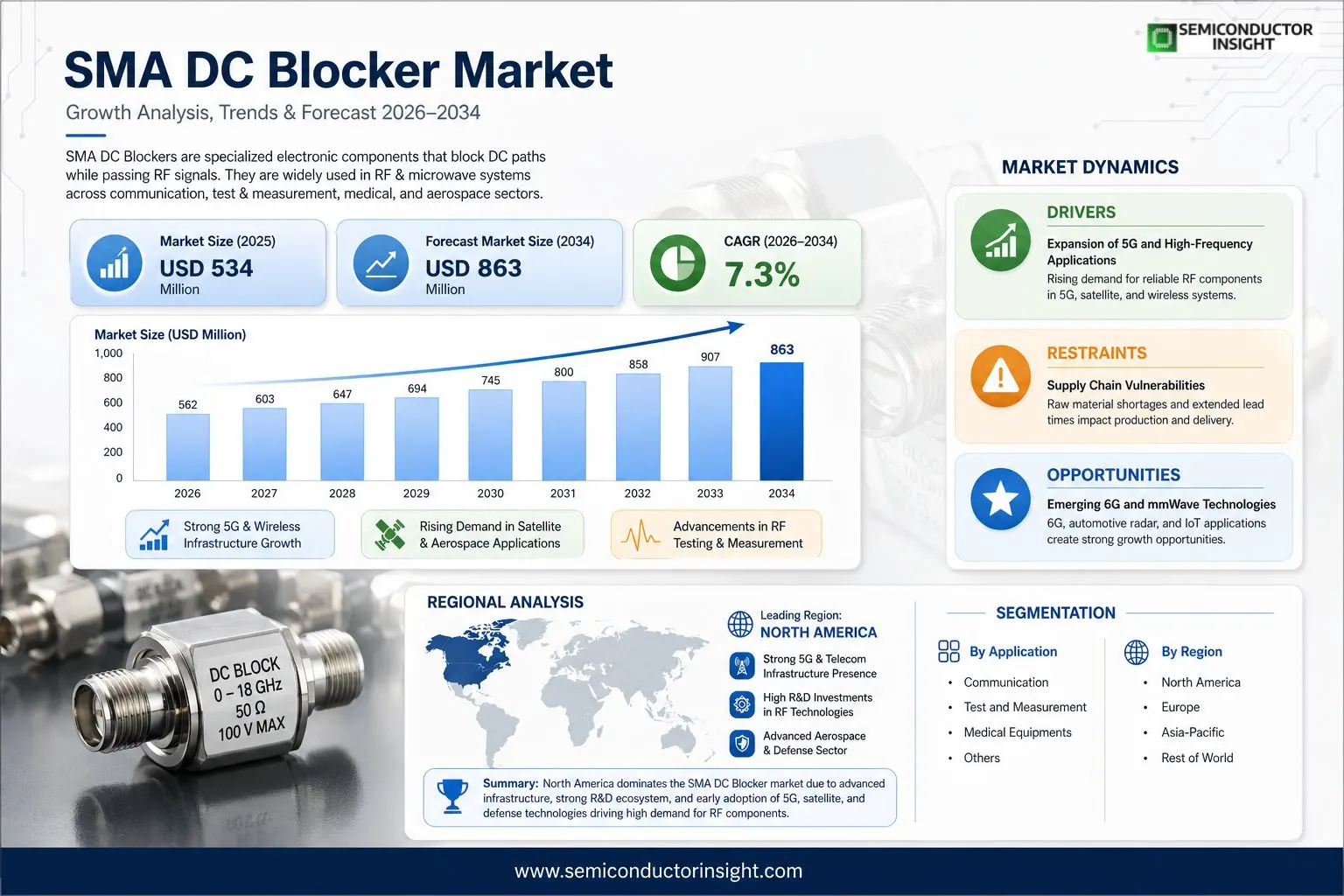
MARKET DRIVERS
Expansion of 5G and High-Frequency Applications
SMA DC Blocker Market is propelled by the global rollout of 5G networks, which demand reliable RF components to manage DC bias in high-frequency signals up to 18 GHz. Telecom equipment manufacturers are increasingly integrating SMA DC blockers to protect amplifiers and mixers, driving a projected market growth of 7.2% CAGR through 2028.
Growth in Aerospace and Defense Sectors
Aerospace and defense applications, including radar systems and satellite communications, require precise DC blocking in SMA-connectorized setups to ensure signal integrity. Rising defense budgets worldwide, exceeding $2 trillion in 2023, boost demand for these components in test benches and active arrays.
➤ Miniaturization trends in RF modules further accelerate adoption of compact SMA DC blockers in phased array antennas.
Additionally, the surge in test and measurement equipment for wireless standards like Wi-Fi 6E enhances market momentum, with North America leading due to R&D investments in RF technologies.
MARKET CHALLENGES
Supply Chain Vulnerabilities
Disruptions in semiconductor supply chains have impacted SMA DC Blocker Market, causing lead times to extend up to 20 weeks for high-capacitance units. Manufacturers face raw material shortages for tantalum capacitors, essential for broad frequency coverage.
Other Challenges
High Manufacturing Precision Requirements
Achieving low insertion loss below 0.5 dB across 40 GHz bandwidths demands advanced thin-film processes, elevating costs by 15-20% compared to standard RF passives.Competition from integrated RF solutions also pressures standalone SMA DC blockers, requiring continuous innovation in voltage ratings up to 100V.
MARKET RESTRAINTS
Stringent Quality and Compliance Standards
SMA DC Blocker Market faces restraints from rigorous MIL-STD-202 and RoHS compliance, complicating production and increasing certification costs by approximately 10%. These standards ensure reliability in harsh environments but slow market entry for new players.Intellectual property barriers protect key designs for low VSWR performance, limiting generic alternatives and maintaining premium pricing structures.Additionally, dependency on specialized assembly lines for hermetic sealing restrains scalability, particularly in emerging markets with underdeveloped RF fabrication capabilities.
MARKET OPPORTUNITIES
Emerging 6G and mmWave Technologies
Opportunities in SMA DC Blocker Market arise from 6G R&D, targeting frequencies beyond 100 GHz where DC blocking is critical for transistor protection. Investments over $1 billion annually in mmWave infrastructure position SMA variants for substantial growth.Automotive radar and LiDAR systems in ADAS present untapped demand for ruggedized SMA DC blockers, with the sector expected to expand at 12% CAGR by 2030.IoT device proliferation in industrial automation further opens avenues, as edge computing requires compact, high-reliability RF components for sensor interfacing.
SMA DC Blocker Market Trends
Growth Driven by Communication Applications
SMA DC Blocker Market is experiencing significant momentum from its core applications in communication sectors, including wireless, satellite, and microwave systems. These components, featuring a compact design with inner conductor, outer conductor, and insulating medium, excel at blocking DC paths while preserving RF signal integrity. This functionality addresses key needs in radio frequency and microwave communication systems, where reliable performance is paramount. Industry surveys of manufacturers and suppliers highlight rising demand, influenced by ongoing developments in product types and applications. The communication segment stands out as a primary driver, with SMA DC Blockers enabling seamless integration in systems requiring frequent connections and disconnections due to their strong structure and ease of use. As markets evolve, this trend underscores the component’s versatility across high-frequency environments.
Other Trends
Expansion in Test and Measurement
The test and measurement application within SMA DC Blocker Market is gaining traction, as professionals rely on these devices for precise signal analysis in RF and microwave testing setups. By isolating DC bias, SMA DC Blockers ensure measurement accuracy, supporting advancements in laboratory and field testing equipment. Surveys indicate manufacturers are responding to this trend with refined product offerings, focusing on durability and performance to meet stringent industry standards. This segment’s growth complements the broader demand in technical validation processes across electronics and telecommunications.
Emerging Opportunities in Medical Equipment and Regional Dynamics
Further trends in SMA DC Blocker Market include increasing adoption in medical equipment, where DC blocking supports sensitive imaging and diagnostic systems reliant on microwave frequencies. Beyond applications, regional dynamics show North America maintaining a strong presence through key players, while Asia, particularly China, emerges as a growth hub due to expanding manufacturing and communication infrastructures. Leading manufacturers such as Pasternack, L-com, Bracke Manufacturing, PolyPhaser, Transtector, Keysight, Broadwave Technologies, ARRA, Atlantic Microwave, and MECA Electronics are actively pursuing recent developments, mergers, and strategic plans. These efforts aim to navigate challenges like supply chain obstacles and competitive pressures, fostering innovation in both external and internal type segments. Overall, the market’s trajectory reflects a balanced push toward diversified applications and global competitiveness.
COMPETITIVE LANDSCAPE
Key Industry Players
Top SMA DC Blocker Manufacturers and Market Share Leaders
SMA DC Blocker Market features a moderately fragmented competitive landscape dominated by a handful of established players specializing in RF and microwave components. Pasternack emerges as a leading manufacturer, renowned for its extensive portfolio of high-performance SMA connectors and DC blockers tailored for wireless and satellite communications. Together with L-com and Keysight, the top five players command a significant revenue share in 2025, leveraging advanced manufacturing capabilities and strong distribution networks. This oligopolistic structure at the top is supported by innovation in blocking DC paths while maintaining RF signal integrity, essential for applications in test and measurement and microwave systems. Market growth, projected at a 7.3% CAGR to US$ 863 million by 2034, intensifies competition, prompting leaders to focus on miniaturization and durability enhancements.
Beyond the frontrunners, a diverse array of niche players contributes to the ecosystem, including specialists like PolyPhaser, Transtector, and Broadwave Technologies, which excel in ruggedized solutions for harsh environments such as military and medical equipment. Companies like ARRA, Atlantic Microwave, and MECA Electronics target specific segments like external and internal type DC blockers, fostering innovation in high-frequency performance. Emerging competitors such as Narda-MITEQ, Huber+Suhner, and Vishay provide customized offerings for communication and test applications, while SHF AG and Vicomm Technology emphasize precision engineering. This tiered competition drives price competitiveness and product differentiation, with ongoing mergers and R&D investments shaping the global SMA DC Blocker market dynamics.
List of Key SMA DC Blocker Companies Profiled
- Pasternack
- L-com
- Bracke Manufacturing
- PolyPhaser
- Transtector
- Keysight
- Broadwave Technologies
- ARRA
- Atlantic Microwave
- MECA Electronics
- Narda-MITEQ
- XMA Corporation
- SHF AG
- Vishay
- Huber+Suhner
- Vicomm Technology
Segment Analysis:
| Segment Category | Sub-Segments | Key Insights |
| By Type |
|
External Type
|
| By Application |
|
Communication
|
| By End User |
|
Telecommunications
|
| By Frequency Range |
|
DC to 6 GHz
|
| By Power Handling |
|
Low Power
|
Regional Analysis: SMA DC Blocker Market
North America
Robust demand stems from 5G infrastructure and defense applications in North America SMA DC Blocker market. Telecom expansions require reliable DC blocking for base stations, while aerospace needs high-frequency performance. Innovation in materials reduces losses, supporting sustained growth.
Leading manufacturers dominate with advanced SMA DC Blocker designs. Focus on customization and quick delivery strengthens positions. Strategic mergers enhance capabilities, ensuring market leadership amid rising competition from specialized RF firms.
Miniaturization and broadband capabilities define North America trends. SMA DC Blockers integrate seamlessly into modern systems, supporting higher frequencies. R&D prioritizes low VSWR and power handling for demanding environments.
Emerging applications in IoT and radar systems open avenues. Partnerships with tech firms accelerate adoption. North America SMA DC Blocker market poised for expansion through 2034 via innovation ecosystems.
Europe
Europe exhibits strong growth in SMA DC Blocker Market, fueled by telecommunications advancements and automotive radar integration. Key countries like Germany and the UK drive demand through 5G deployments and satellite tech. Manufacturers emphasize compliance with stringent EU standards, focusing on eco-friendly materials and high-reliability components. Business strategies involve collaborations with research institutes to develop next-gen RF solutions. Challenges include regulatory hurdles, but opportunities in renewable energy monitoring systems persist. The market dynamics favor precision-focused suppliers, with trends toward integrated modules enhancing signal management. Through 2034, Europe solidifies its role as an innovation hub in SMA DC Blocker applications.
Asia-Pacific
Asia-Pacific emerges as a dynamic region in SMA DC Blocker Market, propelled by rapid telecom expansions in China, India, and Japan. Manufacturing hubs produce cost-effective, high-volume components for consumer electronics and 5G networks. Strategies center on scale-up production and export growth, with local firms investing in quality upgrades. Demand surges from wireless infrastructure and defense modernization. Market dynamics highlight price competitiveness alongside improving tech specs. Future outlook remains bright, supported by government initiatives in digital transformation, positioning the region for significant market share gains by 2034.
South America
South America shows steady progress in SMA DC Blocker Market, driven by telecom upgrades and oil & gas sectors in Brazil and Argentina. Adoption focuses on reliable RF components for remote monitoring and broadcasting. Local strategies emphasize import substitution and partnerships with global players for tech transfer. Challenges like economic volatility are offset by infrastructure projects. Market dynamics evolve with increased focus on broadband access, fostering opportunities in wireless applications. Growth trajectory points to expanded usage through 2034 as connectivity improves regionally.
Middle East & Africa
Middle East & Africa witness rising interest in SMA DC Blocker Market, led by defense investments and telecom builds in UAE, Saudi Arabia, and South Africa. Harsh environments demand rugged designs for satellite and radar uses. Strategies involve joint ventures for localized assembly and training. Market dynamics feature high-growth potential amid diversification from oil dependency. Trends toward smart cities boost component needs. By 2034, the region advances through strategic imports and emerging domestic capabilities.
Report Scope
This market research report provides a comprehensive analysis of the SMA DC Blocker Market , covering the forecast period 2026–2034. It offers detailed insights into market dynamics, technological advancements, competitive landscape, and key trends shaping the industry.
Key focus areas of the report include:
- Market Overview: The report begins with an overview outlining its current market scenario, key growth indicators, and industry transformation drivers. It discusses macroeconomic factors, demand–supply balance, regulatory landscape, and the strategic role of semiconductors in powering advancements across industries such as wireless communication, satellite communication, microwave communication, test and measurement, and medical equipment.
- Market Size & Forecast: Historical data and future projections for revenue, unit shipments, and market value across major regions and segments.
- Segmentation Analysis: Detailed breakdown by product type, technology, application, and end-user industry to identify high-growth segments and investment opportunities.
- Regional Insights: Insights into market performance across North America, Europe, Asia-Pacific, Latin America, and the Middle East & Africa, including country-level analysis where relevant.
- Competitive Landscape: Profiles of leading market participants, including their product offerings, R&D focus, manufacturing capacity, pricing strategies, and recent developments such as mergers, acquisitions, and partnerships.
- Technology Trends & Innovation: Assessment of emerging technologies, integration of AI/IoT, semiconductor design trends, fabrication techniques, and evolving industry standards.
- Market Drivers & Restraints: Evaluation of factors driving market growth along with challenges, supply chain constraints, regulatory issues, and market-entry barriers.
- Stakeholder Insights: Insights for component suppliers, OEMs, system integrators, investors, and policymakers regarding the evolving ecosystem and strategic opportunities.
Primary and secondary research methods are employed, including interviews with industry experts, data from verified sources, and real-time market intelligence to ensure the accuracy and reliability of the insights presented.
FREQUENTLY ASKED QUESTIONS:
What is the current market size of SMA DC Blocker Market?
-> Global SMA DC Blocker Market was valued at USD 534 million in 2025 and is expected to reach USD 863 million by 2034, at a 7.3% CAGR during the forecast period.
Which key companies operate in SMA DC Blocker Market?
-> Key players include Pasternack, L-com, Bracke Manufacturing, PolyPhaser, Transtector, Keysight, among others.
What are the key growth drivers?
-> Key growth drivers include demand in wireless communication, satellite communication, microwave systems, test and measurement, and medical equipment.
Which region dominates the market?
-> Asia is the fastest-growing region, while North America remains a dominant market.
What are the emerging trends?
-> Emerging trends include miniaturization for RF applications, DC blocking in high-frequency systems, and applications in advanced communication technologies.

Get Sample Report PDF for Exclusive Insights
Report Sample Includes
- Table of Contents
- List of Tables & Figures
- Charts, Research Methodology, and more...
 Download Sample Report PDF