MARKET INSIGHTS
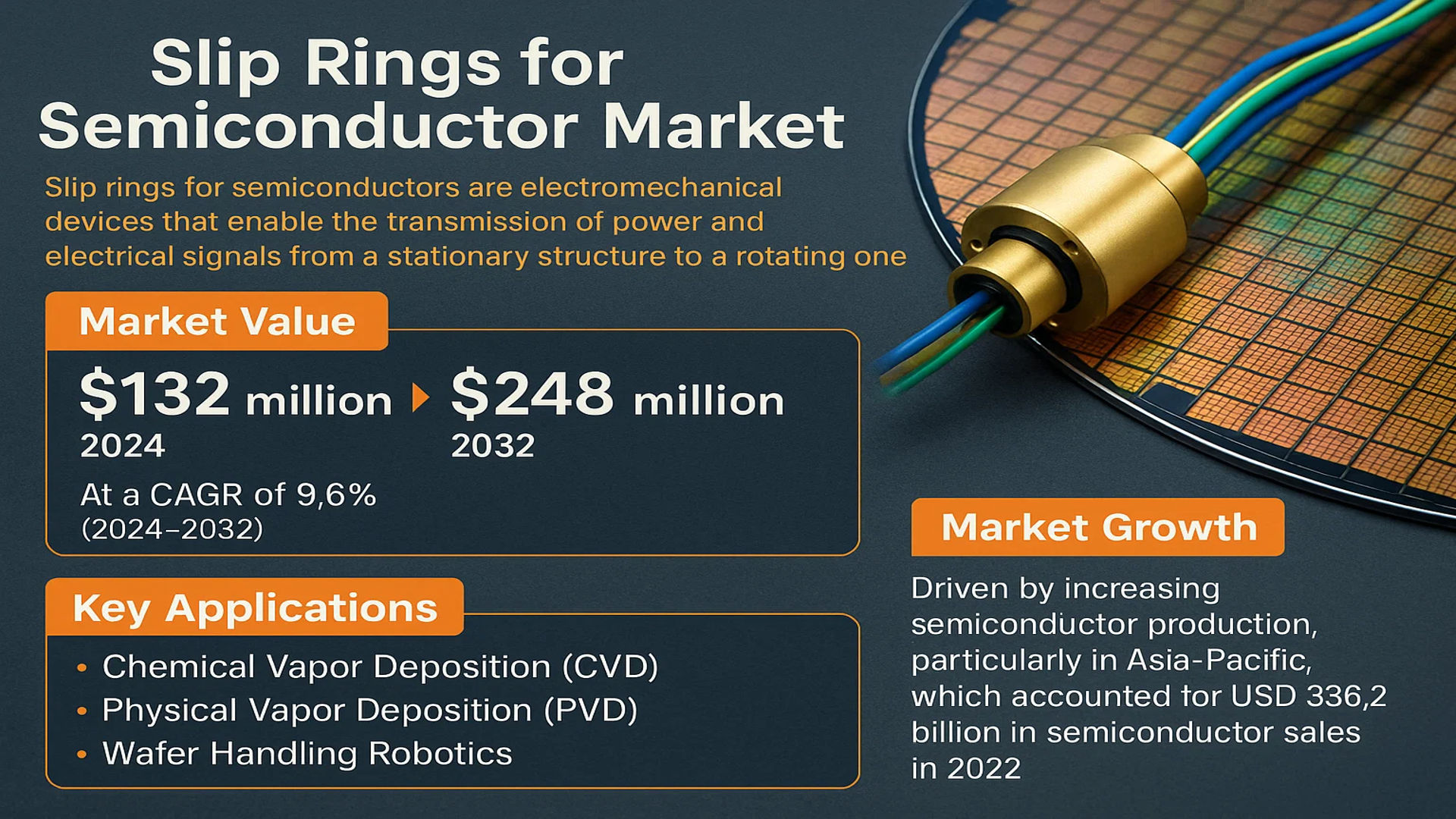
The global Slip Rings for Semiconductor Market was valued at 132 million in 2024 and is projected to reach US$ 248 million by 2032, at a CAGR of 9.6% during the forecast period.
Slip rings for semiconductors are electromechanical devices that enable the transmission of power and electrical signals from a stationary structure to a rotating one. These components are critical for semiconductor manufacturing processes, including chemical vapor deposition (CVD), physical vapor deposition (PVD), and wafer handling robotics. Their ability to maintain continuous electrical connections in high-speed and high-precision applications makes them indispensable in semiconductor fabrication facilities.
The market growth is driven by increasing semiconductor production, particularly in Asia-Pacific, which accounted for USD 336.2 billion in semiconductor sales in 2022. While the region saw a 2.37% decline that year, demand for advanced manufacturing equipment remains strong. Key players like Moog, Meridian Laboratory, and Deublin are innovating compact, high-performance slip rings to meet the semiconductor industry’s stringent requirements for precision and reliability in vacuum environments.
MARKET DYNAMICS
MARKET DRIVERS
Growing Semiconductor Manufacturing Sector to Fuel Slip Ring Demand
The global semiconductor industry continues to expand rapidly, with projections indicating compound annual growth of 6-8% over the next decade. Semiconductor slip rings play a critical role in wafer fabrication equipment by enabling uninterrupted power and signal transmission between stationary and rotating components. As foundries increase capacity to meet demand for chips across automotive, IoT and 5G applications, investments in deposition, polishing and handling equipment requiring slip rings are accelerating. Leading manufacturers have announced over $200 billion in new fabrication plant investments through 2025, creating substantial demand for high-performance slip ring solutions.
Advancements in Vacuum-Compatible Slip Ring Technology
The semiconductor industry’s shift toward more advanced process nodes below 7nm is driving innovation in slip ring design. Modern vacuum deposition and etching systems require slip rings that can maintain reliable performance in high-vacuum environments while handling increased data transmission rates. Recent product launches feature improved contact materials and sealing technologies that reduce particle generation – a critical factor in cleanroom environments. These innovations help semiconductor equipment manufacturers minimize contamination risks while enabling faster throughput, creating strong market demand for next-generation slip ring solutions.
Automation Trends in Wafer Handling Boosting Market Growth
Semiconductor manufacturers are increasingly adopting automated material handling systems to improve yield and reduce human contamination risks. This automation wave is creating strong demand for compact, high-reliability slip rings used in wafer handling robots and transport mechanisms. Modern 300mm wafer fabs typically require hundreds of precision motion control systems, each potentially incorporating multiple slip rings. As automation penetrates smaller wafer sizes and backend packaging facilities, the addressable market for semiconductor-grade slip rings continues expanding across the entire manufacturing value chain.
MARKET RESTRAINTS
High Costs Associated with Semiconductor-Grade Slip Rings
While essential for semiconductor equipment, high-performance slip rings command premium pricing due to stringent material requirements and manufacturing tolerances. Industrial slip rings typically cost between $100-$500 per channel, while semiconductor-grade versions can exceed $2,000 per channel. This price differential stems from specialized materials like gold-plated contacts, ultra-clean manufacturing processes, and extended qualification testing. For equipment manufacturers operating on tight budgets, these costs can delay adoption or push design teams toward alternative solutions where technically feasible.
Technical Challenges in Extreme Semiconductor Environments
Semiconductor fabrication presents uniquely challenging operating conditions for slip rings, including ultra-high vacuum, plasma exposure, and chemical vapor deposition byproducts. Maintaining reliable electrical contact while preventing particulate generation requires advanced material science solutions that are still evolving. Some newer fabrication techniques like atomic layer deposition push these requirements even further, creating design tradeoffs between electrical performance, lifespan, and contamination control. These technical hurdles can extend development cycles and qualification timelines for new slip ring designs.
MARKET OPPORTUNITIES
Expansion of 200mm Wafer Capacity Creating New Demand
While leading-edge semiconductor production focuses on 300mm and larger wafers, ongoing shortages in mature nodes have driven significant reinvestment in 200mm fabrication capacity. Over 20 major 200mm fab projects have been announced globally, requiring modernization of legacy equipment with updated slip ring technology. This trend presents opportunities for slip ring suppliers to provide drop-in upgrades that improve reliability while maintaining compatibility with existing tool architectures.
Emerging Applications in Advanced Packaging
The proliferation of 3D chip stacking and heterogeneous integration techniques is driving innovation in semiconductor packaging equipment. These advanced packaging tools increasingly incorporate rotating elements for precision alignment and bonding processes, creating new applications for miniature slip rings. With the advanced packaging market projected to grow at nearly 10% annually, equipment suppliers are actively seeking compact slip ring solutions that can operate in the unique thermal and mechanical environments of packaging operations.
MARKET CHALLENGES
Supply Chain Constraints Affecting Material Availability
The semiconductor industry’s supply chain challenges extend to slip ring manufacturers, particularly for specialized materials like high-purity gold contacts and vacuum-compatible lubricants. Many of these materials have long lead times and limited supplier bases, creating potential bottlenecks as demand grows. Some manufacturers report component lead times extending beyond 12 months for certain critical materials, forcing design compromises or inventory buffering that increases costs.
Rising Standards for Particle Performance
As semiconductor feature sizes shrink below 5nm, equipment cleanliness requirements become progressively more stringent. Modern fabrication tools often demand slip rings that generate fewer than 10 particles larger than 0.1 microns per million rotations – a specification that pushes the limits of current manufacturing capabilities. Meeting these requirements while maintaining electrical performance and durability represents an ongoing engineering challenge that requires continuous material and process innovation.
SLIP RINGS FOR SEMICONDUCTOR MARKET TRENDS
Rising Demand for High-Precision Semiconductor Manufacturing Drives Market Growth
The semiconductor industry is experiencing unprecedented demand, fueled by advancements in artificial intelligence, 5G, and the Internet of Things (IoT). Slip rings play a critical role in semiconductor manufacturing processes such as Chemical Vapor Deposition (CVD), Physical Vapor Deposition (PVD), and wafer handling robotics, where seamless power and signal transmission under vacuum conditions are essential. The global slip rings for semiconductor market was valued at $132 million in 2024 and is projected to reach $248 million by 2032, growing at a compound annual growth rate (CAGR) of 9.6%. This growth is largely attributed to the increasing complexity of semiconductor fabrication, requiring slip rings with higher bandwidth, lower electrical noise, and superior durability.
Other Trends
Shift Toward Advanced Slip Ring Technologies
Traditional brushed slip rings are being gradually replaced by brushless slip rings, which offer enhanced reliability, reduced maintenance, and longer operational lifespans—crucial for high-throughput semiconductor production. Manufacturers are increasingly adopting fiber optic rotary joints (FORJs) to enable high-speed data transmission in vacuum environments. Furthermore, advancements in materials science have led to slip rings with better corrosion resistance and thermal stability, making them ideal for harsh conditions in semiconductor fabrication.
Regional Semiconductor Industry Expansion Influencing Market Dynamics
Geographically, Asia-Pacific holds the largest share in the semiconductor slip ring market, owing to extensive semiconductor fabrication plants in countries like China, South Korea, and Taiwan. While the region saw a slight decline in semiconductor sales in 2022 due to weakened consumer demand, the Americas and Europe posted strong year-over-year growth, accelerating demand for slip rings in semiconductor equipment manufacturing. The push for domestic semiconductor production in the U.S. and Europe through policies like the CHIPS Act is expected to further boost market expansion in these regions.
Meanwhile, the rise of miniaturization and advanced packaging technologies is driving demand for compact, high-performance slip rings. Wafer handling robots, in particular, require slip rings that ensure minimal signal interference and high rotational precision—leading manufacturers to develop customized solutions tailored to semiconductor manufacturing requirements. With the semiconductor market projected to surpass $600 billion in the coming years, innovation in slip ring technology remains pivotal to supporting scalable and efficient production processes.
COMPETITIVE LANDSCAPE
Key Industry Players
Established and Emerging Players Drive Innovation in Semiconductor Slip Ring Solutions
The global slip rings for semiconductor market features a competitive mix of established manufacturers and specialized suppliers, with Moog Inc. leading the segment through its extensive product range and dominance in high-performance slip ring systems. The company’s technological edge in brushless slip rings for semiconductor manufacturing equipment has helped secure key contracts with major foundries and IDMs.
Specialist firms like Meridian Laboratory and Rotary Systems have gained traction by focusing on customized solutions for semiconductor vacuum applications. Their ability to provide compact, ultra-high vacuum compatible slip rings has made them preferred suppliers for CVD and PVD systems, particularly in Asian markets where semiconductor equipment production is concentrated.
The market has seen increasing competition from Chinese manufacturers such as Senring Electronics and Shenzhen Jingmao Electronics, which are capturing market share through cost-competitive offerings. While these players initially focused on lower-end applications, recent investments in R&D have enabled them to move into more advanced segments including 300mm wafer handling robots.
European suppliers like BGB Innovation and Moflon maintain strong positions in precision slip rings for semiconductor metrology equipment, leveraging their expertise in signal integrity and low-noise electrical transmission. These companies are actively collaborating with equipment manufacturers to develop next-generation solutions compatible with EUV lithography systems.
List of Key Slip Ring Manufacturers in Semiconductor Industry
- Moog Inc. (U.S.)
- Meridian Laboratory (U.S.)
- Rotary Systems, Inc. (U.S.)
- Senring Electronics Co., Ltd. (China)
- BGB Innovation GmbH (Germany)
- Deublin Company (U.S.)
- Moflon Technology Co., Ltd. (China)
- Shenzhen Jingmao Electronics Co., Ltd. (China)
Industry consolidation has accelerated as larger players seek to acquire specialized technology. Recent moves include Moog’s strategic partnerships with semiconductor equipment OEMs and Deublin’s expansion into Asia-Pacific markets through local joint ventures. With semiconductor manufacturers demanding higher reliability and longer mean time between failures (MTBF), companies are differentiating through advanced materials and predictive maintenance capabilities incorporated into their slip ring systems.
Emerging competition comes from manufacturers integrating slip rings with IIoT capabilities, allowing real-time monitoring of brush wear and signal quality. This technological evolution is reshaping the competitive dynamics, with traditional mechanical component suppliers facing pressure to enhance their digital offerings or risk losing ground to more technologically agile competitors.
Segment Analysis:
By Type
Brushless Slip Rings Segment Dominates Due to Its High Reliability and Longevity in Semiconductor Applications
The market is segmented based on type into:
- Brushed
- Subtypes: Low-speed, High-speed, and others
- Brushless
By Application
Chemical Vapor Deposition (CVD) Segment Leads Due to Critical Role in Semiconductor Fabrication
The market is segmented based on application into:
- Chemical Vapor Deposition (CVD)
- Physical Vapor Deposition (PVD)
- Chemical Mechanical Polishing (CMP) and Grinding
- Wafer Handling Robots
- Vacuum Coating Systems
- Others
By Material
Advanced Composite Materials Segment Grows Due to High-Performance Requirements
The market is segmented based on material into:
- Metal Alloy
- Advanced Composites
- Ceramic-impregnated
- Others
By Current Capacity
High-Current Segments Expand with Growing Semiconductor Manufacturing Needs
The market is segmented based on current capacity into:
- Low-current (Below 10A)
- Medium-current (10-50A)
- High-current (Above 50A)
Regional Analysis: Slip Rings for Semiconductor Market
Asia-Pacific
The Asia-Pacific region dominates the global slip rings for semiconductor market, accounting for the largest revenue share in 2024. This leadership position stems from concentrated semiconductor manufacturing hubs in China, Taiwan, South Korea, and Japan – which collectively represent over 60% of global chip production capacity. The region has witnessed aggressive investments in wafer fabrication plants and advanced packaging facilities requiring high-performance slip rings for critical processes. While China’s semiconductor industry saw a 2.37% decline in 2022 sales, government initiatives like the “Made in China 2025” policy continue driving long-term expansion. Taiwan remains a powerhouse in foundry services, with TSMC alone commanding 55% of the global foundry market. The region’s cost-effective manufacturing ecosystem and growing adoption of Industry 4.0 technologies in semiconductor production are accelerating demand for both brushed and brushless slip ring solutions.
North America
North America represents the second-largest market for semiconductor slip rings, driven by robust R&D investments and a resurgence of domestic chip manufacturing. The U.S. CHIPS and Science Act, allocating $52 billion for semiconductor research and production, is catalyzing new fab constructions in Arizona, Ohio, and Texas. These facilities will require slip rings for cutting-edge applications including extreme ultraviolet (EUV) lithography systems and advanced wafer handling robots. The region benefits from strong semiconductor equipment suppliers and slip ring manufacturers like Moog and Meridian Laboratory, who provide high-reliability solutions compatible with stringent U.S. industry standards. Canada’s growing semiconductor ecosystem, particularly in compound semiconductors, presents additional opportunities for specialized slip ring applications.
Europe
Europe maintains a technologically advanced but smaller semiconductor slip ring market, focused on specialized applications and high-precision requirements. The EU Chips Act aims to double Europe’s global semiconductor market share to 20% by 2030, driving investment in new fabrication facilities that will require slip rings for vacuum deposition systems and automated material handling. Germany remains the regional leader, hosting major equipment manufacturers requiring slip rings for their semiconductor production lines. Environmental regulations in Europe favor the adoption of maintenance-free brushless slip ring designs, though their higher costs slow adoption compared to conventional solutions. Collaborative R&D initiatives between European research institutions and slip ring manufacturers continue to yield innovations in high-speed data transmission and miniature slip ring designs.
South America
The South American market for semiconductor slip rings remains nascent but shows promising growth potential. Brazil represents the largest regional market, with incremental investments in semiconductor packaging and testing facilities. However, limited domestic semiconductor manufacturing capacity and reliance on imported equipment restrain market expansion. Regional economic volatility and currency fluctuations create challenges for consistent investment in advanced semiconductor production technologies. Some growth is emerging in Argentina and Chile through small-scale semiconductor assembly operations, though these primarily use refurbished or lower-cost slip ring solutions.
Middle East & Africa
This region represents an emerging market with selective investment in semiconductor-related industries. The UAE and Saudi Arabia are making strategic moves into semiconductor packaging and testing through partnerships with Asian firms, creating new demand for industrial slip rings. Israel’s strong semiconductor design industry drives some domestic demand for specialized slip rings used in prototype development and small-scale production. Across the region, limited manufacturing infrastructure and focus on downstream semiconductor activities result in relatively low slip ring demand compared to other regions. However, long-term growth potential exists as Middle Eastern nations diversify their economies beyond oil and gas.
Report Scope
This market research report provides a comprehensive analysis of the global and regional Slip Rings for Semiconductor markets, covering the forecast period 2025–2032. It offers detailed insights into market dynamics, technological advancements, competitive landscape, and key trends shaping the industry.
Key focus areas of the report include:
- Market Size & Forecast: Historical data and future projections for revenue, unit shipments, and market value across major regions and segments. The Global Slip Rings for Semiconductor market was valued at USD 132 million in 2024 and is projected to reach USD 248 million by 2032, growing at a CAGR of 9.6%.
- Segmentation Analysis: Detailed breakdown by product type (brushed, brushless), technology, application (CMP, CVD, PVD, wafer handling robots, vacuum coating systems), and end-user industry to identify high-growth segments and investment opportunities.
- Regional Outlook: Insights into market performance across North America, Europe, Asia-Pacific, Latin America, and the Middle East & Africa. Asia-Pacific accounted for the largest share in 2024, with China, Japan, and South Korea being key markets.
- Competitive Landscape: Profiles of leading market participants including Moog, Meridian Laboratory, Rotary Systems, Senring Electronics, BGB Innovation, Deublin, Moflon, and Shenzhen Jingmao Electronics, covering their product portfolios, market share, and strategic developments.
- Technology Trends & Innovation: Assessment of emerging technologies in slip ring design, integration with Industry 4.0 systems, and advancements in materials for improved performance in semiconductor manufacturing environments.
- Market Drivers & Restraints: Evaluation of factors driving market growth (increasing semiconductor manufacturing, automation in fabs) along with challenges (supply chain constraints, high precision requirements).
- Stakeholder Analysis: Insights for semiconductor equipment manufacturers, slip ring suppliers, system integrators, and investors regarding the evolving ecosystem and strategic opportunities.
Primary and secondary research methods are employed, including interviews with industry experts, analysis of company financials, and data from semiconductor industry associations to ensure the accuracy and reliability of the insights presented.
FREQUENTLY ASKED QUESTIONS:
What is the current market size of Global Slip Rings for Semiconductor Market?
-> Slip Rings for Semiconductor Market was valued at 132 million in 2024 and is projected to reach US$ 248 million by 2032, at a CAGR of 9.6%.
Which key companies operate in Global Slip Rings for Semiconductor Market?
-> Key players include Moog, Meridian Laboratory, Rotary Systems, Senring Electronics, BGB Innovation, Deublin, Moflon, and Shenzhen Jingmao Electronics.
What are the key growth drivers?
-> Key growth drivers include increasing semiconductor manufacturing capacity, automation in wafer fabrication, and demand for high-precision motion control systems.
Which region dominates the market?
-> Asia-Pacific dominates the market due to its concentration of semiconductor fabs, while North America leads in technology innovation.
What are the emerging trends?
-> Emerging trends include miniaturization of slip rings, integration with Industry 4.0 systems, and development of high-speed, low-noise solutions for advanced semiconductor processes.

Get Sample Report PDF for Exclusive Insights
Report Sample Includes
- Table of Contents
- List of Tables & Figures
- Charts, Research Methodology, and more...
 Download Sample Report PDF