Sleep Monitoring Millimeter-wave Radar Market Insights
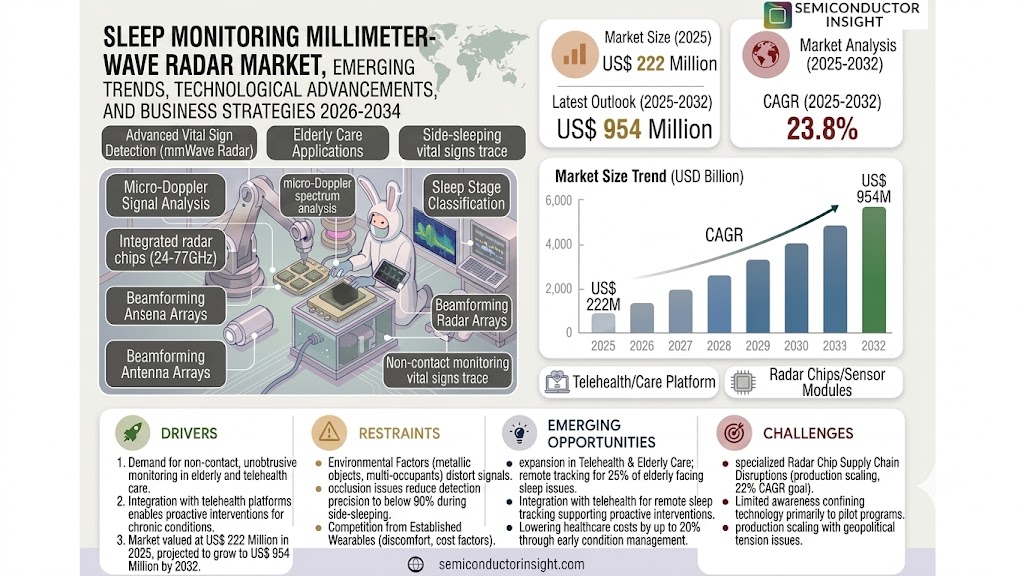
Global Sleep Monitoring Millimeter-wave Radar market size was valued at USD 222 million in 2025. The market is projected to grow from USD 222 million in 2025 to USD 954 million by 2032, exhibiting a CAGR of 23.8% during the forecast period.
Sleep monitoring millimeter-wave radar is a non-contact technology that uses high-frequency radio waves to monitor vital signs and movements during sleep. By emitting and analyzing reflected waves, it detects subtle chest movements from breathing and heartbeats, along with body shifts. Unlike wearables, it requires no physical contact, enabling continuous, unobtrusive tracking ideal for healthcare, smart homes, and wellness applications.
The market is experiencing rapid growth due to surging demand for non-invasive health monitoring, rising sleep disorder prevalence, and IoT integration in consumer devices. Advancements in 60 GHz radar sensors and AI algorithms enhance accuracy for sleep apnea detection and pattern analysis. Key players drive expansion through innovation; for instance, Infineon Technologies offers 60 GHz radar ICs like BGT60TR13C for precise vital signs monitoring in sleep applications. Infineon, Texas Instruments, and Huawei lead with diverse portfolios in this competitive landscape.
MARKET DRIVERS
Technological Advancements in Radar Sensors
Sleep Monitoring Millimeter-wave Radar Market is propelled by rapid improvements in millimeter-wave radar technology, enabling precise detection of vital signs like respiration and heart rate without physical contact. These sensors offer high resolution for tracking subtle movements during sleep, addressing limitations of traditional wearables. Integration with AI algorithms enhances data accuracy, supporting real-time analysis in home and clinical settings.
Increasing Prevalence of Sleep Disorders
Aging populations and sedentary lifestyles contribute to a surge in sleep apnea and insomnia cases, with over 1 billion people worldwide affected. Demand for non-invasive monitoring solutions in Sleep Monitoring Millimeter-wave Radar Market rises as consumers seek convenient alternatives to polysomnography. Healthcare providers increasingly adopt these systems for remote patient monitoring, reducing hospital visits by up to 30%.
➤ Smart Home and IoT Integration Boosts Adoption
Seamless connectivity with smart home ecosystems positions millimeter-wave radar devices as key components in wellness-focused environments. Partnerships between tech firms and medical device manufacturers accelerate market penetration, with the sector expected to capture 15% of the broader sleep tech market by 2028. This synergy drives sustained growth through enhanced user engagement and data-driven insights.
MARKET CHALLENGES
High Development and Deployment Costs
Developing reliable millimeter-wave radar systems for sleep monitoring involves substantial R&D investments, pricing units beyond reach for average consumers in Sleep Monitoring Millimeter-wave Radar Market. Calibration for diverse body types and environments adds complexity, limiting scalability in emerging markets where affordability is paramount.
Technical hurdles in signal processing persist, as multipath interference from room clutter can degrade accuracy. Manufacturers must innovate to achieve consistent performance across varied sleeping positions.
Other Challenges
Regulatory Compliance and Data Privacy
Stringent FDA and CE approvals demand rigorous clinical validation, delaying product launches. Consumer concerns over health data security further complicate adoption in privacy-sensitive regions.
MARKET RESTRAINTS
Accuracy Limitations in Complex Environments
Sleep Monitoring Millimeter-wave Radar Market faces restraints from environmental factors like metallic objects or multiple occupants, which distort radar signals and reduce vital sign detection precision to below 90% in some scenarios. Unlike optical sensors, radar struggles with occlusion issues during side-sleeping.
Competition from established wearable devices, holding 70% market share, restrains growth as users prefer familiar, lower-cost options despite discomfort. Battery life and portability advantages of wearables overshadow radar’s non-contact benefits in consumer segments.
Supply chain disruptions for specialized radar chips, exacerbated by geopolitical tensions, limit production scaling. This results in elongated lead times, hindering the market’s ability to meet rising demand projections of 22% CAGR through 2030.
Limited awareness among healthcare professionals about radar-based sleep monitoring further caps institutional adoption, confining the technology primarily to pilot programs.
MARKET OPPORTUNITIES
Expansion in Telehealth and Elderly Care
Sleep Monitoring Millimeter-wave Radar Market holds significant potential in telemedicine, where remote sleep tracking supports chronic condition management for 25% of the elderly population facing sleep issues. Integration with telehealth platforms enables proactive interventions, potentially lowering healthcare costs by 20%.
Consumer wellness trends favor contactless devices, opening doors for app-linked radar monitors in smart bedrooms. Partnerships with mattress and bedding brands could embed technology, targeting the $50 billion sleep industry.
Emerging markets in Asia-Pacific, with urbanization driving sleep disorder prevalence, offer untapped growth. Localized manufacturing and subsidies could propel adoption rates to match North America’s 18% penetration.
Advancements in 5G and edge computing enhance real-time data processing, positioning radar solutions for B2B opportunities in corporate wellness programs monitoring employee sleep quality.
Sleep Monitoring Millimeter-wave Radar Market Trends
Rise of Non-Contact Monitoring in Healthcare and Homes
Sleep Monitoring Millimeter-wave Radar Market is witnessing a significant shift towards non-contact technologies that enable precise detection of vital signs such as breathing and heartbeats through high-frequency radio waves. This trend is propelled by the growing preference for unobtrusive sleep tracking solutions over traditional wearables, allowing continuous monitoring without physical attachments. In healthcare settings, millimeter-wave radar systems facilitate detailed analysis of sleep patterns and disturbances like apnea, enhancing diagnostic accuracy in clinical environments. Meanwhile, integration into home use applications is accelerating, as consumers seek comfortable alternatives for everyday wellness tracking. Leading developers are focusing on refining algorithms to improve data reliability, positioning this technology as a cornerstone in the evolving Sleep Monitoring Millimeter-wave Radar Market.
Other Trends
Advancements in Frequency-Specific Sensors
Developments in 24 GHz and 60 GHz radar sensors are key drivers in Sleep Monitoring Millimeter-wave Radar Market, with 60 GHz variants gaining traction due to their higher resolution for detecting subtle chest movements. Companies like Infineon and Texas Instruments are innovating these sensors for seamless embedding into smart devices, overcoming earlier limitations in signal processing. This progression supports broader adoption across medical and home applications, where precision in movement and vital sign detection is paramount.
Expansion through Strategic Partnerships and Smart Home Integration
Sleep Monitoring Millimeter-wave Radar Market is expanding via collaborations among manufacturers, suppliers, and tech firms, enabling integration into consumer electronics like smart home systems from players such as Huawei and Aqara. This trend addresses challenges like regulatory hurdles by leveraging established distribution networks and fosters innovation in automotive safety and wellness products. Regional dynamics, particularly in Asia with firms like Shenzhen Ferry Smart and Chuhang Tech, underscore the market’s global reach, emphasizing research to mitigate development costs and enhance competitive positioning. Overall, these trends highlight a maturing ecosystem focused on accessible, high-precision sleep monitoring solutions.
COMPETITIVE LANDSCAPE
Key Industry Players
Top Innovators in Sleep Monitoring Millimeter-Wave Radar Technology
Sleep Monitoring Millimeter-wave Radar Market features a dynamic competitive landscape dominated by semiconductor giants and specialized tech firms leveraging 60 GHz and 24 GHz radar sensors for non-contact vital signs detection. Leading players like Infineon Technologies and Texas Instruments hold significant market share through their advanced mmWave radar chips, enabling precise monitoring of breathing, heartbeats, and sleep movements without wearables. Infineon’s 60 GHz radar solutions integrate seamlessly into smart home devices and healthcare systems, capturing over a notable portion of the global revenue as the market grows from $222 million in 2025 to $954 million by 2032 at a 23.8% CAGR. The structure is moderately concentrated among top-five companies accounting for substantial sales in medical and home use segments, with ongoing innovations in algorithms for sleep apnea detection and regulatory compliance driving leadership.
Beyond frontrunners, niche players contribute through specialized applications in consumer electronics and IoT ecosystems, fostering fragmentation in Asia-dominated manufacturing. Companies such as Huawei, EZVIZ, and Aqara focus on integrated smart home solutions, while Chinese firms like Chuhang Tech and Microbrain Intelligent emphasize affordable 24 GHz systems for home monitoring. Others like Sleepiz (via partnerships), Seeed Technology, WHST, Shenzhen Ferry Smart, Uniview, Tsingray, AxEnd, Innopro, and Shenzhen Ferry Smart address regional demands in North America, Europe, and Asia, with strengths in custom radar modules and software for wellness tracking. Strategic mergers, R&D investments, and supply chain optimizations are key to navigating challenges like high costs and competition from wearables.
List of Key Sleep Monitoring Millimeter-wave Radar Companies Profiled
- Infineon Technologies
- Texas Instruments
- AxEnd
- Huawei
- EZVIZ
- Seeed Technology
- WHST
- Shenzhen Ferry Smart
- Uniview
- Tsingray
- Chuhang Tech
- Microbrain Intelligent
- Innopro
- Aqara
Segment Analysis:
| Segment Category | Sub-Segments | Key Insights |
| By Type |
|
60 GHz
|
| By Application |
|
Medical
|
| By End User |
|
Hospitals and Clinics
|
| By Deployment Mode |
|
Stationary/Fixed
|
| By Component |
|
Radar Sensors
|
Regional Analysis: Sleep Monitoring Millimeter-wave Radar Market
North America
Silicon Valley and Boston lead Sleep Monitoring Millimeter-wave Radar advancements, where startups and giants prototype radar sensors for seamless sleep tracking. These hubs foster rapid iteration, blending AI with radar signals to detect subtle disturbances, enhancing product reliability and market readiness.
Favorable FDA guidelines streamline approvals for millimeter-wave radar devices, emphasizing safety and efficacy in sleep monitoring. This environment encourages investment, enabling quicker commercialization compared to other regions and bolstering competitive positioning.
High consumer affinity for tech-integrated health solutions propels adoption, with integrations into smart homes and apps simplifying sleep data analysis. Wellness-focused initiatives amplify usage in preventive care, driving broader Sleep Monitoring Millimeter-wave Radar Market penetration.
Strategic alliances between radar tech developers and healthcare networks expand reach, customizing solutions for hospitals and consumer markets. These collaborations refine applications, ensuring alignment with evolving sleep health needs through 2034.
Europe
Europe demonstrates robust growth in Sleep Monitoring Millimeter-wave Radar Market, underpinned by stringent data privacy regulations like GDPR that favor non-invasive radar technologies over optical methods. Mature healthcare systems prioritize sleep disorder management, integrating radar monitors into elderly care and clinical trials. Countries like Germany and the UK spearhead R&D, focusing on interoperability with existing medical devices. Consumer demand rises with heightened wellness awareness, supported by EU-funded projects advancing radar precision for apnea detection. Challenges include fragmented markets, yet harmonized standards promote cross-border scalability. Strategic investments in medtech innovation position Europe for steady market evolution, emphasizing sustainable and user-centric Sleep Monitoring Millimeter-wave Radar solutions through the forecast period.
Asia-Pacific
Asia-Pacific emerges as a dynamic force in Sleep Monitoring Millimeter-wave Radar Market, propelled by rapid urbanization, expanding middle classes, and manufacturing prowess. Japan and China dominate production, leveraging cost-effective radar components for affordable sleep trackers tailored to high-density living. Government initiatives in digital health accelerate adoption in smart cities, where radar tech integrates with IoT ecosystems for real-time monitoring. Addressing prevalent sleep issues in aging societies, the region innovates hybrid solutions combining radar with local wearables. Supply chain efficiencies and tech talent pools enhance competitiveness, though regulatory harmonization lags. This vibrant landscape promises accelerated Sleep Monitoring Millimeter-wave Radar Market growth, focusing on scalability and accessibility by 2034.
South America
South America presents emerging opportunities in Sleep Monitoring Millimeter-wave Radar Market, driven by improving healthcare access and rising chronic condition prevalence. Brazil and Mexico lead adoption, piloting radar systems in public health programs for remote sleep assessments. Local manufacturers adapt imported tech for tropical climates, emphasizing durable, low-maintenance designs. Economic recovery fosters investments in telehealth, where non-contact monitoring bridges urban-rural divides. Awareness campaigns highlight benefits over invasive methods, spurring consumer interest. Infrastructure hurdles persist, but partnerships with global players catalyze progress, positioning the region for gradual Sleep Monitoring Millimeter-wave Radar Market maturation amid evolving business strategies.
Middle East & Africa
The Middle East & Africa region unlocks potential in Sleep Monitoring Millimeter-wave Radar Market through modernization efforts and burgeoning smart city projects. Gulf nations like UAE invest heavily in health tech, deploying radar for luxury wellness resorts and hospitals. Africa’s growing middle class seeks affordable sleep solutions amid urbanization stresses. Pilot programs test radar efficacy in diverse environments, prioritizing energy-efficient designs. Collaborative ventures with Asian suppliers mitigate costs, while policy shifts toward digital health enable integration. Early-stage development offers high growth prospects, with focus on culturally sensitive applications driving Sleep Monitoring Millimeter-wave Radar Market entry and expansion toward 2034.
Report Scope
This market research report provides a comprehensive analysis of Sleep Monitoring Millimeter-wave Radar Market, covering the forecast period 2025–2032. It offers detailed insights into market dynamics, technological advancements, competitive landscape, and key trends shaping the industry.
Key focus areas of the report include:
- Market Overview: The report begins with an overview outlining its current market scenario, key growth indicators, and industry transformation drivers. It discusses macroeconomic factors, demand–supply balance, regulatory landscape, and the strategic role of millimeter-wave radar in powering advancements across industries such as healthcare, smart home systems, automotive safety, and wellness applications.
- Market Size & Forecast: Historical data and future projections for revenue, unit shipments, and market value across major regions and segments.
- Segmentation Analysis: Detailed breakdown by product type, technology, application, and end-user industry to identify high-growth segments and investment opportunities.
- Regional Insights: Insights into market performance across North America, Europe, Asia-Pacific, Latin America, and the Middle East & Africa, including country-level analysis where relevant.
- Competitive Landscape: Profiles of leading market participants, including their product offerings, R&D focus, manufacturing capacity, pricing strategies, and recent developments such as mergers, acquisitions, and partnerships.
- Technology Trends & Innovation: Assessment of emerging technologies, integration of AI/IoT, semiconductor design trends, fabrication techniques, and evolving industry standards.
- Market Drivers & Restraints: Evaluation of factors driving market growth along with challenges, supply chain constraints, regulatory issues, and market-entry barriers.
- Stakeholder Insights: Insights for component suppliers, OEMs, system integrators, investors, and policymakers regarding the evolving ecosystem and strategic opportunities.
Primary and secondary research methods are employed, including interviews with industry experts, data from verified sources, and real-time market intelligence to ensure the accuracy and reliability of the insights presented.
FREQUENTLY ASKED QUESTIONS:
What is the current market size of Sleep Monitoring Millimeter-wave Radar Market?
-> Global Sleep Monitoring Millimeter-wave Radar market was valued at USD 222 million in 2025 and is projected to reach USD 954 million by 2032, at a CAGR of 23.8% during the forecast period.
Which key companies operate in Sleep Monitoring Millimeter-wave Radar Market?
-> Key players include Infineon, Texas Instruments, AxEnd, Huawei, EZVIZ, Seeed Technology, among others.
What are the key growth drivers?
-> Key growth drivers include demand for non-invasive high-precision health monitoring solutions, integration into smart home devices, and rising awareness of sleep disorders like sleep apnea.
Which region dominates the market?
-> Asia is the fastest-growing region, while North America remains a dominant market.
What are the emerging trends?
-> Emerging trends include 60 GHz radar sensors with advanced algorithms, non-contact monitoring in consumer electronics, and real-time sleep pattern analysis.

Get Sample Report PDF for Exclusive Insights
Report Sample Includes
- Table of Contents
- List of Tables & Figures
- Charts, Research Methodology, and more...
 Download Sample Report PDF