Six Axis Sensor Market Insights
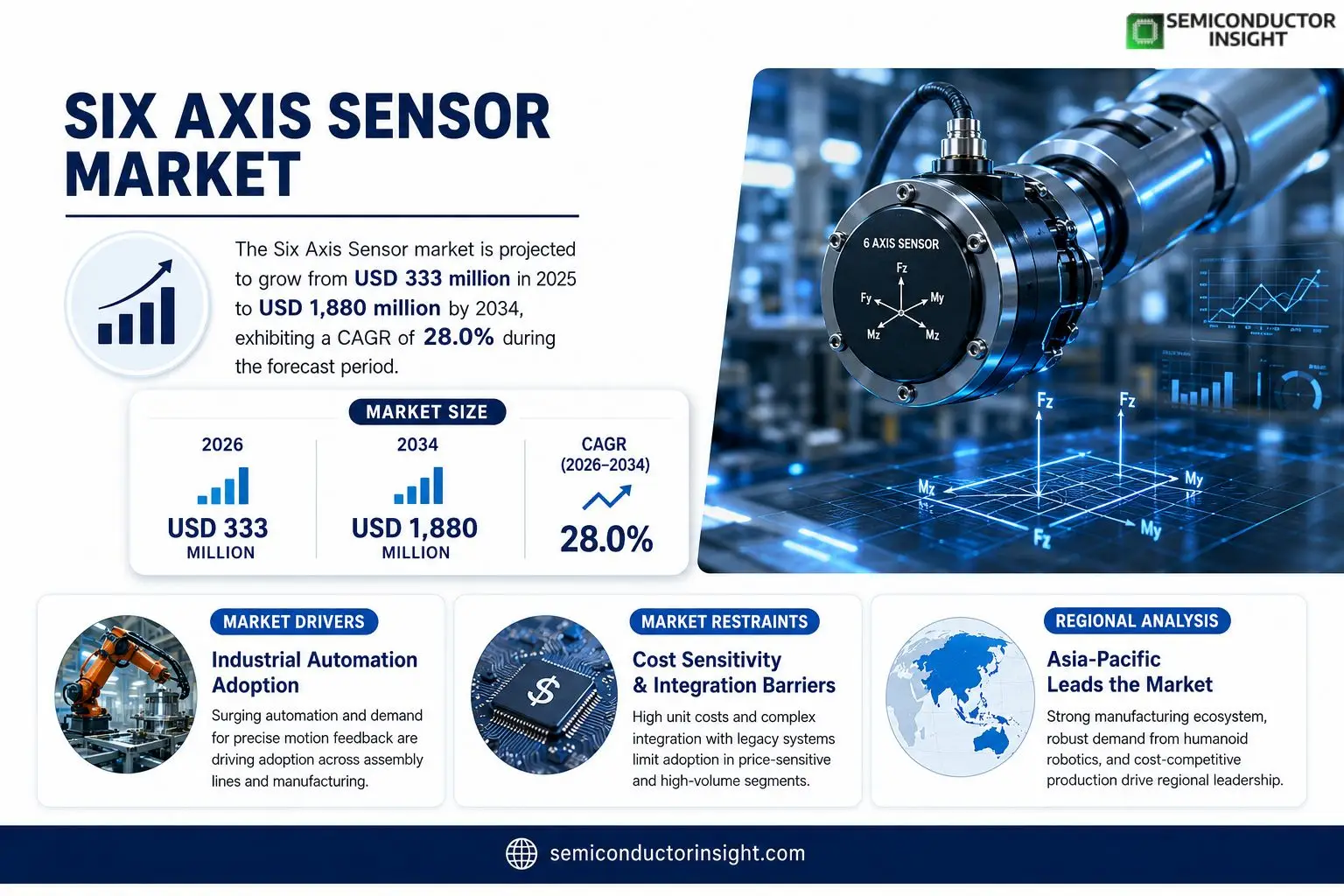
Six Axis Sensor market size was valued at USD 333 million in 2025 and will increase to USD 1880 million by 2034, reflecting a CAGR of 28.0% over the forecast period.
The Six Axis Sensor is a precision device capable of simultaneously detecting force components along three axes (Fx, Fy, Fz) and torque components around three axes (Mx, My, Mz), delivering full six‑degree‑of‑freedom force information. In 2025, worldwide production reached roughly 92,607 units with an average price of about USD 3 933 per unit. High precision, low coupling and fast dynamic response make the sensor indispensable for industrial automation, precision assembly, aerospace testing and medical surgical robots.The rapid expansion is linked to rising adoption in humanoid robotswhere sensors are mounted on wrists, ankles and joint endsto monitor gait impacts, grasping forces and collision events, thereby enhancing balance control and safety. Major suppliers such as ATI Industrial Automation, Epson,Yuli Instruments,Kunwei Technologyand Shenzhen Xinjingcheng Sensing Technology are scaling capacity while new collaborations aim to improve sensitivity and reduce crosstalk.
MARKET DRIVERS
Industrial Automation Adoption
The surge in automated assembly lines has lifted demand for precise motion feedback. Companies upgrading legacy platforms are opting for six‑axis sensors because they consolidate three‑dimensional orientation and linear displacement into a single package, reducing wiring complexity and maintenance overhead. Manufacturers report that integration cycles have shortened by up to 30% when these sensors replace separate gyroscopes and accelerometers.
Growth of Autonomous Robotics
Robotic solutions that navigate unstructured environments rely on high‑resolution orientation data. The proliferation of collaborative robots (cobots) in small‑to‑medium enterprises has created a niche where six‑axis sensors provide the fidelity needed for safe human‑machine interaction. End‑users note a measurable reduction in positional drift, which translates into higher throughput and lower scrap rates.
➤ “Integrating a six‑axis sensor into our pick‑and‑place system cut cycle time by 12%, delivering immediate ROI.” – Senior Engineer, electronics manufacturer
Beyond hardware, software ecosystems that support sensor fusion are maturing, enabling developers to extract richer insights from a single device. This synergy drives a virtuous cycle: better data fuels smarter algorithms, which in turn raise the bar for sensor performance, sustaining momentum across the supply chain.
MARKET CHALLENGES
Cost Sensitivity in High‑Volume Sectors
While six‑axis sensors offer functional advantages, price remains a hurdle for mass‑production lines where unit economics are razor‑thin. Tier‑1 OEMs often negotiate bulk discounts that compress margins for sensor makers, forcing them to balance bill‑of‑materials reductions against performance targets.
Other Challenges
Supply Chain Volatility
Unpredictable component lead times for MEMS chips and specialized packaging materials have introduced scheduling uncertainty. Companies that cannot secure reliable procurement risk delayed product launches, eroding competitive advantage.Additional friction emerges from varying regulatory standards across regions. Aligning sensor calibration procedures to meet both IEC and ISO norms demands engineering resources that smaller firms may lack, thereby limiting market entry.
MARKET RESTRAINTS
Technical Integration Barriers
Integrating six‑axis sensors into legacy control architectures often requires redesign of firmware and communication protocols. The need for specialized calibration tools adds both time and capital outlay, discouraging adoption in facilities where uptime is paramount.Furthermore, the steep learning curve associated with interpreting multi‑dimensional data limits the pool of qualified engineers, creating a talent bottleneck that slows deployment rates.
MARKET OPPORTUNITIES
Emerging Applications in AR/VR Systems
The rise of immersive technologies calls for compact sensors that can track head and hand movements with sub‑degree accuracy. Six‑axis sensors, thanks to their integrated design, are uniquely positioned to meet the size and power constraints of wearable devices, opening a new revenue stream beyond traditional industrial uses.Parallel growth in automotive driver‑assistance systems presents another frontier. High‑precision orientation data supports advanced stability control algorithms, and regulators are increasingly mandating such capabilities in next‑generation vehicles, promising a sizable market uplift.
Six Axis Sensor Market Trends
Humanoid Robot Adoption Accelerates Sensor Demand
The integration of Six Axis Sensors into humanoid platforms has moved from experimental labs to production lines. Engineers place the devices at wrists, ankles and joint terminations to capture six‑degree‑of‑freedom force data, which translates into smoother gait cycles and more nuanced object manipulation. This technical advantage is prompting OEMs to redesign chassis around sensor geometry rather than retrofit existing structures, shortening development cycles and opening new pricing tiers for end‑users. For suppliers, the shift creates a steady pipeline of orders that is less vulnerable to seasonal fluctuations in traditional industrial robot demand, and it forces them to prioritize low‑latency calibration methods to meet the real‑time control loops required by advanced locomotion algorithms.
Other Trends
Supply Chain Resilience and Cost Competitiveness
Core inputs such as elastomers, precision strain gauges and ASIC chips remain sourced from a narrow set of vendors, yet recent investments in regional fabrication have reduced lead times for high‑volume manufacturers in China. The resulting cost advantage is evident in the price‑performance balance of domestic offerings, which now rival brands on accuracy while delivering lower unit costs. Profit margins of 35‑45 % give producers room to invest in automated test rigs, further tightening calibration tolerances and supporting the expansion of the sensor base from a few thousand units per line to tens of thousands. Buyers in automotive crash‑testing labs and medical robot developers are increasingly specifying Chinese‑sourced parts to meet both budget constraints and performance thresholds.
Strain‑Gauge Technology Consolidates Market Share
Across Six Axis Sensor Market, the strain‑gauge principle dominates more than 80 % of unit shipments. Its mechanical robustness and familiarity among calibration engineers make it the default choice for new product launches, especially where long‑term drift must be minimized. While piezoelectric and capacitive variants offer higher bandwidth, the incremental benefit does not yet outweigh the higher material costs and stricter environmental controls they demand. Consequently, manufacturers are focusing R&D budgets on reducing crosstalk and enhancing overload resistance within the strain‑gauge family, narrowing the performance gap with premium competitors. For downstream users, this trend translates into broader availability of mature sensor kits, quicker integration timelines, and a more predictable total cost of ownership, all of which reinforce the upward trajectory of Six Axis Sensor Market.
COMPETITIVE LANDSCAPEKey Industry Players
Six Axis Sensor Market – Competitive Overview
The top tier of Six Axis Sensor Market remains dominated by a handful of multinational firms whose legacy in aerospace and precision instrumentation gives them an edge in high‑accuracy product lines. ATI Industrial Automation and Epson, for instance, continue to leverage mature calibration processes and extensive service networks to command premium pricing in North America and Europe. Meanwhile, Chinese manufacturers such as Yuli Instruments, Kunwei Technology, and Xinjingcheng Sensing Technology have accelerated their market share by offering comparable accuracy at lower cost, aided by rapid scale‑up of automated assembly lines. This blend of established incumbents and emerging cost‑competitors creates a bifurcated structure: high‑margin niche segments stay with the legacy players, while volume‑driven applications in industrial and humanoid robotics shift toward the newer entrants.Beyond the headline names, a diverse set of specialist firms enriches the competitive field. Schunk and Sunrise Instruments (SRI) focus on modular sensor architectures that cater to custom robotics integrators. Kistler and Robotiq provide integrated force‑torque solutions embedded within complete robot end‑effectors, blurring the line between sensor and actuator. Companies such as FUTEK, ME‑Meßsysteme, and Wacoh‑Tech target niche sectors like medical surgical robots and biomechanics testing, where ultra‑low coupling and high bandwidth are decisive. The presence of these niche players pressures larger vendors to broaden their portfolios and adopt faster innovation cycles, thereby intensifying product differentiation across the market.
List of Key Six Axis Sensor Companies Profiled
- ATI Industrial Automation
- Epson
- Yuli Instruments
- Kunwei Technology
- Shenzhen Xinjingcheng Sensing Technology
- Schunk
- Sunrise Instruments (SRI)
- Kistler
- Robotiq
- FUTEK
- ME‑Meßsysteme
- Wacoh‑Tech
- Nordbo Robotics
- Bota Systems
Segment Analysis:
| Segment Category | Sub-Segments | Key Insights |
| By Type |
|
Strain Gauge Type dominates the market because it delivers unparalleled accuracy and robustness for industrial robot arms.
|
| By Application |
|
Humanoid Robots are emerging as the fastest‑growing application segment.
|
| By End User |
|
Robotics Manufacturers drive demand through continuous product innovation.
|
| By Deployment Environment |
|
On‑Robot Embedded Systems are gaining prominence as manufacturers embed sensors directly into joint structures.
|
| By Technology Trend |
|
AI‑Assisted Calibration is reshaping quality assurance for Six Axis Sensors.
|
Regional Analysis: Six Axis Sensor Market
North America
Vehicle manufacturers are embedding six‑axis sensors into chassis control modules to refine dynamic stability functions. The move reflects a strategic shift toward software‑defined vehicle platforms, where sensor fidelity directly influences driver‑assist capabilities and future autonomous features.
Factories upgrading to collaborative robots favor multi‑axis sensing for nuanced force feedback. The technology enables robots to respond to subtle variations in load, improving cycle times and reducing wear on mechanical components.
In aerospace, six‑axis sensors are critical for inertial navigation in drones and satellite attitude control. Their compact form factor and high bandwidth meet the sector’s demand for lightweight, reliable guidance solutions.
Regional suppliers are diversifying component sources to mitigate geopolitical risks. This strategy builds buffer capacity, ensuring uninterrupted delivery of sensor modules to high‑volume manufacturers.
Europe
European firms are leveraging the continent’s strong standards framework to differentiate sensor solutions for safety‑critical applications. Collaboration among automotive clusters in Germany and Sweden yields modular architectures that can be retrofitted across vehicle generations. Meanwhile, the Nordic focus on sustainable manufacturing drives the development of low‑power sensor chips, aligning with broader EU energy‑efficiency directives. This regulatory alignment encourages manufacturers to invest in sensor platforms that can satisfy both performance and compliance criteria, reinforcing Europe’s reputation as a hub for high‑quality motion‑detection components.
Asia‑Pacific
The Asia‑Pacific region benefits from a confluence of rapid industrialization and expansive consumer electronics markets. Manufacturing powerhouses such as China and Vietnam are scaling production of six‑axis sensor assemblies for both domestic consumption and export. At the same time, electronic device makers in South Korea and Japan embed these sensors into wearable health monitors, capitalizing on a growing wellness trend. The region’s cost‑effective manufacturing base, combined with an appetite for technology‑driven products, creates a fertile environment for sensor manufacturers to iterate quickly and capture emerging niche applications.
South America
In South America, emerging logistics networks and a nascent electric‑vehicle sector spark interest in advanced motion‑sensing technologies. Companies in Brazil are piloting sensor‑enabled fleet management solutions to optimize route efficiency and reduce fuel consumption. Additionally, local startups explore agricultural automation, employing six‑axis sensors to enhance precision in planting and harvesting equipment. While the market remains smaller relative to other continents, the emphasis on operational efficiency drives a pragmatic adoption of sensor capabilities.
Middle East & Africa
The Middle East & Africa region exhibits a distinct trajectory, where infrastructure projects and defense initiatives fuel demand for robust sensor systems. In the United Arab Emirates, smart‑city initiatives incorporate six‑axis sensors into autonomous transport pods, aligning with broader aspirations for urban mobility. African nations, focusing on resource extraction, experiment with sensor‑enhanced drilling rigs to improve safety monitoring. Though the ecosystem is still developing, strategic investments by sovereign wealth funds and defense budgets create pockets of rapid growth for sensor providers willing to tailor solutions to local operational challenges.
Report Scope
This market research report provides a comprehensive analysis of the Six Axis Sensor Market , covering the forecast period 2026–2034. It offers detailed insights into market dynamics, technological advancements, competitive landscape, and key trends shaping the industry.
Key focus areas of the report include:
- Market Overview: The report begins with an overview outlining its current market scenario, key growth indicators, and industry transformation drivers. It discusses macroeconomic factors, demand–supply balance, regulatory landscape, and the strategic role of semiconductors in powering advancements across industries such as automotive, telecommunications, consumer electronics, and industrial automation.
- Market Size & Forecast: Historical data and future projections for revenue, unit shipments, and market value across major regions and segments.
- Segmentation Analysis: Detailed breakdown by product type, technology, application, and end-user industry to identify high-growth segments and investment opportunities.
- Regional Insights: Insights into market performance across North America, Europe, Asia-Pacific, Latin America, and the Middle East & Africa, including country-level analysis where relevant.
- Competitive Landscape: Profiles of leading market participants, including their product offerings, R&D focus, manufacturing capacity, pricing strategies, and recent developments such as mergers, acquisitions, and partnerships.
- Technology Trends & Innovation: Assessment of emerging technologies, integration of AI/IoT, semiconductor design trends, fabrication techniques, and evolving industry standards.
- Market Drivers & Restraints: Evaluation of factors driving market growth along with challenges, supply chain constraints, regulatory issues, and market-entry barriers.
- Stakeholder Insights: Insights for component suppliers, OEMs, system integrators, investors, and policymakers regarding the evolving ecosystem and strategic opportunities.
Primary and secondary research methods are employed, including interviews with industry experts, data from verified sources, and real-time market intelligence to ensure the accuracy and reliability of the insights presented.
FREQUENTLY ASKED QUESTIONS:
What is the current market size of Six Axis Sensor Market?
-> Six Axis Sensor Market was valued at USD 333 million in 2025 and is expected to reach USD 1880 million by 2034, growing at a CAGR of 28.0% during the forecast period.
Which key companies operate in Six Axis Sensor Market?
-> Key players include ATI Industrial Automation, Schunk, Advanced Mechanical Technology, Sunrise Instruments (SRI), Epson, Link-touch (Beijing) Technology, Changzhou Kunwei Sensing Technology, Kistler, Robotiq, Shenzhen Xinjingcheng Sensing Technology, ME‑Meßsysteme, Wacoh‑Tech, Nordbo Robotics, Bota Systems, FUTEK, Robotous, Anhui Zhongke Midian Sensor, Changzhou Right Measurement and Control System, Aidin Robotics, FANUC, Sintokogio, OnRobot, Keli Sensing Ningbo Technology, Guangzhou Haozhi Industrial, Hypersen Technologies, Zhonghang Electronic Measuring Instruments, and Nanjing Bio‑inspired Intelligent Technology.
What are the key growth drivers?
-> Key growth drivers include the rapid expansion of the humanoid robot industry, increasing adoption of Six Axis Sensors in industrial automation and precision assembly, growing demand for high‑precision force feedback in aerospace testing and medical surgical robots, and the broader shift toward advanced robotics in manufacturing.
Which region dominates the market?
-> Asia dominates Six Axis Sensor Market, with China accounting for the largest share of production and sales, driven by strong domestic manufacturing capabilities and the fast‑growing humanoid‑robot sector.
What are the emerging trends?
-> Emerging trends include the increasing market share of Chinese manufacturers offering competitive accuracy at lower cost, the push for higher sensitivity and lower crosstalk in sensor design, and the integration of Six Axis Sensors into next‑generation humanoid robots for enhanced force control, stability, and safety.

Get Sample Report PDF for Exclusive Insights
Report Sample Includes
- Table of Contents
- List of Tables & Figures
- Charts, Research Methodology, and more...