Six Axis FT Sensors Market Insights
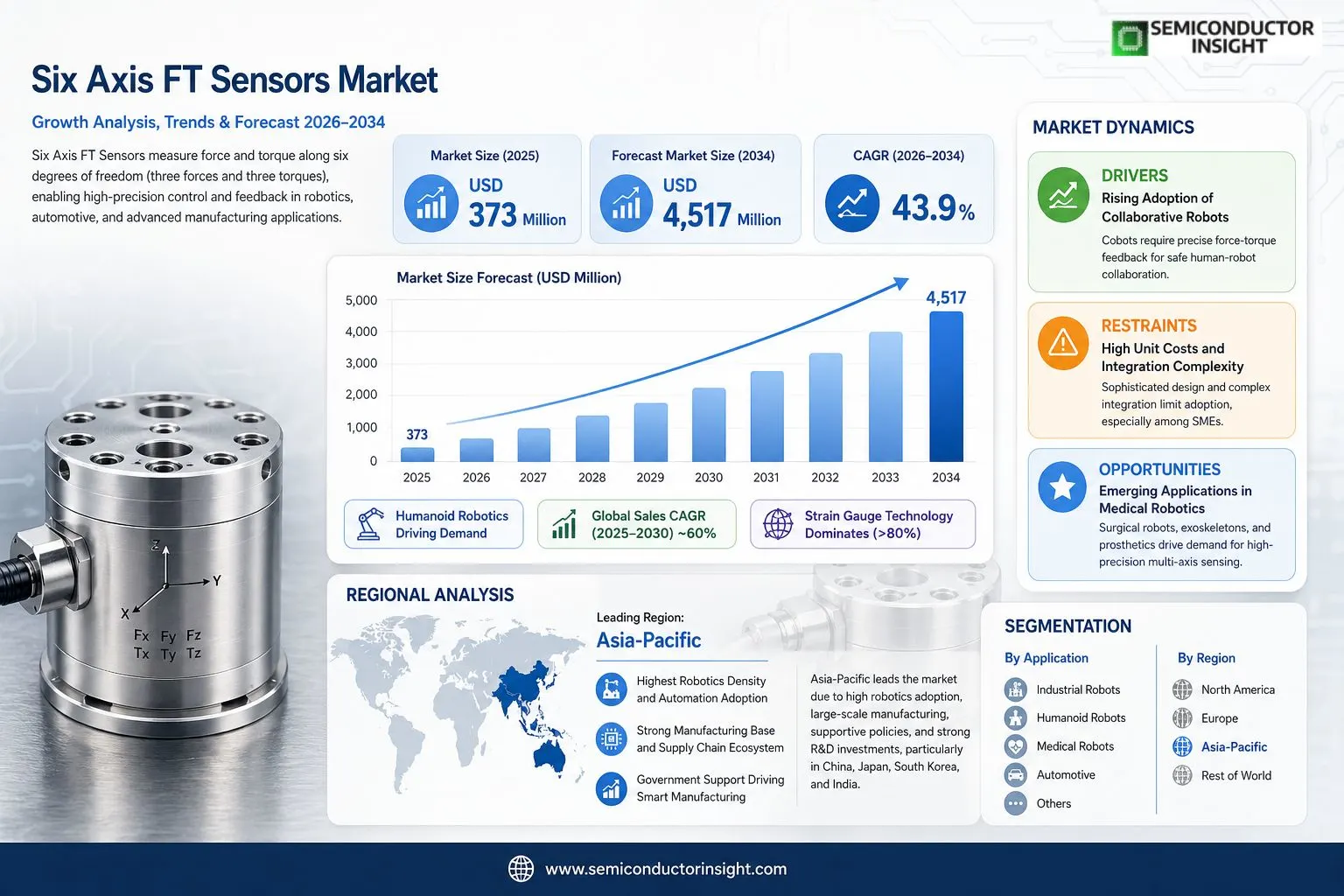
Global Six Axis FT Sensors market size was valued at USD 373 million in 2025. The market is projected to grow from USD 373 million in 2025 to USD 4,517 million by 2034, exhibiting a CAGR of 43.9% during the forecast period.
A Six Axis FT Sensor is a precision device that measures force and torque along six degrees of freedom: three translational forces (X, Y, Z axes) and three rotational torques (around the X, Y, Z axes). It uses strain gauge technology or similar methods to detect the forces and moments applied to the sensor body, converting them into electrical signals for precise quantification. These sensors are commonly used in robotics, automotive, and manufacturing for tasks requiring high accuracy in force measurement, such as assembly, haptics, and quality control, enabling enhanced control and feedback in complex mechanical systems.
The market is experiencing remarkable growth driven by the rapid expansion of industrial automation and the accelerating development of humanoid robots. According to recent research data, global sales of Six Axis FT Sensors reached nearly 60,000 sets in 2024, with China accounting for approximately 17,000 sets , a year-on-year increase of more than 40%. It is estimated that by 2030, global market sales will reach 820,000 sets, with China’s sales projected at 300,000 sets, reflecting a compound annual sales growth rate of 60% from 2025 to 2030. Among measurement technologies, strain force sensors dominate the landscape, accounting for more than 80% of total force sensor usage. Key players operating in the market include ATI Industrial Automation, Schunk, and Advanced Mechanical Technology, which collectively hold dominant positions in Global core market, while Chinese manufacturers such as Kunwei Technology and Xinjingcheng have also emerged with strong growth trajectories.
MARKET DRIVERS
Rising Adoption of Collaborative Robots Accelerating Demand for Six Axis FT Sensors
Global six axis FT sensors market is experiencing robust growth driven primarily by the rapid proliferation of collaborative robots (cobots) across manufacturing industries. Unlike traditional industrial robots, cobots require highly sensitive force and torque feedback to operate safely alongside human workers, making six axis force torque sensors an indispensable component. As automotive, electronics, and consumer goods manufacturers increasingly automate assembly lines, the demand for precision six axis FT sensors capable of measuring forces and torques along all three translational and three rotational axes has intensified considerably. This multidimensional sensing capability enables robots to perform delicate tasks such as parts insertion, grinding, and polishing with a level of dexterity and safety that single-axis sensors cannot provide.
Expansion of Advanced Manufacturing and Industry 4.0 Initiatives
Industry 4.0 transformation is a significant driver propelling Six Axis FT Sensors Market forward. Smart factories increasingly rely on real-time force and torque data to enable closed-loop control systems, predictive maintenance, and adaptive manufacturing processes. Six axis force torque sensors provide the granular, multi-dimensional data streams required for machine learning algorithms to optimize robotic performance and detect anomalies before they result in costly downtime. Governments across North America, Europe, and Asia-Pacific have launched national advanced manufacturing programs, creating substantial investment pipelines that directly benefit sensor technology suppliers. The integration of six axis FT sensors into computer numerical control (CNC) machines and automated guided vehicles (AGVs) is further broadening addressable markets beyond conventional robotic arms.
➤ The medical robotics segment represents one of the fastest-growing end-use applications for six axis FT sensors, as surgical robots and rehabilitation devices demand micro-level force feedback precision to ensure patient safety and procedural accuracy.
Research and development investments in humanoid robotics and exoskeleton technologies are creating additional long-term demand drivers for Six Axis FT Sensors Market. Leading robotics firms are deploying these sensors in end effectors and joint actuators to replicate human-like dexterity, enabling machines to interact with unstructured environments. The convergence of artificial intelligence with multi-axis force torque sensing is unlocking new capabilities in autonomous manipulation, reinforcing the strategic importance of six axis FT sensors as a foundational component in next-generation intelligent automation systems.
MARKET CHALLENGES
High Unit Costs and Integration Complexity Limiting Broader Market Penetration
Despite compelling growth dynamics, Six Axis FT Sensors Market faces meaningful challenges related to product cost and technical integration complexity. High-precision six axis force torque sensors involve sophisticated strain gauge arrays, advanced signal conditioning electronics, and rigorous calibration processes, all of which contribute to relatively elevated unit prices compared to simpler single-axis sensing solutions. For small and medium-sized enterprises (SMEs) seeking to automate operations, the capital expenditure associated with deploying six axis FT sensor-enabled robotic systems can represent a significant barrier. Additionally, integrating these sensors into existing robotic architectures requires specialized engineering expertise in signal processing, real-time control systems, and mechanical mounting design, creating further friction in adoption particularly among manufacturers with limited in-house technical resources.
Other Challenges
Environmental Sensitivity and Durability Concerns
Six axis FT sensors deployed in industrial environments must withstand vibration, temperature fluctuations, electromagnetic interference, and exposure to coolants or particulates. Maintaining calibration accuracy and sensor longevity under such demanding operating conditions remains a persistent engineering challenge. Sensor drift over time can compromise measurement integrity, necessitating periodic recalibration and increasing total cost of ownership. Manufacturers in Six Axis FT Sensors Market are actively investing in ruggedized sensor designs and improved thermal compensation algorithms, though closing the durability gap relative to less complex sensing technologies continues to require ongoing research and development commitment.
Standardization and Interoperability Gaps
The absence of universally adopted communication protocol standards across robotic platforms creates interoperability challenges for six axis FT sensor suppliers. Customers working with heterogeneous robot ecosystems from multiple vendors often encounter compatibility issues that require custom interface development, extending deployment timelines and adding engineering costs. Fragmented standardization across analog, digital, and fieldbus output formats , including EtherCAT, CANopen, and analog voltage outputs , means that sensor suppliers must maintain broad product portfolios to address diverse customer requirements, increasing inventory and development complexity across Six Axis FT Sensors Market.
MARKET RESTRAINTS
Competition from Alternative Force Sensing Technologies Constraining Market Share Growth
Six Axis FT Sensors Market faces competitive pressure from alternative force sensing approaches that offer lower cost points for applications where full six-dimensional measurement is not strictly required. Technologies such as joint torque sensors embedded within robot actuators, vision-based force estimation using tactile imaging, and single or three-axis load cells are increasingly capable of meeting the requirements of certain assembly and inspection tasks at lower system cost. As robot manufacturers integrate proprietary torque sensing directly into servo joints, the addressable market for standalone six axis force torque sensors in some cobot segments faces potential displacement. This competitive dynamic requires six axis FT sensor suppliers to continuously differentiate through superior measurement bandwidth, lower noise floors, and compact form factors that embedded solutions cannot readily replicate.
Supply Chain Vulnerabilities and Precision Component Sourcing Constraints
The manufacturing of high-performance six axis FT sensors depends on specialty materials including precision-machined elastic elements, high-grade strain gauge foils, and application-specific integrated circuits (ASICs) for signal conditioning. Disruptions in global semiconductor supply chains and the concentration of specialized machining capabilities among a limited number of suppliers introduce procurement risks that can constrain production scalability for six axis FT sensor manufacturers. Geopolitical uncertainties affecting electronics component trade flows have highlighted the vulnerability of sensor supply chains, prompting leading market participants to explore regional supply chain diversification strategies. These structural restraints may moderate the pace at which Six Axis FT Sensors Market can scale to meet growing industrial automation demand in the near term.
MARKET OPPORTUNITIES
Emerging Applications in Medical Robotics and Surgical Automation Opening New Revenue Streams
The medical robotics sector presents a compelling growth opportunity for Six Axis FT Sensors Market as surgical robot platforms, rehabilitation exoskeletons, and prosthetic limb systems increasingly require high-fidelity multi-axis force feedback. Regulatory approvals for new robotic-assisted surgical systems across the United States, European Union, and Japan are expanding the installed base of platforms that incorporate six axis force torque sensing for haptic feedback and tissue interaction monitoring. The push toward minimally invasive procedures is driving demand for miniaturized six axis FT sensors capable of operating within constrained anatomical spaces while maintaining measurement precision, creating opportunities for sensor manufacturers that invest in micro-scale fabrication technologies.
Growth in Space Robotics and Defense Applications Expanding High-Value Market Segments
Space exploration programs and defense robotics initiatives are emerging as high-value application domains for Six Axis FT Sensors Market. Robotic systems deployed for satellite servicing, planetary exploration, and autonomous ordnance handling require highly reliable six axis force torque sensors capable of operating across extreme temperature ranges and radiation environments. Space agencies and defense contractors are actively procuring ruggedized, radiation-hardened sensor solutions, representing a premium market segment where performance requirements justify significantly higher price points than conventional industrial applications. Investment in these sectors is expected to generate specialized product development opportunities and long-term supply agreements that can anchor revenue streams for established six axis FT sensor manufacturers.
Asia-Pacific Industrial Automation Investments Creating Substantial Regional Market Expansion Potential
The Asia-Pacific region represents the most dynamic geographic growth opportunity for Six Axis FT Sensors Market, underpinned by large-scale factory automation investments in China, South Korea, Japan, and India. Government-backed smart manufacturing initiatives, combined with rising labor costs driving automation adoption among regional manufacturers, are generating substantial demand for robotic systems equipped with multi-axis force torque sensing capabilities. The expansion of electric vehicle battery assembly lines, semiconductor fabrication facilities, and consumer electronics manufacturing across the region is creating concentrated clusters of high-volume sensor demand. Local sensor manufacturers are increasingly investing in indigenous six axis FT sensor development to reduce reliance on imported solutions, while international suppliers are establishing regional partnerships and distribution networks to capture growing market share across Asia-Pacific’s diverse industrial base.
Trends
Humanoid Robotics Driving Unprecedented Demand for Six Axis FT Sensors
Six Axis FT Sensors Market is experiencing a significant transformation driven by the rapid commercialization of humanoid robots. Since the concept of humanoid robots gained global momentum in 2021, demand for precision force-torque sensing solutions has surged across industrial and research sectors. Global sales of Six Axis FT Sensors reached nearly 60,000 units in 2024, with China alone contributing approximately 17,000 units , representing a year-on-year increase of more than 40%. These sensors, which simultaneously measure three translational forces and three rotational torques across six degrees of freedom, have become standard components in high-performance humanoid robots, particularly at wrist and ankle end-effectors where refined motion control is critical. Global compound annual sales growth rate for this segment is projected at 60% between 2025 and 2030, with global sales expected to reach 820,000 units by 2030 , underscoring the transformative role of humanoid robotics in reshaping market dynamics.
Other Trends
Dominance of Strain Gauge Technology Across Six Axis FT Sensors Market
Among the various measurement technologies available in Six Axis FT Sensors Market , including photoelectric, capacitive, piezoelectric, and resistance strain types , strain gauge-based sensors continue to dominate, accounting for more than 80% of total force sensor usage globally. This widespread adoption is attributed to the technology’s superior balance of precision, reliability, and cost-effectiveness. Leading global manufacturers including ATI Industrial Automation, Schunk, ME-Meßsysteme, and Sintokogio, as well as virtually all Chinese manufacturers, rely on strain gauge methodology as the foundation of their product portfolios. This technological standardization is fostering interoperability and accelerating integration across industrial automation systems.
Expanding Application Landscape Beyond Traditional Industrial Robotics
While industrial automation , encompassing traditional robotic arms and assembly systems , continues to represent the largest application segment for Six Axis FT Sensors, the fastest growth is emerging from adjacent sectors. Applications in medical robotics, automotive testing, aerospace research, and biomechanics are broadening the market’s addressable scope. In the automotive sector, these sensors are widely deployed in collision testing, wheel hub evaluation, and seat component analysis. In medical and scientific research environments, their high sensitivity and multi-axis measurement capability enable precise biomechanical studies and surgical robot force feedback. This diversification is reducing market dependency on any single downstream vertical and strengthening overall demand resilience.
Competitive Landscape Shifting as Chinese Manufacturers Scale Rapidly
The competitive structure of Six Axis FT Sensors Market is evolving as established Western players face growing competition from Chinese manufacturers. Historically dominated by companies such as ATI Industrial Automation, Schunk, and Advanced Mechanical Technology, Global market is witnessing rapid scaling by Chinese firms including Kunwei Beijing Technology, Shenzhen Xinjingcheng Sensing Technology, and Yuli Instruments. As of 2024, the world’s top five manufacturers collectively accounted for more than 60% of Global market share, but this concentration is gradually moderating as domestic Chinese producers capture increasing volumes driven by local humanoid robot development programs and government-backed industrial automation initiatives. This competitive evolution is intensifying pressure on pricing, product differentiation, and technological advancement across Six Axis FT Sensors Market globally.
COMPETITIVE LANDSCAPE
Key Industry Players
Global Six Axis FT Sensors Market: Competitive Dynamics, Leading Manufacturers, and Strategic Positioning
Global Six Axis FT Sensors market is characterized by a moderately consolidated competitive structure, with the top five manufacturers collectively accounting for more than 60% of global market share as of 2025. ATI Industrial Automation stands as the dominant force in this space, renowned for its precision strain gauge-based sensors widely deployed across industrial robotics, aerospace, and advanced manufacturing applications. Schunk and Advanced Mechanical Technology (AMTI) follow closely, leveraging decades of engineering expertise and broad application portfolios spanning collision testing, biomechanics, and robotic force control. Kistler and Sunrise Instruments (SRI) also command significant positions in Global core market, particularly in high-accuracy piezoelectric and strain-type measurement solutions. The market’s explosive projected CAGR of 43.9% through 2034, driven in large part by the rapid commercialization of humanoid robots , a segment forecast to grow at a compound annual rate exceeding 100% from 2025 to 2030 , is intensifying competitive activity, attracting new entrants and accelerating R&D investment across incumbents.
Chinese manufacturers have emerged as formidable competitors, registering year-on-year sales growth exceeding 40% in 2024. Companies such as Kunwei Beijing Technology, Shenzhen Xinjingcheng Sensing Technology, and Hypersen Technologies are scaling rapidly to capture domestic and international demand, particularly from humanoid robot OEMs integrating six-axis FT sensors at wrist and ankle joints as standard components. European players including ME-Meßsysteme, Bota Systems, and Nordbo Robotics are carving niche positions in collaborative robotics and medical robot applications, where precision force feedback and safety control are paramount. Meanwhile, established automation giants such as FANUC, Epson, and OnRobot are expanding their sensor portfolios organically and through strategic partnerships, reinforcing their competitive standing in the industrial automation and robotic end-effector segments. The competitive landscape is further shaped by the overwhelming dominance of resistance strain technology, which accounts for over 80% of total sensor usage globally, with capacitive and piezoelectric alternatives gaining incremental traction in specialized high-bandwidth applications.
List of Key Six Axis FT Sensors Companies Profiled
- ATI Industrial Automation
- Schunk
- Advanced Mechanical Technology (AMTI)
- Sunrise Instruments (SRI)
- Kistler
- Robotiq
- Epson
- Nordbo Robotics
- ME-Meßsysteme
- Wacoh-Tech
- Kunwei Beijing Technology
- Shenzhen Xinjingcheng Sensing Technology
- FUTEK Advanced Sensor Technology
- Bota Systems
- FANUC
- Hypersen Technologies
- Sintokogio
- OnRobot
- Robotous
- Guangzhou Haozhi Industrial
Segment Analysis:
| Segment Category | Sub-Segments | Key Insights |
| By Type |
|
Resistance Strain sensors represent the dominant technology type in Six Axis FT Sensors Market, commanding the overwhelming majority of industry adoption globally.
Capacitive and piezoelectric types are gaining traction in niche high-frequency dynamic measurement scenarios, while photoelectric variants continue to find specialized roles in environments demanding non-contact measurement and immunity to electromagnetic interference. |
| By Application |
|
Industrial Robots currently constitute the largest application segment for Six Axis FT Sensors, driven by decades of automation investment across manufacturing industries worldwide.
Medical robotics is an emerging high-value application where Six Axis FT Sensors support minimally invasive surgical systems and rehabilitation devices by providing surgeons with precise haptic feedback and tissue interaction data. |
| By End User |
|
Industrial Automation & Manufacturing end users form the backbone of demand for Six Axis FT Sensors, encompassing robot integrators, smart factory operators, and precision manufacturing enterprises across electronics, aerospace components, and general machinery sectors.
Healthcare and medical device companies are increasingly adopting Six Axis FT Sensors for surgical robotics validation, prosthetics development, and rehabilitation equipment, representing a fast-maturing end-user vertical with stringent accuracy and biocompatibility requirements. |
| By Measurement Range |
|
Medium-Range (General Industrial) sensors dominate procurement volumes across global markets, serving the broadest cross-section of robotic and automated machinery applications with versatile load capacity and reliable signal resolution.
|
| By Interface & Connectivity |
|
Digital / Bus-Based interface sensors are rapidly emerging as the preferred connectivity standard across advanced robotics and smart manufacturing deployments, reflecting the industry-wide shift toward integrated, networked automation architectures.
|
Regional Analysis: Six Axis FT Sensors Market
Asia-Pacific
Asia-Pacific hosts some of the world’s highest-density robotics deployment environments. The proliferation of collaborative robots, or cobots, in electronics assembly and automotive body manufacturing across China, Japan, and South Korea creates sustained and growing demand for six-axis force torque sensors that ensure precision, safety, and adaptability in human-machine interaction workflows.
Strategic national programs such as China’s “Made in China 2025,” Japan’s Society 5.0, and South Korea’s Smart Factory Initiative have substantially accelerated industrial sensor adoption. These frameworks prioritize intelligent manufacturing infrastructure, directly incentivizing the integration of six-axis FT sensors into next-generation production lines and quality control systems across the region.
The region’s unmatched concentration of semiconductor fabrication and consumer electronics manufacturing plants demands extreme precision in component handling. Six-axis force torque sensors are increasingly embedded in wafer handling, micro-assembly, and circuit board production processes, where even marginal deviations in applied force can result in yield losses and significant quality failures.
India and Southeast Asian nations including Vietnam, Thailand, and Indonesia are emerging as new growth corridors within Six Axis FT Sensors Market. Rising foreign direct investment in manufacturing, expanding automotive sectors, and government-led digitization of industrial infrastructure are collectively positioning these markets as significant contributors to regional demand trajectories through 2034.
North America
North America represents one of the most technologically mature and innovation-intensive markets within Global Six Axis FT Sensors Market. The United States, in particular, is home to a robust ecosystem of robotics integrators, aerospace manufacturers, medical device developers, and defense contractors , all of which are significant consumers of high-performance six-axis force torque sensing solutions. The region’s emphasis on advanced manufacturing, coupled with substantial research activity at leading universities and national laboratories, continually generates new application domains for six-axis FT sensors. The automotive sector’s accelerating shift toward electric vehicles and automated assembly processes is a notable demand driver. Additionally, the growing integration of force-torque sensing in surgical robotics and rehabilitation technology reflects the region’s leadership in medical technology innovation. Strong intellectual property protections and a well-developed venture capital ecosystem also support the commercialization of next-generation sensor technologies across the North American market landscape.
Europe
Europe holds a prominent position in Six Axis FT Sensors Market, anchored by its world-class precision engineering heritage and stringent industrial quality standards. Germany, as the epicenter of European manufacturing excellence, drives substantial demand through its automotive original equipment manufacturers and highly automated industrial machinery producers. The broader European Union’s commitment to digital transformation under Industry 4.0 frameworks has directly elevated the strategic importance of intelligent sensing technologies, including six-axis force torque sensors, across manufacturing verticals. Countries such as Sweden, Switzerland, and the Netherlands contribute through their advanced robotics research institutions and medical technology sectors. Europe’s emphasis on worker safety, collaborative robotics integration, and sustainable manufacturing practices also aligns strongly with the value proposition of six-axis FT sensors, which enhance both operational precision and safe human-robot collaboration in factory environments.
South America
South America represents a developing but gradually expanding frontier in Six Axis FT Sensors Market. Brazil, as the region’s largest industrial economy, is the primary demand generator, particularly through its automotive assembly plants and growing food and beverage processing automation sector. While the region currently lags behind more mature markets in terms of large-scale robotics deployment, increasing awareness of automation benefits among mid-sized manufacturers is beginning to shift adoption patterns. Economic stabilization efforts, coupled with foreign investment inflows into Brazilian and Argentine manufacturing infrastructure, are laying the groundwork for more structured Six Axis FT Sensors Market growth. Infrastructure constraints and import dependency for high-precision sensor components remain challenges, but regional trade agreements and technology transfer initiatives are expected to progressively lower these barriers through the forecast horizon extending to 2034.
Middle East & Africa
The Middle East and Africa region occupies an emerging stage within Global Six Axis FT Sensors Market, with growth prospects closely tied to ongoing economic diversification and industrial modernization programs. Gulf Cooperation Council nations, particularly the United Arab Emirates and Saudi Arabia, are making significant investments in non-oil manufacturing sectors, smart city infrastructure, and logistics automation , all of which present nascent opportunities for six-axis force torque sensor adoption. Vision 2030 and similar national transformation agendas are catalyzing technology-forward industrial development across the region. In Africa, South Africa leads with its established automotive assembly operations and mining automation initiatives. While the overall penetration of advanced sensing technologies remains limited compared to global peers, the long-term trajectory for Six Axis FT Sensors Market in this region is constructive, supported by rising technology awareness and increasing international manufacturing partnerships.
Report Scope
This market research report provides a comprehensive analysis of Six Axis FT Sensors Market, covering the forecast period 2026–2034. It offers detailed insights into market dynamics, technological advancements, competitive landscape, and key trends shaping the industry.
Key focus areas of the report include:
- Market Overview: The report begins with an overview outlining its current market scenario, key growth indicators, and industry transformation drivers. It discusses macroeconomic factors, demand–supply balance, regulatory landscape, and the strategic role of Six Axis FT Sensors in powering advancements across industries such as robotics, automotive, industrial automation, and humanoid robots.
- Market Size & Forecast: Historical data and future projections for revenue, unit shipments, and market value across major regions and segments.
- Segmentation Analysis: Detailed breakdown by product type, technology, application, and end-user industry to identify high-growth segments and investment opportunities.
- Regional Insights: Insights into market performance across North America, Europe, Asia-Pacific, Latin America, and the Middle East & Africa, including country-level analysis where relevant.
- Competitive Landscape: Profiles of leading market participants, including their product offerings, R&D focus, manufacturing capacity, pricing strategies, and recent developments such as mergers, acquisitions, and partnerships.
- Technology Trends & Innovation: Assessment of emerging technologies, integration of AI/IoT, sensor design trends, fabrication techniques, and evolving industry standards.
- Market Drivers & Restraints: Evaluation of factors driving market growth along with challenges, supply chain constraints, regulatory issues, and market-entry barriers.
- Stakeholder Insights: Insights for component suppliers, OEMs, system integrators, investors, and policymakers regarding the evolving ecosystem and strategic opportunities.
Primary and secondary research methods are employed, including interviews with industry experts, data from verified sources, and real-time market intelligence to ensure the accuracy and reliability of the insights presented.
FREQUENTLY ASKED QUESTIONS:
What is the current market size of Six Axis FT Sensors Market?
-> Global Six Axis FT Sensors Market was valued at USD 373 million in 2025 and is expected to reach USD 4,517 million by 2034, growing at a CAGR of 43.9% during the forecast period.
Which key companies operate in Six Axis FT Sensors Market?
-> Key players include ATI Industrial Automation, Schunk, Advanced Mechanical Technology, Sunrise Instruments (SRI), Kistler, Robotiq, FUTEK, Bota Systems, FANUC, and OnRobot, among others. In 2024, the world’s top five manufacturers accounted for more than 60% of Global market.
What are the key growth drivers?
-> Key growth drivers include rapid adoption of humanoid robots, expansion of industrial automation, increasing use in automotive collision testing, rising demand in medical robotics, and the mass production of humanoid robots. Global compound annual growth rate of humanoid robots from 2025 to 2030 is projected to reach 104%, making it a major source of growth for Six Axis FT Sensors Market.
Which region dominates the market?
-> Asia-Pacific, particularly China, is the fastest-growing region. China’s sales of Six Axis FT Sensors reached approximately 17,000 sets in 2024, a year-on-year increase of more than 40%, and are projected to reach 300,000 sets by 2030.
What are the emerging trends?
-> Emerging trends include integration of Six Axis FT Sensors in humanoid robots at wrist and ankle joints, growing adoption of strain gauge-based sensors (accounting for over 80% of usage), expansion into medical and biomechanics applications, and explosive growth of Chinese manufacturers such as Yuli Instruments, Kunwei Technology, and Xinjingcheng in Global market.

Get Sample Report PDF for Exclusive Insights
Report Sample Includes
- Table of Contents
- List of Tables & Figures
- Charts, Research Methodology, and more...
 Download Sample Report PDF