SIP Systems Market Insights
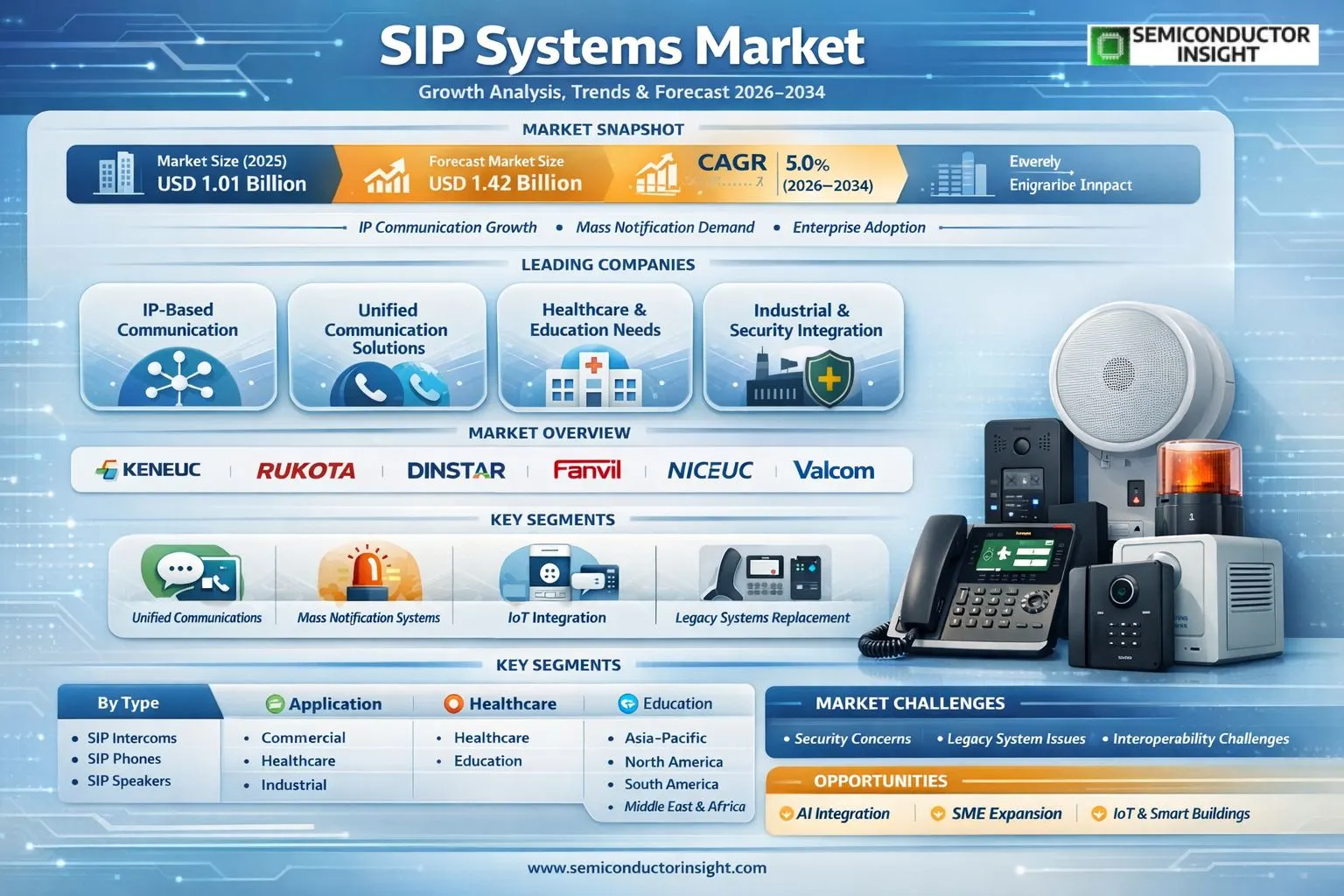
Global SIP systems market size was valued at USD 1.01 billion in 2025. The market is projected to grow from USD 1.06 billion in 2026 to USD 1.42 billion by 2034, exhibiting a CAGR of 5.0% during the forecast period.
SIP (Session Initiation Protocol) paging and broadcasting systems are communication solutions built around the SIP protocol, which is commonly used for voice and video communication over IP networks. These systems facilitate efficient, one-to-many communication and are integral to modern unified communications (UC) strategies, encompassing devices such as SIP intercoms, phones, speakers, paging amplifiers, and SIP-enabled strobe lights and alarms.
The market is experiencing steady growth driven by Global shift towards IP-based communication infrastructure and the retirement of legacy analog systems. Key growth factors include the rising adoption of UC solutions across enterprises, heightened demand for reliable mass notification systems in sectors like healthcare and education, and the increasing integration of SIP with IoT platforms for smarter building management. Furthermore, initiatives by key players to enhance product portfolios and form strategic partnerships are accelerating market expansion. For instance, companies like Grandstream Networks, Inc., Panasonic, and Akuvox continuously innovate their SIP device offerings to cater to evolving security and operational needs. The competitive landscape also features prominent players such as CyberData Corporation, Valcom, Snom, and Zenitel, who operate globally with diverse product ranges.
MARKET DRIVERS
Demand for Unified Communication and Digital Transformation
The shift to hybrid and remote work models is a primary catalyst for growth in the SIP Systems Market. Organizations are replacing legacy telephony with SIP trunking and Session Initiation Protocol-based solutions. This adoption is driven by the need for scalable, software-centric unified communications platforms that integrate voice, video, and messaging. The pursuit of digital transformation compels enterprises to seek cost-effective, flexible alternatives to traditional PRI lines, directly fueling market expansion.
Cost Efficiency and Scalability Advantages
SIP trunking offers significant operational expenditure reduction, eliminating the need for physical hardware and long-distance call charges associated with conventional systems. The SIP Systems Market benefits from its inherent scalability, allowing businesses to easily add or remove channels based on demand. This elasticity supports dynamic business environments and growth phases more effectively than capital-intensive legacy infrastructure.
➤ SIP protocols are foundational to modern VoIP and UCaaS deployments, making them indispensable for enterprises modernizing their communication stacks.
The integration of SIP systems with cloud-based contact centers and CRM software creates a powerful driver. This enhances agent productivity and customer experience by enabling unified routing and richer data context, making a modern SIP Systems Market solution a strategic asset for competitive businesses.
MARKET CHALLENGES
Security and Fraud Vulnerabilities
Adoption faces hurdles from persistent security threats, including toll fraud, SIP trunk hacking, and denial-of-service attacks. The open architecture of the Session Initiation Protocol can be exploited without robust encryption and session border controllers (SBCs). Ensuring regulatory compliance alongside these security measures adds complexity and cost for providers and end-users within the SIP Systems Market.
Other Challenges
Interoperability and Quality of Service (QoS)
Integration with existing PBX equipment and ensuring consistent, high-quality voice and video transmission across diverse networks present technical challenges. Variability in internet service provider performance can lead to jitter and latency, impacting reliability perceptions.
Legacy System Inertia and Skills Gap
Many organizations remain entrenched with traditional ISDN/PRI systems due to perceived reliability and upfront migration costs. Additionally, a shortage of IT professionals skilled in VoIP and SIP protocol management can slow deployment and optimization efforts for advanced SIP systems.
MARKET RESTRAINTS
Regulatory Compliance and Carrier Interconnection Complexities
Stringent regulations concerning lawful intercept, emergency service calling (E911), and data privacy vary significantly by region, creating a fragmented compliance landscape. Navigating carrier interconnection agreements and ensuring seamless PSTN integration involves substantial technical and legal overhead. These complexities can delay implementation and restrain the broader expansion of the SIP Systems Market.
Competition from Proprietary and Alternative Platforms
The market faces competition from proprietary unified communications suites and alternative WebRTC-based solutions that may bypass traditional SIP trunking models. For smaller deployments or specific use cases, these alternatives can limit the growth potential for pure-play SIP Systems Market offerings, pushing vendors towards more integrated, platform-based approaches.
MARKET OPPORTUNITIES
Adoption of AI-Powered Unified Communications Features
Convergence of SIP infrastructure with artificial intelligence unlocks significant opportunities. AI can enhance SIP Systems Market solutions through intelligent call routing, real-time transcription, sentiment analysis, and automated customer service via voicebots. This creates new value propositions and revenue streams for providers, moving beyond basic connectivity to intelligent communication layers.
Expansion Among Small and Medium Enterprises (SMEs)
The SME segment represents a substantial, under-penetrated opportunity. As cloud delivery models reduce upfront costs and complexity, SIP trunking and hosted PBX services become more accessible. Solution providers are developing bundled, easy-to-manage offerings tailored for SMEs, driving market democratization and volume growth.
Integration with IoT and Edge Computing Environments
The rise of IoT devices and edge computing creates a novel frontier. SIP protocols can facilitate machine-to-machine communication and enable voice/video capabilities for smart devices and industrial applications. This expands the relevance of the SIP Systems Market beyond traditional enterprise communications into new verticals like smart manufacturing, healthcare telemetry, and connected vehicles.
SIP Systems Market Trends
Convergence of Security and Communication
A primary trend driving the SIP Systems Market is the increasing integration with security and building management infrastructures. SIP paging and intercom systems are no longer standalone communication tools. They are being designed to interface seamlessly with access control, video surveillance, and emergency notification platforms. This convergence creates unified, intelligent environments,particularly in commercial, healthcare, and educational settings,where a single event can trigger coordinated audio alerts, lock-down procedures, and visual alarms from SIP-enabled strobes, enhancing overall safety and operational efficiency.
Other Trends
Expansion Beyond Traditional Telephony
The application landscape for the SIP Systems Market is broadening significantly. While enterprise voice communication remains core, deployment is accelerating in industrial environments for plant-wide announcements and in transportation hubs for public address. The protocol’s flexibility supports not only voice but also streaming audio for background music and multicast paging, enabling versatile use cases that extend far beyond traditional desk phone functionality.
Transition to Software-Defined and Cloud-Managed Solutions
There is a marked shift towards software-defined architectures and cloud-based management within the SIP Systems Market. Enterprises are adopting solutions that allow for centralized provisioning, monitoring, and management of thousands of SIP endpoints,from phones and speakers to intercoms,from a single web dashboard. This trend reduces on-premise hardware dependency, simplifies scalability for multi-site organizations, and facilitates seamless firmware updates, which is crucial for maintaining security across the network.
Rise of Interoperability and Hybrid Deployments
A key market trend is the strong emphasis on vendor interoperability and support for hybrid deployments. As organizations modernize legacy systems, they require SIP systems that can integrate with existing analog equipment and multi-vendor environments. Leading players in the SIP Systems Market are focusing on adherence to open standards and developing gateway solutions. This allows for a gradual, cost-effective migration path and ensures that new SIP-based paging, intercom, and emergency devices can function cohesively within a broader, heterogeneous communication ecosystem.
COMPETITIVE LANDSCAPE
Key Industry Players
An Evolving Market Led by Telecommunications and Specialized Providers
Global SIP Systems market is moderately fragmented, characterized by a mix of established telecommunication equipment providers and specialized manufacturers focusing on SIP-based paging, intercom, and PA solutions. The competitive intensity is high as players strive to expand their product portfolios across different system types like SIP Intercoms, SIP Phones, SIP Speakers, and SIP-enabled alarms to cater to diverse verticals such as healthcare, education, and large enterprises. In 2025, Global top five players collectively held a significant, but not dominant, revenue share, indicating room for growth and market share shifts among the numerous active competitors. Innovation in integrating with broader unified communications platforms and ensuring robust, scalable network performance are key differentiators.
Beyond the leading revenue-generating companies, several other significant players compete effectively by focusing on niche applications or regional strengths. For instance, companies like Valcom and CyberData Corporation have strong positions in specialized paging and notification systems, particularly for healthcare and industrial safety applications. Similarly, European players such as Snom and Barix are recognized for high-quality VoIP endpoints and audio over-IP solutions, respectively. The market also sees participation from broader electronics giants like Panasonic, which leverage their brand recognition and extensive distribution networks. This diverse ecosystem ensures constant technological advancement and competitive pricing, driving the market toward the projected $1416 million valuation by 2034.
List of Key SIP Systems Companies Profiled
- KENEUC
- DINSTAR
- Fanvil Technology
- Guangzhou Unisoft Information Technology
- SHENZHEN NICEUC
- Grandstream Networks, Inc.
- CyberData Corporation
- Valcom
- TONMIND
- Akuvox
- Flyingvoice
- Snom
- Panasonic
- Nextiva
- Barix
Segment Analysis:
| Segment Category | Sub-Segments | Key Insights |
| By Type |
|
SIP Intercoms and SIP Phones are the foundational product types, collectively driving high market relevance due to their role as primary communication endpoints across all verticals. The growth of SIP Intercoms is particularly pronounced, spurred by their integration into security and facility access systems. Meanwhile, niche segments like SIP-enabled strobe lights and alarms exhibit strong growth potential for critical notification scenarios, presenting a specialized avenue for market players to explore. |
| By Application |
|
Healthcare and Commercial Use are the most dynamic application segments. In healthcare, the critical need for reliable, instantaneous, and zone-based paging for emergency codes and staff coordination creates a non-negotiable demand for robust SIP paging systems. The commercial sector, including large office campuses and retail spaces, leverages these systems for background music, announcements, and general facility management, driving consistent adoption as part of modern unified communications deployments. |
| By End User |
|
Large Enterprises and the Public Sector represent the dominant end-user cohorts. Large enterprises adopt SIP systems for scalable, cost-effective internal communication across multiple locations, integrating them with existing VoIP infrastructure. The public sector, including municipal buildings and transportation hubs, shows significant uptake due to projects focused on modernizing legacy PA systems and enhancing public safety communication networks with IP-based reliability and flexibility. |
| By Deployment Model |
|
Cloud-Based / Hosted deployment is gaining rapid traction as it lowers upfront capital expenditure and simplifies management for multi-site organizations. However, On-Premises solutions remain the leading segment for organizations with stringent data security, compliance requirements, or the need for deep customization and control over their communication infrastructure, particularly in industries like finance and government. |
| By System Integration |
|
Integration with Unified Communications (UCaaS & VoIP) is the leading and most strategic segment. The inherent value of SIP systems is maximized when they function as a seamless component of a broader unified communications platform, allowing for features like click-to-page from softphones and unified management. This trend is compelling vendors to ensure open APIs and compatibility with major UC providers, making interoperability a key purchasing criterion for clients seeking future-proof solutions. |
Regional Analysis: Global SIP Systems Market
North America
North America exhibits the highest level of SIP Systems Market maturity, driven by the corporate sector’s near-complete migration from TDM to IP-based communications. This widespread digitization creates a stable base for high-value service upgrades and integration with enterprise software ecosystems.
The shift towards Unified Communications as a Service (UCaaS) is most pronounced here, accelerating demand for flexible SIP trunking and hosted IP-PBX solutions. Providers in the North American SIP Systems Market are competing intensely on API integrations, security features, and hybrid deployment models.
Strict compliance requirements for data privacy and emergency calling (E911) in the region compel sophisticated SIP Systems deployment. This regulatory landscape necessitates advanced security protocols, making encryption and fraud mitigation key competitive differentiators in the market.
A dense network of technology hubs, software developers, and telecom carriers fosters rapid innovation in SIP-based applications. This ecosystem drives the SIP Systems Market forward with developments in WebRTC integration, AI-powered call analytics, and seamless connectivity for remote workforces.
Europe
Europe represents a significant and steadily growing region for the SIP Systems Market, shaped by a diverse regulatory framework across its member states. The adoption of SIP trunking and IP telephony solutions is propelled by the region’s strong focus on data sovereignty, leading to a preference for locally hosted and compliant systems. Markets in Western Europe, particularly in Germany, the UK, and France, are highly advanced, with enterprises leveraging SIP Systems for cost-efficient multi-site connectivity and integration with EU-centric CRM platforms. Stringent GDPR regulations mandate specific security and data handling protocols for communication systems, influencing product development and deployment strategies. Meanwhile, Eastern Europe presents a growth frontier within the European SIP Systems Market, characterized by modernization of legacy infrastructure and increasing investments in cloud communications by small and medium-sized enterprises seeking operational agility.
Asia-Pacific
The Asia-Pacific region is the fastest-growing market for SIP Systems, driven by massive digital transformation initiatives, expanding internet penetration, and a booming SME sector. Countries like China, India, Japan, and Australia are key contributors, each with distinct drivers. The regional SIP Systems Market benefits from massive investments in national broadband networks and 5G infrastructure, which create a robust foundation for IP-based voice and video services. A surge in demand for affordable, scalable communication solutions from burgeoning startups and the outsourcing industry is a primary catalyst. Vendors are tailoring offerings to meet diverse needs, from low-cost SIP trunking for call centers to sophisticated UC platforms for multinational corporations, making it a highly dynamic and competitive landscape with tremendous potential for market expansion.
South America
The SIP Systems Market in South America is in a progressive growth phase, characterized by gradual modernization and economic recovery in key markets such as Brazil, Argentina, and Chile. Adoption is primarily driven by the need for businesses to reduce high international communication costs and improve operational efficiency. The market dynamics are influenced by increasing mobile and broadband penetration, which is enabling more organizations to consider transitioning from traditional phone lines to SIP trunks. While economic volatility can affect investment cycles, a growing recognition of the benefits of unified communications for customer service and remote collaboration is creating a steady demand. Local and regional telecom providers are playing a crucial role in educating the market and deploying SIP Systems solutions tailored to the specific economic and infrastructural context of the region.
Middle East & Africa
The Middle East & Africa region presents a diverse and opportunistic landscape for the SIP Systems Market, marked by varying levels of technological maturity. Gulf Cooperation Council (GCC) countries, with their visionary economic diversification plans and smart city projects, are leading adopters of advanced unified communications and SIP infrastructure. In contrast, many African nations are experiencing growth driven by mobile-first strategies and the rapid expansion of digital services, creating demand for cost-effective SIP-based solutions. The overall market is propelled by investments in telecom infrastructure, the growth of the BPO sector, and governmental digital initiatives. However, challenges such as inconsistent broadband quality and varying regulatory environments influence deployment strategies, making localized support and flexible service models key to success in the regional SIP Systems Market.
Report Scope
This market research report provides a comprehensive analysis of the SIP Systems Market , covering the forecast period 2026–2034. It offers detailed insights into market dynamics, technological advancements, competitive landscape, and key trends shaping the industry.
Key focus areas of the report include:
- Market Overview: The report begins with an overview outlining its current market scenario, key growth indicators, and industry transformation drivers. It discusses macroeconomic factors, demand–supply balance, regulatory landscape, and the strategic role of semiconductors in powering advancements across industries such as automotive, telecommunications, consumer electronics, and industrial automation.
- Market Size & Forecast: Historical data and future projections for revenue, unit shipments, and market value across major regions and segments.
- Segmentation Analysis: Detailed breakdown by product type, technology, application, and end-user industry to identify high-growth segments and investment opportunities.
- Regional Insights: Insights into market performance across North America, Europe, Asia-Pacific, Latin America, and the Middle East & Africa, including country-level analysis where relevant.
- Competitive Landscape: Profiles of leading market participants, including their product offerings, R&D focus, manufacturing capacity, pricing strategies, and recent developments such as mergers, acquisitions, and partnerships.
- Technology Trends & Innovation: Assessment of emerging technologies, integration of AI/IoT, semiconductor design trends, fabrication techniques, and evolving industry standards.
- Market Drivers & Restraints: Evaluation of factors driving market growth along with challenges, supply chain constraints, regulatory issues, and market-entry barriers.
- Stakeholder Insights: Insights for component suppliers, OEMs, system integrators, investors, and policymakers regarding the evolving ecosystem and strategic opportunities.
Primary and secondary research methods are employed, including interviews with industry experts, data from verified sources, and real-time market intelligence to ensure the accuracy and reliability of the insights presented.
FREQUENTLY ASKED QUESTIONS:
What is the current market size of SIP Systems Market?
-> Global SIP Systems Market was valued at USD 1006 million in 2025 and is projected to reach USD 1416 million by 2034, growing at a CAGR of 5.0% during the forecast period.
Which key companies operate in SIP Systems Market?
-> Key players include KENEUC, RUKOTA, DINSTAR, Fanvil Technology, Guangzhou Unisoft Information Technology, SHENZHEN NICEUC, Grandstream Networks, Inc., Cyber Data Corporation, Valcom, and TONMIND, among others. Global top five players accounted for a significant revenue share in 2025.
What are the key growth drivers?
-> Key growth drivers include widespread adoption of IP-based communication, demand for efficient one-to-many communication in large enterprises, and increasing deployments in healthcare, educational institutions, and industrial settings.
Which region dominates the market?
-> North America, particularly the U.S., holds a significant market share, while Asia (especially China) is a key growing region, driven by rapid infrastructure development.
What are the emerging trends?
-> Emerging trends include integration with broader unified communication systems, technological advancements in SIP-enabled devices, and expansion into new vertical applications.

Get Sample Report PDF for Exclusive Insights
Report Sample Includes
- Table of Contents
- List of Tables & Figures
- Charts, Research Methodology, and more...
 Download Sample Report PDF