MARKET INSIGHTS
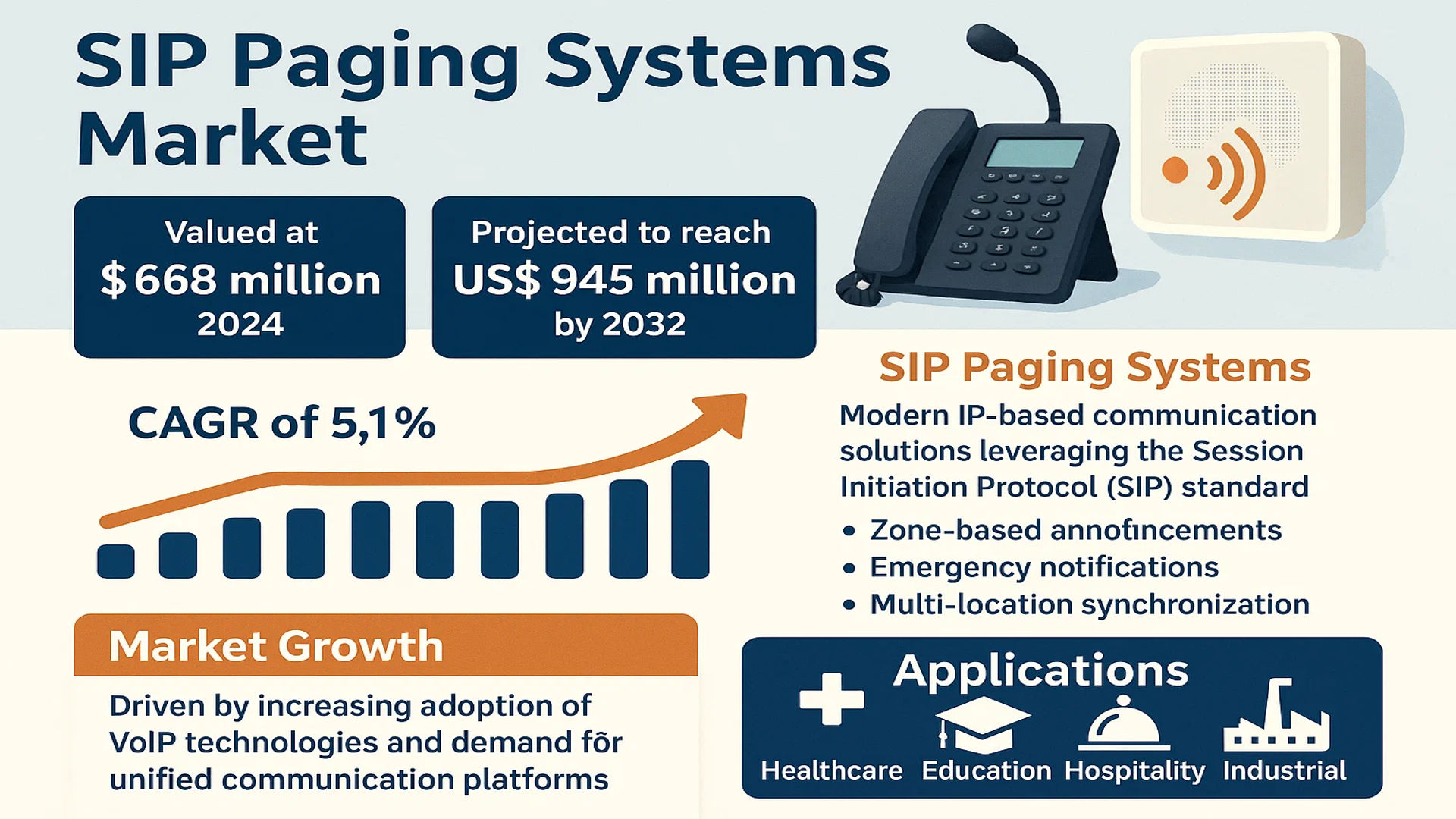
The global SIP Paging Systems Market was valued at 668 million in 2024 and is projected to reach US$ 945 million by 2032, at a CAGR of 5.1% during the forecast period.
SIP Paging Systems are modern IP-based communication solutions leveraging the Session Initiation Protocol (SIP) standard. These systems enable real-time voice broadcasting across organizations through IP networks, replacing traditional analog paging infrastructure. Key functionalities include zone-based announcements, emergency notifications, and multi-location synchronization, making them ideal for healthcare, education, hospitality, and industrial applications.
The market growth is driven by increasing adoption of VoIP technologies and demand for unified communication platforms. While North America currently dominates with over 35% market share due to early IP infrastructure adoption, Asia-Pacific is witnessing accelerated growth with a projected 6.8% CAGR through 2032, fueled by smart city initiatives in China and India. Recent industry developments include KENEUC’s 2024 launch of AI-powered paging analytics and Grandstream’s strategic partnership with Microsoft Teams for SIP integration.
MARKET DYNAMICS
MARKET DRIVERS
Rising Adoption of IP-based Communication Systems to Fuel Market Growth
The global shift towards IP-based communication infrastructure is accelerating the adoption of SIP paging systems across multiple industries. Organizations are increasingly replacing traditional analog systems with VoIP-enabled solutions to improve efficiency and reduce costs. SIP paging systems offer superior scalability, seamless integration with existing networks, and enhanced audio quality, making them ideal for enterprises managing multiple locations. The education sector, for instance, has seen a 27% year-over-year increase in SIP paging deployments as schools modernize their emergency notification and campus-wide communication systems.
Increasing Demand for Emergency Communication Solutions to Drive Market Expansion
Heightened focus on workplace safety and emergency preparedness is creating strong demand for reliable mass notification systems. SIP paging provides instant broadcasting capabilities crucial for crisis situations, with deployment growing particularly fast in healthcare facilities where response time can mean the difference between life and death. Recent regulatory mandates requiring hospitals to maintain redundant communication systems have contributed to a 19% annual growth in healthcare sector installations. The technology’s ability to integrate with fire alarms, security systems, and mobile devices makes it indispensable for modern safety protocols.
➤ Manufacturing plants have reported a 42% reduction in emergency response time after implementing SIP-based zone paging solutions, demonstrating their operational impact.
Cost Reduction and Operational Efficiency Benefits to Accelerate Adoption
Enterprises are recognizing significant cost savings by consolidating communication infrastructure through SIP paging systems. The elimination of separate wiring and hardware for PA systems typically delivers full ROI within 18-24 months. Retail chains have been particularly proactive, with deployments growing at 23% CAGR as businesses leverage the technology for both operational announcements and loss prevention. The ability to remotely manage entire networks from centralized dashboards further enhances the value proposition for distributed organizations.
MARKET RESTRAINTS
Legacy System Integration Challenges to Limit Market Penetration
While SIP paging offers numerous advantages, many organizations face technical hurdles when integrating with existing analog infrastructure. The conversion from traditional PBX systems requires specialized gateways and can result in temporary service disruptions during transition periods. Financial institutions with stringent uptime requirements have been slower to adopt, with only 38% of banks surveyed having completed full SIP migration due to these integration complexities.
Other Restraints
Bandwidth Limitations
Quality concerns persist in environments with limited network bandwidth, where voice prioritization becomes critical. Manufacturing facilities with heavy machinery interference and schools with high concurrent usage often require additional QoS implementations, adding 15-20% to deployment costs.
Security Vulnerabilities
As IP-based systems, SIP paging solutions face cybersecurity risks including eavesdropping and spoofing attacks. The need for additional encryption and authentication measures has slowed adoption in government applications where communication security is paramount.
MARKET CHALLENGES
Lack of Standardization to Hinder Widespread Implementation
The absence of universal protocols for SIP paging creates interoperability issues between equipment from different vendors. Many healthcare providers report incompatibility between their VoIP phones and paging endpoints, forcing costly workarounds. This fragmentation adds complexity to large-scale rollouts and discourages some enterprises from transitioning from proprietary systems.
Other Challenges
Regulatory Compliance Complexities
Varying regional requirements for emergency communication systems create compliance obstacles for multinational deployments. Differences in audio clarity standards and backup power specifications often necessitate custom configurations by location.
User Training Requirements
The shift from simple analog interfaces to feature-rich digital systems requires substantial staff training. Organizations typically allocate 25-30% of implementation budgets for training programs to ensure effective system utilization.
MARKET OPPORTUNITIES
Smart Building Integration to Create New Growth Avenues
The convergence of SIP paging with IoT platforms presents significant expansion potential. Building automation systems increasingly incorporate voice alerts for environmental controls and security notifications. Forward-thinking vendors are developing API integrations that allow SIP paging to trigger automated responses, such as lockdown procedures when gunshot detection systems are activated.
Hybrid Work Models to Drive Demand for Flexible Solutions
The post-pandemic workplace evolution creates opportunities for SIP paging systems that bridge physical and remote environments. Solutions enabling mobile app integration for off-site workers are gaining traction, particularly in industries with distributed teams. Early adopters report 37% improvement in reaching remote employees during critical situations compared to traditional methods.
5G Network Rollouts to Enable Advanced Capabilities
Next-generation cellular networks will enhance SIP paging with ultra-low latency and improved reliability for mobile endpoints. The healthcare sector stands to benefit significantly, with pilot programs showing 50% faster emergency alert delivery times over 5G compared to existing Wi-Fi implementations. This technology convergence will likely expand use cases in transportation hubs and large venues where coverage has traditionally been challenging.
SIP PAGING SYSTEMS MARKET TRENDS
Integration with Unified Communications to Emerge as a Key Trend
The SIP Paging Systems market is witnessing a surge in demand owing to their integration with Unified Communications (UC) platforms. Businesses and institutions are increasingly adopting cloud-based UC solutions, which seamlessly incorporate voice paging capabilities over IP networks. This enables organizations to consolidate communication systems, reducing infrastructure costs while improving operational efficiency. Enterprises leveraging hybrid work models are particularly benefiting from SIP paging, as it facilitates instant notifications across geographically dispersed teams. The market is projected to grow at a CAGR of 5.1%, reaching $945 million by 2032, with UC adoption being a major contributor.
Other Trends
Rising Demand in Healthcare and Emergency Communication
Healthcare facilities are increasingly deploying SIP-based paging systems to streamline communication during emergencies and daily operations. Hospitals prioritize these solutions because of their reliability, scalability, and compatibility with other healthcare IT infrastructure. Real-time alerts for code blues, facility-wide announcements, and emergency evacuation procedures make SIP paging indispensable in medical environments. Additionally, regulatory requirements for mass notification systems (MNS) in public safety are driving installations in schools, airports, and government buildings, further expanding market penetration.
Adoption of AI and IoT for Advanced Paging Solutions
Advancements in Artificial Intelligence (AI) and the Internet of Things (IoT) are transforming SIP paging systems into smarter, automated communication tools. AI-driven analytics optimize message routing, while IoT integrations enable paging systems to trigger alerts based on real-time sensor data—such as fire alarms or security breaches. For instance, manufacturing plants utilize IoT-connected SIP paging to broadcast safety warnings when machinery malfunctions are detected. This fusion of technologies enhances situational awareness and response times, making SIP paging systems vital for industrial and commercial security applications.
COMPETITIVE LANDSCAPE
Key Industry Players
IP-Based Communication Solutions Drive Market Competition
The global SIP paging systems market exhibits a fragmented competitive landscape, featuring established telecommunication providers alongside specialized VoIP equipment manufacturers. Grandstream Networks, Inc. leads the market with its comprehensive portfolio of SIP paging solutions, capturing significant share in North America and Europe through its reliable hardware and software ecosystems.
Meanwhile, Cyber??Data Corporation and Valcom have strengthened their positions by focusing on niche applications in healthcare and education sectors. These companies differentiate themselves through specialized features like emergency alert integration and multi-zone capabilities, which are increasingly demanded in institutional settings.
Chinese manufacturers, particularly Fanvil Technology and Guangzhou Unisoft Information Technology, are gaining traction in APAC markets through cost-effective hardware solutions. Their growth strategy emphasizes local partnerships and customization for regional communication standards, allowing them to compete effectively against global players.
The competitive environment continues evolving as companies invest in cloud-based paging solutions and integration with unified communications platforms. Recent developments include AI-powered voice clarity enhancements and IoT device interoperability, indicating the market’s shift toward smarter, interconnected systems.
List of Key SIP Paging Systems Companies
- Grandstream Networks, Inc. (U.S.)
- Cyber??Data Corporation (U.S.)
- Valcom, Inc. (U.S.)
- DINSTAR Technologies Ltd. (China)
- Fanvil Technology Co., Ltd. (China)
- Guangzhou Unisoft Information Technology (China)
- SHENZHEN NICEUC Technology (China)
- Tonmind Technology Co. Ltd (China)
- KENEUC (China)
- RUKOTA Communication (China)
- Panasonic Corporation (Japan)
- Clear-Com LLC (U.S.)
- Telos Alliance (U.S.)
Segment Analysis:
By Type
Hardware Segment Dominates the Market Due to Rising Demand for Advanced Paging Infrastructure
The market is segmented based on type into:
- Hardware
- Subtypes: IP speakers, amplifiers, controllers, and others
- Software
- Subtypes: Cloud-based, on-premise solutions, and others
By Application
Commercial Use Segment Leads Owing to Extensive Adoption Across Enterprises and Institutions
The market is segmented based on application into:
- Residential Use
- Commercial Use
- Subtypes: Healthcare facilities, education institutions, retail spaces, industrial sites, and others
- Other Applications
By End User
Healthcare Sector Emerges as Key Adoption Area for Emergency Communication Needs
The market is segmented based on end user into:
- Healthcare
- Education
- Retail
- Industrial
- Others
Regional Analysis: SIP Paging Systems Market
North America
North America leads the global SIP Paging Systems market, driven by advanced IP infrastructure and widespread adoption in healthcare, education, and enterprise sectors. The U.S. accounted for the largest regional revenue share in 2024, supported by regulatory mandates for emergency communication systems in public facilities. Commercial applications dominate demand due to high security requirements in corporate campuses and retail spaces. While hardware deployments remain prevalent, cloud-based SIP solutions are gaining traction among SMEs. Key players like Grandstream Networks and CyberData Corporation hold significant market presence, focusing on integrated communication platforms.
Asia-Pacific
As the fastest-growing region, Asia-Pacific benefits from massive digital transformation initiatives across China, India, and Southeast Asia. China’s smart city projects and India’s expanding IT sector fuel demand for scalable paging solutions, particularly in transportation hubs and manufacturing plants. Price sensitivity drives preference for localized vendors like DINSTAR and Fanvil Technology, though international brands compete through advanced software features. The region shows increasing hybrid deployments combining SIP with traditional PA systems, reflecting transitional infrastructure upgrades. Language-specific solutions and government tenders present key growth avenues.
Europe
Europe’s mature market emphasizes compliance with GDPR and industry-specific communication standards, particularly in healthcare and manufacturing. Germany and the U.K. lead in adopting IP-based emergency notification systems, with stringent requirements for system reliability and interoperability. The shift from analog to SIP solutions accelerates as enterprises modernize legacy infrastructure, though data privacy concerns temporarily hinder cloud adoption in some countries. Vendors like Snom and Zenitel leverage local partnerships to deliver customized solutions, with increasing R&D focus on cybersecurity features for critical environments.
South America
The region demonstrates gradual but steady growth, primarily concentrated in Brazil’s financial sector and Colombia’s expanding retail industry. Economic constraints prioritize cost-effective hardware solutions over advanced software platforms, creating opportunities for mid-range Asian manufacturers. While IP adoption lags behind other regions due to inconsistent network coverage, upcoming 5G deployments promise to unlock potential for mobile-integrated paging systems. Regulatory gaps in unified communication standards currently limit large-scale implementations, though major cities show increasing pilot projects in public safety applications.
Middle East & Africa
Market growth concentrates in GCC countries, particularly UAE and Saudi Arabia, where smart infrastructure projects drive demand for high-end SIP solutions in hospitality and government sectors. Africa’s adoption remains niche, focused on mining and industrial applications requiring rugged systems. The region shows strong preference for turnkey solutions combining hardware, software, and local support—a segment where vendors like Panasonic and Telos Alliance maintain competitive advantage. Political instability and currency fluctuations in some African nations continue to challenge market expansion beyond urban centers.
Report Scope
This market research report provides a comprehensive analysis of the global SIP Paging Systems market, covering the forecast period 2024–2032. It offers detailed insights into market dynamics, technological advancements, competitive landscape, and key trends shaping the industry.
Key focus areas of the report include:
- Market Size & Forecast: Historical data and future projections for revenue, unit shipments, and market value across major regions and segments. The global SIP Paging Systems market was valued at USD 668 million in 2024 and is projected to reach USD 945 million by 2032, growing at a CAGR of 5.1%.
- Segmentation Analysis: Detailed breakdown by product type (hardware and software), application (residential, commercial, and others), and end-user industry to identify high-growth segments and investment opportunities.
- Regional Outlook: Insights into market performance across North America, Europe, Asia-Pacific, Latin America, and the Middle East & Africa, including country-level analysis where relevant. The U.S. market is estimated at USD million in 2024, while China is projected to reach USD million by 2032.
- Competitive Landscape: Profiles of leading market participants, including their product offerings, R&D focus, manufacturing capacity, pricing strategies, and recent developments such as mergers, acquisitions, and partnerships. Key players include KENEUC, RUKOTA, DINSTAR, Fanvil Technology, and Grandstream Networks, Inc.
- Technology Trends & Innovation: Assessment of emerging technologies, integration of AI/IoT, and evolving industry standards in SIP-based communication systems.
- Market Drivers & Restraints: Evaluation of factors driving market growth, such as increasing demand for IP-based communication solutions, along with challenges like supply chain constraints and regulatory issues.
- Stakeholder Analysis: Insights for component suppliers, OEMs, system integrators, investors, and policymakers regarding the evolving ecosystem and strategic opportunities.
Primary and secondary research methods are employed, including interviews with industry experts, data from verified sources, and real-time market intelligence to ensure the accuracy and reliability of the insights presented.
FREQUENTLY ASKED QUESTIONS:
What is the current market size of Global SIP Paging Systems Market?
-> SIP Paging Systems Market was valued at 668 million in 2024 and is projected to reach US$ 945 million by 2032, at a CAGR of 5.1% during the forecast period.
Which key companies operate in Global SIP Paging Systems Market?
-> Key players include KENEUC, RUKOTA, DINSTAR, Fanvil Technology, Guangzhou Unisoft Information Technology, SHENZHEN NICEUC, Grandstream Networks, Inc., Cyber??Data Corporation, Valcom, and TONMIND, among others.
What are the key growth drivers?
-> Key growth drivers include increasing adoption of IP-based communication systems, demand for efficient emergency notification systems, and growth in smart infrastructure development.
Which region dominates the market?
-> North America currently holds a significant market share, while Asia-Pacific is expected to witness the highest growth rate during the forecast period.
What are the emerging trends?
-> Emerging trends include integration with unified communication systems, cloud-based SIP paging solutions, and AI-enhanced voice recognition capabilities.

Get Sample Report PDF for Exclusive Insights
Report Sample Includes
- Table of Contents
- List of Tables & Figures
- Charts, Research Methodology, and more...
 Download Sample Report PDF