SIP Paging and Broadcasting Devices Market Insights
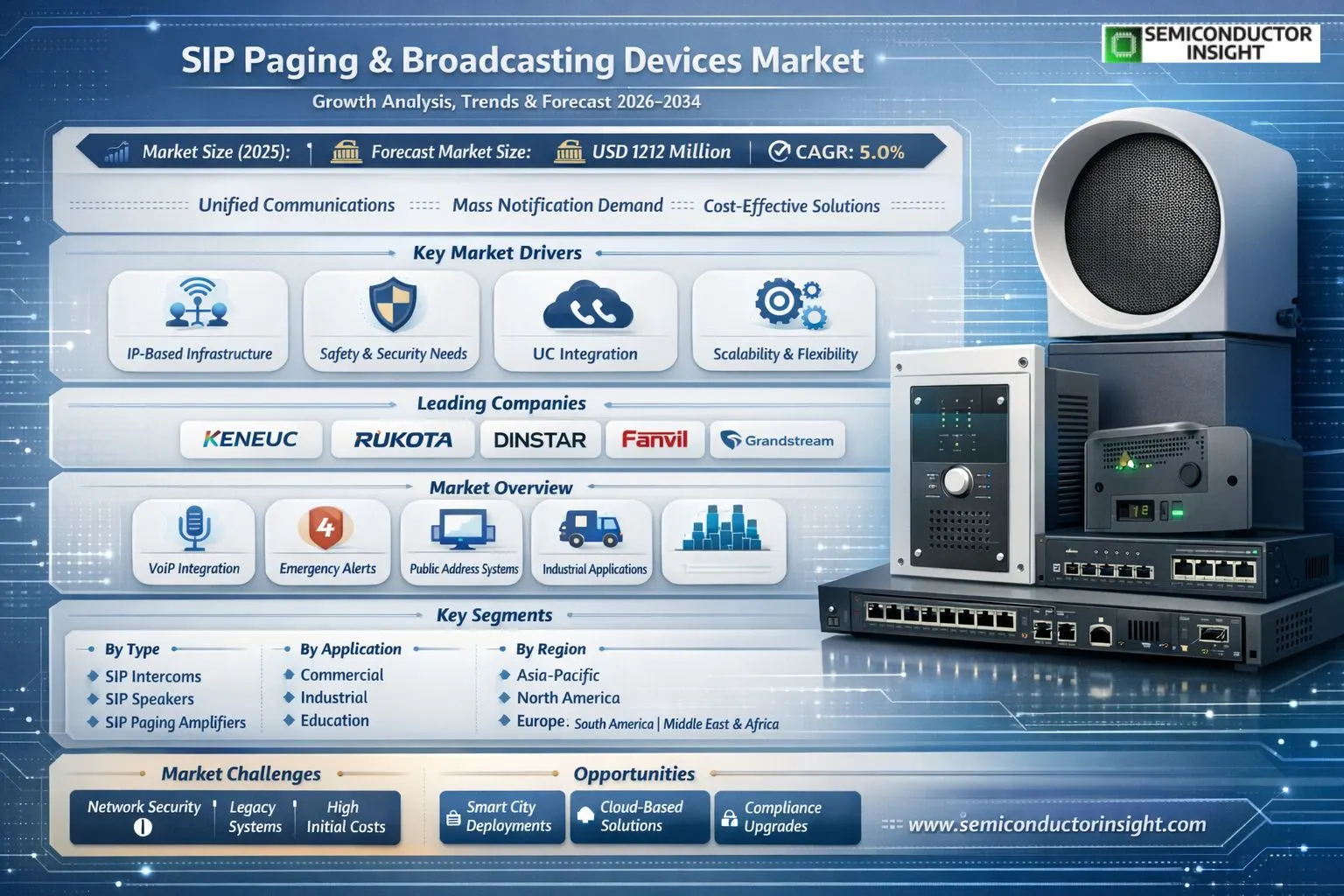
Global SIP Paging and Broadcasting Devices market size was valued at USD 859 million in 2025. The market is projected to grow from USD 902 million in 2026 to USD 1212 million by 2034, exhibiting a CAGR of 5.0% during the forecast period.
SIP Paging and Broadcasting Devices are essential components of modern communication systems that leverage the Session Initiation Protocol (SIP) to transmit audio messages across IP networks. These devices are used to broadcast one-way or two-way messages, often in environments like office buildings, schools, factories, hospitals, airports, and public spaces. SIP-based devices are highly flexible, scalable, and cost-effective compared to traditional analog systems. They integrate with VoIP (Voice over IP) systems, offering enhanced features like zone-based paging, emergency alerts, and centralized control.
The market is experiencing steady growth due to several factors, including Global transition towards unified communications (UC) and IP-based infrastructure across all sectors. The rising demand for reliable mass notification systems for safety and security is a primary driver; for instance, regulations in education and healthcare increasingly mandate robust emergency alert capabilities. Furthermore, the inherent scalability and lower total cost of ownership of SIP solutions compared to legacy hardware are accelerating adoption. Initiatives by key players are also expected to fuel market growth. For example, companies like Grandstream Networks regularly expand their SIP paging product lines with new amplifiers and speakers designed for harsh industrial environments. Other key players operating in the market with a wide range of portfolios include Valcom, CyberData Corporation, Algo (now part of Aiphone), Snom Technology GmbH (part of VTech), and Barix AG.
MARKET DRIVERS
Widespread Adoption of IP-Based Communication Infrastructure
Global migration from traditional analog and digital systems to VoIP and unified communications is a primary engine for SIP Paging and Broadcasting Devices Market. Organizations are investing in Session Initiation Protocol (SIP)-based solutions to leverage their existing data networks, reduce cabling costs, and achieve superior audio clarity and reliability. This shift is particularly strong in sectors like education, healthcare, and corporate enterprises, where seamless, network-wide communication is critical for daily operations and emergency response.
Enhanced Integration with Business and Security Ecosystems
Modern SIP paging devices are no longer standalone units; they are designed for deep integration with other business software and safety platforms. This includes interoperability with IP-PBX systems, VoIP phones, Physical Security Information Management (PSIM) software, access control systems, and building automation. The ability to trigger mass notifications from within these integrated systems for events like security breaches or facility evacuations adds significant value and drives procurement decisions in SIP Paging and Broadcasting Devices Market.
➤ A 2024 market analysis projects that demand for network-integrated emergency notification capabilities will grow SIP Paging segment by over 8% annually in the next five years.
Furthermore, the rise of hybrid work models necessitates robust, location-agnostic communication tools. SIP technology enables paging to reach not only on-premise speakers but also softphones and mobile devices, ensuring messages are delivered to all personnel regardless of their physical location, thereby enhancing organizational resilience.
MARKET CHALLENGES
Network Security and Quality of Service (QoS) Complexities
Deploying SIP Paging and Broadcasting Devices Market solutions introduces network-dependent challenges. Prioritizing paging traffic to ensure zero latency during critical announcements requires meticulous QoS configuration on corporate networks. More significantly, connecting these devices to the network expands the potential attack surface, making them targets for cyber threats like eavesdropping, toll fraud, or denial-of-service attacks. Implementing and maintaining robust security protocols, including encryption and network segmentation, adds layers of complexity and cost for end-users.
Other Challenges
Interoperability and Legacy System Integration
Despite the SIP standard, achieving flawless interoperability between devices from different manufacturers and with various VoIP platforms can be difficult. Many organizations face hurdles when integrating new SIP paging hardware with legacy public address components or proprietary systems, leading to extended project timelines and higher integration costs.
Cost Sensitivity in Price-Conscious Segments
While the total cost of ownership is favorable, the initial capital expenditure for a full-scale SIP paging system, including endpoints, amplifiers, and network upgrades, can be a barrier for small and medium-sized businesses or budget-constrained institutions like public schools, slowing adoption rates in these segments.
MARKET RESTRAINTS
Economic Uncertainties and Capital Expenditure Delays
Macroeconomic volatility influences investment cycles in communication infrastructure. During periods of economic tightening, organizations often defer non-essential upgrades, directly impacting SIP Paging and Broadcasting Devices Market. Large-scale deployments in hospitality, retail, and corporate campuses, which represent significant revenue opportunities, are particularly susceptible to postponement as companies prioritize operational expenditure over capital projects, creating a cyclical restraint on market growth.
Perceived Sufficiency of Existing Systems
A significant restraint is customer inertia, where organizations continue to operate functional legacy paging systems. The perception that “if it isn’t broken, don’t fix it,” coupled with a lack of immediate pressure to meet modern compliance standards for emergency communication, leads to extended refresh cycles. Convincing these customers of the tangible ROI from features like centralized management, lower maintenance, and enhanced capabilities remains a persistent challenge for vendors in this space.
MARKET OPPORTUNITIES
Expansion into Smart Cities and Large Public Venues
SIP Paging and Broadcasting Devices Market holds substantial potential within smart city initiatives and large-scale public infrastructure. SIP-based mass notification systems are ideal for transportation hubs, stadiums, university campuses, and municipal areas, where they can be integrated with IoT sensors and city-wide emergency protocols. This convergence of public safety and intelligent infrastructure creates a high-growth avenue for scalable, interoperable paging solutions.
Development of Advanced Software and Cloud-Based Services
The shift towards cloud-managed and hybrid communication models presents a major opportunity. Vendors can expand beyond hardware sales to offer recurring revenue streams through software-as-a-service (SaaS) platforms for paging management, analytics, and automated alerting. These platforms allow for the remote management of distributed SIP paging networks, providing valuable data on system usage and reliability, which is particularly attractive for multi-site enterprises and managed service providers.
Compliance-Driven Upgrades Across Regulated Industries
Stringent and evolving regulations for emergency communication and life safety in industries such as healthcare, manufacturing, and education mandate reliable, auditable notification systems. This regulatory environment compels organizations to upgrade outdated systems to compliant solutions, directly benefiting SIP Paging and Broadcasting Devices Market. Products that can provide detailed logs, redundancy, and integration with other compliance-critical systems are positioned to capture this steady, requirement-driven demand.
Key SIP Paging and Broadcasting Devices Market Trends
Accelerated Shift Towards Unified IP Communication Ecosystems
The dominant trend in SIP Paging and Broadcasting Devices Market is the accelerated migration away from legacy analog systems towards unified IP-based communication ecosystems. Organizations across all verticals are replacing standalone paging hardware with SIP devices that seamlessly integrate with existing Voice over IP (VoIP) platforms and network infrastructure. This convergence offers significant operational advantages, including centralized management, reduced cabling and maintenance costs, and the ability to trigger broadcasts from software applications. The demand for this integration is a primary growth driver, as it future-proofs communication investments and enhances organizational agility.
Other Trends
Rising Demand in Healthcare and Education Sectors
A distinct trend is the accelerated adoption of SIP Paging and Broadcasting Devices within healthcare and educational institutions. Hospitals and clinics leverage these systems for critical emergency alerts, staff paging, and patient notifications, where reliability and clear audio are paramount. Similarly, schools and universities utilize them for daily announcements, class change signals, and campus-wide emergency broadcasting. The ability to create specific audio zones and integrate with security systems makes SIP technology particularly valuable in these sensitive environments.
Diversification of Product Segments and Feature Sets
The market is witnessing a clear trend towards product diversification and feature enrichment. Beyond basic SIP speakers and intercoms, manufacturers are expanding into specialized segments such as SIP-enabled strobe lights and visual alarms for ADA compliance, robust outdoor-rated speakers, and powerful paging amplifiers for large industrial spaces. This expansion addresses the nuanced needs of different applications, from quiet background music in commercial settings to high-decibel alerts in noisy factories. The competitive landscape, featuring key players like Grandstream Networks, Valcom, and DINSTAR, is characterized by continuous innovation in device durability, audio fidelity, and software-based control features to capture specific market niches.
COMPETITIVE LANDSCAPE
Key Industry Players
Increasing Shift to IP-Based Unified Communication Systems Drives Competition and Innovation
Global SIP Paging and Broadcasting Devices market features a moderately concentrated competitive structure, currently led by players like Grandstream Networks, Inc. and DINSTAR, with a group of top five companies holding a significant combined revenue share as of 2025. The market’s progression, valued at $859 million in 2025, is fueling strategic maneuvers such as product portfolio expansion into specific device types like SIP intercoms and speakers, as well as targeted mergers and acquisitions. Leading companies are competing by enhancing the integration of their solutions with broader VoIP and unified communication platforms, emphasizing scalability, centralized management, and reliability for critical applications in healthcare and industrial settings.
Beyond the market leaders, numerous established and niche players contribute to the dynamic ecosystem. Companies such as Valcom, Cyber Data Corporation, and Barix AG have strong positions in specialized segments like robust outdoor paging amplifiers and IP audio endpoints for mass notification. Concurrently, technology firms like Fanvil Technology, Akuvox, and Snom are leveraging their expertise in SIP endpoints to capture share in the commercial and educational sectors. The competitive landscape is further populated by communication specialists like Clear-Com, Zenitel, and the Telos Alliance, who bring professional audio broadcasting and critical communication expertise, particularly for high-stakes environments like broadcast studios and security command centers.
List of Key SIP Paging and Broadcasting Devices Companies Profiled
- Grandstream Networks, Inc.
- DINSTAR
- KENEUC
- Valcom
- Cyber Data Corporation
- Fanvil Technology
- RUKOTA
- Barix AG
- TONMIND
- Snom
- Akuvox
- Guangzhou Unisoft Information Technology
- SHENZHEN NICEUC
- Clear-Com (a HME company)
- Zenitel
Segment Analysis:
| Segment Category | Sub-Segments | Key Insights |
| By Type |
|
SIP Intercoms are a dominant category, given their central role in two-way communication and access control systems. Their leadership is driven by the critical demand for interactive, secure communication points in facilities requiring both paging and immediate voice feedback, such as building entrances and security checkpoints. Furthermore, the integration capabilities of SIP Intercoms with broader building management and security systems enhance their value proposition, offering unified control that appeals to system integrators and end-users seeking consolidated solutions. |
| By Application |
|
Commercial Use represents a leading application segment, as modern office buildings, retail complexes, and hospitality venues increasingly adopt IP-based communication for operational efficiency. The shift is fueled by the need for scalable, zone-based paging for daily announcements, background music, and emergency coordination across large, multi-tenant properties. Additionally, the inherent cost-benefit of integrating SIP paging with existing VoIP and data networks, eliminating separate wiring infrastructure, provides a compelling financial and operational argument for widespread commercial deployment over traditional systems. |
| By End User |
|
Large Enterprises & Corporates are the primary adopters due to their extensive physical footprints and complex communication requirements across campuses and multi-story headquarters. These organizations have the capital and IT resources to invest in scalable, enterprise-grade SIP paging solutions that offer centralized management, high reliability, and integration with unified communications platforms. The strategic need for robust mass notification systems for business continuity and safety compliance further solidifies this segment’s leadership, as they seek future-proof solutions that can adapt to evolving operational and regulatory demands. |
| By System Integration |
|
Integrated UC & VoIP Platforms is the fastest-growing and most influential segment, as organizations move away from siloed communication tools. The convergence of paging with unified communications suites enhances functionality, enabling features like scheduled broadcasts, call routing to paging zones, and management through a single software interface. This deep integration reduces operational complexity and total cost of ownership, creating a strong pull from IT departments looking to streamline infrastructure. The trend towards cloud-based UC solutions further accelerates this segment, offering remote management and seamless scalability. |
| By Alert Type |
|
Emergency & Mass Notification is the critical and high-growth driver for the market, transcending basic paging to become a vital component of organizational safety and compliance strategies. The capability of SIP devices to deliver immediate, targeted, and reliable alerts during crises adds immense value in sectors like healthcare, education, and industry. This segment’s prominence is reinforced by stringent regulatory requirements for emergency communication and the technological advantage of SIP systems in creating pre-recorded messages, activating visual alarms like strobes, and initiating cascading alerts across designated zones to ensure comprehensive coverage and swift response. |
Regional Analysis: Global SIP Paging and Broadcasting Devices Market
North America
The adoption of SIP Paging and Broadcasting Devices is heavily propelled by compliance with safety regulations like HIPAA in healthcare and Clery Act requirements in education, mandating reliable emergency communication systems. Industry-wide standards for VoIP and SIP interoperability ensure seamless device integration, creating a stable and predictable market environment for vendors and end-users alike.
Large corporate enterprises and the extensive healthcare sector represent the core demand drivers. The need for efficient overhead paging in hospitals, instant announcements in corporate campuses, and integration with nurse call or building management systems fuels continuous investment in advanced SIP-based broadcasting solutions, prioritizing clarity, coverage, and redundancy.
North America serves as the primary hub for R&D and integration of SIP Paging and Broadcasting Devices with next-gen technologies. This includes deep compatibility with unified communications platforms, cloud services, and IoT ecosystems, allowing paging systems to function as intelligent nodes within broader smart building and operational technology networks.
The market is characterized by high customer acquisition and replacement cycles. Organizations are increasingly phasing out legacy analog and traditional PA systems in favor of IP-based SIP paging for its superior flexibility, scalability, and lower long-term total cost of ownership, supported by strong channel partnerships and vendor support networks.
Europe
The European SIP Paging and Broadcasting Devices Market is characterized by a strong emphasis on privacy, data security (GDPR), and high-quality manufacturing standards. Adoption is significant within the industrial, transportation, and hospitality sectors, where reliable and zone-specific communication is critical. The market benefits from concerted EU-wide initiatives promoting digital transformation and smart city projects, which often incorporate IP-based public address and mass notification systems. Regional variations exist, with Western European nations like the UK, Germany, and France leading in deployment due to advanced infrastructure, while Eastern Europe shows growth potential through modernization of educational and commercial facilities. The competitive landscape features both global players and strong regional specialists offering SIP paging solutions tailored to local languages, regulations, and architectural requirements.
Asia-Pacific
The Asia-Pacific region represents the most dynamic and high-growth frontier for SIP Paging and Broadcasting Devices Market, driven by rapid urbanization, massive investments in IT infrastructure, and the construction of new smart buildings, airports, and metro systems. Countries like China, Japan, South Korea, and Australia are at the forefront, integrating SIP paging into new commercial and institutional builds. The manufacturing boom, particularly in Southeast Asia, fuels demand for robust factory-floor communication systems. Growth is tempered by the presence of cost-sensitive segments and a varied landscape of local and international vendors. The long-term trajectory is strongly positive, shaped by the region’s economic expansion, rising focus on safety standards, and the gradual replacement of aging analog systems with flexible IP-based solutions.
South America
The South American market for SIP Paging and Broadcasting Devices is in a developmental phase, with growth concentrated in major economic hubs such as Brazil, Argentina, and Chile. Adoption is primarily driven by the commercial sector, including retail chains, corporate offices, and hospitality, seeking modern communication tools. Economic volatility can impact large-scale investment, but the fundamental shift from traditional to IP-based systems provides a steady underlying demand. The market faces challenges related to uneven internet connectivity quality in some areas, but improvements in national broadband projects are gradually mitigating this. Vendors often compete on price and reliability, with solutions tailored for the region’s specific economic and infrastructural context.
Middle East & Africa
SIP Paging and Broadcasting Devices Market in the Middle East & Africa is bifurcated. The Gulf Cooperation Council (GCC) countries, with their visionary smart city projects and luxury hospitality and retail sectors, are early adopters of high-end, integrated SIP paging solutions for mega-malls, airports, and government complexes. In contrast, the African market is largely emergent, with growth pockets in South Africa, Kenya, and Nigeria focused on the banking, education, and healthcare sectors. The overarching driver is the need for reliable mass communication, with adoption slowly progressing from basic systems to more sophisticated SIP-based networks as digital infrastructure expands and becomes more reliable across the region.
Report Scope
This market research report provides a comprehensive analysis of the SIP Paging and Broadcasting Devices Market , covering the forecast period 2026–2034. It offers detailed insights into market dynamics, technological advancements, competitive landscape, and key trends shaping the industry.
Key focus areas of the report include:
- Market Overview: The report begins with an overview outlining its current market scenario, key growth indicators, and industry transformation drivers. It discusses macroeconomic factors, demand–supply balance, regulatory landscape, and the strategic role of communications technology in powering advancements across industries such as commercial, industrial, education, healthcare, and public infrastructure.
- Market Size & Forecast: Historical data and future projections for revenue, unit shipments, and market value across major regions and segments.
- Segmentation Analysis: Detailed breakdown by product type, technology, application, and end-user industry to identify high-growth segments and investment opportunities.
- Regional Insights: Insights into market performance across North America, Europe, Asia-Pacific, Latin America, and the Middle East & Africa, including country-level analysis where relevant.
- Competitive Landscape: Profiles of leading market participants, including their product offerings, R&D focus, manufacturing capacity, pricing strategies, and recent developments such as mergers, acquisitions, and partnerships.
- Technology Trends & Innovation: Assessment of emerging technologies, integration with VoIP/IP systems, design trends, and evolving industry standards.
- Market Drivers & Restraints: Evaluation of factors driving market growth along with challenges, supply chain constraints, regulatory issues, and market-entry barriers.
- Stakeholder Insights: Insights for component suppliers, OEMs, system integrators, investors, and policymakers regarding the evolving ecosystem and strategic opportunities.
Primary and secondary research methods are employed, including interviews with industry experts, data from verified sources, and real-time market intelligence to ensure the accuracy and reliability of the insights presented.
FREQUENTLY ASKED QUESTIONS:
What is the current market size and forecast of SIP Paging and Broadcasting Devices Market?
-> Global SIP Paging and Broadcasting Devices Market was valued at USD 859 million in 2025 and is expected to reach USD 1212 million by 2034, growing at a 5.0% CAGR during the forecast period.
Which key companies operate in SIP Paging and Broadcasting Devices Market?
-> Key players include KENEUC, RUKOTA, DINSTAR, Fanvil Technology, Guangzhou Unisoft Information Technology, SHENZHEN NICEUC, Grandstream Networks, Inc., CyberData Corporation, Valcom, and TONMIND, among others. The top five players held a significant revenue share in 2025.
What are the key applications of SIP Paging and Broadcasting Devices?
-> Key applications include Commercial Use, Industrial Use, Educational Institutions (Schools, Universities), Healthcare (Hospitals, Clinics), and other public and private facilities for broadcasting messages and emergency alerts.
How is the market segmented by product type?
-> Major segments by type include SIP Intercoms, SIP Phones, SIP Speakers, SIP Paging Amplifiers, SIP-enabled Strobe Lights and Alarms, and other devices. SIP Intercoms is a key growth segment.
Which geographic regions are covered in this market analysis?
-> The report provides a detailed regional analysis covering markets in North America, Europe, Asia, South America, and the Middle East & Africa, including country-level insights for major economies like the US, China, Germany, and others.

Get Sample Report PDF for Exclusive Insights
Report Sample Includes
- Table of Contents
- List of Tables & Figures
- Charts, Research Methodology, and more...
 Download Sample Report PDF